Skip to content · ⁨الانتقال إلى المحتوى⁩

Development and Learning · ⁨التطور والتعلم⁩

AP Psychology · ⁨علم النفس (AP)⁩ · Topic 3 · ⁨الموضوع 3⁩

Video lesson for this topic · ⁨درس فيديو لهذا الموضوع⁩ Open the video page · ⁨افتح صفحة الفيديو⁩
12:18

التطور والتعلم

يختار طفل عمره أربع سنوات زجاجاً ثقيلاً ويحاول رده على الأرض. هو ليس غبي. كان لديه قاعدة للأشياء الدائرية: الأشياء الدائرية ترتد.…

English narration · English + 中文 subtitles burned in · ⁨سرد باللغة الإنجليزية · ترجمة مدمجة بالإنجليزية + الصينية⁩

3.1

Studying Development · ⁨دراسة التطور⁩

Syllabus · ⁨المنهج⁩
English

Learning Objective 3.1.A: Explain how enduring themes inform developmental psychology.

  • 3.1.A.1 Developmental psychology is concerned with both chronological order of development and/ or thematic issues in development across the lifespan. Thematic issues of interest to developmental psychologists include stability and change, nature and nurture, and continuous and discontinuous stages of development.

Learning Objective 3.1.B: Describe ways cross-sectional and longitudinal research design methods used in developmental psychology inform understanding about behavior and mental processes.

العربية

هدف التعلم 3.1.A: اشرح كيف ترسم الموضوعات الدائمة إطار عمل علم النفس التنموي.

  • 3.1.A.1 يهتم علم النفس التنموي بكل من الترتيب الزمني للنمو و/أو القضايا الموضوعية في النمو طوال دورة الحياة. تشمل القضايا الموضوعية التي تهم علماء نفس التنمية: الثبات والتغير، الطبيعة والتنشئة، والمراحل المستمرة وغير المستمرة للنمو.

هدف التعلم 3.1.B: صف الطرق التي تستخدم بها طرق تصميم البحث المقطعي والطويل الأمد في علم النفس التنموي لفهم السلوك والعمليات العقلية.

Source: College Board AP Course and Exam Description · ⁨المصدر: وصف دورة وامتحان College Board AP⁩

English

Developmental psychology 发展心理学 studies how people change across the lifespan. Two questions run through the whole unit.

  • Is change continuous 连续的 (gradual and smooth) or discontinuous 不连续的 (in stages)?
  • Is a trait stable 稳定的 across life, or does it change?

Researchers answer these with two designs. A cross-sectional study 横断研究 compares different age groups at one time - fast, but differences may come from the groups' different generations. A longitudinal study 纵向研究 follows the same people over years - slower, but it shows real change within a person.

العربية

علم النفس التطوري يدرس كيف يتغير الناس عبر عمرهم. تسود سؤالان طوال الوحدة.

  • هل التغيير متصل (تدريجي وناعم) أم منفصل (في مراحل)?
  • هل الصفة ثابتة طوال الحياة، أم أنها تتغير؟

يجيب الباحثون عن هذه الأسئلة بتصميمين. الدراسة المقطعية تقارن مجموعات عمرية مختلفة في وقت واحد - سريعة، لكن قد تكون الفروقات ناتجة عن أجيال مختلفة للمجموعات. الدراسة الطولية تتبع نفس الأشخاص على مدى سنوات - أبطأ، لكنها تظهر تغييراً حقيقياً داخل الفرد.

3.2

Physical Development · ⁨النمو الجسدي⁩

Syllabus · ⁨المنهج⁩
English

Learning Objective 3.2.A: Explain how physical development before birth applies to behavior and mental processes.

  • 3.2.A.1 Teratogens, maternal illness, genetic mutations, hormonal, and environmental factors can influence the major physical and psychological milestones that occur during prenatal development.
    • Exclusion Statement: The stages of prenatal development (zygote, embryo, and fetus) are outside the scope of the AP Psychology Exam.

Learning Objective 3.2.B: Explain how physical development in infancy and childhood apply to behavior and mental processes.

  • 3.2.B.1 Physical development in infancy and childhood happens in generally the same order, but the timing of the development can vary. The development of fine and gross motor coordination is among the major physical and psychological milestones that define infancy and childhood. These physical skills develop as children mature, allowing children to develop critical skills needed to become more independent.
  • 3.2.B.2 Infants possess reflexes, like the rooting reflex, that indicate on-track physical and psychological milestone development.
  • 3.2.B.3 Research using the visual cliff apparatus demonstrates an early ability in infants to perceive depth and an innovative way to assess infant responses.
  • 3.2.B.4 Research suggests that critical or sensitive periods in infancy and childhood have strong developmental effects, especially for skills such as language. Some non-human animals will imprint on the first object they encounter as a means of survival.

Learning Objective 3.2.C: Explain how physical development in adolescence applies to behavior and mental processes.

  • 3.2.C.1 The main physical and psychological milestones that occur in adolescence are the adolescent growth spurt and puberty, in which reproductive ability develops. Adolescents develop primary and secondary sex characteristics during this time, such as menarche and spermarche.

Learning Objective 3.2.D: Explain how physical development in adulthood applies to behavior and mental processes.

  • 3.2.D.1 Adulthood spans most of the lifespan and is characterized by a general leveling off and then a varying decline in reproductive ability (i.e., menopause), mobility, flexibility, reaction time, and visual and auditory sensory acuity.
العربية

هدف التعلم 3.2.A: اشرح كيف ينطبق التطور الجسدي قبل الولادة على السلوك والعمليات العقلية.

  • 3.2.A.1 يمكن للمواد المسببة للتشوهات الخلقية، وأمراض الأم، الطفرات الجينية، والعوامل الهرمونية والبيئية أن تؤثر على المحاور الجسدية والنفسية الرئيسية التي تحدث أثناء التطور الجنيني.
    • بيان الاستبعاد: مراحل التطور الجنيني (الزيجوت، الجنين، والجنين) خارج نطاق امتحان علم النفس AP.

هدف التعلم 3.2.B: اشرح كيف ينطبق التطور الجسدي في مرحلة الرضاعة والطفولة على السلوك والعمليات العقلية.

  • 3.2.B.1 يحدث التطور الجسدي في مرحلة الرضاعة والطفولة بشكل عام بنفس الترتيب، لكن توقيت النمو قد يختلف. يعد تطور التنسيق الحركي الدقيق والخشن من بين المحاور الجسدية والنفسية الرئيسية التي تحدد الرضاعة والطفولة. تتطور هذه المهارات الجسدية عندما يتقدم الأطفال في السن، مما يسمح لهم بتطوير المهارات الحاسمة اللازمة لتصبح أكثر استقلالية.
  • 3.2.B.2 يمتلك الرضع ردود فعل غريزية، مثل رد الفعل الجذري، والتي تشير إلى تطور سليم للمحاور الجسدية والنفسية.
  • 3.2.B.3 تُظهر أبحاث استخدام جهاز المنحدر البصري قدرة مبكرة لدى الرضع على إدراك العمق وطريقة مبتعة لتقييم استجاباتهم.
  • 3.2.B.4 تشير الأبحاث إلى أن الفترات الحرجة أو الحساسة في مرحلة الرضاعة والطفولة لها تأثيرات تنموية قوية، خاصة على مهارات مثل اللغة. بعض الحيوانات غير البشرية ستقوم بالتثبيت على أول كائن تصادفه كوسيلة للبقاء على قيد الحياة.

هدف التعلم 3.2.C: اشرح كيف ينطبق التطور الجسدي في المراهقة على السلوك والعمليات العقلية.

  • 3.2.C.1 المحاور الجسدية والنفسية الرئيسية التي تحدث في المراهقة هي طفرة النمو المراهقة والبلوغ، حيث تتطور القدرة الإنجابية. طور المراهقون خصائص جنسية أولية وثانوية خلال هذه الفترة، مثل الطمث وبداية إنتاج الحيوانات المنوية.

هدف التعلم 3.2.D: اشرح كيف ينطبق التطور الجسدي في مرحلة البلوغ على السلوك والعمليات العقلية.

  • 3.2.D.1 تمتد مرحلة البلوغ معظم دورة الحياة وتتميز بانخفاض عام ثم تراجع متفاوت في القدرة الإنجابية (أي انقطاع الطمث)، والحركة، والمرونة، وزمن الاستجابة، والدقة الحسية البصرية والسمعية.

Source: College Board AP Course and Exam Description · ⁨المصدر: وصف دورة وامتحان College Board AP⁩

English

Development before birth can be disrupted by teratogens 致畸物 (harmful agents such as alcohol), maternal illness, genetic mutations, and hormonal or environmental factors.

Infant physical development follows the same general order everywhere, though the rate varies. Newborns show reflexes 反射 that indicate healthy development, such as the rooting reflex 觅食反射 (turning towards a touch on the cheek). The visual cliff 视崖 experiment shows that infants perceive depth early.

A critical period 关键期 is a window in which a particular experience has an unusually strong effect; a sensitive period 敏感期 is a softer version of the same idea.

Adolescence 青春期 brings the adolescent growth spurt 青春期发育突增 and puberty 青春发育期, including primary sex characteristics 第一性征 and secondary sex characteristics 第二性征. Adulthood spans most of life and is marked by a gradual levelling off, then decline - including menopause 更年期 in women.

العربية

يمكن أن يُعيق النمو قبل الولادة العوامل المؤثرة على الجنين (عوامل ضارة مثل الكحول)، وأمراض الأم، الطفرات الجينية، والعوامل الهرمونية أو البيئية.

يتبع النمو الجسدي للرضع نفس الترتيب العام في كل مكان، رغم اختلاف المعدل. تُظهر حديثو الولادة منعكسات تدل على نمو سليم، مثل منعكس البحث (التوجه نحو لمسة على الخد). يُظهر تجربة المنحدر المرئي أن الرضع يدركون العمق مبكراً.

الفترة الحرجة هي نافذة يكون فيها لتجربة معينة تأثير قوي بشكل غير عادي؛ الفترة الحساسة هي نسخة ألطف من نفس الفكرة.

المراهقة تجلب قفزة النمو المراهقة والبلوغ، بما في ذلك الخصائص الجنسية الأولية والخصائص الجنسية الثانوية. تمتد مرحلة البلوغ معظم الحياة وتتميز بانحدار تدريجي، ثم تراجع - بما في ذلك انقطاع الطمث عند النساء.

3.3

Gender and Sexual Orientation · ⁨الجنس والتوجه الجنسي⁩

Syllabus · ⁨المنهج⁩
English

Learning Objective 3.3.A: Describe how sex and gender influence socialization and other aspects of development.

العربية

هدف التعلم 3.3.A: صف كيف يؤثر الجنس والجندر على التنشئة الاجتماعية وجوانب أخرى من النمو.

Source: College Board AP Course and Exam Description · ⁨المصدر: وصف دورة وامتحان College Board AP⁩

English

Sex 生理性别 refers to biological characteristics, while gender 社会性别 refers to the roles and expectations a society attaches to them. Gender roles 性别角色 are learned through socialization 社会化: family, school, peers, and media all teach what behaviour is expected. Sexual orientation 性取向 describes a person's enduring pattern of attraction. The exam asks how sex and gender influence socialization and development, not for any evaluation of individuals.

العربية

الجنس يشير إلى الخصائص البيولوجية، بينما النوع الاجتماعي يشير إلى الأدوار والتوقعات التي تربطها بها المجتمع. أدوار النوع الاجتماعي تُكتسب من خلال التنشئة الاجتماعية: العائلة والمدرسة والأقراب والوسائط جميعها تعلم ما هو السلوك المتوقع. الاتجاه الجنسي يصف النمط الدائم للجذب لدى الشخص. يطرح الامتحان كيف يؤثر الجنس والنوع الاجتماعي على التنشئة والتنمية، وليس لإجراء أي تقييم للأفراد.

3.4

Cognitive Development · ⁨التطور المعرفي⁩

Syllabus · ⁨المنهج⁩
English

Learning Objective 3.4.A: Explain how theories of cognitive development apply to behavior and mental processes.

  • 3.4.A.1 According to Piaget, children develop schemas via continuous and discontinuous processes such as assimilation and accommodation.
    • 3.4.A.1.i The sensorimotor stage occurs from infancy through toddlerhood. Object permanence develops during this stage.
    • 3.4.A.1.ii The preoperational stage occurs from toddlerhood through early childhood. Children become proficient in using mental symbols and engage in pretend play. The preoperational stage is identified more by cognitive tasks children cannot perform such as conservation and reversibility, or by those they exhibit, such as animism and egocentrism. Children begin to develop a theory of mind during this stage.
    • 3.4.A.1.iii The concrete operational stage occurs from early through late childhood. Children in this stage can generally correct the cognitive errors made in the preoperational stage and understand the world in logical, realistic, and straightforward ways, but struggle to think systematically.
    • 3.4.A.1.iv The formal operational stage occurs from late childhood through adulthood. People in this stage gain the ability to think abstractly and hypothetically. Piaget proposed that not all people achieve formal operational thinking.
  • 3.4.A.2 According to Vygotsky, children are social learners who learn through interacting with and scaffolding by other people within sociocultural contexts. Ideally, learning occurs while the person is in their zone of proximal development.
  • 3.4.A.3 Adults experience changes in cognitive capabilities as they progress through the lifespan. Crystallized intelligence remains relatively stable through adulthood while fluid intelligence tends to wane as people age. Cognitive disorders that affect adults include dementia.
العربية

هدف التعلم 3.4.A: اشرح كيف تطبق نظريات التطور المعرفي على السلوك والعمليات العقلية.

  • 3.4.A.1 وفقاً لبياجيه، ينمي الأطفال مخططات معرفية عبر عمليات مستمرة وغير مستمرة مثل الاستيعاب والتكيف.
    • 3.4.A.1.i يحدث المرحلة الحسية الحركية من مرحلة الرضاعة حتى سن الصغر. يتطور إدراك ثبات الأجسام خلال هذه المرحلة.
    • 3.4.A.1.ii تحدث المرحلة ما قبل العمليات من مرحلة الطفولة المبكرة حتى أواخرها. يصبح الأطفال ماهرين في استخدام الرموز الذهنية ويشاركون في اللعب التخيلي. تُعرف المرحلة ما قبل العمليات أكثر بالمهام المعرفية التي لا يستطيع الأطفال أدائها مثل الحفظ والعكوسية، أو تلك التي يظهرونها مثل حيوية الأشياء وأنانية الذات. يبدأ الأطفال في تطوير نظرية العقل خلال هذه المرحلة.
    • 3.4.A.1.iii تحدث المرحلة العملياتية المجردة من أواخر الطفولة المبكرة حتى أواخرها. يمكن للأطفال في هذه المرحلة عادةً تصحيح الأخطاء المعرفية التي ارتكبوها في المرحلة ما قبل العمليات وفهم العالم بطرق منطقية وواقعية وبسيطة، لكنهم يواجهون صعوبة في التفكير المنهجي.
    • 3.4.A.1.iv تحدث المرحلة العملية الشكلية من أواخر الطفولة وحتى البلوغ. يكتسب الأفراد في هذه المرحلة القدرة على التفكير المجرد والافتراضي. اقترح بايجيه أن ليس جميع الناس يحققون التفكير العملي الشكلي.
  • 3.4.A.2 وفقاً لفيغوتسكي، الأطفال متعلمون اجتماعيون يتعلمون من خلال التفاعل مع الآخرين والتدعيم المقدم منهم داخل السياقات الاجتماعية والثقافية. مثالياً، يحدث التعلم بينما يكون الشخص في منطقة التطور القريب.
  • 3.4.A.3 يمر البالغون بتغيرات في القدرات المعرفية مع تقدمهم عبر عمر الحياة. يبقى الذكاء المتبلور مستقراً نسبياً طوال مرحلة البلوغ بينما يميل الذكاء السائل إلى التراجع مع تقدم العمر. تشمل الاضطرابات المعرفية التي تؤثر على البالغين الخرف.

Source: College Board AP Course and Exam Description · ⁨المصدر: وصف دورة وامتحان College Board AP⁩

English

Piaget 皮亚杰 proposed that children build schemas and pass through four stages:

  • Sensorimotor stage 感知运动阶段 (infancy to toddlerhood): the child learns through senses and action, and develops object permanence 客体永久性 - knowing an object still exists when hidden.
  • Preoperational stage 前运算阶段 (toddlerhood to early childhood): the child uses symbols and pretend play but shows egocentrism 自我中心 (difficulty taking another view) and lacks conservation 守恒 (knowing quantity stays the same when shape changes).
  • Concrete operational stage 具体运算阶段 (early to late childhood): the child reasons logically about concrete things and gains conservation.
  • Formal operational stage 形式运算阶段 (late childhood onward): abstract and hypothetical reasoning becomes possible.

Vygotsky 维果茨基 saw children as social learners. The zone of proximal development 最近发展区 is the gap between what a child can do alone and what they can do with help; scaffolding 支架 is the support that closes it.

Adult cognition changes too, and here the fluid/crystallised split from Unit 2 returns: reasoning speed declines while accumulated knowledge does not. Dementia 痴呆 is a decline beyond normal ageing.

العربية
المراحل الأربع لبياجيه كدرج، لكل منها نطاق عمري والإنجاز الذي يميزه
المراحل الأربع لبياجيه، كل منها يُعرّف بما يستطيع الطفل فعله حديثاً

اقترح بياجيه أن يبني الأطفال مخططات معرفية (schemas) ويمررون بأربع مراحل:

  • مرحلة الحسية الحركية (الرضاعة حتى مرحلة الطفولة المبكرة): يتعلم الطفل من خلال الحواس والحركة، وي developing ثبات الكائن - معرفة أن الكائن لا يزال موجوداً عندما يختفي عن النظر.
  • مرحلة ما قبل العمليات (مرحلة الطفولة المبكرة حتى أواخر الطفولة): يستخدم الطفل الرموز واللعب التمثيلي لكن يظهر الأنانية الذاتية (صعوبة تبني وجهة نظر أخرى) ويفتقر إلى الحفظ (معرفة أن الكمية تظل ثابتة عند تغير الشكل).
  • مرحلة العمليات الملموسة (من أواخر الطفولة المبكرة إلى أواخر الطفولة): يستنتج الطفل منطقياً حول الأشياء الملموسة ويكتسب الحفظ.
  • مرحلة العمليات المجردة (من أواخر الطفولة فما بعد): يصبح الاستنتاج المجرد والافتراضي ممكناً.

رايفسكي رأى الأطفال كمتعلمين اجتماعيين. حيز التطور القريب هو الفجوة بين ما يمكن للطفل فعله بمفرده وما يمكنه فعله بمساعدة الآخرين؛ الإسناد السقفي هو الدعم الذي يسد هذه الفجوة.

يتغير الإدراك البشري أيضاً، وهنا يعود التقسيم بين السائل والمترسب من الوحدة 2: تنخفض سرعة الاستنتاج بينما لا يتناقص المعرفة المتراكمة. الخرف هو انخفاض يتجاوز الشيخوخة الطبيعية.

Vocabulary · ⁨مفردات⁩ Train · ⁨تدريب⁩
English العربية
Developmental psychology/dɪˈveləpmentl saɪˈkɒlədʒi/ علم النفس التطوري
continuous/kənˈtɪnjuːəs/ متصلة
discontinuous/dɪskənˈtɪnjuːəs/ غير متصلة
stable/ˈsteɪbl/ استقراراً
cross-sectional study/krɒs ˈsekʃənl ˈstʌdi/ دراسة مقطعية
longitudinal study/ˌlɒŋɡɪˈtjuːdɪnl ˈstʌdi/ دراسة طولية
teratogens/ˈterətədʒnz/ مسببات التشوهات الخلقية
reflexes/ˈriːfleksɪz/ ردود الفعل اللاإرادية
rooting reflex/ˈruːtɪŋ ˈriːfleks/ رد فعل البحث عن الرضاعة
visual cliff/ˈvɪʒuːəl klɪf/ الجرف البصري
critical period/ˈkrɪtɪkl ˈpɪərɪəd/ الفترة الحرجة
sensitive period/ˈsensɪtɪv ˈpɪərɪəd/ الفترة الحساسة
Adolescence/ˌædəˈlesəns/ المراهقة
adolescent growth spurt/ˌædəˈlesənt ɡrəʊθ spɜːt/ انتفاضة النمو المراهقة
puberty/ˈpjuːbəti/ البلوغ
primary sex characteristics/ˈpraɪməri seks ˌkærɪktəˈrɪstɪks/ الخصائص الجنسية الأولية
secondary sex characteristics/ˈsekəndəri seks ˌkærɪktəˈrɪstɪks/ الخصائص الجنسية الثانوية
menopause/ˈmenəpɔːz/ سن اليأس
Sex/seks/ الجنس
gender/ˈdʒendə/ النوع الاجتماعي
Gender roles/ˈdʒendə rəʊlz/ أدوار النوع الاجتماعي
socialization/ˌsəʊʃəlaɪˈzeɪʃn/ التنشئة الاجتماعية
Sexual orientation/ˈsekʃuːəl ˌɔːrɪənˈteɪʃn/ التوجه الجنسي
Piaget/ˈpaɪəɡɪt/ بياجيه
Sensorimotor stage/ˈsensɔːrɪməʊtə steɪdʒ/ المرحلة الحسية الحركية
object permanence/ˈɒbdʒekt ˈpɜːmənəns/ ثبات الجسم
Preoperational stage/prɪəʊˈpreɪʃənl steɪdʒ/ المرحلة قبل العملية
egocentrism/ˈiːɡəʊsentrɪzəm/ الذاتية
conservation/ˌkɒnsəˈveɪʃn/ الحفظ
Concrete operational stage/ˈkɒŋkriːt ˌɒpəˈreɪʃənl steɪdʒ/ المرحلة العملية المجردة
Formal operational stage/ˈfɔːml ˌɒpəˈreɪʃənl steɪdʒ/ المرحلة العملية الرسمية
Vygotsky/vaɪˈɡɒtski/ فيجوتسكي
zone of proximal development/zəʊn ɒv ˈprɒksɪml dɪˈveləpmənt/ منطقة التطور القريب
scaffolding/ˈskæfəʊldɪŋ/ الإطار الداعم (scaffolding)
Dementia/dɪˈmenʃə/ الخرف
Language/ˈlæŋɡwɪdʒ/ اللغة
gestures/ˈdʒestʃəz/ الإشارات
cooing/ˈkuːɪŋ/ النغمات (cooing)
babbling/ˈbæblɪŋ/ الثرثرة (babbling)
one-word stage/wʌn wɜːd steɪdʒ/ مرحلة كلمة واحدة
telegraphic speech/ˌtelɪˈɡræfɪk spiːtʃ/ اللغة البرقية
overgeneralization/ˌəʊvəˌdʒenərəlaɪˈzeɪʃn/ التعميم المفرط
Ecological systems theory/ˌekəˈlɒdʒɪkl ˈsɪstəmz ˈθɪəri/ نظرية الأنظمة البيئية
parenting styles/ˈpeərəntɪŋ staɪlz/ أساليب التربية
authoritarian/ˌɔːθɔːrɪˈteərɪən/ سلطوي
authoritative/ɔːˈθɒrɪtətɪv/ سلطوي ديمقراطي (موجه)
permissive/pəˈmɪsɪv/ مُرخٍ
3.5

Language Development · ⁨التطور اللغوي⁩

Syllabus · ⁨المنهج⁩
English

Learning Objective 3.5.A: Explain how key components of language and communication apply to behavior and mental processes.

  • 3.5.A.1 Language is a shared (mutually agreed upon) system of arbitrary symbols (often expressed as and combined into phonemes, morphemes, and semantics) that are rule-governed (via grammar and syntax) and generative to produce an infinity of ideas.
    • Exclusion Statement: Pragmatics of language are outside the scope of the AP Psychology Exam.

Learning Objective 3.5.B: Explain how language develops in humans.

  • 3.5.B.1 In language development across all cultures, people use nonverbal manual gestures (e.g., pointing) to communicate and develop formal language through specific stages (cooing, babbling, one-word stage, and telegraphic speech). People learning a language often make errors such as overgeneralization of language rules as they learn.
العربية

هدف التعلم 3.5.A: اشرح كيف تنطبق المكونات الرئيسية للغة والتواصل على السلوك والعمليات العقلية.

  • 3.5.A.1 اللغة هي نظام مشترك (متفق عليه) من الرموز التعسفية (تُعبر عنها غالباً وتُجمع لتكوين مقاطع صوتية، ومورفيمات، ودلالات) تخضع لقواعد (من خلال القواعد النحوية والتراكيب) وقادرة على الإنتاج لإنتاج عدد لا نهائي من الأفكار.
    • عبارة الاستبعاد: البراغماتية اللغوية تقع خارج نطاق امتحان علم النفس AP.

هدف التعلم 3.5.B: اشرح كيف تتطور اللغة عند البشر.

  • 3.5.B.1 في تطور اللغة عبر جميع الثقافات، يستخدم البشر إشارات يدوية غير لفظية (مثل الإشارة بالإصبع) للتواصل ويطورون اللغة الرسمية من خلال مراحل محددة (التنغيم، البهلعة، مرحلة كلمة واحدة، والكلام البرقي). غالباً ما يرتكب الأشخاص الذين يتعلمون لغة ما أخطاء مثل تعميم قواعد اللغة excessively أثناء التعلم.

Source: College Board AP Course and Exam Description · ⁨المصدر: وصف دورة وامتحان College Board AP⁩

English

Language 语言 is a shared system of arbitrary symbols used to communicate. Development follows a common sequence: nonverbal gestures 手势, then cooing 咕咕声, babbling 咿呀语, the one-word stage 单词阶段, and telegraphic speech 电报式语言 (two-word combinations).

Children generalise rules before they master exceptions, which produces overgeneralization 过度规则化 - saying "goed" instead of "went". This is evidence that they are learning rules, not just copying.

العربية

اللغة هي نظام مشترك من الرموز التعسفية المستخدمة للتواصل. يتبع التطور تسلسلاً شائعاً: الإشارات غير اللفظية، ثم التنغيم، والثرثرة، ومرحلة الكلمة الواحدة، والكلام البرقي (تركيبات مكونة من كلمتين).

يعمم الأطفال القواعد قبل إتباعهم للاستثناءات، مما ينتج عنه الإفراط في التعميم - مثل قول "goed" بدلاً من "went". هذا دليل على أنهم يتعلمون القواعد وليس مجرد التقليد.

3.6

Social and Emotional Development · ⁨التطور الاجتماعي والعاطفي⁩

Syllabus · ⁨المنهج⁩
English

Learning Objective 3.6.A: Explain how social development relates to behavior and mental processes.

  • 3.6.A.1 The ecological systems theory explores how the social environment influences development. The five systems in this theory are as follows: Bullet Microsystem (groups that have direct contact with the individual) Bullet Mesosystem (the relationships between groups in the microsystem) Bullet Exosystem (indirect factors in an individual’s life) Bullet Macrosystem (cultural events that affect the individuals and others around them) Bullet Chronosystem (the individual’s current stage of life).
  • 3.6.A.2 Research has identified different parenting styles of caregivers, including authoritarian, authoritative, and permissive. Cultural differences exist in the ways these parenting styles affect outcomes in caregivers and children.
  • 3.6.A.3 Research has identified different attachment styles demonstrated by infants and children, which vary by culture. The types of attachment infants and children display include secure and insecure (avoidant, anxious, and disorganized). Temperament is related to how children attach to caregivers.
    • 3.6.A.3.i Separation anxiety occurs when children express heightened anxiety or fear when away from a caregiver or in the presence of a stranger.
    • 3.6.A.3.ii Studies with monkeys demonstrate the importance of comfort over food in attachment.
  • 3.6.A.4 Developmental psychologists study how peer relationships develop over time.
    • 3.6.A.4.i Children engage with peers via play (parallel and pretend).
    • 3.6.A.4.ii Adolescents gradually rely more on peer relationships as they age. As adolescents interact with peers, they demonstrate a type of egocentrism that is often demonstrated via the imaginary audience and the personal fable.
  • 3.6.A.5 Developmental psychologists study how adults develop socially over time.
    • 3.6.A.5.i Culture plays a role in determining when adulthood begins and when major life events occur (social clock). Some cultures allow for a time of emerging adulthood as a transition from adolescence to adulthood.
    • 3.6.A.5.ii Relationships with other adults result in adults forming families or family-like relationships that should provide mutual support and care. Childhood attachment styles can affect how adults form attachments to other adults.
  • 3.6.A.6 The stage theory of psychosocial development, which was a reconceptualization of the psychosexual theory, proposes that people must resolve psychosocial conflicts at each stage of the lifespan. The stages are as follows: Bullet Trust and mistrust Bullet Autonomy and shame and doubt Bullet Initiative and guilt Bullet Industry and inferiority Bullet Identity and role confusion Bullet Intimacy and isolation Bullet Generativity and stagnation Bullet Integrity and despair
    • Exclusion Statement: The psychosexual stage theory of development is outside of the scope of the AP Psychology Exam.
  • 3.6.A.7 The experience of adverse childhood experiences (ACEs) has effects on relationships people form throughout the lifespan. Sociocultural differences exist in what is considered an ACE and how ACEs affect outcomes people may experience.
  • 3.6.A.8 Adolescents develop a sense of identity for who they will be as an adult through the processes of achievement, diffusion, foreclosure, and moratorium. Identity development also includes processes for developing identities such as racial/ethnic identity, gender identity, sexual orientation, religious identity, occupational identity, and familial identity, often through considering possible selves.
العربية

هدف التعلم 3.6.A: اشرح كيف يرتبط التطور الاجتماعي بالسلوك والعمليات العقلية.

  • 3.6.A.1 تستكشف النظرية البيئية الأنظمة كيفية تأثير البيئة الاجتماعية على التطور. الأنظمة الخمسة في هذه النظرية هي كما يلي: نقطة فرعية النظام الدقيق (المجموعات التي تتواصل مباشرة مع الفرد) نقطة فرعية النظام المتوسط (العلاقات بين المجموعات في النظام الدقيق) نقطة فرعية النظام الخارجي (عوامل غير مباشرة في حياة الفرد) نقطة فرعية النظام الكلي (الأحداث الثقافية التي تؤثر على الأفراد والآخرين حولهم) نقطة فرعية النظام الزمني (المرحلة الحالية للفرد في الحياة).
  • 3.6.A.2 حددت البحث أساليب تربية مختلفة من قبل مقدمي الرعاية، بما في ذلك الأسلوب الاستبدادي، والأسلوب السلطوي، والأسلوب المتساهل. توجد اختلافات ثقافية في الطرق التي تؤثر بها هذه الأساليب على نتائج مقدمي الرعاية والأطفال.
  • 3.6.A.3 حددت البحث أنماط ترابط مختلفة تظهرها الرضع والأطفال، والتي تختلف حسب الثقافة. تشمل أنواع الترابط التي يعرضها الرضع والأطفال الترابط الآمن وغير الآمن (التجنب، القلق، والفوضوي). يرتبط الطابع بالتعلق الذي يظهره الأطفال لمقدمي الرعاية.
    • 3.6.A.3.i يحدث القلق الانفصالي عندما يعبر الأطفال عن قلق أو خوف متزايد عند الابتعاد عن مقدم الرعاية أو في وجود غريب.
    • 3.6.A.3.ii تُظهر الدراسات التي أجريت على القرود أهمية الراحة على الطعام في الترابط.
  • 3.6.A.4 يدرس علماء النفس التطوري كيف تتطور علاقات الأقراب عبر الزمن.
    • 3.6.A.4.i يتفاعل الأطفال مع الأقران عبر اللعب (التوازيي والمحاكاة).
    • 3.6.A.4.ii يعتمد المراهقون تدريجيًا أكثر على علاقات الأقران كلما تقدموا في العمر. أثناء تفاعل المراهقين مع الأقران، فإنهم يُظهرون نوعًا من الأنانية ذاتية التي تظهر غالبًا من خلال الجمهور الوهمي والقصة الشخصية.
  • 3.6.A.5 يدرس علماء النفس التطوري كيف يتطور البالغون اجتماعياً عبر الزمن.
    • 3.6.A.5.i تلعب الثقافة دورًا في تحديد متى تبدأ مرحلة البلوغ ومتى تحدث الأحداث الرئيسية في الحياة (الساعة الاجتماعية). تسمح بعض الثقافات بفترة من «البلوغ الناشئ» كمرحلة انتقالية من المراهقة إلى البلوغ.
    • 3.6.A.5.ii تؤدي العلاقات مع البالغين الآخرين إلى تكوين البالغين للعائلات أو علاقات شبيهة بالعائلة والتي يجب أن توفر الدعم المتبادل والعناية. يمكن أن تؤثر أنماط الترابط في الطفولة على كيفية قيام البالغين بتكوين ترابط مع بالغين آخرين.
  • 3.6.A.6 تقترح نظرية المراحل للتطور النفسي الاجتماعي، وهي إعادة مفاهيمية للنظرية النفسية الجنسية، أنه يجب على-breaking حل النزاعات النفسية الاجتماعية في كل مرحلة من مراحل عمر الحياة. المراحل هي كما يلي: نقطة فرعية الثقة والشك نقطة فرعية الاستقلالية والخجل والشك نقطة فرعية المبادرة والإحساس بالذنب نقطة فرعية الصناعة والدونية نقطة فرعية الهوية والارتباك في الأدوار نقطة فرعية التقارب والعزلة نقطة فرعية الإبداع والركود نقطة فرعية التكامل واليأس
    • عبارة الاستبعاد: نظرية المراحل الجنسية النفسية للتطور تقع خارج نطاق امتحان علم النفس AP.
  • 3.6.A.7 تجارب الطفولة السلبية (ACEs) لها تأثير على العلاقات التي يكوّنونها عبر عمر الحياة. توجد اختلافات اجتماعية وثقافية فيما يُعتبر تجربة سلبية في الطفولة وكيف تؤثر هذه التجارب على النتائج التي قد يختبرها الأفراد.
  • 3.6.A.8 يطور المراهقون شعوراً بالهوية لمن سيصبحون عليه ككبار من خلال عمليات التحصيل، والانتشار، والتسرع، والانتظار. تشمل عملية تطوير الهوية أيضاً عمليات لتطوير هويات مثل الهوية العرقية/الإثنية، والهوية الجندرية، وتوجهات التوجه الجنسي، والهوية الدينية، والهوية المهنية، والهوية الأسرية، وغالباً ما يتم ذلك من خلال النظر في «الأنفس الممكنة».

Source: College Board AP Course and Exam Description · ⁨المصدر: وصف دورة وامتحان College Board AP⁩

English

Ecological systems theory 生态系统理论 describes development as nested environments, from the immediate family outwards to culture.

Research identifies parenting styles 教养方式: authoritarian 专制型 (high demands, low warmth), authoritative 权威型 (high demands, high warmth), and permissive 放任型 (low demands, high warmth).

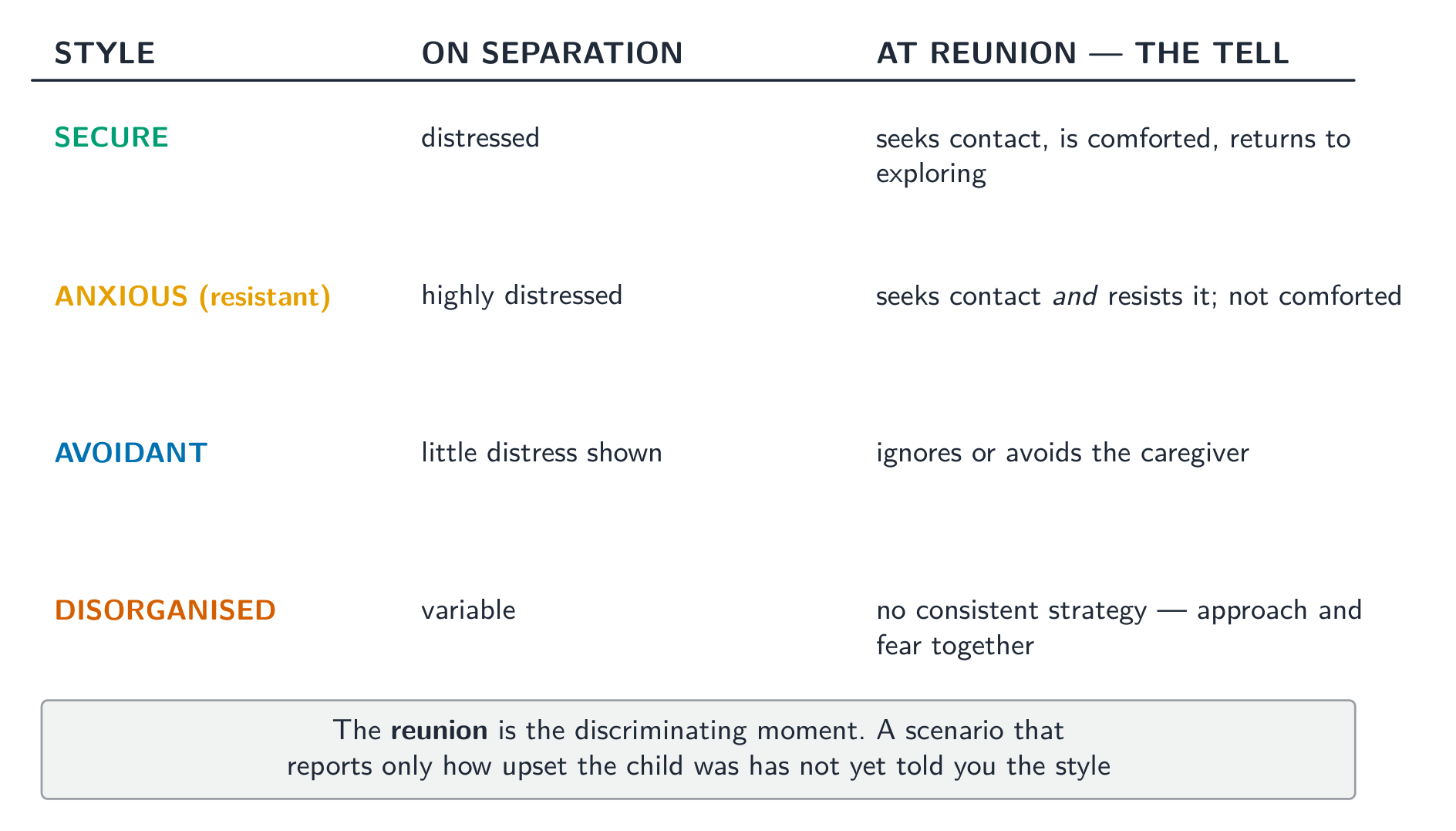
Attachment 依恋 is the emotional bond between infant and caregiver, studied with the strange situation 陌生情境 procedure. Styles include secure attachment 安全型依恋 and insecure forms (avoidant 回避型, anxious 焦虑型, disorganized 混乱型). Separation anxiety 分离焦虑 is heightened distress when away from a caregiver. Studies with monkeys showed that infants prefer contact comfort 接触安慰 over food, which changed how attachment was understood.

Peer relationships develop through parallel play 平行游戏 and pretend play 假装游戏 in childhood, and adolescents rely on peers more as they age.

Erikson 埃里克森 proposed a stage theory of psychosocial development 心理社会发展, in which each stage poses a conflict to resolve - the adolescent stage being identity versus role confusion 同一性与角色混乱. Adverse childhood experiences (ACEs) 童年不良经历 affect later relationships and health.

العربية

نظرية الأنظمة البيئية تصف التطور بيئات متداخلة، من العائلة المباشرة إلى الخارج نحو الثقافة.

تحديد البحث أساليب التربية: سلطوي (متطلبات عالية، دفء منخفض)، سلطوي ديمقراطي (متطلبات عالية، دفء عالي)، وتساهلي (متطلبات منخفضة، دفء عالي).

الترابط العاطفي هو الرابطة العاطفية بين الرضيع ومقدم الرعاية، يتم دراستها باستخدام إجراء الموقف الغريب. تشمل الأساليب الترابط الآمن والأشكال غير الآمنة (تجنب، قلق، اضطراب تنظيمي). القلق الانفصالي هو اضطراب متزايد عند الابتعاد عن مقدم الرعاية. أظهرت الدراسات مع القرود أن الرضع يفضلون راحة الاتصال الجسدي على الطعام، مما غيّر فهم الترابط العاطفي.

تنشأ علاقات الأقران من خلال اللعب المتوازي واللعب التمثيلي في الطفولة، ويعتمد المراهقون أكثر على الأقران كلما تقدموا في العمر.

إريكسون اقترح نظرية مراحل لـالتطور النفسي الاجتماعي، حيث تطرح كل مرحلة صراعاً للحل - مرحلة المراهقة وهي الهوية مقابل ارتباك الأدوار. التجارب السلبية في الطفولة (ACEs) تؤثر على العلاقات والصحة لاحقاً.

المواجهة هي اللحظة المميزة، وليس الانفصال
Vocabulary · ⁨مفردات⁩ Train · ⁨تدريب⁩
English العربية
Attachment/əˈtætʃmənt/ الترابط
strange situation/streɪndʒ ˌsɪtʃuːˈeɪʃn/ الموقف الغريب
secure attachment/sɪˈkjʊə əˈtætʃmənt/ الارتباط الآمن
avoidant/əˈvɔɪdənt/ تجنبي
anxious/ˈæŋʃəs/ قلقي
disorganized/dɪˈsɔːɡənaɪzd/ منظم
Separation anxiety/ˌsepəˈreɪʃn æŋˈzaɪəti/ قلق الانفصال
contact comfort/ˈkɒntækt ˈkʌmfət/ الراحة الملمسية
parallel play/ˈpærəlel pleɪ/ اللعب المتوازي
pretend play/prɪˈtend pleɪ/ اللعب التخيلي
Erikson/ˈerɪksn/ إريكسون
psychosocial development/ˈsaɪkəʊsəʊʃl dɪˈveləpmənt/ التطور النفسي الاجتماعي
identity versus role confusion/aɪˈdentɪti ˈvɜːsɪz rəʊl kənˈfjuːʒn/ الهوية مقابل ارتباك الأدوار
Adverse childhood experiences (ACEs)/ædˈvɜːs ˈtʃaɪldhʊd ekˈspɪərɪənsɪz/ التجارب الطفولية السلبية (ACEs)
behavioral perspective/bɪˈheɪvjərəl pəˈspektɪv/ المنظور السلوكي
3.7

Classical Conditioning · ⁨الشرط الكلاسيكي⁩

Syllabus · ⁨المنهج⁩
English

Learning Objective 3.7.A: Explain how classical conditioning applies to behavior and mental processes.

  • 3.7.A.1 The behavioral perspective evolved from theories about learning via conditioning. Behaviorists have traditionally focused on observable behavior to the exclusion of mental processes.
  • 3.7.A.2 Classical conditioning focuses on the association of one stimulus with another stimulus to elicit a response. Learning the association (also known as acquisition) involves a series of steps that demonstrate principles of associative learning.
    • 3.7.A.2.i The unconditioned stimulus (UCS) elicits an unconditioned response (UCR). This response becomes the conditioned response (CR) when it is performed in response to the conditioned stimulus (CS).
    • 3.7.A.2.ii The order of presentation of the CS with the UCS is important to successful acquisition.
    • 3.7.A.2.iii A CR can become extinct when the CS is no longer paired with the UCS. A formerly extinct CR can be spontaneously recovered when the CS is again presented after extinction.
    • 3.7.A.2.iv Stimulus discrimination and generalization have been demonstrated in studies of classical conditioning.
    • 3.7.A.2.v A CS can be used as a UCS in higher-order conditioning.
      • Exclusion Statement: Delayed conditioning, trace conditioning, simultaneous conditioning, and backward conditioning are outside the scope of the AP Psychology Exam.
  • 3.7.A.3 Research has demonstrated that emotional responses can be classically conditioned. These findings form the basis of therapeutic interventions for many mental disorders, such as counterconditioning.
    • Exclusion Statement: The expectancy theory is outside the scope of the AP Psychology Exam.
  • 3.7.A.4 Research on taste aversions, which are acquired through classical conditioning, demonstrates one-trial conditioning and biological preparedness. One-trial learning occurs when the association is acquired through one pairing of the stimulus and response and is not strengthened by further pairings. Biological preparedness refers to how animals are biologically predisposed to learning certain stimulus-response pairings more quickly than others.
  • 3.7.A.5 Habituation occurs when organisms grow accustomed to and exhibit a diminished response to a repeated or enduring stimulus.
العربية

هدف التعلم 3.7.A: اشرح كيف ينطبق الشرط الكلاسيكي على السلوك والعمليات العقلية.

  • 3.7.A.1 تطورت المنظور السلوكي من نظريات حول التعلم عبر الشرط. ركز السلوكيون تقليدياً على السلوك المرئي باستبعاد العمليات العقلية.
  • 3.7.A.2 يركز الشرط الكلاسيكي على ارتباط محفز بآخر لإثارة استجابة. يتضمن تعلم هذا الارتباط (المعروف أيضاً بالاكتساب) سلسلة من الخطوات التي توضح مبادئ التعلم الترابطي.
    • 3.7.A.2.i المحفز غير المشروط (UCS) يُثير استجابة غير مشروطة (UCR). تصبح هذه الاستجابة هي الاستجابة المشروطة (CR) عندما تُنفذ استجابة للمحفز المشروط (CS).
    • 3.7.A.2.ii ترتيب تقديم CS مع UCS مهم لاكتساب ناجح.
    • 3.7.A.2.iii يمكن أن تنقرض CR عندما لم يعد CS مقترناً مع UCS. يمكن استعادة CR التي انقرضت سابقاً بشكل تلقائي عند تقديم CS مرة أخرى بعد الانقراض.
    • 3.7.A.2.iv تم إثبات التمييز المحفزي والتعميم في دراسات الشرط الكلاسيكي.
    • 3.7.A.2.v يمكن استخدام CS كمحفز غير مشروط في الشرط من الرتبة الأعلى.
      • عبارة الاستبعاد: الشرط المتأخر، والشرط التتبعي، والشرط المتزامن، والشرط العكسي خارج نطاق امتحان علم النفس AP.
  • 3.7.A.3 أثبت البحث أن الاستجابات العاطفية يمكن شرطها كلاسيكياً. تشكل هذه النتائج أساس التدخلات العلاجية للعديد من الاضطرابات النفسية، مثل الشرط المعاكس.
    • عبارة الاستبعاد: نظرية التوقع خارج نطاق امتحان علم النفس AP.
  • 3.7.A.4 يظهر بحث عن سُموم الذوق (التي تُكتسب عبر الشرط الكلاسيكي) شرط单次 (one-trial conditioning) والاستعداد البيولوجي. يحدث التعلم مرة واحدة عندما يُكتسب الارتباط عبر اقتران واحد بين المحفز والاستجابة ولا يت strengthened بواسطة الاقترانات اللاحقة. يشير الاستعداد البيولوجي إلى كيفية استعداد الحيوانات بيولوجياً لتعلم بعض الاقترانات المحفز-استجابة بشكل أسرع من غيرها.
  • 3.7.A.5 يحدث التعود عندما تعتاد الكائنات الحية على محفز متكرر أو دائم وتُظهر استجابة مُخفَّضة تجاهه.

Source: College Board AP Course and Exam Description · ⁨المصدر: وصف دورة وامتحان College Board AP⁩

English

The behavioral perspective 行为主义视角 explains behaviour through learning rather than thought.

Classical conditioning 经典条件作用 associates one stimulus with another:

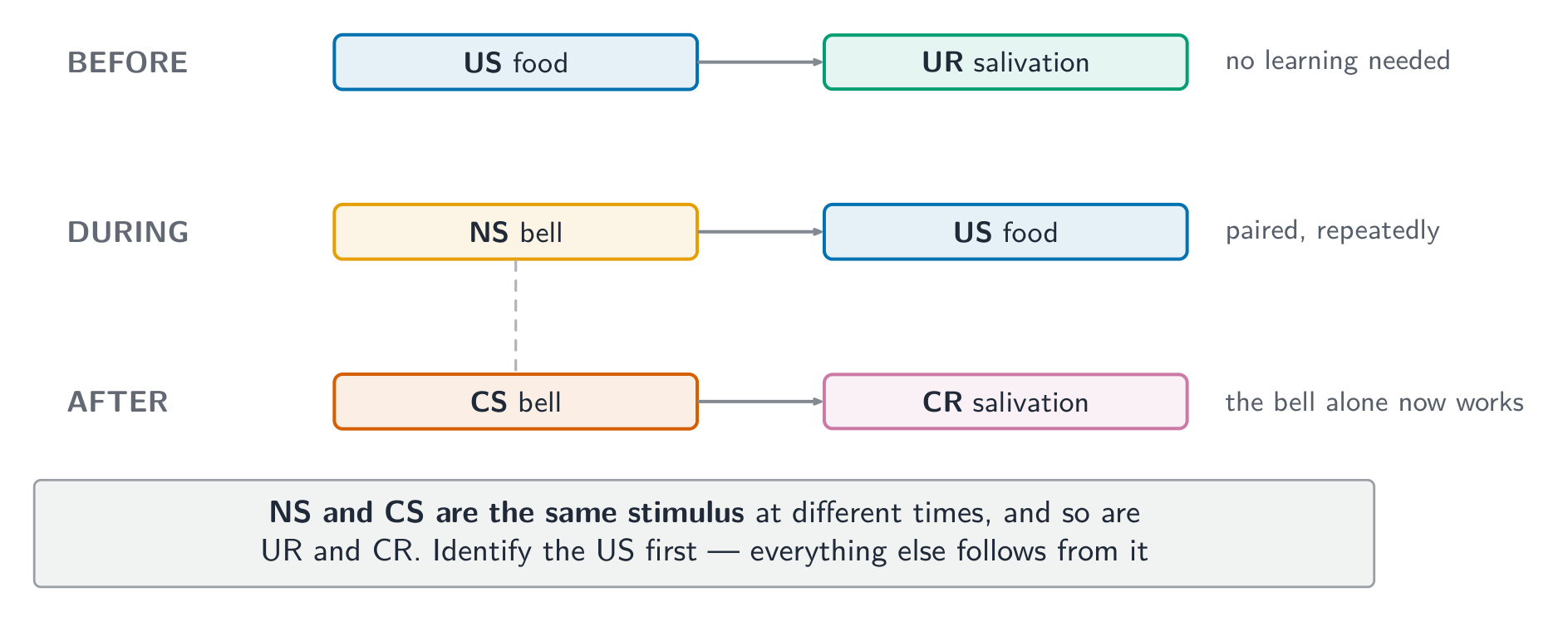
  • An unconditioned stimulus (UCS) 无条件刺激 naturally produces an unconditioned response (UCR) 无条件反应 - food causes salivation.
  • A neutral stimulus 中性刺激 paired with the UCS becomes a conditioned stimulus (CS) 条件刺激, producing a conditioned response (CR) 条件反应.
  • Acquisition 习得 depends on the order and timing of the pairing.
  • Extinction 消退 occurs when the CS is no longer paired with the UCS; spontaneous recovery 自发恢复 is the reappearance of an extinguished CR.
  • Generalization 泛化 is responding to similar stimuli; stimulus discrimination 刺激辨别 is responding only to the exact CS.
  • In higher-order conditioning 高级条件作用 an established CS acts as a UCS for a new one.

Emotional responses can be conditioned, and taste aversion 味觉厌恶 shows that some associations are learned in a single trial because they aided survival. Habituation 习惯化 is a diminished response to a repeated stimulus.

العربية

المنظور السلوكي يفسر السلوك من خلال التعلم بدلاً من التفكير.

الشرط الكلاسيكي يربط محفزاً واحداً بآخر:

  • المحفز غير المشروط (UCS) ينتج بشكل طبيعي استجابة غير مشروطة (UCR) - الطعام يسبب إفراز اللعاب.
  • المحفز المحايد المرتبط مع UCS يصبح محفزاً مشروطاً (CS)، مما ينتج استجابة مشروطة (CR).
  • الاكتساب يعتمد على ترتيب وتوقيت الربط.
  • الانطفاء يحدث عندما لم يعد CS مرتبطاً بـ UCS؛ الانتعاش التلقائي هو إعادة ظهور استجابة مشروطة منطفأة.
  • التعميم هو الاستجابة للمحفزات المشابهة؛ تمييز المحفز هو الاستجابة فقط لـ CS الدقيق.
  • في الشرط من الرتبة الأعلى يعمل CS مثبت مسبقاً كمحفز غير مشروط لمحفز جديد.

يمكن شرط الاستجابات العاطفية، ويوضح تجنب الطعم أن بعض الروابط تُكتسب في تجربة واحدة لأنها ساعدت على البقاء. التعود هو انخفاض الاستجابة لمحفز مكرر.

NS و CS هما نفس المحفز في أوقات مختلفة - حدد US أولاً
Explore · ⁨استكشف⁩

Condition a response in three stages · ⁨شرط استجابة في ثلاث مراحل⁩

NS and CS are the same stimulus at different times, and so are UR and CR. Identify the US first and the rest follows. · ⁨NS وCS هما نفس المحفز في أوقات مختلفة، وكذلك UR وCR. حدد US أولاً وسيكون الباقي تلقائياً.⁩

Vocabulary · ⁨مفردات⁩ Train · ⁨تدريب⁩
English العربية
Classical conditioning/ˈklæsɪkl kənˈdɪʃənɪŋ/ التكييف الكلاسيكي
unconditioned stimulus (UCS)/ʌŋkənˈdɪʃnd ˈstɪmjʊləs/ المحفز غير المشروط (UCS)
unconditioned response (UCR)/ʌŋkənˈdɪʃnd rɪˈspɒns/ الاستجابة غير المشروطة (UCR)
neutral stimulus/ˈnjuːtrəl ˈstɪmjʊləs/ المحفز المحايد
conditioned stimulus (CS)/kənˈdɪʃnd ˈstɪmjʊləs/ المحفز المشروط (CS)
conditioned response (CR)/kənˈdɪʃnd rɪˈspɒns/ الاستجابة المشروطة (CR)
Acquisition/əkwɪˈsɪʃn/ الاكتساب
Extinction/ekˈstɪŋkʃn/ الانقضاء
spontaneous recovery/spɒnˈteɪnɪəs rɪˈkʌvəri/ الاسترداد التلقائي
Generalization/ˌdʒenərəlaɪˈzeɪʃn/ التعميم
stimulus discrimination/ˈstɪmjʊləs dɪˌskrɪmɪˈneɪʃn/ تمييز المحفز
higher-order conditioning/ˈhaɪə ˈɔːdə kənˈdɪʃənɪŋ/ التشروط من الرتبة الأعلى
taste aversion/teɪst əˈvɜːʃn/ كراهية الذوق
Habituation/ˌhæbɪtʃuːˈeɪʃn/ التعود
Operant conditioning/ˈɒpərənt kənˈdɪʃənɪŋ/ التكيف العملي
Reinforcement/ˌriːɪnˈfɔːsmənt/ التعزيز
punishment/ˈpʌnɪʃmənt/ العقاب
Positive/ˈpɒzɪtɪv/ إيجابي
negative/ˈneɡətɪv/ سالب
negative reinforcement/ˈneɡətɪv ˌriːɪnˈfɔːsmənt/ التعزيز السلبي
primary reinforcer/ˈpraɪməri ˌriːɪnˈfɔːsə/ معزز أولي
secondary reinforcer/ˈsekəndəri ˌriːɪnˈfɔːsə/ معزز ثانوي
Shaping/ˈʃeɪpɪŋ/ التشكيل
successive approximations/səkˈsesɪv əˌprɒksɪˈmeɪʃnz/ تقريبات متتالية
Reinforcement schedules/ˌriːɪnˈfɔːsmənt ˈʃedjuːlz/ جداول التعزيز
Continuous reinforcement/kənˈtɪnjuːəs ˌriːɪnˈfɔːsmənt/ تعزيز مستمر
Partial reinforcement/ˈpɑːʃl ˌriːɪnˈfɔːsmənt/ التعزيز الجزئي
fixed-ratio/fɪkst ˈreɪʃɪəʊ/ نسبة ثابتة
variable-ratio/ˈveərɪəbl ˈreɪʃɪəʊ/ نسبة متغيرة
fixed-interval/fɪkst ˈɪntəvl/ فترة زمنية ثابتة
variable-interval/ˈveərɪəbl ˈɪntəvl/ فترة زمنية متغيرة
Superstitious behavior/ˌsuːpəˈstɪʃəs bɪˈheɪvjə/ سلوك خرافي
Learned helplessness/lɜːnd ˈhelpləsnəs/ العجز المتعلم
Social learning theory/ˈsəʊʃl ˈlɜːnɪŋ ˈθɪəri/ نظرية التعلم الاجتماعي
observation/ɒbzəˈveɪʃn/ ملاحظة
modeling/ˈmɒdəlɪŋ/ النمذجة
Insight learning/ˈɪnsaɪt ˈlɜːnɪŋ/ التعلم بالفهم المفاجئ
Latent learning/ˈleɪtənt ˈlɜːnɪŋ/ التعلم الكامن
cognitive map/ˈkɒɡnɪtɪv mæp/ الخريطة المعرفية
3.8

Operant Conditioning · ⁨الشرط الأوبرانت⁩

Syllabus · ⁨المنهج⁩
English

Learning Objective 3.8.A: Explain how operant conditioning applies to behavior and mental processes.

  • 3.8.A.1 Operant conditioning focuses on associating consequences (reinforcement and punishment) with behaviors. The Law of Effect states that behaviors with reinforcing consequences are more likely to be repeated while behaviors with punishing consequences are not as likely to be repeated.
  • 3.8.A.2 Reinforcement and punishment can be positive or negative. Reinforcers can be primary or secondary. Reinforcement discrimination and generalization have been demonstrated in studies of operant conditioning.
  • 3.8.A.3 Reinforcement can be used to shape behavior (“shaping”) gradually through rewarding successive approximations of the desired behavior. Research with animals shows that only certain behaviors can be shaped through reinforcement (known as instinctive drift).
  • 3.8.A.4 Superstitious behavior occurs when consequences reinforce unrelated behaviors. Learned helplessness occurs when organisms learn that they have no control over their experience of aversive consequences in a given situation.
  • 3.8.A.5 The schedule with which reinforcement is delivered can determine the strength of the association between the consequence and the response. The two main types of reinforcement schedules are continuous and partial. Each type of reinforcement behavior can be graphed, resulting in a distinctive pattern on the graph (e.g., fixed-interval schedule produces a scalloped graph).
    • 3.8.A.5.i Continuous reinforcement schedules deliver reinforcement for each and every correct behavior.
    • 3.8.A.5.ii The partial reinforcement schedules focus on whether reinforcement is delivered on a time-based schedule (fixed- or variable-interval) or for the number of behaviors performed (fixed- or variable-ratio).
العربية

هدف التعلم 3.8.A: اشرح كيف ينطبق الشرط الأوبرالي على السلوك والعمليات العقلية.

  • 3.8.A.1 يركز الشرط الأوبرالي على ربط العواقب (التعزيز والعقاب) بالسلوكات. تنص قانون النتيجة على أن السلوكات ذات العواقب المعززة أكثر احتمالاً للتكرار بينما السلوكات ذات العواقب العقابية أقل احتمالاً للتكرار.
  • 3.8.A.2 يمكن أن يكون التعزيز والعقاب إيجابيين أو سلبيين. يمكن أن تكون المعززات أولية أو ثانوية. تم إثبات تمييز التعزيز والتعميم في دراسات الشرط الأوبرالي.
  • 3.8.A.3 يمكن استخدام التعزيز لتشكيل السلوك («تشكيل») تدريجياً من خلال مكافأة التقريبات المتتالية للسلوك المطلوب. أظهرت الأبحاث على الحيوانات أنه يمكن تشكيل سلوكات معينة فقط من خلال التعزيز (ما يُعرف بانحراف الغرائز).
  • 3.8.A.4 يحدث السلوك الخرافي عندما تعزز العواقب سلوكات غير ذات صلة. يحدث اليأس المتعلم عندما تتعلم الكائنات الحية أنها لا تملك سيطرة على تجربتها لعواقب مؤلمة في موقف معين.
  • 3.8.A.5 يمكن أن يحدد الجدول الذي يُقدَّم فيه التعزيز قوة الارتباط بين العاقبة والاستجابة. النوعان الرئيسيان لجدولات التعزيز هما المستمر والجزئي. يمكن رسم كل نوع من سلوكيات التعزيز بيانياً، مما ينتج نمطاً مميزاً على الرسم البياني (على سبيل المثال، ينتج جدول الفاصل الثابت رسماً موجياً).
    • 3.8.A.5.i تقدم جدالات التعزيز المستمر تعزيزاً لكل سلوك صحيح على حدة.
    • 3.8.A.5.ii تركز جدالات التعزيز الجزئي على ما إذا كان التعزيز يُقدَّم بناءً على جدول زمني (فاصل ثابت أو متغير) أم لعدد السلوكات المنفذة (نسبة ثابتة أو متغيرة).

Source: College Board AP Course and Exam Description · ⁨المصدر: وصف دورة وامتحان College Board AP⁩

English

Operant conditioning 操作性条件作用 associates a behaviour with its consequence.

  • Reinforcement 强化 increases a behaviour; punishment 惩罚 decreases it.
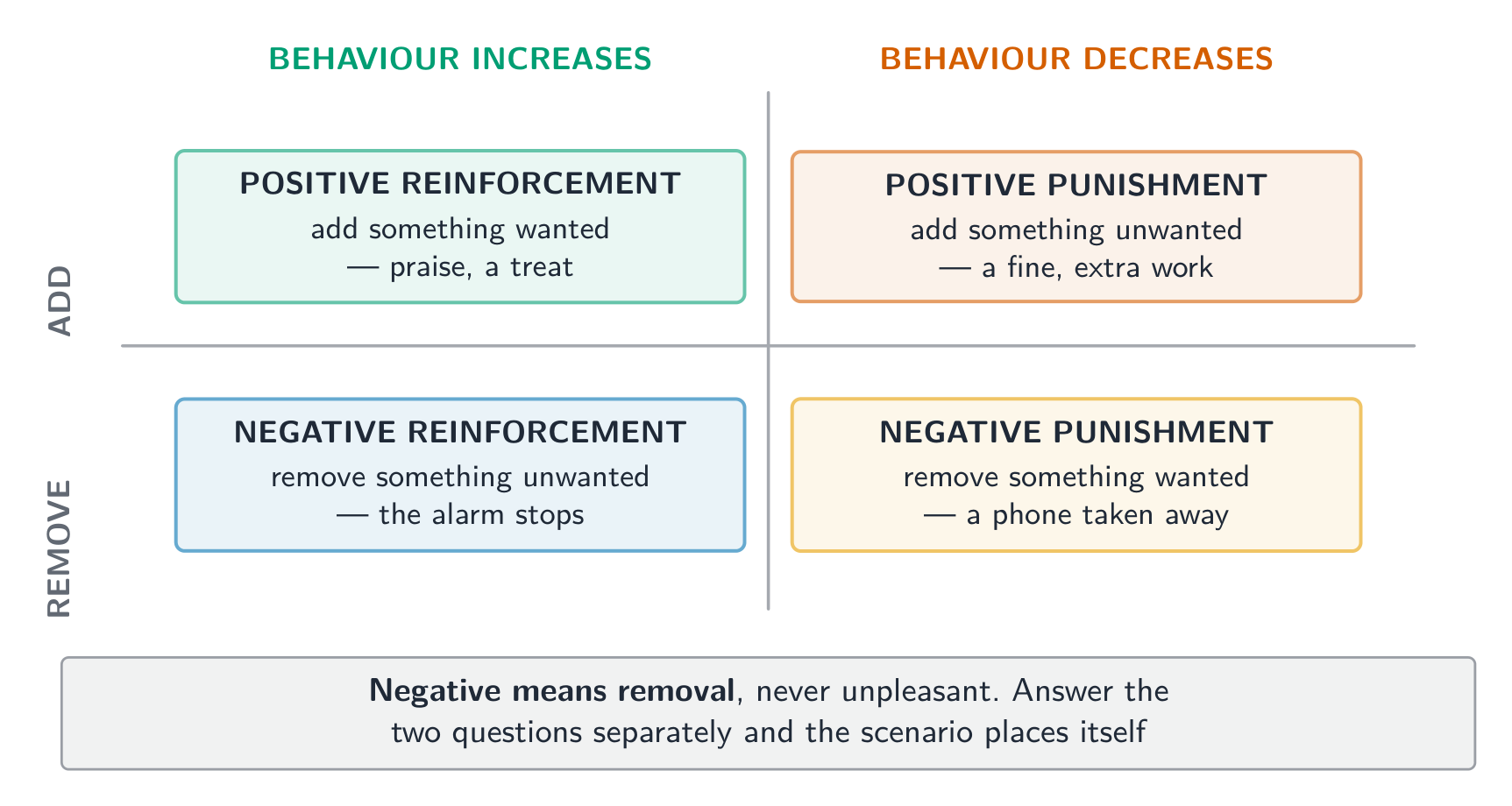
  • Positive 正 means something is added; negative 负 means something is removed. So negative reinforcement 负强化 increases behaviour by removing something unpleasant - it is not punishment.
  • A primary reinforcer 原级强化物 satisfies a biological need; a secondary reinforcer 次级强化物 (money) is learned.
  • Shaping 塑造 rewards successive approximations 逐步接近 of a target behaviour.

Reinforcement schedules 强化程式 change how strong and persistent learning is. Continuous reinforcement 连续强化 rewards every response and produces fast learning but fast extinction. Partial reinforcement 部分强化 comes in four kinds - fixed-ratio 固定比率, variable-ratio 变动比率, fixed-interval 固定时距, and variable-interval 变动时距 - and variable-ratio produces the highest, most extinction-resistant rate.

Superstitious behavior 迷信行为 arises when a consequence reinforces an unrelated action. Learned helplessness 习得性无助 develops when an organism repeatedly cannot escape an aversive event and stops trying.

العربية

الشرط الأوبرانت يربط سلوكاً بعاقبته.

  • التعزيز يزيد السلوك؛ والعقاب يقلله.
  • الإيجابي يعني إضافة شيء ما؛ السالب يعني إزالة شيء ما. لذا التعزيز السلبي يزيد السلوك عن طريق إزالة شيء غير مريح - إنه ليس عقاباً.
  • المُزز الأولي يلبي حاجة بيولوجية؛ المُزز الثانوي (النقود) يُكتسب.
  • التشكيل يكافئ التقاربات المتتالية لسلوك مستهدف.

جداول التعزيز تغير مدى قوة واستمرارية التعلم. التعزيز المستمر يكافئ كل استجابة وينتج تعلماً سريعاً لكنه انطفاء سريع. التعزيز الجزئي يأتي بأربعة أنواع - نسبة ثابتة، نسبة متغيرة، فترة زمنية ثابتة، وفترة زمنية متغيرة - ونسبة متغيرة تنتج أعلى معدل وأكثر مقاومة للانطفاء.

السلوك الخرافي ينشأ عندما يعزز نتيجة سلوكاً غير مرتبط به. العجز المتعلم يتطور عندما لا يستطيع الكائن الحي الهروب من حدث مؤلم بشكل متكرر ويتوقف عن المحاولة.

السالب يعني الإزالة، وليس بالضرورة شيء سيئ - أجب عن السؤالين منفصلتين
Explore · ⁨استكشف⁩

Place each scenario in the operant grid · ⁨ضع كل سيناريو في شبكة السلوك الآلي⁩

Negative means removal, never unpleasant. Answer two questions separately: add or remove, and does the behaviour go up or down? · ⁨السالب يعني الإزالة، ليس المزعج. أجب عن سؤالين منفصلين: إضافة أو إزالة، وهل يتصرف السلوك صعوداً أم هبوطاً؟⁩

3.9

Observational and Cognitive Learning · ⁨التعلم الرصدي والمعرفي⁩

Syllabus · ⁨المنهج⁩
English

Learning Objective 3.9.A: Explain how social learning applies to behavior and mental processes.

  • 3.9.A.1 Social learning theory proposes that learning can occur by observation and does not have to involve personal experience with a consequence (vicarious conditioning). Learning can occur by copying the behavior of models. The more similar a model is, the more likely the behavior is to be learned.

Learning Objective 3.9.B: Explain how cognitive factors in learning apply to behavior and mental processes.

  • 3.9.B.1 Insight learning occurs when the solution to a problem occurs without any association, consequence, or model being present.
  • 3.9.B.2 Latent learning occurs when information is learned without reinforcement but is not immediately evident. Latent learning is often demonstrated by cognitive maps.
العربية

هدف التعلم 3.9.A: اشرح كيف ينطبق التعلم الاجتماعي على السلوك والعمليات العقلية.

  • 3.9.A.1 تقترح نظرية التعلم الاجتماعي أن التعلم يمكن أن يحدث بالملاحظة ولا يتطلب بالضرورة تجربة شخصية بعاقبة (شرط بديل). يمكن أن يحدث التعلم بنسخ سلوك النماذج. كلما كانت النموذج مشابهة أكثر، كان السلوك أكثر احتمالا أن يُتعلم.

هدف التعلم 3.9.B: اشرح كيف تنطبق العوامل المعرفية في التعلم على السلوك والعمليات العقلية.

  • 3.9.B.1 يحدث التعلم بالإدراك عندما تحدث حل لمشكلة دون وجود أي ارتباط أو عاقبة أو نموذج.
  • 3.9.B.2 يحدث التعلم الكامن عندما تُتعلم المعلومات بدون تعزيز ولكن لا تظهر فوراً. غالباً ما يُستعرض التعلم الكامن من خلال الخرائط المعرفية.

Source: College Board AP Course and Exam Description · ⁨المصدر: وصف دورة وامتحان College Board AP⁩

English

Not all learning needs direct experience. Social learning theory 社会学习理论 shows that behaviour can be learned by observation 观察 and modeling 榜样示范 - the basis of the Bobo doll findings on imitated aggression.

Insight learning 顿悟学习 is a sudden solution with no gradual conditioning. Latent learning 潜伏学习 is learning that occurs without reinforcement and stays hidden until there is a reason to show it, demonstrated by rats forming a cognitive map 认知地图 of a maze.

Worked example (a real AP exam question). The 2024 exam described Gavin, a preschooler at a science museum: he grabbed a large glass marble and tried to bounce it, he was briefly separated from his parents, and the next day he told his grandmother about a picture he had drawn. Students had to "Explain how Jean Piaget's concept of assimilation could relate to Gavin's experience with the glass marble" and "Explain how egocentrism could relate to how Gavin interacted with his grandmother in the car". A full-mark answer defines the term and ties it to the specific detail: "Gavin already had a schema for balls, which bounce. He assimilated the marble into that schema by treating it as a ball and trying to bounce it." Notice the shape: the definition alone earns nothing, and so does retelling the story. The mark is for the join between them.

العربية

ليس كل التعلم يحتاج إلى خبرة مباشرة. تُظهر نظرية التعلم الاجتماعي أن السلوك يمكن تعلمه عبر الملاحظة والنمذجة - وهو أساس نتائج دمية بوبو حول العدوان المقلد.

التعلم بالإبصار هو حل مفاجئ دون تكييف تدريجي. التعلم الكامن هو تعلم يحدث بدون تعزيز ويبقى خفياً حتى يكون هناك سبب لإظهاره، مما تم إثباته من خلال تشكل الفئران لـخريطة معرفية للمتاهة.

مثال محلول (سؤال حقيقي في امتحان AP). وصف امتحان عام 2024 غافين، طفل روضة في متحف علوم: أمسك بكرة زجاجية كبيرة وحاول قذفها، انفصل عن والديه لفترة وجيزة، وفي اليوم التالي أخبر جده بصورته التي رسمها. كان على الطلاب "شرح كيف يمكن لمفهوم الاندماج عند جان بياجيه أن يرتبط بتجربة غافين مع الكرة الزجاجية" و "شرح كيف يمكن مركزية الذات أن ترتبط بكيفية تفاعل غافين مع جده في السيارة". الإجابة الكاملة الدرجة تعني تعريف المصطلح و ربطه بالتفاصيل المحددة: "كان لدى غافين بالفعل مخطط للأقلامات التي تقفز. قام باندماج الكرة الزجاجية في ذلك المخطط من خلال معاملتها ككرة ومحاولة قذفها." لاحظ الشكل: التعريف وحده لا يكتسب أي درجة، وكذلك سرد القصة. الدرجة هي لربطهما ببعضهما البعض.

3.9

Exam tips · ⁨نصائح للامتحان⁩

English
  • Negative reinforcement increases behaviour. If you can say what was removed, and the behaviour went up, it is not punishment.
  • Match a Piaget stage to its achievement - object permanence, conservation, abstract reasoning - rather than to an age.
  • Classical conditioning links two stimuli and produces an involuntary response; operant conditioning links behaviour to consequence.
  • Variable-ratio schedules resist extinction best. Use it whenever a question describes gambling-like persistence.
  • Keep critical period for the narrow window and sensitive period for the softer one.
  • On scenario questions, name the term and then point at the detail in the scenario that proves it. The detail is what earns the mark.
العربية
  • التعزيز السلبي يزيد السلوك. إذا كنت تستطيع قول ما تم إزالته، وذهب السلوك لأعلى، فهو ليس عقاباً.
  • طابق مرحلة بياجيه بإنجازاتها - ثبوت الشيء، الحفظ، الاستدلال المجرد - بدلاً من الطابق إلى العمر.
  • الت/Area الكلاسيكي يربط بين محفين وينتج استجابة لا إرادية؛ الت/Area الألي يربط السلوك بالنتيجة.
  • الجداول نسبة متغيرة تقاوم الانطفاء بشكل أفضل. استخدمها كلما وصف سؤال ما مثل الإصرار على القمار.
  • احتفظ بـ الفترة الحرجة للنافذة الضيقة و الفترة الحساسة للنافذة الأكثر مرونة.
  • في أسئلة السيناريو، سمِّ المصطلح ثم اشاره إلى التفاصيل في السيناريو التي تثبت ذلك. التفاصيل هي ما يكتسب الدرجة.

Interactive lessons on this topic · ⁨دروس تفاعلية حول هذا الموضوع⁩

Work through it step by step, with instant-check exercises. · ⁨ا-working عليه خطوة بخطوة، مع تمارين تحقق فوري.⁩

Past Papers · ⁨أوراق الامتحانات السابقة⁩

More topics in AP Psychology · ⁨علم النفس (AP)⁩ · ⁨المزيد من المواضيع في AP Psychology · ⁨علم النفس (AP)⁩⁩

Log in or create account · ⁨تسجيل الدخول أو إنشاء حساب⁩

IGCSE, A-Level & AP