Skip to content · ⁨الانتقال إلى المحتوى⁩

Trigonometric and Polar Functions · ⁨الدوال المثلثية والدوال القطبية⁩

AP Precalculus · ⁨AP ما قبل التفاضل والتكامل⁩ · Topic 3 · ⁨الموضوع 3⁩

Video lesson for this topic · ⁨درس فيديو لهذا الموضوع⁩ Open the video page · ⁨افتح صفحة الفيديو⁩
8:08

الدوال المثلثية والقطبية

شاهد نقطة تتحرك حول دائرة بمعدل ثابت. يرتفع ارتفاعها، وينخفض، ثم يرتفع مرة أخرى، مراراً وتكراراً. تتبع هذا الارتفاع مقابل الزمن، وستحصل على…

English narration · English + 中文 subtitles burned in · ⁨سرد باللغة الإنجليزية · ترجمة مدمجة بالإنجليزية + الصينية⁩

3.1

Periodic Phenomena · ⁨الظواهر الدورية⁩

Syllabus · ⁨المنهج⁩
English

Learning Objective 3.1.A: Construct graphs of periodic relationships based on verbal representations.

  • 3.1.A.1 A periodic relationship can be identified between two aspects of a context if, as the input values increase, the output values demonstrate a repeating pattern over successive equal-length intervals.
  • 3.1.A.2 The graph of a periodic relationship can be constructed from the graph of a single cycle of the relationship.

Learning Objective 3.1.B: Describe key characteristics of a periodic function based on a verbal representation.

  • 3.1.B.1 The period of the function is the smallest positive value $k$ such that $f(x + k) = f(x)$ for all $x$ in the domain. Consequently, the behavior of a periodic function is completely determined by any interval of width $k$.
  • 3.1.B.2 The period can be estimated by investigating successive equal-length output values and finding where the pattern begins to repeat.
  • 3.1.B.3 Periodic functions take on characteristics of other functions, such as intervals of increase and decrease, different concavities, and various rates of change. However, with periodic functions, all characteristics found in one period of the function will be in every period of the function.
العربية

هدف التعلم 3.1.A: رسم بياني للعلاقات الدورية بناءً على التمثيلات اللفظية.

  • 3.1.A.1 يمكن تحديد علاقة دورية بين جانبين من سياق ما إذا كانت قيم المدخلات تزداد وقيم المخرجات تُظهر نمطاً متكرراً على فترات متتالية متساوية الطول.
  • 3.1.A.2 يمكن رسم بياني للعلاقة الدورية انطلاقاً من الرسم البياني لدورة واحدة فقط من العلاقة.

هدف التعلم 3.1.B: وصف الخصائص الرئيسية للدالة الدورية بناءً على تمثيل لفظي.

  • 3.1.B.1 الفترة للدالة هي أصغر قيمة موجبة $k$ بحيث $f(x + k) = f(x)$ لجميع $x$ في المجال. بالتالي، يكون سلوك الدالة الدورية محددًا تماماً بواسطة أي فترة عرضها $k$.
  • 3.1.B.2 يمكن تقدير الفترة من خلال فحص قيم المخرجات المتتالية المتساوية الطول وإيجاد نقطة بداية تكرار النمط.
  • 3.1.B.3 تأخذ الدوال الدورية خصائص من دوال أخرى، مثل فترات الزيادة والنقصان، والتقعر المختلفة، ومعدلات التغير المتنوعة. ومع ذلك، بالنسبة للدوال الدورية، ستكون جميع الخصائص التي تُوجد في دورة واحدة من الدالة موجودة في كل دورة من الدالة.
Source: College Board AP Course and Exam Description · ⁨المصدر: وصف دورة وامتحان College Board AP⁩

English

A relationship is periodic 周期性 if its output pattern repeats at regular input steps. The period 周期 is the smallest positive $k$ with $f(x+k)=f(x)$ for all $x$. You can build the whole graph by copying a single cycle 周期段, and estimate the period by finding how far apart the pattern repeats. Within each cycle a periodic function still has intervals of increase/decrease and maxima/minima.

العربية
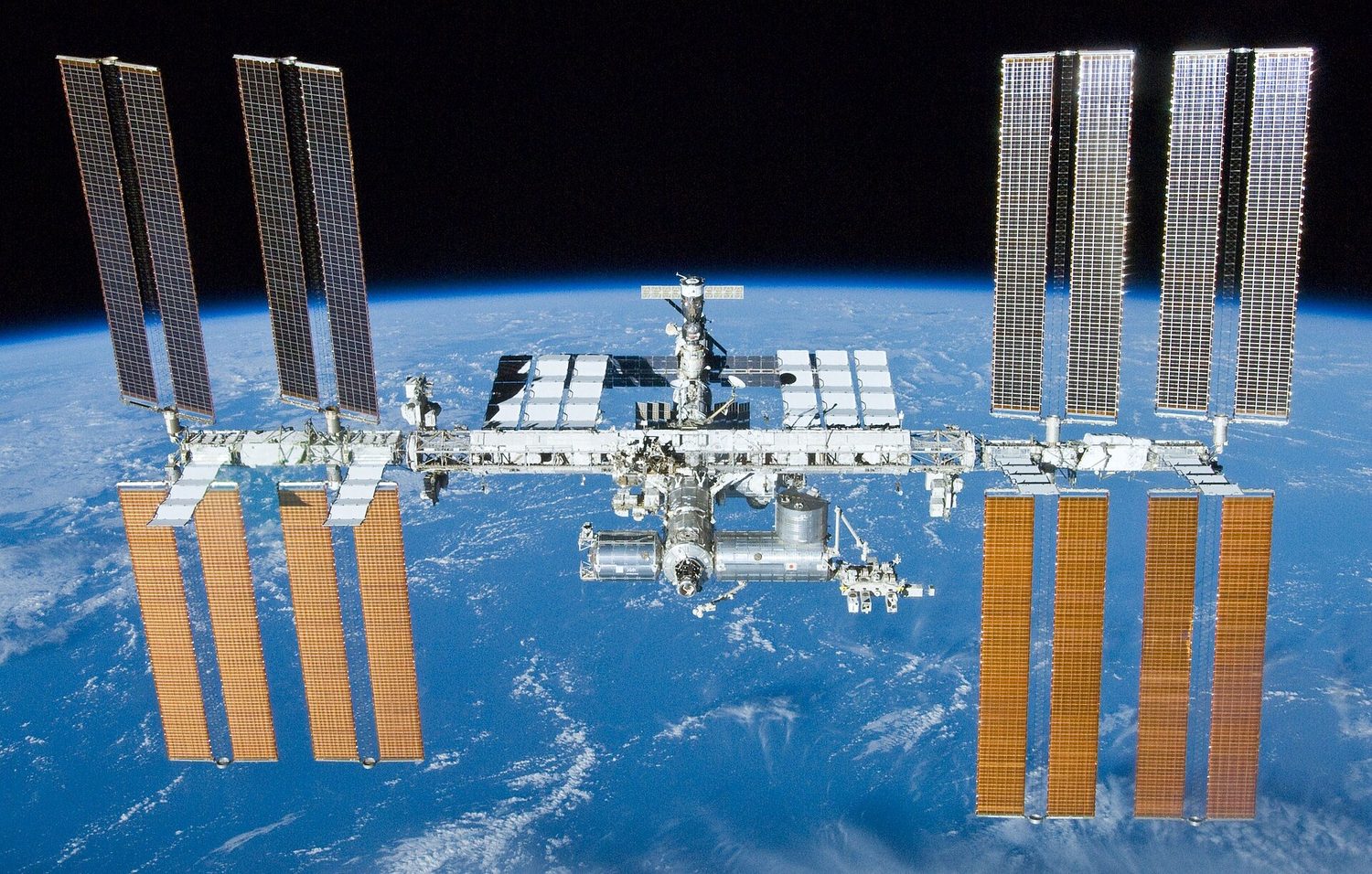
المحطة الفضائية الدولية في المدار: تصف الدوال المثلثية والقطبية الحركة الدورية والدائرية

تكون العلاقة دورية إذا كان نمط نتيجتها يتكرر على خطوات إدخال منتظمة. الدورة هي أصغر قيمة موجبة $k$ مع $f(x+k)=f(x)$ لكل $x$. يمكنك بناء الرسم البياني بالكامل بنسخ دورة واحدة، وتقدير الدورة بإيجاد المسافة بين تكرارات النمط. ضمن كل دورة، لا تزال الدالة الدورية تحتوي على فترات زيادة/نقصان وقيم عظمى/صغرى.

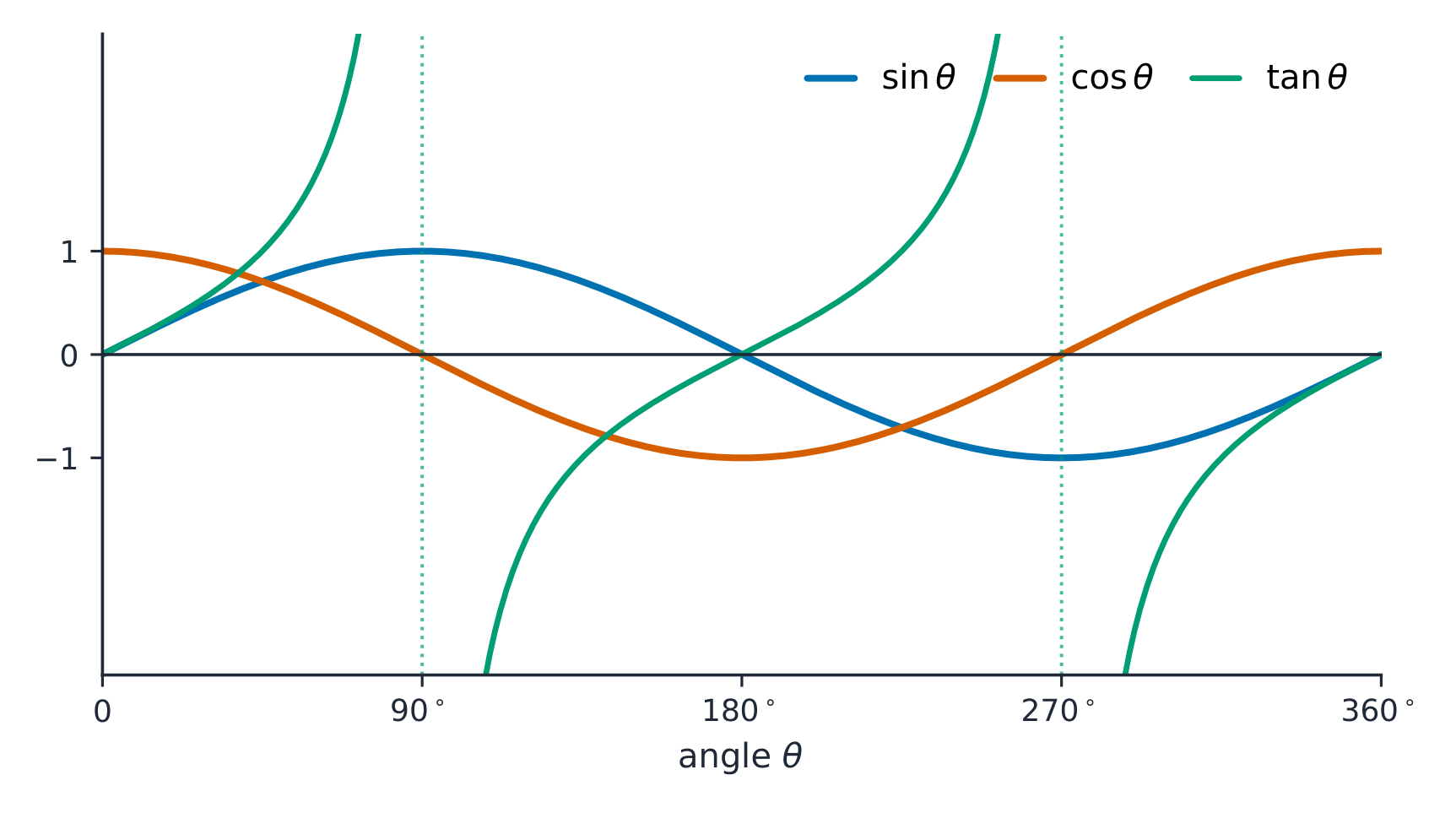
sin و cos تتذببان بين -1 و 1؛ tan تنكسر عند 90 و 270 درجة
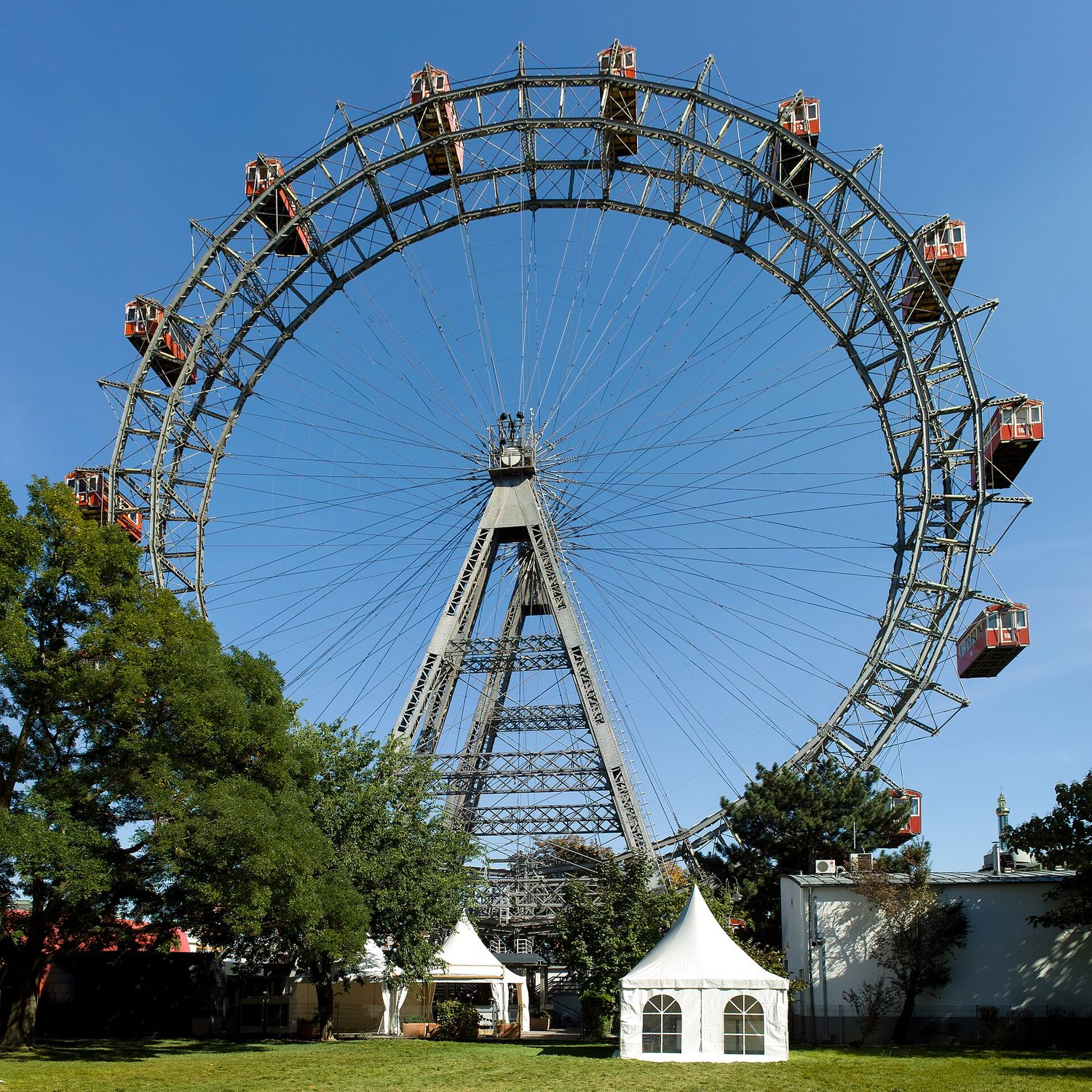
عجلة فيينا العملاقة مقابل السماء الزرقاء
عندما تدور العجلة بشكل ثابت، يرتفع ارتفاعك وينخفض مراراً وتكراراً — موجة جيبية حقيقية في الزمن
3.2

Sine, Cosine, and Tangent · ⁨الجيب، جيب التمام، والظل⁩

Syllabus · ⁨المنهج⁩
English

Learning Objective 3.2.A: Determine the sine, cosine, and tangent of an angle using the unit circle.

  • 3.2.A.1 In the coordinate plane, an angle is in standard position when the vertex coincides with the origin and one ray coincides with the positive $x$-axis. The other ray is called the terminal ray. Positive and negative angle measures indicate rotations from the positive $x$-axis in the counterclockwise and clockwise direction, respectively. Angles in standard position that share a terminal ray differ by an integer number of revolutions.
  • 3.2.A.2 The radian measure of an angle in standard position is the ratio of the length of the arc of a circle centered at the origin subtended by the angle to the radius of that same circle. For a unit circle, which has radius $1$, the radian measure is the same as the length of the subtended arc.
  • 3.2.A.3 Given an angle in standard position and a circle centered at the origin, there is a point, $P$, where the terminal ray intersects the circle. The sine of the angle is the ratio of the vertical displacement of $P$ from the $x$-axis to the distance between the origin and point $P$. Therefore, for a unit circle, the sine of the angle is the $y$-coordinate of point $P$.
  • 3.2.A.4 Given an angle in standard position and a circle centered at the origin, there is a point, $P$, where the terminal ray intersects the circle. The cosine of the angle is the ratio of the horizontal displacement of $P$ from the $y$-axis to the distance between the origin and point $P$. Therefore, for a unit circle, the cosine of the angle is the $x$-coordinate of point $P$.
  • 3.2.A.5 Given an angle in standard position, the tangent of the angle is the slope, if it exists, of the terminal ray. Because the slope of the terminal ray is the ratio of the vertical displacement to the horizontal displacement over any interval, the tangent of the angle is the ratio of the $y$-coordinate to the $x$-coordinate of the point at which the terminal ray intersects the unit circle; alternately, it is the ratio of the angle's sine to its cosine.
العربية

هدف التعلم 3.2.A: تحديد جيب وجيب التمام والظل لزوايا باستخدام الدائرة الوحدة.

  • 3.2.A.1 في المستوى الإحداثي، تكون الزاوية في الموضع القياسي عندما يتطابق رأسها مع نقطة الأصل وتتناصف أحد شعاعيها مع المحور الموجب $x$. يسمى الشعاع الآخر بالشعاع النهائي. تشير قياسات الزوايا الموجبة والسالبة إلى الدوران من المحور الموجب $x$ في الاتجاه المضاد لاتجاه عقارب الساعة وفي اتجاه عقارب الساعة على التوالي. تتباين الزوايا في الموضع القياسي التي تشترك في شعاع نهائي بعدد صحيح من الدورات.
  • 3.2.A.2 مقياس الراديان للزاوية في الموضع القياسي هو نسبة طول قوس دائرة مركزها نقطة الأصل ومقطوعة بالزاوية إلى نصف قطر نفس الدائرة. بالنسبة للدائرة الوحدة ذات نصف القطر $1$، يكون مقياس الراديان مساوياً لطول القوس المقطوع.
  • 3.2.A.3 بمعلومية زاوية في الموضع القياسي ودائرة مركزها نقطة الأصل، توجد نقطة $P$ يتقاطع فيها الشعاع النهائي مع الدائرة. جيب الزاوية هو نسبة الانزياح العمودي لـ $P$ عن المحور $x$ إلى المسافة بين نقطة الأصل والنقطة $P$. لذلك، بالنسبة للدائرة الوحدة، يكون جيب الزاوية هو الإحداثي $y$ للنقطة $P$.
  • 3.2.A.4 بمعلومية زاوية في الموضع القياسي ودائرة مركزها نقطة الأصل، توجد نقطة $P$ يتقاطع فيها الشعاع النهائي مع الدائرة. جيب تمام الزاوية هو نسبة الانزياح الأفقي لـ $P$ عن المحور $y$ إلى المسافة بين نقطة الأصل والنقطة $P$. لذلك، بالنسبة للدائرة الوحدة، يكون جيب تمام الزاوية هو الإحداثي $x$ للنقطة $P$.
  • 3.2.A.5 بمعلومية زاوية في الموضع القياسي، ظل الزاوية هو الميل، إن وجد، للشعاع النهائي. وبما أن ميل الشعاع النهائي هو نسبة الانزياح العمودي إلى الانزياح الأفقي على أي فترة، فإن ظل الزاوية هو نسبة الإحداثي $y$ إلى الإحداثي $x$ للنقطة التي يتقاطع فيها الشعاع النهائي مع الدائرة الوحدة؛ أو بشكل بديل، هو نسبة جيب الزاوية إلى جيب تمامها.

Source: College Board AP Course and Exam Description · ⁨المصدر: وصف دورة وامتحان College Board AP⁩

English

An angle is in standard position 标准位置 when its vertex is at the origin and its initial ray lies on the positive $x$-axis. Its radian 弧度 measure is the arc length on a unit circle. For the point $P$ where the terminal ray meets a circle of radius $r$:

$$\cos\theta = \frac{x}{r},\qquad \sin\theta = \frac{y}{r},\qquad \tan\theta = \frac{y}{x}\ (\text{the slope of the terminal ray}).$$

العربية

يكون الزاوية في الموضع القياسي عندما تكون ذروتها في نقطة الأصل وشعاعها الأولي يقع على المحور $x$ الموجب. مقياسها بالراديان هو طول القوس على دائرة الوحدة. للنقطة $P$ حيث يلتقي الشعاع النهائي بدائرة نصف قطرها $r$:

$$\cos\theta = \frac{x}{r},\qquad \sin\theta = \frac{y}{r},\qquad \tan\theta = \frac{y}{x}\ (\text{the slope of the terminal ray}).$$

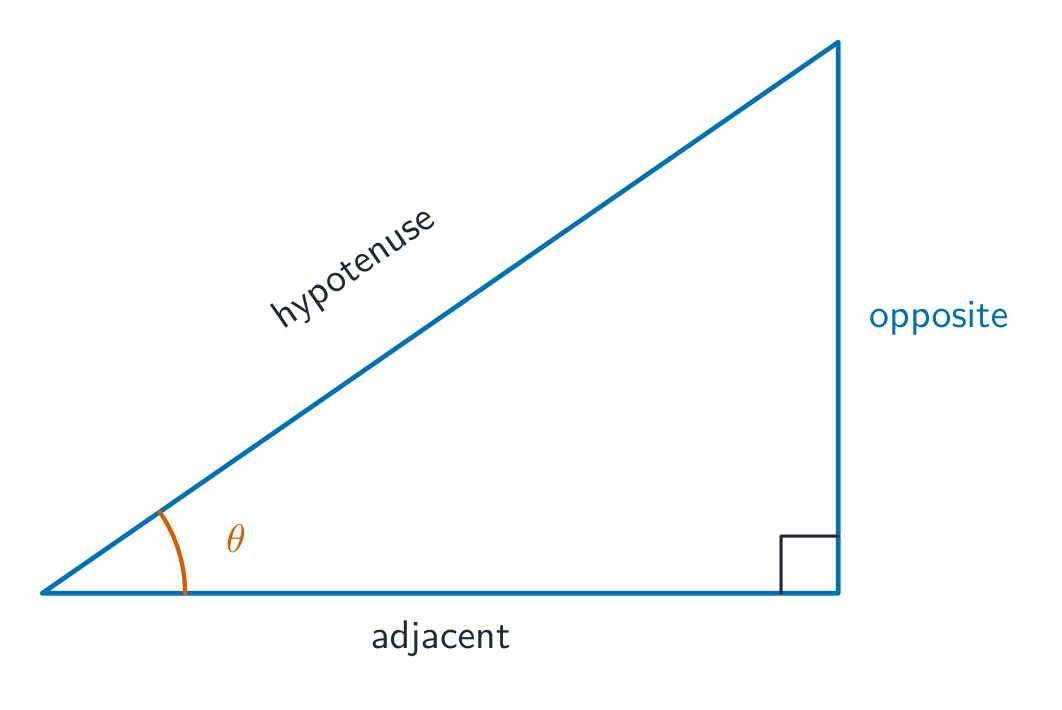
تسمية أضلاع المثلث القائم من الزاوية
Explore · ⁨استكشف⁩

Read sine and cosine off the unit circle · ⁨اقرأ الجيب وجيب التمام من الدائرة الوحدة⁩

On the unit circle a point at angle $\theta$ has coordinates $(\cos\theta,\ \sin\theta)$. Spin the angle to watch sine and cosine trace out as the height and width. · ⁨على الدائرة الوحدة، النقطة عند الزاوية $\theta$ إحداثياتها $(\cos\theta,\ \sin\theta)$. حرك الزاوية لترى كيف يرسم الجيب وجيب التمام الارتفاع والعرض.⁩

3.3

Sine and Cosine Function Values · ⁨قيم دوال الجيب وجيب التمام⁩

Syllabus · ⁨المنهج⁩
English

Learning Objective 3.3.A: Determine coordinates of points on a circle centered at the origin.

  • 3.3.A.1 Given an angle of measure $\theta$ in standard position and a circle with radius $r$ centered at the origin, there is a point, $P$, where the terminal ray intersects the circle. The coordinates of point $P$ are $(r\cos\theta, r\sin\theta)$.
  • 3.3.A.2 The geometry of isosceles right and equilateral triangles, while attending to the signs of the values based on the quadrant of the angle, can be used to find exact values for the cosine and sine of angles that are multiples of $\dfrac{\pi}{4}$ and $\dfrac{\pi}{6}$ radians and whose terminal rays do not lie on an axis.
العربية

هدف التعلم 3.3.A: تحديد إحداثيات النقاط على دائرة مركزها نقطة الأصل.

  • 3.3.A.1 بمعلومية زاوية مقدارها $\theta$ في الموضع القياسي ودائرة نصف قطرها $r$ مركزها نقطة الأصل، توجد نقطة $P$ يتقاطع فيها الشعاع النهائي مع الدائرة. إحداثيات النقطة $P$ هي $(r\cos\theta, r\sin\theta)$.
  • 3.3.A.2 يمكن استخدام هندسة المثلثات المتساوية الساقين والمتساوية الأضلاع، مع مراعاة إشارات القيم بناءً على الربع الذي تقع فيه الزاوية، لإيجاد القيم الدقيقة لجيب التمام والجيب للزوايا التي تساوي مضاعفات $\dfrac{\pi}{4}$ و$\dfrac{\pi}{6}$ راديان والتي لا تقع أشعتها النهائية على محور.

Source: College Board AP Course and Exam Description · ⁨المصدر: وصف دورة وامتحان College Board AP⁩

English

On a circle of radius $r$, $x=r\cos\theta$ and $y=r\sin\theta$. Exact values at the special angles ($0,\tfrac{\pi}{6},\tfrac{\pi}{4},\tfrac{\pi}{3},\tfrac{\pi}{2},\dots$) come from isosceles right and equilateral triangle 等边三角形 geometry, with signs set by the quadrant 象限 of the angle.

العربية

على دائرة نصف قطرها $r$، $x=r\cos\theta$ و$y=r\sin\theta$. القيم الدقيقة عند الزوايا الخاصة ($0,\tfrac{\pi}{6},\tfrac{\pi}{4},\tfrac{\pi}{3},\tfrac{\pi}{2},\dots$) مستمدة من هندسة المثلث القائم المتساوي الساقين والمثلث المتساوي الأضلاع، مع تحديد الإشارات بناءً على الربع الذي يقع فيه الزاوية.

3.4

Sine and Cosine Function Graphs · ⁨رسوم بيانية لدوال الجيب وجيب التمام⁩

Syllabus · ⁨المنهج⁩
English

Learning Objective 3.4.A: Construct representations of the sine and cosine functions using the unit circle.

  • 3.4.A.1 Given an angle of measure $\theta$ in standard position and a unit circle centered at the origin, there is a point, $P$, where the terminal ray intersects the circle. The sine function, $f(\theta) = \sin\theta$, gives the $y$-coordinate, or vertical displacement from the $x$-axis, of point $P$. The domain of the sine function is all real numbers.
  • 3.4.A.2 As the input values, or angle measures, of the sine function increase, the output values oscillate between $-1$ and $1$, taking every value in between and tracking the vertical distance of points on the unit circle from the $x$-axis.
  • 3.4.A.3 Given an angle of measure $\theta$ in standard position and a unit circle centered at the origin, there is a point, $P$, where the terminal ray intersects the circle. The cosine function, $f(\theta) = \cos\theta$, gives the $x$-coordinate, or horizontal displacement from the $y$-axis, of point $P$. The domain of the cosine function is all real numbers.
  • 3.4.A.4 As the input values, or angle measures, of the cosine function increase, the output values oscillate between $-1$ and $1$, taking every value in between and tracking the horizontal distance of points on the unit circle from the $y$-axis.
العربية

هدف التعلم 3.4.A: بناء تمثيلات لدوال الجيب وجيب التمام باستخدام الدائرة الوحدة.

  • 3.4.A.1 بمعلومية زاوية مقدارها $\theta$ في الموضع القياسي ودائرة وحدة مركزها نقطة الأصل، توجد نقطة $P$ يتقاطع فيها الشعاع النهائي مع الدائرة. تعطي دالة الجيب $f(\theta) = \sin\theta$ الإحداثي $y$، أو الانزياح العمودي عن المحور $x$، للنقطة $P$. مجال دالة الجيب هو جميع الأعداد الحقيقية.
  • 3.4.A.2 مع زيادة قيم الإدخال، أو قياسات الزاوية، في دالة الجيب، تتذبذب قيم الإخراج بين $-1$ و$1$، وتأخذ كل قيمة في بينهما وتتبع المسافة العمودية لنقاط على الدائرة الوحدة من المحور $x$.
  • 3.4.A.3 بافتراض زاوية مقدارها $\theta$ في الوضع القياسي ودائرة وحدة مركزها نقطة الأصل، توجد نقطة، $P$، حيث يتقاطع الشعاع النهائي مع الدائرة. تعطي دالة جيب التمام، $f(\theta) = \cos\theta$، الإحداثي $x$، أو الإزاحة الأفقية من محور $y$، للنقطة $P$. مجال دالة جيب التمام هو جميع الأعداد الحقيقية.
  • 3.4.A.4 مع زيادة قيم الإدخال، أو قياسات الزاوية، في دالة جيب التمام، تتذبذب قيم الإخراج بين $-1$ و$1$، وتأخذ كل قيمة في بينهما وتتبع المسافة الأفقية لنقاط على الدائرة الوحدة من المحور $y$.

Source: College Board AP Course and Exam Description · ⁨المصدر: وصف دورة وامتحان College Board AP⁩

English
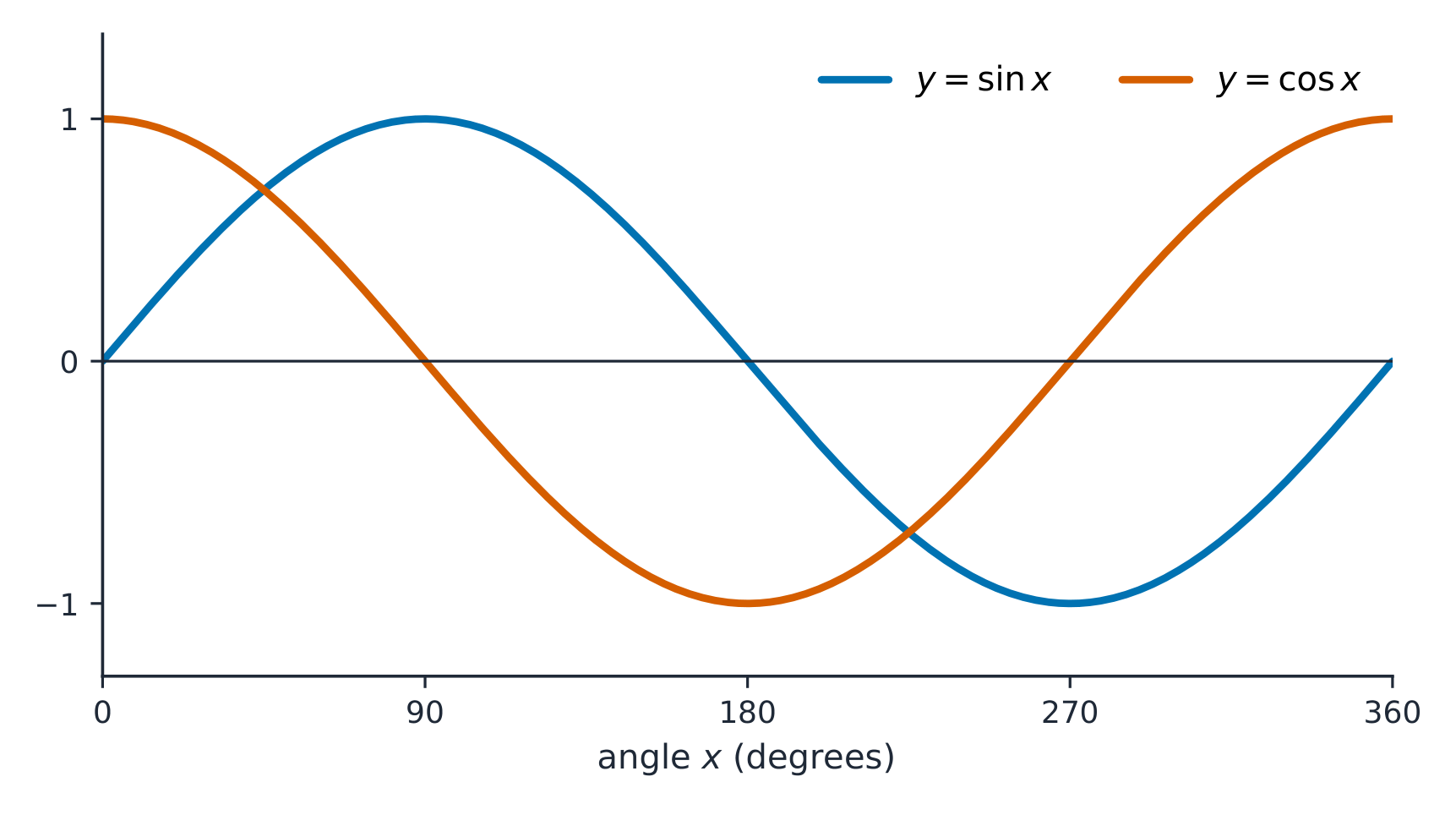
The unit circle draws the sine curve

On the unit circle 单位圆 ($r=1$), $\sin\theta$ is the $y$-coordinate and $\cos\theta$ is the $x$-coordinate. As $\theta$ increases, both oscillate 振荡 smoothly between $-1$ and $1$ with period $2\pi$. Sine starts at $0$ (rising); cosine starts at $1$. They are the same wave shifted by $\tfrac{\pi}{2}$.

العربية
الدائرة الوحدة ترسم منحنى الجيب

على الدائرة الوحدة ($r=1$)، $\sin\theta$ هو الإحداثي $y$ و $\cos\theta$ هو الإحداثي $x$. مع ازدياد $\theta$، كلاهما يتذبذب بسلاسة بين $-1$ و $1$ مع فترة $2\pi$. يبدأ الجيب عند $0$ (متصعداً)؛ يبدأ جيب التمام عند $1$. هما نفس الموجة مزاحة بمقدار $\tfrac{\pi}{2}$.

y = sin x و y = cos x هما موجتان ناعمتان بين -1 و 1
Explore · ⁨استكشف⁩

Graph a sine wave · ⁨رسم موجة جيبية⁩

Unrolling the circle gives the wave $y=\sin x$: it repeats every $2\pi$ (its period) and swings between $-1$ and $1$ (its amplitude). · ⁨إمالة الدائرة تولد الموجة $y=\sin x$: تتكرر كل $2\pi$ (دورها) وتهتز بين $-1$ و$1$ (سعتها).⁩

Vocabulary · ⁨مفردات⁩ Train · ⁨تدريب⁩
English العربية
periodic/ˌpɪərɪˈɒdɪk/ دوريان
period/ˈpɪərɪəd/ الدور
cycle/ˈsaɪkl/ دورة
standard position/ˈstændəd pəˈzɪʃn/ الموضع القياسي
radian/ˈreɪdɪən/ راديان
equilateral triangle/ˌiːkwɪˈlætərəl ˈtraɪæŋɡl/ المثلث متساوي الأضلاع
quadrant/ˈkwɒdrənt/ الربع
unit circle/ˈjuːnɪt ˈsɜːkl/ الدائرة الوحدة
oscillate/ˈɒsɪleɪt/ يتذبذب
sinusoidal function/ˌsaɪnəˈsɔɪdl ˈfʌŋkʃn/ دالة جيبية
frequency/ˈfriːkwənsi/ التردد
Amplitude/ˈæmplɪtjuːd/ السعة
Midline/ˈmɪdlaɪn/ الخط الأوسط
phase shift/feɪz ʃɪft/ إزاحة الطور
inverse trigonometric functions/ɪnˈvɜːs ˌtrɪɡənəʊˈmetrɪk ˈfʌŋkʃnz/ الدوال المثلثية العكسية
arcsine/ˈɑːksaɪn/ الجيب العكسي
reciprocals/rɪˈsɪprəklz/ مقلوبات
Pythagorean identity/ˈpaɪθəɡɔːrɪən aɪˈdentɪti/ متطابقة فيثاغورس
sum identities/sʌm aɪˈdentɪtiz/ متطابقات المجموع
double-angle/ˈdʌbl ˈæŋɡl/ زاوية مزدوجة
Polar coordinates/ˈpəʊlə kəʊˈɔːdɪnəts/ الإحداثيات القطبية
complex number/ˈkɒmpleks ˈnʌmbə/ عدد مركب
3.5

Sinusoidal Functions · ⁨الدوال الجيبية⁩

Syllabus · ⁨المنهج⁩
English

Learning Objective 3.5.A: Identify key characteristics of the sine and cosine functions.

  • 3.5.A.1 A sinusoidal function is any function that involves additive and multiplicative transformations of $f(\theta) = \sin\theta$. The sine and cosine functions are both sinusoidal functions, with $\cos\theta = \sin\left(\theta + \dfrac{\pi}{2}\right)$.
  • 3.5.A.2 The period and frequency of a sinusoidal function are reciprocals. The period of $f(\theta) = \sin\theta$ and $g(\theta) = \cos\theta$ is $2\pi$, and the frequency is $\dfrac{1}{2\pi}$.
  • 3.5.A.3 The amplitude of a sinusoidal function is half the difference between its maximum and minimum values. The amplitude of $f(\theta) = \sin\theta$ and $g(\theta) = \cos\theta$ is $1$.
  • 3.5.A.4 The midline of the graph of a sinusoidal function is determined by the average, or arithmetic mean, of the maximum and minimum values of the function. The midline of the graphs of $y = \sin\theta$ and $y = \cos\theta$ is $y = 0$.
  • 3.5.A.5 As input values increase, the graphs of sinusoidal functions oscillate between concave down and concave up.
  • 3.5.A.6 The graph of $y = \sin\theta$ has rotational symmetry about the origin and is therefore an odd function. The graph of $y = \cos\theta$ has reflective symmetry over the $y$-axis and is therefore an even function.
العربية

هدف التعلم 3.5.A: تحديد الخصائص الرئيسية لدلتي الجيب وجيب التمام.

  • 3.5.A.1 الدالة المثلثية هي أي دالة تتضمن تحويلات جمعية وضربية لـ $f(\theta) = \sin\theta$. كلتا دالتي الجيب وجيب التمام هما دوال مثلثية، بـ $\cos\theta = \sin\left(\theta + \dfrac{\pi}{2}\right)$.
  • 3.5.A.2 الدور والتردد للدالة المثلثية مت reciprocalان. دور $f(\theta) = \sin\theta$ و$g(\theta) = \cos\theta$ هو $2\pi$، والتردد هو $\dfrac{1}{2\pi}$.
  • 3.5.A.3 السعة للدالة المثلثية هي نصف الفرق بين قيمتها العظمى والصغرى. سعة $f(\theta) = \sin\theta$ و$g(\theta) = \cos\theta$ هي $1$.
  • 3.5.A.4 خط المنتصف لمخطط الدالة المثلثية يُحدد عن طريق المتوسط الحسابي للقيم العظمى والصغرى للدالة. خط المنتصف لمخططات $y = \sin\theta$ و$y = \cos\theta$ هو $y = 0$.
  • 3.5.A.5 مع زيادة قيم الإدخال، تتذبذب مخططات الدوال المثلثية بين التقعر لأسفل والتقعر لأعلى.
  • 3.5.A.6 بياني لـ $y = \sin\theta$ يمتلك تناظر دوراني حول نقطة الأصل وهو بالتالي دالة فردية. بياني لـ $y = \cos\theta$ يمتلك تناظر انعكاسي عبر محور $y$ وهو بالتالي دالة زوجية.

Source: College Board AP Course and Exam Description · ⁨المصدر: وصف دورة وامتحان College Board AP⁩

English

A sinusoidal function 正弦型函数 is any transformation of sine (or cosine). Its key features:

  • Period and frequency 频率 are reciprocals; $\sin\theta$ has period $2\pi$.
  • Amplitude 振幅 = half the distance between the maximum and minimum output.
  • Midline 中线 $y=d$ = the average of the maximum and minimum (the horizontal center line).

The graph alternates concave up and concave down each half-cycle.

Worked example. For $f(\theta)=3\sin(2\theta)+1$: the amplitude is $3$, the period is $\dfrac{2\pi}{2}=\pi$, and the midline is $y=1$. So the maximum output is $1+3=4$ and the minimum is $1-3=-2$.

العربية

الدالة الجيبية هي أي تحول للجيب (أو جيب التمام). خصائصها الرئيسية:

  • الدور والتواتر مقلوبان؛ $\sin\theta$ له دور $2\pi$.
  • السعة = نصف المسافة بين القيمة العظمى والصغرى للمخرجات.
  • خط المنتصف $y=d$ = المتوسط الحسابي للقيمة العظمى والصغرى (الخط الأفقي المركزي).

يتناوب الرسم البياني بين الانحناء لأعلى والانحناء لأسفل في كل نصف دورة.

مثال محلول. لـ $f(\theta)=3\sin(2\theta)+1$: السعة هي $3$، والدور هو $\dfrac{2\pi}{2}=\pi$، وخط المنتصف هو $y=1$. إذن القيمة العظمى للمخرجات هي $1+3=4$ والقيمة الصغرى هي $1-3=-2$.

3.6

Sinusoidal Function Transformations · ⁨تحويلات الدوال الجيبية⁩

Syllabus · ⁨المنهج⁩
English

Learning Objective 3.6.A: Identify the amplitude, vertical shift, period, and phase shift of a sinusoidal function.

  • 3.6.A.1 Functions that can be written in the form $f(\theta) = a\sin(b(\theta + c)) + d$ or $g(\theta) = a\cos(b(\theta + c)) + d$, where $a, b, c,$ and $d$ are real numbers and $a \neq 0$, are sinusoidal functions and are transformations of the sine and cosine functions. Additive and multiplicative transformations are the same for both sine and cosine because the cosine function is a phase shift of the sine function by $-\dfrac{\pi}{2}$ units.
  • 3.6.A.2 The graph of the additive transformation $g(\theta) = \sin\theta + d$ of the sine function $f(\theta) = \sin\theta$ is a vertical translation of the graph of $f$, including its midline, by $d$ units. The same transformation of the cosine function yields the same result.
  • 3.6.A.3 The graph of the additive transformation $g(\theta) = \sin(\theta + c)$ of the sine function $f(\theta) = \sin\theta$ is a horizontal translation, or phase shift, of the graph of $f$ by $-c$ units. The same transformation of the cosine function yields the same result.
  • 3.6.A.4 The graph of the multiplicative transformation $g(\theta) = a\sin\theta$ of the sine function $f(\theta) = \sin\theta$ is a vertical dilation of the graph of $f$ and differs in amplitude by a factor of $|a|$. The same transformation of the cosine function yields the same result.
  • 3.6.A.5 The graph of the multiplicative transformation $g(\theta) = \sin(b\theta)$ of the sine function $f(\theta) = \sin\theta$ is a horizontal dilation of the graph of $f$ and differs in period by a factor of $\left|\dfrac{1}{b}\right|$. The same transformation of the cosine function yields the same result.
  • 3.6.A.6 The graph of $y = f(\theta) = a\sin(b(\theta + c)) + d$ has an amplitude of $|a|$ units, a period of $\left|\dfrac{1}{b}\right|2\pi$ units, a midline vertical shift of $d$ units from $y = 0$, and a phase shift of $-c$ units. The same transformations of the cosine function yield the same results.
العربية

هدف التعلم 3.6.A: تحديد السعة والإزاحة الرأسية والدور والإزاحة الطورية للدالة المثلثية.

  • 3.6.A.1 الدوال التي يمكن كتابتها على الصيغة $f(\theta) = a\sin(b(\theta + c)) + d$ أو $g(\theta) = a\cos(b(\theta + c)) + d$، حيث $a, b, c,$ و$d$ أعداد حقيقية و$a \neq 0$، هي دوال مثلثية وت representing تحويلات لدلتي الجيب وجيب التمام. التحويلات الجمعية والضربية متطابقة لكلا الدالتين لأن دالة جيب التمام هي إزاحة طورية لدالة الجيب بمقدار $-\dfrac{\pi}{2}$ وحدات.
  • 3.6.A.2 مخطط التحويل الجمعي $g(\theta) = \sin\theta + d$ لدالة الجيب $f(\theta) = \sin\theta$ هو إزاحة رأسية لمخطط $f$، بما في ذلك خط منتصفه، بمقدار $d$ وحدات. نفس التحويل applied لدالة جيب التمام يعطي نفس النتيجة.
  • 3.6.A.3 مخطط التحويل الجمعي $g(\theta) = \sin(\theta + c)$ لدالة الجيب $f(\theta) = \sin\theta$ هو إزاحة أفقية، أو إزاحة طورية، لمخطط $f$ بمقدار $-c$ وحدات. نفس التحويل applied لدالة جيب التمام يعطي نفس النتيجة.
  • 3.6.A.4 مخطط التحويل الضربي $g(\theta) = a\sin\theta$ لدالة الجيب $f(\theta) = \sin\theta$ هو تمدد رأسي لمخطط $f$ ويختلف في السعة بعامل قدره $|a|$. نفس التحويل applied لدالة جيب التمام يعطي نفس النتيجة.
  • 3.6.A.5 مخطط التحويل الضربي $g(\theta) = \sin(b\theta)$ لدالة الجيب $f(\theta) = \sin\theta$ هو تمدد أفقي لمخطط $f$ ويختلف في الدور بعامل قدره $\left|\dfrac{1}{b}\right|$. نفس التحويل applied لدالة جيب التمام يعطي نفس النتيجة.
  • 3.6.A.6 لمخطط $y = f(\theta) = a\sin(b(\theta + c)) + d$ سعة مقدارها $|a|$ وحدة، ودور مقدارها $\left|\dfrac{1}{b}\right|2\pi$ وحدة، وإزاحة رأسية لخط المنتصف مقدارها $d$ وحدات من $y = 0$، وإزاحة طورية مقدارها $-c$ وحدات. نفس تحويلات دالة جيب التمام تعطي نفس النتائج.

Source: College Board AP Course and Exam Description · ⁨المصدر: وصف دورة وامتحان College Board AP⁩

English
Amplitude, period & phase of a sinusoid

The general sinusoid is

$$f(\theta)=a\sin\big(b(\theta+c)\big)+d \quad\text{or}\quad a\cos\big(b(\theta+c)\big)+d,$$
where $|a|$ is the amplitude, $\dfrac{2\pi}{|b|}$ is the period, $-c$ is the horizontal phase shift 相移 (a $+c$ inside the bracket shifts the graph left by $c$), and $d$ is the vertical shift (midline). A negative $a$ reflects the wave.

العربية
السعة، الدور، والطور لدالة جيبية

الدالة الجيبية العامة هي

$$f(\theta)=a\sin\big(b(\theta+c)\big)+d \quad\text{or}\quad a\cos\big(b(\theta+c)\big)+d,$$
حيث $|a|$ هي السعة، $\dfrac{2\pi}{|b|}$ هو الدور، $-c$ هو إزاحة الطور الأفقية (حيث أن إضافة $+c$ داخل القوس تحرك الرسم البياني يساراً بمقدار $c$)، و$d$ هو الإزاحة الرأسية (خط المنتصف). إزاحة $a$ سالبة تعكس الموجة.

Explore · ⁨استكشف⁩

Stretch and shift a sinusoid · ⁨تمدد وإزاحة موجة جيبية⁩

In $y=a\sin(bx+c)+d$: $a$ sets the amplitude, $b$ the period, $c$ a horizontal phase shift, and $d$ a vertical shift. Change each and watch the wave respond. · ⁨في $y=a\sin(bx+c)+d$: $a$ يحدد السعة، $b$ الدورة، $c$ إزاحة طور أفقية، و$d$ إزاحة عمودية. غيّر كل واحد لترى استجابة الموجة.⁩

3.7

Sinusoidal Function Context and Data Modeling · ⁨سياق الدوال الجيبية ونمذجة البيانات⁩

Syllabus · ⁨المنهج⁩
English

Learning Objective 3.7.A: Construct sinusoidal function models of periodic phenomena.

  • 3.7.A.1 The smallest interval of input values over which the maximum or minimum output values start to repeat, that is, the input-value interval between consecutive maxima or consecutive minima, can be used to determine or estimate the period and frequency for a sinusoidal function model.
  • 3.7.A.2 The maximum and minimum output values can be used to determine or estimate the amplitude and vertical shift for a sinusoidal function model.
  • 3.7.A.3 An actual pair of input-output values can be compared to pairs of input-output values produced by a sinusoidal function model to determine or estimate a phase shift for the model.
  • 3.7.A.4 Sinusoidal function models can be constructed for a data set with technology by estimating key values or using sinusoidal regressions.
  • 3.7.A.5 Sinusoidal functions that model a data set are frequently only useful over their contextual domain and can be used to predict values of the dependent variable from values of the independent variable.
العربية

هدف التعلم 3.7.A: بناء نماذج لدوال مثلثية للظواهر الدورية.

  • 3.7.A.1 أصغر فترة من قيم الإدخال التي تبدأ فيها قيم الإخراج العظمى أو الصغرى بالتكرار، أي فترة قيم الإدخال بين ذروات متتالية أو قيعان متتالية، يمكن استخدامها لتحديد أو تقدير الدور والتردد لنموذج دالة مثلثية.
  • 3.7.A.2 يمكن استخدام قيم الإخراج العظمى والصغرى لتحديد أو تقدير السعة والإزاحة الرأسية لنموذج دالة مثلثية.
  • 3.7.A.3 يمكن مقارنة زوج فعلي من قيم الإدخال والإخراج بأزواج من قيم الإدخال والإخراج الناتجة عن نموذج دالة مثلثية لتحديد أو تقدير الإزاحة الطورية للنموذج.
  • 3.7.A.4 يمكن بناء نماذج لدوال مثلثية لمجموعة بيانات باستخدام التكنولوجيا عن طريق تقدير القيم الأساسية أو باستخدام الانحدار المثلثي.
  • 3.7.A.5 الدوال المثلثية التي نمذج مجموعة بيانات تكون مفيدة عادةً فقط خلال مجالها السياقي ويمكن استخدامها للتنبؤ بقيم المتغير التابع من قيم المتغير المستقل.

Source: College Board AP Course and Exam Description · ⁨المصدر: وصف دورة وامتحان College Board AP⁩

English

To model periodic data (tides, daylight, temperature): read the period from where the pattern repeats, get the amplitude and midline from the max and min, and set the phase shift so a peak lands at the right input. Technology fits a sinusoidal regression. Such a model is only trustworthy over its contextual domain.

العربية

لنمذجة البيانات الدورية (المد والجزر، ضوء النهار، درجة الحرارة): اقرأ الدور من حيث يتكرر النمط، واحصل على السعة وخط المنتصف من القيم القصوى والمثلى، وضع إزاحة الطور بحيث يقع الذروة عند المدخل الصحيح. تستخدم التكنولوجيا انحداراً جيبياً. هذا النموذج موثوق فقط ضمن نطاقه السياقي.

3.8

The Tangent Function · ⁨دالة الظل (Tangent)⁩

Syllabus · ⁨المنهج⁩
English

Learning Objective 3.8.A: Construct representations of the tangent function using the unit circle.

  • 3.8.A.1 Given an angle of measure $\theta$ in standard position and a unit circle centered at the origin, there is a point, $P$, where the terminal ray intersects the circle. The tangent function, $f(\theta) = \tan\theta$, gives the slope of the terminal ray.
  • 3.8.A.2 Because the slope of the terminal ray is the ratio of the change in the $y$-values to the change in the $x$-values between any two points on the ray, the tangent function is also the ratio of the sine function to the cosine function. Therefore, $\tan\theta = \dfrac{\sin\theta}{\cos\theta}$, where $\cos\theta \neq 0$.

Learning Objective 3.8.B: Describe key characteristics of the tangent function.

  • 3.8.B.1 Because the slope values of the terminal ray repeat every one-half revolution of the circle, the tangent function has a period of $\pi$.
  • 3.8.B.2 The tangent function demonstrates periodic asymptotic behavior at input values $\theta = \dfrac{\pi}{2} + k\pi$, for integer values of $k$, because $\cos\theta = 0$ at those values.
  • 3.8.B.3 The tangent function increases and its graph changes from concave down to concave up between consecutive asymptotes.
العربية

هدف التعلم 3.8.A: بناء تمثيلات لدالة الظل باستخدام الدائرة الوحدة.

  • 3.8.A.1 بمعلومية زاوية قياسها $\theta$ في الوضع القياسي ودائرة وحدة مركزها نقطة الأصل، يوجد نقطة، $P$، حيث يتقاطع الشعاع الطرفي مع الدائرة. تعطي دالة الظل، $f(\theta) = \tan\theta$، ميل الشعاع الطرفي.
  • 3.8.A.2 بما أن ميل الشعاع النهائي هو نسبة التغير في $y$-القيم إلى التغير في $x$-القيم بين أي نقطتين على الشعاع، فإن دالة الظل هي أيضًا نسبة دالة الجيب إلى دالة جيب التمام. لذلك، $\tan\theta = \dfrac{\sin\theta}{\cos\theta}$، حيث $\cos\theta \neq 0$.

هدف التعلم 3.8.B: وصف الخصائص الرئيسية لدالة الظل.

  • 3.8.B.1 بما أن قيم الميل للشعاع النهائي تتكرر كل نصف دورة من الدائرة، فإن لدالة الظل فترة تساوي $\pi$.
  • 3.8.B.2 تُظهر دالة الظل سلوكاً تقاربيًا دورياً عند قيم الإدخال $\theta = \dfrac{\pi}{2} + k\pi$، لقيم صحيحة من $k$، لأن $\cos\theta = 0$ عند تلك القيم.
  • 3.8.B.3 تزداد دالة الظل ويتغير بيانها من مقعر لأسفل إلى مقعر لأعلى بين التقاربيات المتتالية.

Source: College Board AP Course and Exam Description · ⁨المصدر: وصف دورة وامتحان College Board AP⁩

English

$\tan\theta=\dfrac{\sin\theta}{\cos\theta}$ is the slope of the terminal ray. Its slope values repeat every half-revolution, so its period is $\pi$. It has vertical asymptotes where $\cos\theta=0$ (at $\theta=\tfrac{\pi}{2}+k\pi$), and it is always increasing between consecutive asymptotes, switching concavity at each zero.

العربية

$\tan\theta=\dfrac{\sin\theta}{\cos\theta}$ هو الميل للشعاع النهائي. قيم ميله تتكرر كل نصف دورة، لذا دوره هو $\pi$. لها أقطاب رأسية حيث $\cos\theta=0$ (عند $\theta=\tfrac{\pi}{2}+k\pi$)، وهي دائماً متزايدة بين الأقطاب المتتالية، وتغير انحنائها عند كل صفر.

3.9

Inverse Trigonometric Functions · ⁨الدوال المثلثية العكسية⁩

Syllabus · ⁨المنهج⁩
English

Learning Objective 3.9.A: Construct analytical and graphical representations of the inverse of the sine, cosine, and tangent functions over a restricted domain.

  • 3.9.A.1 For inverse trigonometric functions, the input and output values are switched from their corresponding trigonometric functions, so the output value of an inverse trigonometric function is often interpreted as an angle measure and the input is a value in the range of the corresponding trigonometric function.
  • 3.9.A.2 The inverse trigonometric functions are called arcsine, arccosine, and arctangent (also represented as $\sin^{-1}x, \cos^{-1}x,$ and $\tan^{-1}x$). Because the corresponding trigonometric functions are periodic, they are only invertible if they have restricted domains.
  • 3.9.A.3 In order to define their respective inverse functions, the domain of the sine function is restricted to $\left[-\dfrac{\pi}{2}, \dfrac{\pi}{2}\right]$, the cosine function to $[0, \pi]$, and the tangent function to $\left(-\dfrac{\pi}{2}, \dfrac{\pi}{2}\right)$.
العربية

هدف التعلم 3.9.A: إنشاء تمثيل تحليلي وبياني لمقلوب دوال الجيب وجيب التمام والظل على مجال محدود.

  • 3.9.A.1 بالنسبة للدوال المثلثية العكسية، يتم تبديل قيم الإدخال والمخرجات عن نظيراتها في الدوال المثلثية المقابلة، لذا تُفسر قيمة المخرج لدالة مثلثية عكسية غالبًا كمقياس زاوية، بينما تكون القيمة المدخلة قيمة في نطاق الدالة المثلثية المقابلة.
  • 3.9.A.2 تُسمى الدوال المثلثية العكسية جيب التمام العكسي (arcsine) وجيب التمام العكسي (arccosine) وظل العكسي (arctangent) (يُمثلان أيضًا بـ $\sin^{-1}x, \cos^{-1}x,$ و$\tan^{-1}x$). ونظرًا لأن الدوال المثلثية المقابلة دورية، فهي قابلة للعكس فقط إذا كان لها مجالات محدودة.
  • 3.9.A.3 لتعريف الدوال العكسية المقابلة لها، يتم تقييد مجال دالة الجيب بـ $\left[-\dfrac{\pi}{2}, \dfrac{\pi}{2}\right]$، ودالة جيب التمام بـ $[0, \pi]$، ودالة الظل بـ $\left(-\dfrac{\pi}{2}, \dfrac{\pi}{2}\right)$.

Source: College Board AP Course and Exam Description · ⁨المصدر: وصف دورة وامتحان College Board AP⁩

English

The inverse trigonometric functions 反三角函数 – arcsine 反正弦, arccosine, arctangent – reverse the trig functions, so they take a ratio and return an angle. Because sine, cosine, and tangent repeat, their domains must be restricted (e.g. sine to $[-\tfrac{\pi}{2},\tfrac{\pi}{2}]$) before an inverse can exist.

العربية

الدوال المثلثية العكسية – الجيب التمام العكسي، جيب التمام العكسي، ظل التمام العكسي – تعكس الدوال المثلثية، لذا تأخذ نسبة وترجع زاوية. لأن الجيب وجيب التمام والظل يتكررون، يجب تقييد مجالاتها (تقييد النطاق) (مثل تقييد الجيب بـ $[-\tfrac{\pi}{2},\tfrac{\pi}{2}]$) قبل وجود الدالة العكسية.

3.10

Trigonometric Equations and Inequalities · ⁨المعادلات والمتباينات المثلثية⁩

Syllabus · ⁨المنهج⁩
English

Learning Objective 3.10.A: Solve equations and inequalities involving trigonometric functions.

  • 3.10.A.1 Inverse trigonometric functions are useful in solving equations and inequalities involving trigonometric functions, but solutions may need to be modified due to domain restrictions.
  • 3.10.A.2 Because trigonometric functions are periodic, there are often infinitely many solutions to trigonometric equations.
  • 3.10.A.3 In trigonometric equations and inequalities arising from a contextual scenario, there is often a domain restriction that can be implied from the context, which limits the number of solutions.
العربية

هدف التعلم 3.10.A: حل المعادلات والمتباينات التي تتضمن الدوال المثلثية.

  • 3.10.A.1 الدوال المثلثية العكسية مفيدة في حل المعادلات والمتباينات التي تتضمن الدوال المثلثية، ولكن قد تحتاج الحلول إلى تعديل بسبب قيود المجال.
  • 3.10.A.2 بما أن الدوال المثلثية دورية، فإن هناك غالباً عددًا لا نهائيًا من حلول المعادلات المثلثية.
  • 3.10.A.3 في المعادلات والمتباينات المثلثية الناشئة عن سيناريو سياقي، غالبًا ما يكون هناك قيد مجال يمكن استنتاجه من السياق، مما يحد من عدد الحلول.

Source: College Board AP Course and Exam Description · ⁨المصدر: وصف دورة وامتحان College Board AP⁩

English

Use inverse trig functions to solve trig equations. Because the functions are periodic, there are usually infinitely many solutions – write the general solution by adding multiples of the period, then keep those in the required (often contextual) domain.

Worked example. Solve $2\sin\theta=1$ on $[0,2\pi)$. Then $\sin\theta=\tfrac12$, and on the unit circle sine is positive in the first and second quadrants, so $\theta=\dfrac{\pi}{6}$ or $\dfrac{5\pi}{6}$. Over all reals you would add $2\pi k$ to each.

العربية

استخدم الدوال المثلثية العكسية لحل المعادلات المثلثية. نظراً لأن الدوال دورية، عادة ما تكون هناك عدد لا نهائي من الحلول – اكتب الحل العام بإضافة مضاعفات الدور، ثم احتفظ بالحلول الموجودة في النطاق المطلوب (الذي غالباً ما يكون سياقياً).

مثال محلول. حل $2\sin\theta=1$ على $[0,2\pi)$. إذن $\sin\theta=\tfrac12$، وعلى الدائرة الوحدة يكون الجيب موجباً في الربعين الأول والثاني، لذا $\theta=\dfrac{\pi}{6}$ أو $\dfrac{5\pi}{6}$. عبر جميع الأعداد الحقيقية، ستضيف $2\pi k$ إلى كل منها.

3.11

The Secant, Cosecant, and Cotangent Functions · ⁨دوال الجيب التمام، وقاطع التمام، وظل التمام⁩

Syllabus · ⁨المنهج⁩
English

Learning Objective 3.11.A: Identify key characteristics of functions that involve quotients of the sine and cosine functions.

  • 3.11.A.1 The secant function, $f(\theta) = \sec\theta$, is the reciprocal of the cosine function, where $\cos\theta \neq 0$.
  • 3.11.A.2 The cosecant function, $f(\theta) = \csc\theta$, is the reciprocal of the sine function, where $\sin\theta \neq 0$.
  • 3.11.A.3 The graphs of the secant and cosecant functions have vertical asymptotes where cosine and sine are zero, respectively, and have a range of $(-\infty, -1] \cup [1, \infty)$.
  • 3.11.A.4 The cotangent function, $f(\theta) = \cot\theta$, is the reciprocal of the tangent function, where $\tan\theta \neq 0$. Equivalently, $\cot\theta = \dfrac{\cos\theta}{\sin\theta}$, where $\sin\theta \neq 0$.
  • 3.11.A.5 The graph of the cotangent function has vertical asymptotes for domain values where $\tan\theta = 0$ and is decreasing between consecutive asymptotes.
العربية

هدف التعلم 3.11.A: تحديد الخصائص الرئيسية للدوال التي تتضمن نواتج دوال الجيب وجيب التمام.

  • 3.11.A.1 دالة القطع، $f(\theta) = \sec\theta$، هي مقلوب دالة جيب التمام، حيث $\cos\theta \neq 0$.
  • 3.11.A.2 دالة تمام القطع، $f(\theta) = \csc\theta$، هي مقلوب دالة الجيب، حيث $\sin\theta \neq 0$.
  • 3.11.A.3 تحتوي رسوم بيانية لدالتي القطع وتمام القطع على مقاربات رأسية حيث يساوي جيب التمام والجيب صفراً على التوالي، ولها مدى $(-\infty, -1] \cup [1, \infty)$.
  • 3.11.A.4 دالة الظل التمامي، $f(\theta) = \cot\theta$، هي مقلوب دالة الظل، حيث $\tan\theta \neq 0$. وبالمثل، $\cot\theta = \dfrac{\cos\theta}{\sin\theta}$، حيث $\sin\theta \neq 0$.
  • 3.11.A.5 يحتوي الرسم البياني لدالة قاطع التمام على مقاربات رأسية عند قيم المجال حيث $\tan\theta = 0$ وهو دالة تناقصية بين المقاربات المتتالية.

Source: College Board AP Course and Exam Description · ⁨المصدر: وصف دورة وامتحان College Board AP⁩

English

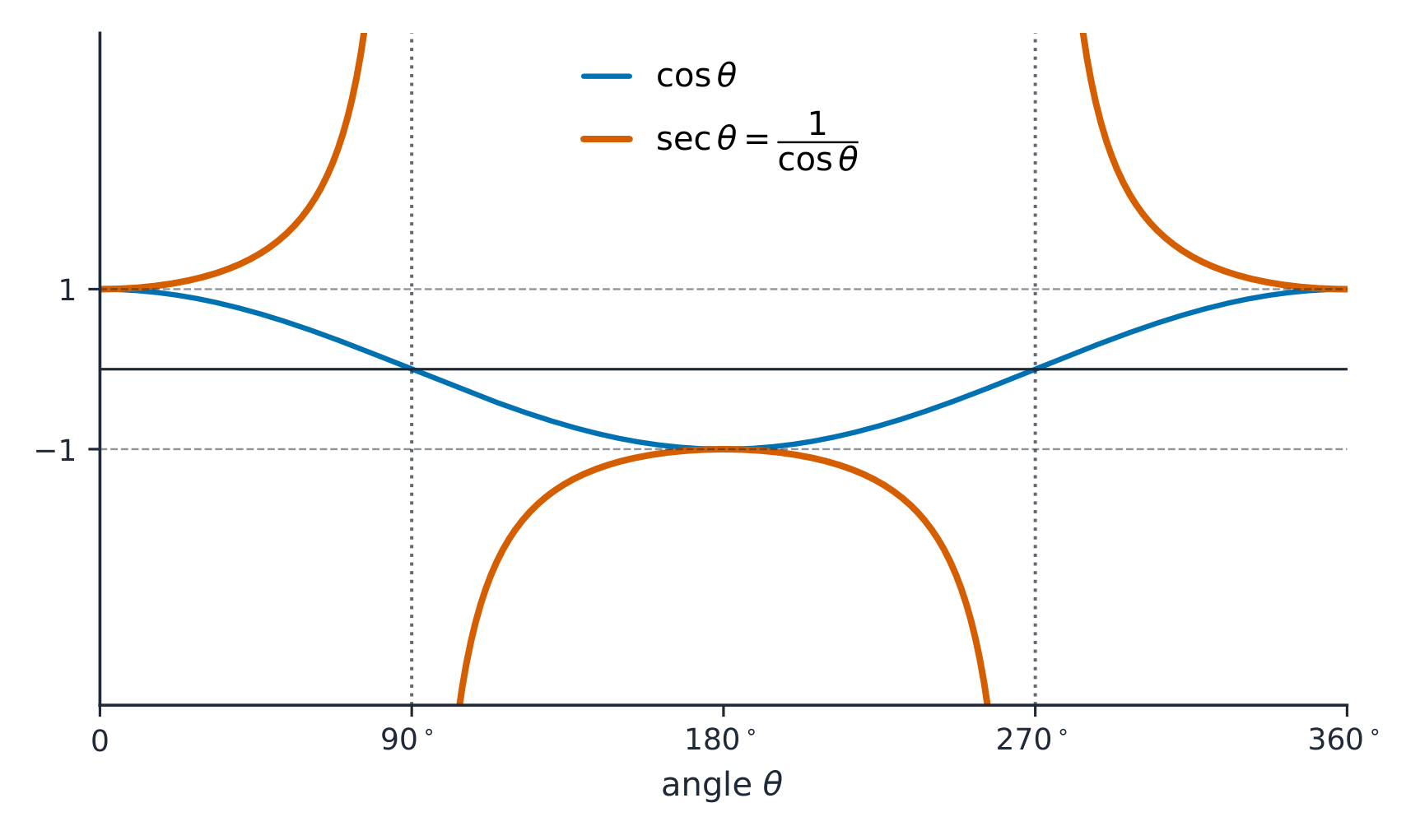
These are the reciprocals 倒数 of the main three:

$$\sec\theta=\frac{1}{\cos\theta},\qquad \csc\theta=\frac{1}{\sin\theta},\qquad \cot\theta=\frac{1}{\tan\theta}.$$
Secant and cosecant have vertical asymptotes where cosine and sine are zero; cotangent has them where tangent is zero (where sine is zero).

العربية

هي مقلوبات الثلاث دوال الرئيسية:

$$\sec\theta=\frac{1}{\cos\theta},\qquad \csc\theta=\frac{1}{\sin\theta},\qquad \cot\theta=\frac{1}{\tan\theta}.$$
للقاطع وقاطع التمام أقطاب رأسية حيث يكون جيب التمام والجيب صفراً؛ ولظل التمام أقطاب رأسية حيث يكون الظل صفراً (حيث يكون الجيب صفراً).

sec هو مقلوب cos، مع أقطاب رأسية حيث يكون cos صفراً
3.12

Equivalent Representations of Trigonometric Functions · ⁨التمثيلات المتكافئة للدوال المثلثية⁩

Syllabus · ⁨المنهج⁩
English

Learning Objective 3.12.A: Rewrite trigonometric expressions in equivalent forms with the Pythagorean identity.

  • 3.12.A.1 The Pythagorean Theorem can be applied to right triangles with points on the unit circle at coordinates $(\cos\theta, \sin\theta)$, resulting in the Pythagorean identity: $\sin^2\theta + \cos^2\theta = 1$.
  • 3.12.A.2 The Pythagorean identity can be algebraically manipulated into other forms involving trigonometric functions, such as $\tan^2\theta = \sec^2\theta - 1$, and can be used to establish other trigonometric relationships, such as $\arcsin x = \arccos\left(\sqrt{1 - x^2}\right)$, with appropriate domain restrictions.

Learning Objective 3.12.B: Rewrite trigonometric expressions in equivalent forms with sine and cosine sum identities.

  • 3.12.B.1 The sum identity for sine is $\sin(\alpha + \beta) = \sin\alpha\cos\beta + \cos\alpha\sin\beta$.
  • 3.12.B.2 The sum identity for cosine is $\cos(\alpha + \beta) = \cos\alpha\cos\beta - \sin\alpha\sin\beta$.
  • 3.12.B.3 The sum identities for sine and cosine can also be used as difference and double-angle identities.
  • 3.12.B.4 Properties of trigonometric functions, known trigonometric identities, and other algebraic properties can be used to verify additional trigonometric identities.

Learning Objective 3.12.C: Solve equations using equivalent analytic representations of trigonometric functions.

  • 3.12.C.1 A specific equivalent form involving trigonometric expressions can make information more accessible.
  • 3.12.C.2 Equivalent trigonometric forms may be useful in solving trigonometric equations and inequalities.
العربية

هدف التعلم 3.12.A: إعادة كتابة التعبيرات المثلثية بصيغ مكافئة باستخدام المتطابقة الباغورثية.

  • 3.12.A.1 يمكن تطبيق نظرية باغورثس على المثلثات القائمة ذات النقاط على دائرة الوحدة إحداثياتها $(\cos\theta, \sin\theta)$، مما يؤدي إلى المتطابقة الباغورثية: $\sin^2\theta + \cos^2\theta = 1$.
  • 3.12.A.2 يمكن معالجة المتطابقة الباغورثية جبرياً للحصول على صيغ أخرى تتضمن الدوال المثلثية، مثل $\tan^2\theta = \sec^2\theta - 1$، ويمكن استخدامها لإثبات علاقات مثلثية أخرى، مثل $\arcsin x = \arccos\left(\sqrt{1 - x^2}\right)$، مع قيود مجال مناسبة.

هدف التعلم 3.12.B: إعادة كتابة التعبيرات المثلثية بصيغ مكافئة باستخدام متطابقات مجموع الجيب وجيب التمام.

  • 3.12.B.1 متطابقة المجموع للجيب هي $\sin(\alpha + \beta) = \sin\alpha\cos\beta + \cos\alpha\sin\beta$.
  • 3.12.B.2 متطابقة المجموع لجيب التمام هي $\cos(\alpha + \beta) = \cos\alpha\cos\beta - \sin\alpha\sin\beta$.
  • 3.12.B.3 يمكن استخدام متطابقات المجموع للجيب وجيب التمام أيضاً كمتطابقات الفرق وزاوية مضاعفة.
  • 3.12.B.4 يمكن استخدام خصائص الدوال المثلثية والمتطابقات المثلثية المعروفة والخصائص الجبرية الأخرى للتحقق من متطابقات مثلثية إضافية.

هدف التعلم 3.12.C: حل المعادلات باستخدام التمثيلات التحليلية المكافئة للدوال المثلثية.

  • 3.12.C.1 يمكن أن تجعل الصيغة المكافئة المحددة التي تتضمن تعبيرات مثلثية المعلومات أكثر سهولة في الوصول إليها.
  • 3.12.C.2 قد تكون الأشكال المثلثية المكافئة مفيدة في حل المعادلات والمتباينات المثلثية.

Source: College Board AP Course and Exam Description · ⁨المصدر: وصف دورة وامتحان College Board AP⁩

English

The Pythagorean identity 毕达哥拉斯恒等式 comes from $x^2+y^2=1$ on the unit circle:

$$\sin^2\theta+\cos^2\theta=1,$$
which rearranges into forms with $\sec$ and $\tan$. The sum identities 和角公式:
$$\sin(\alpha+\beta)=\sin\alpha\cos\beta+\cos\alpha\sin\beta,\qquad \cos(\alpha+\beta)=\cos\alpha\cos\beta-\sin\alpha\sin\beta,$$
also give the difference and double-angle 二倍角 identities (set $\beta=\alpha$).

العربية

يأتي الهوية البيرغوطورية من $x^2+y^2=1$ على الدائرة الوحدة:

$$\sin^2\theta+\cos^2\theta=1,$$
والتي تُعاد ترتيبها لصيغ تحتوي على $\sec$ و$\tan$. متطابقات المجموع:
$$\sin(\alpha+\beta)=\sin\alpha\cos\beta+\cos\alpha\sin\beta,\qquad \cos(\alpha+\beta)=\cos\alpha\cos\beta-\sin\alpha\sin\beta,$$
تُعطى أيضاً متطابقات الفرق وزاوية مزدوجة (ضع $\beta=\alpha$).

3.13

Trigonometry and Polar Coordinates · ⁨حساب المثلثات والإحداثيات القطبية⁩

Syllabus · ⁨المنهج⁩
English

Learning Objective 3.13.A: Determine the location of a point in the plane using both rectangular and polar coordinates.

  • 3.13.A.1 The polar coordinate system is based on a grid of circles centered at the origin and on lines through the origin. Polar coordinates are defined as an ordered pair, $(r, \theta)$, such that $|r|$ represents the radius of the circle on which the point lies, and $\theta$ represents the measure of an angle in standard position whose terminal ray includes the point. In the polar coordinate system, the same point can be represented many ways.
  • 3.13.A.2 The coordinates of a point in the polar coordinate system, $(r, \theta)$, can be converted to coordinates in the rectangular coordinate system, $(x, y)$, using $x = r\cos\theta$ and $y = r\sin\theta$.
  • 3.13.A.3 The coordinates of a point in the rectangular coordinate system, $(x, y)$, can be converted to coordinates in the polar coordinate system, $(r, \theta)$, using $r = \sqrt{x^2 + y^2}$ and $\theta = \arctan\left(\dfrac{y}{x}\right)$ for $x > 0$ or $\theta = \arctan\left(\dfrac{y}{x}\right) + \pi$ for $x < 0$.
  • 3.13.A.4 A complex number can be understood as a point in the complex plane and can be determined by its corresponding rectangular or polar coordinates. When the complex number has the rectangular coordinates $(a, b)$, it can be expressed as $a + bi$. When the complex number has polar coordinates $(r, \theta)$, it can be expressed as $(r\cos\theta) + i(r\sin\theta)$.
العربية

هدف التعلم 3.13.A: تحديد موقع نقطة في المستوى باستخدام الإحداثيات المستطيلة والقطبية معاً.

  • 3.13.A.1 يعتمد نظام الإحداثيات القطبية على شبكة من الدوائر مركزها نقطة الأصل وعلى خطوط تمر بنقطة الأصل. تُعرف الإحداثيات القطبية بأنها زوج مرتب، $(r, \theta)$، بحيث يمثل $|r|$ نصف قطر الدائرة التي تقع عليها النقطة، ويمثل $\theta$ قياس زاوية في الوضع القياسي شعاعها النهائي يتضمن النقطة. في نظام الإحداثيات القطبية، يمكن تمثيل نفس النقطة بطرق عديدة.
  • 3.13.A.2 يمكن تحويل إحداثيات نقطة في نظام الإحداثيات القطبية، $(r, \theta)$، إلى إحداثيات في نظام الإحداثيات المستطيلة، $(x, y)$، باستخدام $x = r\cos\theta$ و$y = r\sin\theta$.
  • 3.13.A.3 يمكن تحويل إحداثيات نقطة في نظام الإحداثيات المستطيلة، $(x, y)$، إلى إحداثيات في نظام الإحداثيات القطبية، $(r, \theta)$، باستخدام $r = \sqrt{x^2 + y^2}$ و$\theta = \arctan\left(\dfrac{y}{x}\right)$ لـ $x > 0$ أو $\theta = \arctan\left(\dfrac{y}{x}\right) + \pi$ لـ $x < 0$.
  • 3.13.A.4 يمكن فهم العدد المركب كنقطة في المستوى المركب، ويمكن تحديده بإحداثياته المستطيلة أو القطبية المقابلة له. عندما يكون للعدد المركب الإحداثيات المستطلة $(a, b)$، يمكن التعبير عنه بـ $a + bi$. وعندما يكون للعدد المركب الإحداثيات القطبية $(r, \theta)$، يمكن التعبير عنه بـ $(r\cos\theta) + i(r\sin\theta)$.

Source: College Board AP Course and Exam Description · ⁨المصدر: وصف دورة وامتحان College Board AP⁩

English

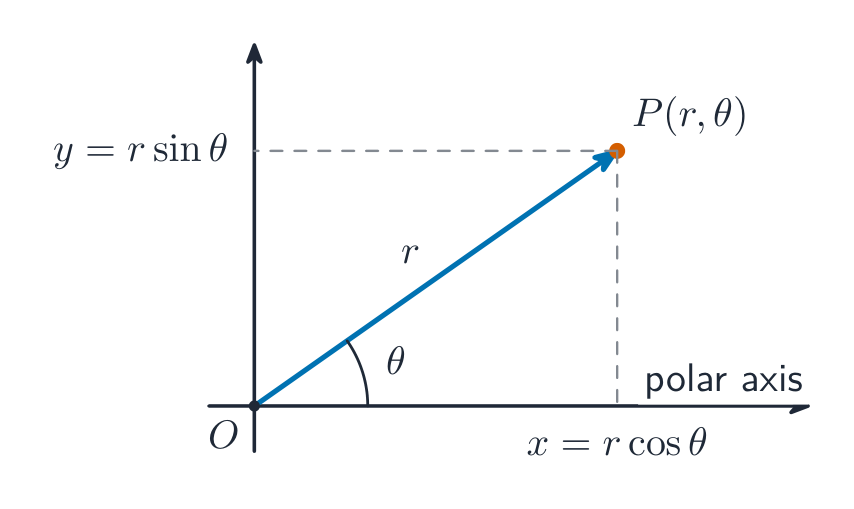
Polar coordinates 极坐标 locate a point by $(r,\theta)$ – distance $r$ from the origin at angle $\theta$. Convert with

$$x=r\cos\theta,\quad y=r\sin\theta,\qquad r=\sqrt{x^2+y^2},\quad \tan\theta=\frac{y}{x}.$$
A complex number 复数 is the point $(x,y)=x+yi$ and can likewise be written with $r$ and $\theta$.

العربية

الإحداثيات القطبية تحدد نقطة بـ $(r,\theta)$ – المسافة $r$ من نقطة الأصل بزاوية $\theta$. للتحويل استخدم

$$x=r\cos\theta,\quad y=r\sin\theta,\qquad r=\sqrt{x^2+y^2},\quad \tan\theta=\frac{y}{x}.$$
العدد المركب هو النقطة $(x,y)=x+yi$ ويمكن كتابته أيضاً باستخدام $r$ و$\theta$.

الإحداثيات القطبية تعطي نقطة عن طريق مسافتها r وزاوية theta
3.14

Polar Function Graphs · ⁨رسوم بيانية للدوال القطبية⁩

Syllabus · ⁨المنهج⁩
English

Learning Objective 3.14.A: Construct graphs of polar functions.

  • 3.14.A.1 The graph of the function $r = f(\theta)$ in polar coordinates consists of input-output pairs of values where the input values are angle measures and the output values are radii.
  • 3.14.A.2 The domain of the polar function $r = f(\theta)$, given graphically, can be restricted to a desired portion of the function by selecting endpoints corresponding to the desired angle and radius.
  • 3.14.A.3 When graphing polar functions in the form of $r = f(\theta)$, changes in input values correspond to changes in angle measure from the positive $x$-axis, and changes in output values correspond to changes in distance from the origin.
العربية

هدف التعلم 3.14.A: بناء رسوم للدوال القطبية.

  • 3.14.A.1 يتكون رسم الدالة $r = f(\theta)$ في الإحداثيات القطبية من أزواج قيم الإدخال والإخراج حيث تمثل قيم الإدخال قياسات الزوايا وقيم الإخراج أنصاف الأقطار.
  • 3.14.A.2 يمكن تقييد مجال الدالة القطبية $r = f(\theta)$ الممثلة بيانياً إلى جزء مطلوب من الدالة عن طريق تحديد نقاط النهاية المقابلة للزاوية ونصف القطر المطلوبين.
  • 3.14.A.3 عند رسم الدوال القطبية بصيغة $r = f(\theta)$، تتوافق التغيرات في قيم الإدخال مع التغيرات في قياس الزاوية من المحور الموجب $x$، وتتوافق التغيرات في قيم الإخراج مع التغيرات في المسافة من نقطة الأصل.

Source: College Board AP Course and Exam Description · ⁨المصدر: وصف دورة وامتحان College Board AP⁩

English
Tracing a polar curve

The graph of $r=f(\theta)$ is all points $(r,\theta)$ as $\theta$ sweeps around. Restricting the domain of $\theta$ draws only part of the curve. As $\theta$ increases, $r$ grows or shrinks, tracing spirals, circles, roses, and limaçons.

العربية
تتبع منحنى قطبي

رسم $r=f(\theta)$ يضم جميع النقاط $(r,\theta)$ بينما تدور $\theta$ حولها. تقييد مجال $\theta$ يرسم جزءاً فقط من المنحنى. مع زيادة $\theta$، تكبر $r$ أو تصغر، ترسم حلزونات ودوائر وزهور وليماسون.

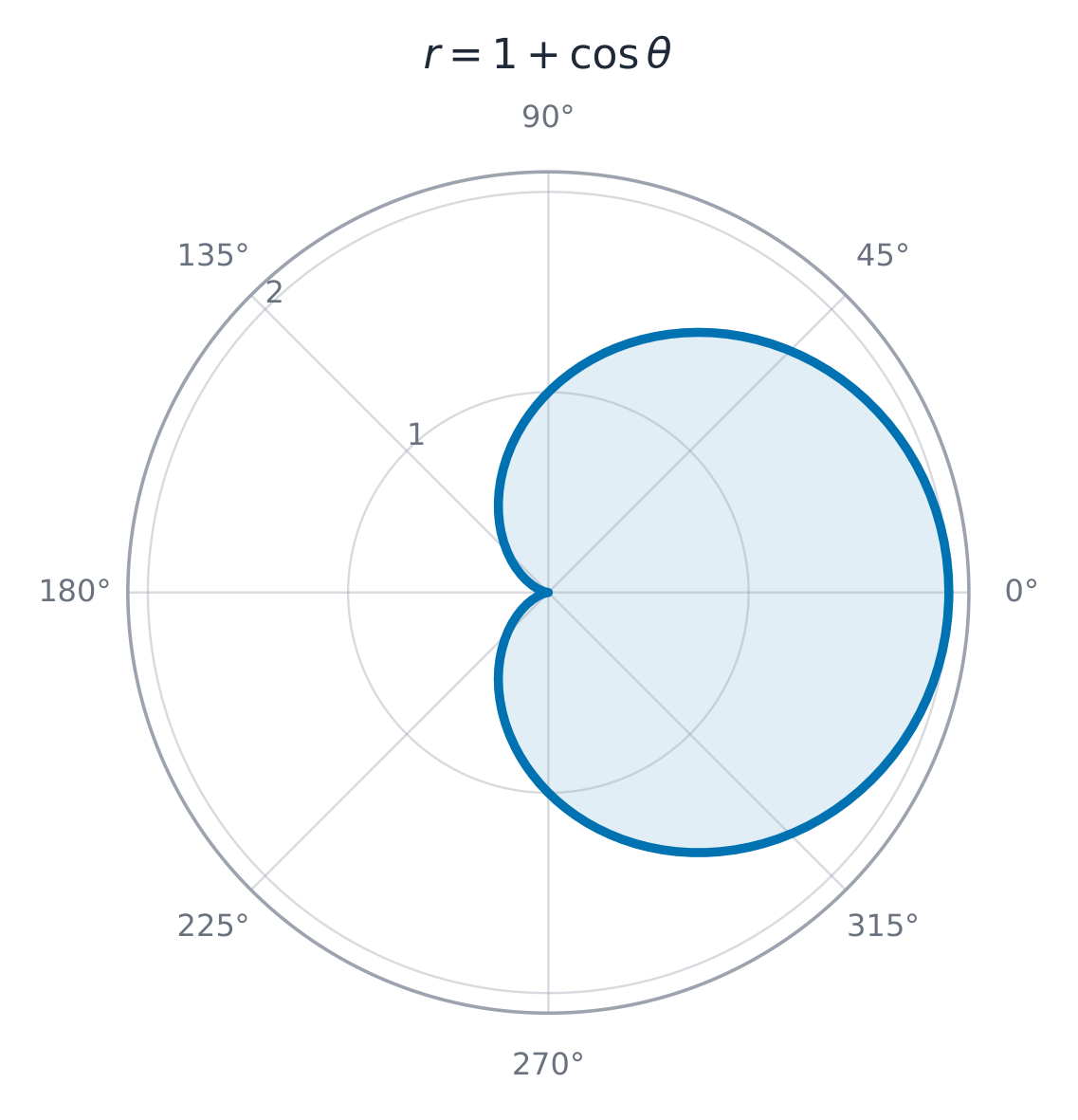
قلب r = 1 + cos theta، مرسوم مباشرة بصيغة قطبية
Explore · ⁨استكشف⁩

Plot a curve in polar coordinates · ⁨رسم منحنى بإحداثيات قطبية⁩

In polar form a point is a distance $r$ at angle $\theta$. Letting $r$ depend on $\theta$ traces shapes a rule in $x,y$ can't — like this cardioid. · ⁨في الصيغة القطبية، النقطة على مسافة $r$ عند زاوية $\theta$. جعل $r$ يعتمد على $\theta$ يرسم أشكالاً لا يمكن لقاعدة في $x,y$ أن تفعل — مثل هذا القلب.⁩

3.15

Rates of Change in Polar Functions · ⁨معدلات التغير في الدوال القطبية⁩

Syllabus · ⁨المنهج⁩
English

Learning Objective 3.15.A: Describe characteristics of the graph of a polar function.

  • 3.15.A.1 If a polar function, $r = f(\theta)$, is positive and increasing or negative and decreasing, then the distance between $f(\theta)$ and the origin is increasing.
  • 3.15.A.2 If a polar function, $r = f(\theta)$, is positive and decreasing or negative and increasing, then the distance between $f(\theta)$ and the origin is decreasing.
  • 3.15.A.3 For a polar function, $r = f(\theta)$, if the function changes from increasing to decreasing or decreasing to increasing on an interval, then the function has a relative extremum on the interval corresponding to a point relatively closest to or farthest from the origin.
  • 3.15.A.4 The average rate of change of $r$ with respect to $\theta$ over an interval of $\theta$ is the ratio of the change in the radius values to the change in $\theta$ over an interval of $\theta$. Graphically, the average rate of change indicates the rate at which the radius is changing per radian.
  • 3.15.A.5 The average rate of change of $r$ with respect to $\theta$ over an interval of $\theta$ can be used to estimate values of the function within the interval.
العربية

هدف التعلم 3.15.A: وصف خصائص رسم الدالة القطبية.

  • 3.15.A.1 إذا كانت الدالة القطبية $r = f(\theta)$ موجبة ومتزايدة أو سالبة ومتناقصة، فإن المسافة بين $f(\theta)$ ونقطة الأصل تزداد.
  • 3.15.A.2 إذا كانت الدالة القطبية $r = f(\theta)$ موجبة ومتناقصة أو سالبة ومتزايدة، فإن المسافة بين $f(\theta)$ ونقطة الأصل تتناقص.
  • 3.15.A.3 بالنسبة لدالة قطبية $r = f(\theta)$، إذا تغيرت الدالة من متزايدة إلى متناقصة أو من متناقصة إلى متزايدة على فترة ما، فإن للدالة قيمة حدية نسبية على تلك الفترة تقابل نقطة أقرب نسبياً أو أبعد نسبياً عن نقطة الأصل.
  • 3.15.A.4 معدل التغير المتوسط لـ $r$ بالنسبة لـ $\theta$ على فترة $\theta$ هو نسبة التغير في قيم نصف القطر إلى التغير في $\theta$ على فترة $\theta$. بيانياً، يشير معدل التغير المتوسط إلى معدل تغير نصف القطر لكل راديان.
  • 3.15.A.5 يمكن استخدام معدل التغير المتوسط لـ $r$ بالنسبة لـ $\theta$ على فترة $\theta$ لتقدير قيم الدالة داخل تلك الفترة.

Source: College Board AP Course and Exam Description · ⁨المصدر: وصف دورة وامتحان College Board AP⁩

English

As $\theta$ increases, the distance from the origin $r$ changes:

  • $r$ positive and increasing (or negative and decreasing) $\Rightarrow$ moving away from the origin;
  • $r$ positive and decreasing (or negative and increasing) $\Rightarrow$ moving toward the origin.

Where $r$ switches between increasing and decreasing, the distance reaches a relative extreme. The average rate of change of $r$ with respect to $\theta$, $\dfrac{\Delta r}{\Delta \theta}$, estimates how fast the curve moves in or out over an interval.

العربية

عندما تزداد $\theta$، تتغير المسافة من نقطة الأصل $r$:

  • $r$ موجبة ومتزايدة (أو سالبة ومتناقصة) $\Rightarrow$ تتحرك بعيداً عن نقطة الأصل؛
  • $r$ موجبة ومتناقصة (أو سالبة ومتزايدة) $\Rightarrow$ تتحرك نحو نقطة الأصل.

حيث تتحول $r$ بين التزايد والتناقص، تصل المسافة إلى حد أقصى أو أدنى محلي. متوسط معدل التغير لـ $r$ بالنسبة لـ $\theta$، $\dfrac{\Delta r}{\Delta \theta}$، يقدّر سرعة حركة المنحنى داخلًا أو خارجًا خلال فترة زمنية.

3.15

Exam tips · ⁨نصائح للامتحان⁩

English
  • Use radians and the unit circle: $\cos\theta$ and $\sin\theta$ are the coordinates, always between $-1$ and $1$.
  • For a sinusoid $a\sin(b(\theta+c))+d$: $|a|$ is the amplitude, $\tfrac{2\pi}{|b|}$ the period, $d$ the midline, and the phase shift is $-c$ (a $+c$ shifts left).
  • Model periodic data by reading period, amplitude, and midline from the max and min.
  • Inverse trig functions need a restricted domain and return an angle; trig equations have infinitely many solutions (add the period).
  • Convert polar↔rectangular with $x=r\cos\theta$, $y=r\sin\theta$.
العربية
  • استخدم الراديان والدائرة الوحدة: $\cos\theta$ و$\sin\theta$ هما الإحداثيان، دائماً بين $-1$ و$1$.
  • لموجة جيبية $a\sin(b(\theta+c))+d$: $|a|$ هو السعة، $\tfrac{2\pi}{|b|}$ هي الدورة، $d$ هو خط المنتصف، والانزياح الطوري هو $-c$ (يُزيح $+c$ إلى اليسار).
  • نمذج البيانات الدورية بقراءة الدور والسعة وخط المنتصف من القيم القصوى والمثلى.
  • الدوال المثلثية العكسية تحتاج نطاقاً مقيداً وترجع زاوية؛ المعادلات المثلثية لها عدد لا نهائي من الحلول (أضف الدور).
  • حوّل بين الإحداثيات القطبية والمستطيلة باستخدام $x=r\cos\theta$، $y=r\sin\theta$.

Interactive lessons on this topic · ⁨دروس تفاعلية حول هذا الموضوع⁩

Work through it step by step, with instant-check exercises. · ⁨ا-working عليه خطوة بخطوة، مع تمارين تحقق فوري.⁩

Past Papers · ⁨أوراق الامتحانات السابقة⁩

More topics in AP Precalculus · ⁨AP ما قبل التفاضل والتكامل⁩ · ⁨المزيد من المواضيع في AP Precalculus · ⁨AP ما قبل التفاضل والتكامل⁩⁩

Log in or create account · ⁨تسجيل الدخول أو إنشاء حساب⁩

IGCSE, A-Level & AP