Transfer of thermal energy · 热能传递
| English | 中文 | Pinyin · 拼音 |
|---|---|---|
| conduction/kənˈdʌkʃn/ | 热传导 | rè chuán dǎo |
| convection/kənˈvekʃn/ | 对流 | duì liú |
| radiation/ˌreɪdɪˈeɪʃn/ | 辐射 | fú shè |
| insulators/ˈɪnsjuːleɪtəz/ | 绝缘体 | jué yuán tǐ |
| infrared/ˌɪnfrəˈred/ | 红外线 | hóng wài xiàn |
| emitter/ɪˈmɪtə/ | 发射体 | fā shè tǐ |
Three ways heat travels
- A metal spoon left in hot soup soon burns your hand.
- Yet the Sun warms you across millions of kilometres of empty space.
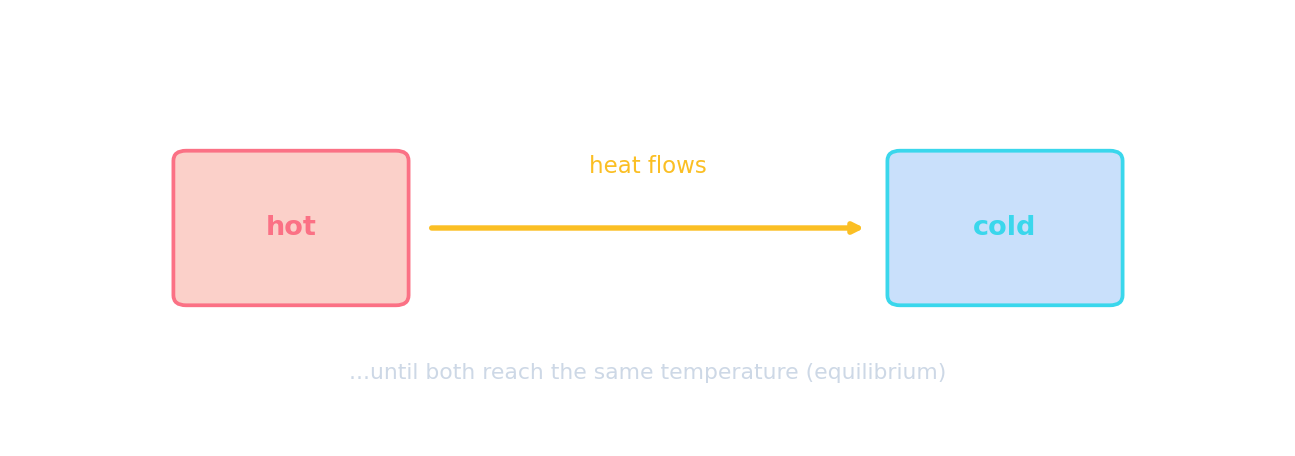
- Thermal energy always flows from hot to cold — by three routes: conduction 热传导, convection 对流 and radiation 辐射.
热传播的三种方式
- 留在热汤里的一个金属勺子很快烫你的手。
- 然而太阳跨越数百万千米的空旷空间温暖你。
- 热能总是从热流向冷——通过三条路线:传导、对流和辐射。
Heat transfer lab · 热传递实验
Compare the routes by which thermal energy moves. · 比较热能移动的不同途径。
Conduction
- Conduction carries energy through a material without the material moving.
- Heated particles vibrate more and pass the energy to their neighbours.
- Metals are the best conductors: their free (delocalised) electrons carry energy quickly.
- Insulators 绝缘体 (air, wood, plastic) conduct badly — which is why we use them to keep things warm.
Conduction: vibrating particles pass energy along a metal bar
传导
- 传导(conduction)通过一种材料携带能量,而材料不移动。
- 被加热的粒子振动更多并把能量传给它们的邻居。
- 金属是最好的导体:它们的自由(离域)电子快速携带能量。
- 绝缘体(空气、木头、塑料)传导得差——这就是为什么我们用它们来保温。

传导:振动的粒子沿一根金属棒传递能量
Why are metals such good conductors of thermal energy? · 为什么金属是优良的热导体?
Metals have free (delocalised) electrons that move through the metal and carry energy rapidly from the hot end to the cold end. · 金属拥有自由(离域)电子,这些电子在金属内部移动,将能量从热端快速传导至冷端。
Convection
- Convection happens in liquids and gases.
- Heated fluid expands, becomes less dense, and rises; cooler, denser fluid sinks to take its place.
- This circulation is a convection current — it carries energy around the fluid.
- It cannot happen in a solid, because the particles cannot move from place to place.
对流
- 对流(convection)发生在液体和气体中。
- 被加热的流体膨胀、变得密度更小并上升;更冷、更密集的流体下沉来取代它。
- 这个循环是一个对流流(convection current)——它把能量带到流体周围。
- 它不能在固体中发生,因为粒子不能从一处移到另一处。
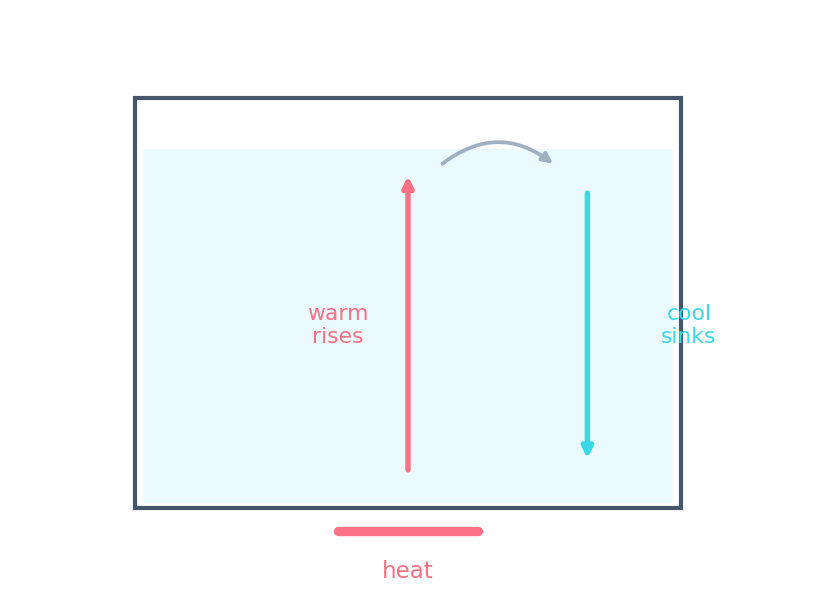
In convection, heated fluid rises because it has become: · 在对流中,受热流体上升是因为它变得:
Heating makes the fluid expand, so it is less dense and floats upward; cooler, denser fluid sinks to replace it. · 加热使流体膨胀,从而密度变小并向上浮起;较冷、密度较大的流体下沉以补充空间。
Convection can happen in a solid. · 对流可以在固体中发生。
Convection needs particles to move from place to place, so it only happens in liquids and gases — not solids. · 对流需要粒子在不同位置间移动,因此只发生在液体和气体中——不会在固体中发生。
Radiation
- Thermal radiation is energy carried by infrared 红外线 waves.
- All objects emit it, and it needs no material — it can cross empty space (this is how the Sun's energy reaches us).
- A dull, black surface is a good emitter 发射体 and absorber of infrared.
- A shiny, white surface is a poor emitter and a good reflector — which is why hot-water tanks and spacecraft are often shiny.
A dull, black surface emits (and absorbs) infrared much better than a shiny, white one
辐射
- 热辐射(thermal radiation)是由红外(infrared)波携带的能量。
- 所有物体都发射它,而它不需要材料——它能跨越空旷空间(这是太阳的能量如何到达我们)。
- 一个暗的、黑的表面是红外的一个好发射体和吸收体。
- 一个发亮的、白的表面是一个差的发射体和一个好的反射体——这就是为什么热水箱和航天器常常是发亮的。

一个暗的、黑的表面发射(和吸收)红外比一个发亮的、白的表面好得多
Which method of heat transfer can travel through empty space (a vacuum)? · 哪种热传递方式能在真空中传播?
Radiation is carried by infrared waves, which need no material — so the Sun's energy reaches us across empty space. · 辐射以红外线波的形式传递,不需要介质——因此太阳的能量可以穿过真空到达地球。
Match each method of heat transfer to how it works. · 将每种热传递方式与其工作原理相匹配。
Conduction works through a material; convection moves the fluid itself in a current; radiation is infrared waves that need no material. · 传导通过材料传递;对流随流体本身的环流移动;辐射是以红外线波形式存在且无需介质的能量传递。
Which surface is the best emitter of thermal radiation? · 哪种表面是热辐射的最佳发射体?
Dull black surfaces are the best emitters (and absorbers) of infrared; shiny, light surfaces are poor emitters and good reflectors. · 哑光黑色表面是红外线最佳发射体(也是吸收体);光亮浅色表面是不良发射体但反射率高。
You've got it
- thermal energy always flows from hot to cold
- conduction: through a material, particle to particle; metals best (free electrons)
- convection: warm fluid rises, cool sinks — a current; never in solids
- radiation: infrared, needs no material; dull black = best emitter/absorber
你掌握了
- 热能总是从热流向冷
- 传导:通过一种材料,粒子到粒子;金属最好(自由电子)
- 对流:温暖的流体上升,冷的下沉——一个流;从不在固体中
- 辐射:红外,不需要材料;暗黑 = 最好的发射体/吸收体