Melting, boiling and evaporation · 熔化、沸腾与蒸发
| English | 中文 | Pinyin · 拼音 |
|---|---|---|
| melting/ˈmeltɪŋ/ | 熔化 | róng huà |
| boiling/ˈbɔɪlɪŋ/ | 沸腾 | fèi téng |
| evaporation/ɪˌvæpəˈreɪʃn/ | 蒸发 | zhēng fā |
| boiling point/ˈbɔɪlɪŋ pɔɪnt/ | 沸点 | fèi diǎn |
Why sweating cools you
- When sweat dries off your skin, you feel cooler.
- A changing state — liquid turning to gas — is carrying energy away.
- Let's see how melting 熔化, boiling 沸腾 and evaporation 蒸发 work.
为什么出汗使你凉爽
- 当汗从你的皮肤上干掉时,你感觉更凉爽。
- 一个变化的状态——液体变成气体——正在带走能量。
- 让我们看看熔化、沸腾和蒸发如何起作用。
Melting and boiling
- Melting (solid → liquid) and boiling (liquid → gas) both need energy.
- But while the state is changing, the temperature stays the same — the energy goes into breaking the forces between particles, not into speeding them up.
- For water at normal air pressure: melting at $0\ {}^{\circ}\text{C}$, boiling at $100\ {}^{\circ}\text{C}$.
熔化与沸腾
- 熔化(melting,固体 → 液体)和沸腾(boiling,液体 → 气体)都需要能量。
- 但当状态在变化时,温度保持不变——能量进入打破粒子之间的力,而不是加速它们。
- 对正常空气压强下的水:在 $0\ {}^{\circ}\text{C}$ 熔化,在 $100\ {}^{\circ}\text{C}$ 沸腾。
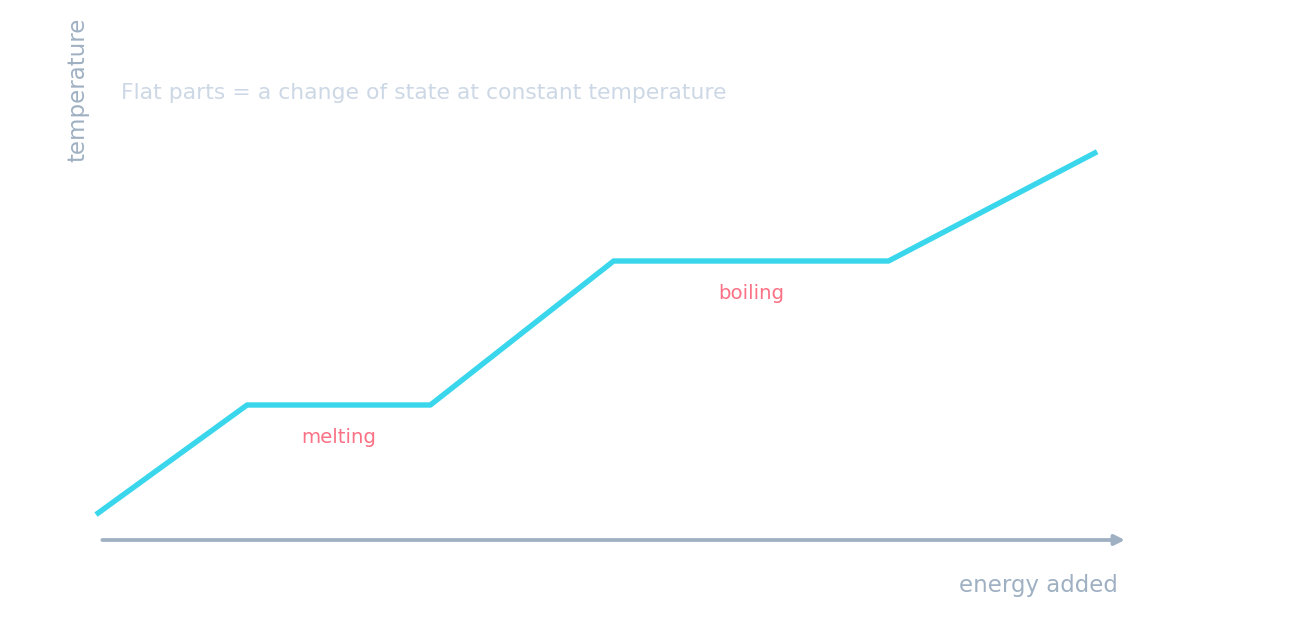
The heating curve — watch the temperature pause · 加热曲线——观察温度暂停
While the substance is melting or boiling the temperature stays flat, even though heat is still going in — the energy breaks bonds instead of warming it. · 当物质在熔化或沸腾时温度保持平,即使热仍在进入——能量打破键而不是温暖它。
While ice is melting into water, what happens to the temperature? · 当冰熔化成水时,温度会怎样?
During a change of state the energy goes into breaking the forces between particles, so the temperature stays constant until the change is complete. · 在一个状态变化期间,能量进入打破粒子之间的力,所以温度保持恒定,直到变化完成。
On a heating curve, a flat (horizontal) section means: · 在一条加热曲线上,一个平(水平)的部分意味着:
Energy is still being added, but it is used to change the state, so the temperature does not rise — the curve is flat. · 能量仍在被加入,但它被用来改变状态,所以温度不上升——曲线是平的。
Evaporation
- Evaporation is a liquid turning to gas at its surface, and it happens below the boiling point 沸点.
- The fastest particles escape from the surface.
- That leaves slower particles behind, so the average energy drops — the liquid cools down.
- This is exactly why evaporating sweat cools your skin.
Temperature stays flat while the substance melts and while it boils
蒸发
- 蒸发(evaporation)是一种液体在它的表面变成气体,且它发生在沸点之下。
- 最快的粒子从表面逃逸。
- 那留下更慢的粒子,所以平均能量下降——液体冷却。
- 这正是为什么蒸发的汗使你的皮肤凉爽。
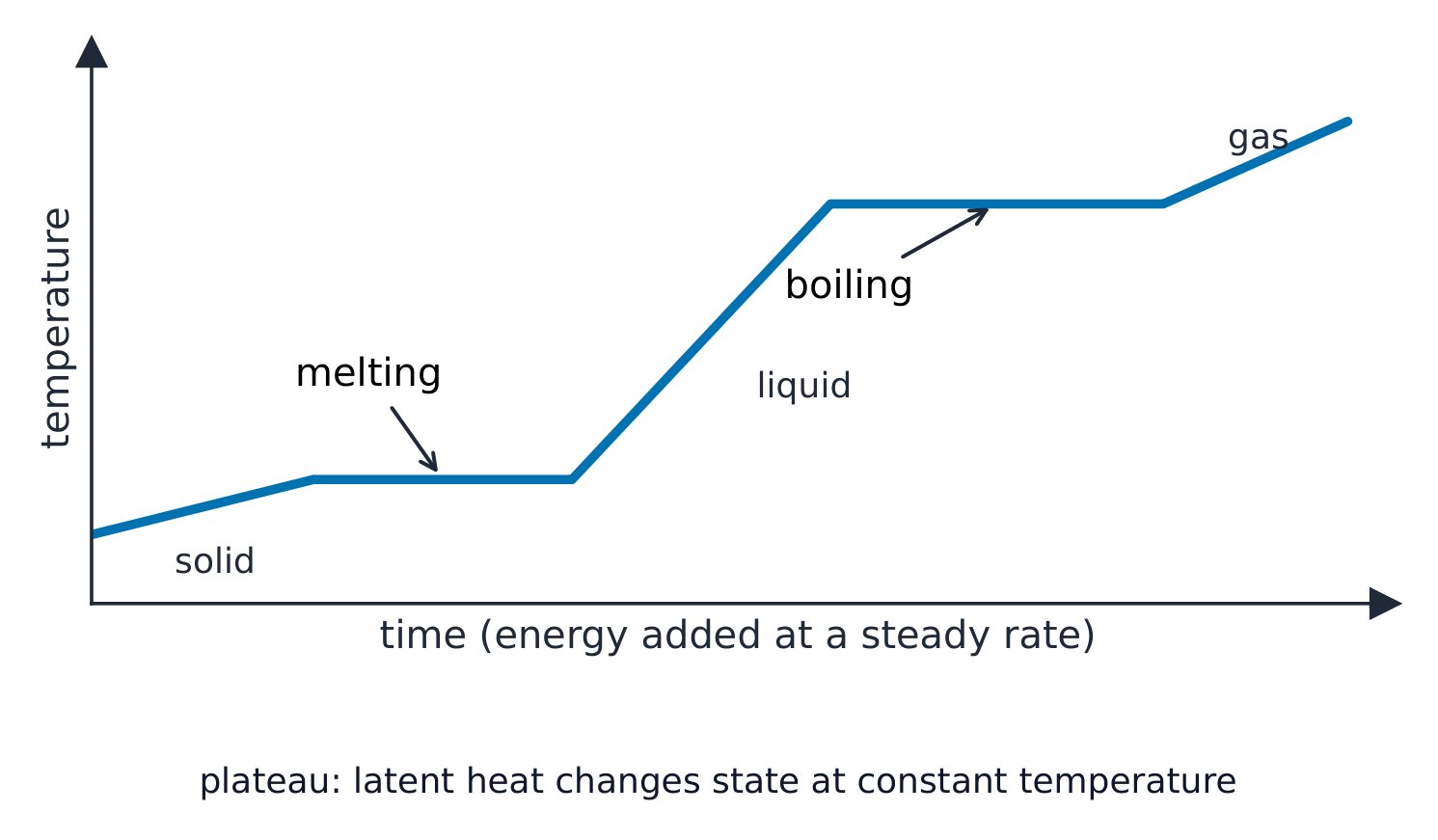
温度在物质熔化时和沸腾时保持平
Evaporation can happen below the boiling point. · 蒸发能发生在沸点之下。
Evaporation happens at the surface at any temperature — the fastest surface particles escape. Boiling happens throughout the liquid at the boiling point. · 蒸发在任何温度下发生在表面——最快的表面粒子逃逸。沸腾在沸点遍及整个液体发生。
Why does an evaporating liquid cool down? · 为什么一种蒸发的液体冷却?
The most energetic particles leave the surface, so the particles left behind have a lower average energy — a lower temperature. · 最有能量的粒子离开表面,所以留下的粒子有一个更低的平均能量——一个更低的温度。
What speeds up evaporation
- Higher temperature — more particles are moving fast enough to escape.
- Larger surface area — more particles are at the surface.
- More air movement (wind) — escaped particles are carried away, so fewer return.
- That's why washing dries fastest on a warm, breezy day.
什么加快蒸发
- 更高的温度——更多粒子运动得足够快以逃逸。
- 更大的表面积——更多粒子在表面。
- 更多的空气运动(风)——逃逸的粒子被带走,所以更少返回。
- 那就是为什么洗的衣服在一个温暖、有微风的日子干得最快。
Select all · 所有 the things that make a puddle evaporate faster · 更快. · 选择所有使一个水坑蒸发更快的东西。
Higher temperature, larger surface area, and more airflow all speed up evaporation. A lower temperature slows it down. · 更高的温度、更大的表面积和更多的气流都加快蒸发。一个更低的温度减慢它。
You've got it
- melting and boiling need energy, but the temperature stays constant during the change
- a flat part on a heating curve = a change of state
- evaporation happens at the surface, below boiling; the fastest particles leave, so the liquid cools
- faster evaporation: higher temperature, bigger surface area, more airflow
你掌握了
- 熔化和沸腾需要能量,但变化期间温度保持恒定
- 一条加热曲线上的一个平的部分 = 一个状态变化
- 蒸发发生在表面,沸腾之下;最快的粒子离开,所以液体冷却
- 更快的蒸发:更高的温度、更大的表面积、更多气流