Thermal expansion and specific heat capacity · 热膨胀与比热容
| English | 中文 | Pinyin · 拼音 |
|---|---|---|
| specific heat capacity/spəˈsɪfɪk hiːt kəˈpæsɪti/ | 比热容 | bǐ rè róng |
| thermal expansion/ˈθɜːml ekˈspænʃn/ | 热膨胀 | rè péng zhàng |
| internal energy/ɪnˈtɜːnl ˈenədʒi/ | 内能 | nèi néng |
Why bridges have gaps
- Railway lines have small gaps; bridges sit on rollers; power cables hang loose in summer.
- All for the same reason: things get bigger when they are heated.
- Heating also stores energy inside matter — measured by its specific heat capacity 比热容.
为什么桥有缝隙
- 铁轨有小缝隙;桥坐在滚轮上;电缆在夏天松松地挂着。
- 都是因为同样的原因:东西被加热时变大。
- 加热也在物质内部储存能量——由它的比热容测量。
Thermal expansion 热膨胀
- Heat a material and its particles move more, so they take up more space — it expands.
- Gases expand the most, then liquids, then solids (whose particles are held tightly).
- Engineers leave gaps in rails and put bridges on rollers so the expansion does not buckle them.
- A tight metal jar lid loosens when you run it under hot water — the metal expands.
Thermal expansion: heating makes the rail longer, closing the gap left for it.
Worked example. A steel bridge is $50\ \text{m}$ long at $10\ {}^{\circ}\text{C}$. Steel expands about $0.012\ \text{mm}$ per metre per ${}^{\circ}\text{C}$. If the temperature rises to $40\ {}^{\circ}\text{C}$ (a $30\ {}^{\circ}\text{C}$ rise): expansion $= 50 \times 0.012 \times 30 = 18\ \text{mm}$. That's why bridges have expansion joints!
The particles don't get bigger. When a solid expands, the particles themselves stay the same size — they just vibrate more and push further apart. This is a common exam misconception.
热膨胀
- 加热一种材料,它的粒子运动更多,所以它们占用更多空间——它膨胀(expands)。
- 气体膨胀最多,然后液体,然后固体(它的粒子被紧紧抓住)。
- 工程师在轨道中留缝隙并把桥放在滚轮上,这样膨胀不会使它们弯曲。
- 一个紧的金属罐盖在你用热水冲它时松开——金属膨胀。
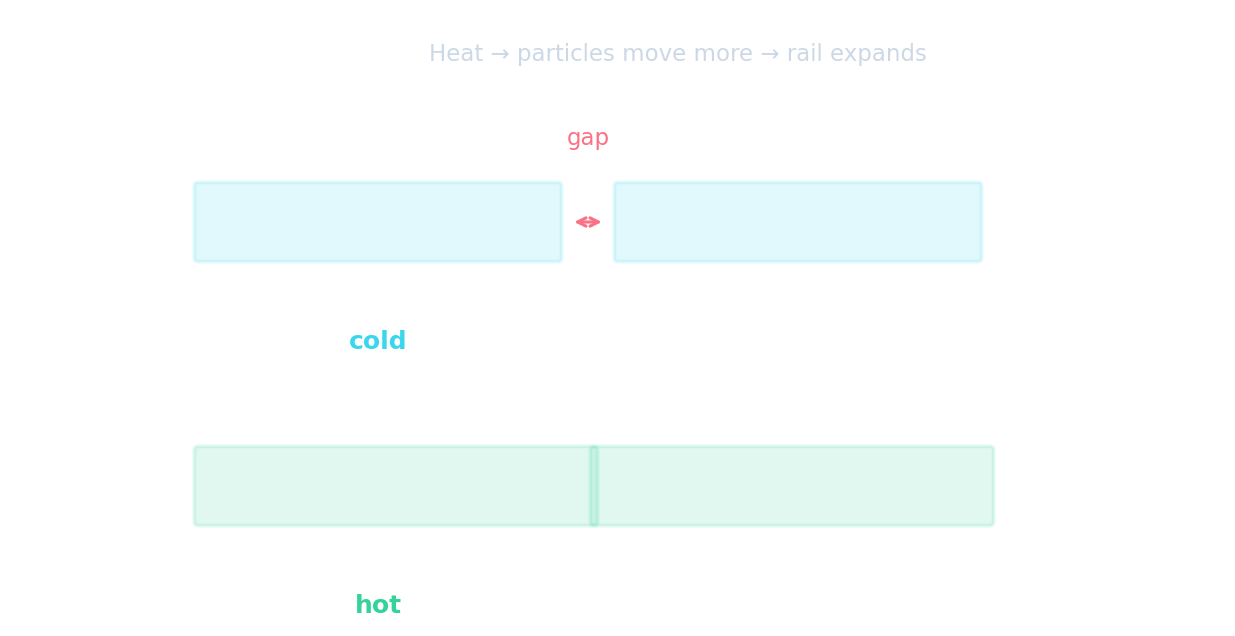
热膨胀:加热使轨道变长,闭合为它留的缝隙。
例题。 一座钢桥在 $10\ {}^{\circ}\text{C}$ 时长 $50\ \text{m}$。钢每米每 ${}^{\circ}\text{C}$ 膨胀约 $0.012\ \text{mm}$。如果温度上升到 $40\ {}^{\circ}\text{C}$(一个 $30\ {}^{\circ}\text{C}$ 的上升):膨胀 $= 50 \times 0.012 \times 30 = 18\ \text{mm}$。那就是为什么桥有伸缩缝!
粒子不会变大。 当一个固体膨胀时,粒子本身保持相同的大小——它们只是振动更多并推得更远。这是一个常见的考试误解。
Heating and specific heat capacity · 加热与比热容
Q = mcΔT
The heat energy needed is proportional to the temperature rise for a given mass of material. · 对一个给定质量的材料,所需的热能与温度上升成正比。
For the same rise in temperature, which expands the most? · 对相同的温度上升,哪个膨胀最多?
Gases expand the most, then liquids, then solids (whose particles are held most tightly). · 气体膨胀最多,然后液体,然后固体(它的粒子被抓得最紧)。
Why are small gaps left between railway lines? · 为什么在铁轨之间留小缝隙?
On a hot day the rails expand. The gaps give the extra length somewhere to go, so the track does not bend out of shape. · 在炎热的日子轨道膨胀。缝隙给额外的长度一个去处,所以轨道不弯出形状。
Internal energy 内能
- The internal energy of an object is the total energy of all its particles (their movement and arrangement).
- Heating an object raises its internal energy — usually raising its temperature too.
The same hand in ordinary light and through a thermal (infrared) camera
内能
- 一个物体的内能(internal energy)是它所有粒子的总能量(它们的运动和排列)。
- 加热一个物体提高它的内能——通常也提高它的温度。

普通光下和通过一个热(红外)相机的同一只手
Specific heat capacity
- The specific heat capacity $c$ is the energy needed to raise the temperature of $1\ \text{kg}$ of a material by $1\ {}^{\circ}\text{C}$:
- So the energy to warm something is $\Delta E = m c\,\Delta\theta$.
- Water has a very high $c$ ($\approx 4200$ joules per kg per °C): it needs a lot of energy to warm up and cools down slowly. That is why the sea stays mild and water is used in heating systems.
A digital thermometer measures temperature
比热容
- 比热容(specific heat capacity)$c$ 是把 $1\ \text{kg}$ 一种材料的温度提高 $1\ {}^{\circ}\text{C}$ 所需的能量:
- 所以温暖某物的能量是 $\Delta E = m c\,\Delta\theta$。
- 水有一个非常高的 $c$(每 kg 每 °C 约 $4200$ 焦耳):它需要很多能量来变暖并慢慢冷却。那就是为什么海保持温和且水被用在供暖系统中。
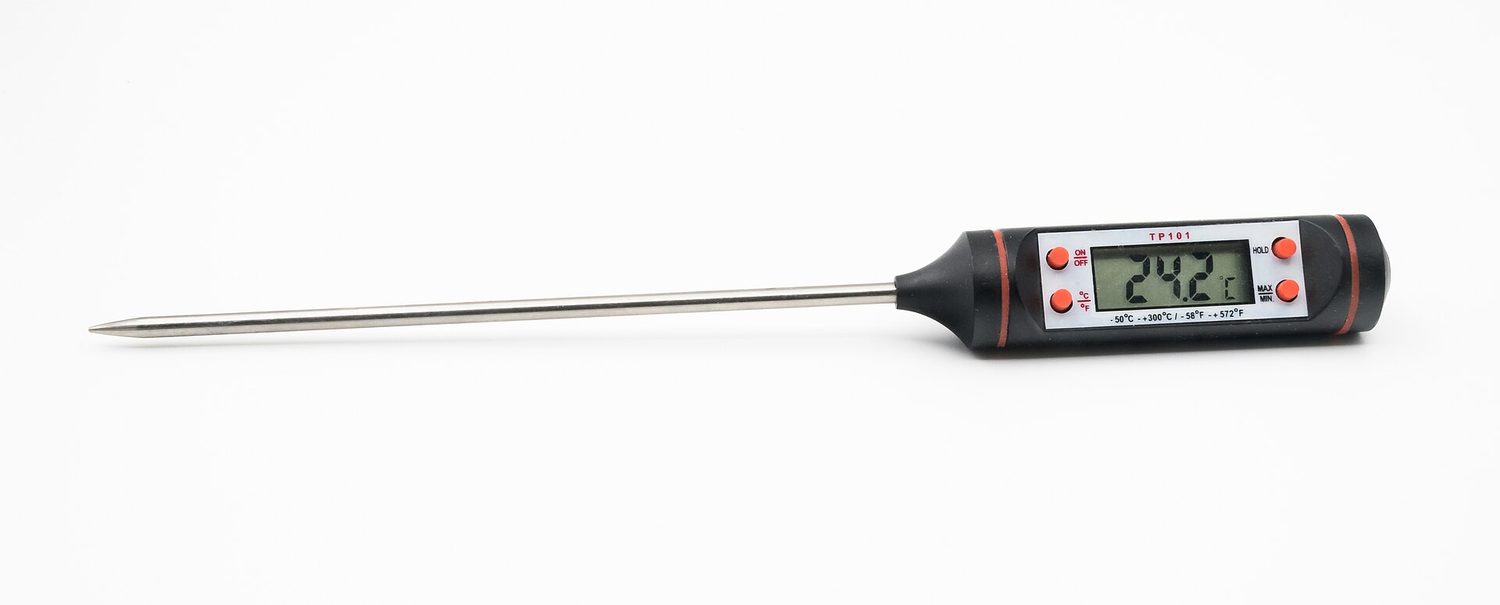
一个数字温度计测量温度
How much energy is needed to heat $2.0\ \text{kg}$ of water by $10\ {}^{\circ}\text{C}$? (Use $c = 4200$ J per kg per °C.) · 把 $2.0\ \text{kg}$ 的水加热 $10\ {}^{\circ}\text{C}$ 需要多少能量?(用 $c = 4200$ J 每 kg 每 °C。)
$\Delta E = mc\,\Delta\theta = 2.0 \times 4200 \times 10 = 84\,000\ \text{J}$. · $\Delta E = mc\,\Delta\theta = 2.0 \times 4200 \times 10 = 84\,000\ \text{J}$。
Adding $8400\ \text{J}$ raises the temperature of $0.50\ \text{kg}$ of a metal by $40\ {}^{\circ}\text{C}$. What is its specific heat capacity, in J per kg per °C? · 加入 $8400\ \text{J}$ 把 $0.50\ \text{kg}$ 一种金属的温度提高 $40\ {}^{\circ}\text{C}$。它的比热容是多少,以 J 每 kg 每 °C 计?
$c = \dfrac{\Delta E}{m\,\Delta\theta} = \dfrac{8400}{0.50 \times 40} = \dfrac{8400}{20} = 420$ J per kg per °C. · $c = \dfrac{\Delta E}{m\,\Delta\theta} = \dfrac{8400}{0.50 \times 40} = \dfrac{8400}{20} = 420$ J 每 kg 每 °C。
Because water has a high specific heat capacity, it warms up and cools down slowly. · 因为水有一个高的比热容,它慢慢变暖和冷却。
A high specific heat capacity means a lot of energy is needed per degree, so water changes temperature slowly. · 一个高的比热容意味着每度需要很多能量,所以水慢慢改变温度。
You've got it
- heating makes matter expand — gases most, solids least; leave gaps for it
- internal energy = total energy of all the particles
- specific heat capacity $c = \dfrac{\Delta E}{m\,\Delta\theta}$, so $\Delta E = mc\,\Delta\theta$
- water has a high $c$ → warms and cools slowly
你掌握了
- 加热使物质膨胀——气体最多,固体最少;为它留缝隙
- 内能 = 所有粒子的总能量
- 比热容 $c = \dfrac{\Delta E}{m\,\Delta\theta}$,所以 $\Delta E = mc\,\Delta\theta$
- 水有一个高的 $c$ → 慢慢变暖和冷却