| English | 释义 | 拼音 |
|---|---|---|
| particles/ˈpɑːtɪklz/ | 粒子 | lì zi |
| kinetic particle model/kɪˈnetɪk ˈpɑːtɪkl ˈmɒdl/ | 分子动理论 | fèn zǐ dòng lǐ lùn |
| solid/ˈsɒlɪd/ | 固体 | gù tǐ |
| liquid/ˈlɪkwɪd/ | 液体 | yè tǐ |
| gas/ɡæs/ | 气体 | qì tǐ |
| temperature/ˈtemprɪtʃə/ | 温度 | wēn dù |
| absolute zero/ˈæbsəluːt ˈzɪərəʊ/ | 绝对零度 | jué duì líng dù |
| kelvin/ˈkelvɪn/ | 开尔文 | kāi ěr wén |
| Brownian motion/ˈbraʊnɪən ˈməʊʃn/ | 布朗运动 | bù lǎng yùn dòng |
Everything is made of particles 粒子
- Look closely enough and all matter is tiny particles that never stop moving.
- This one idea — the kinetic particle model 分子动理论 — explains solids 固体, liquids 液体, gases 气体, heat and pressure.
- Let's see what the particles are doing.
The three states of matter
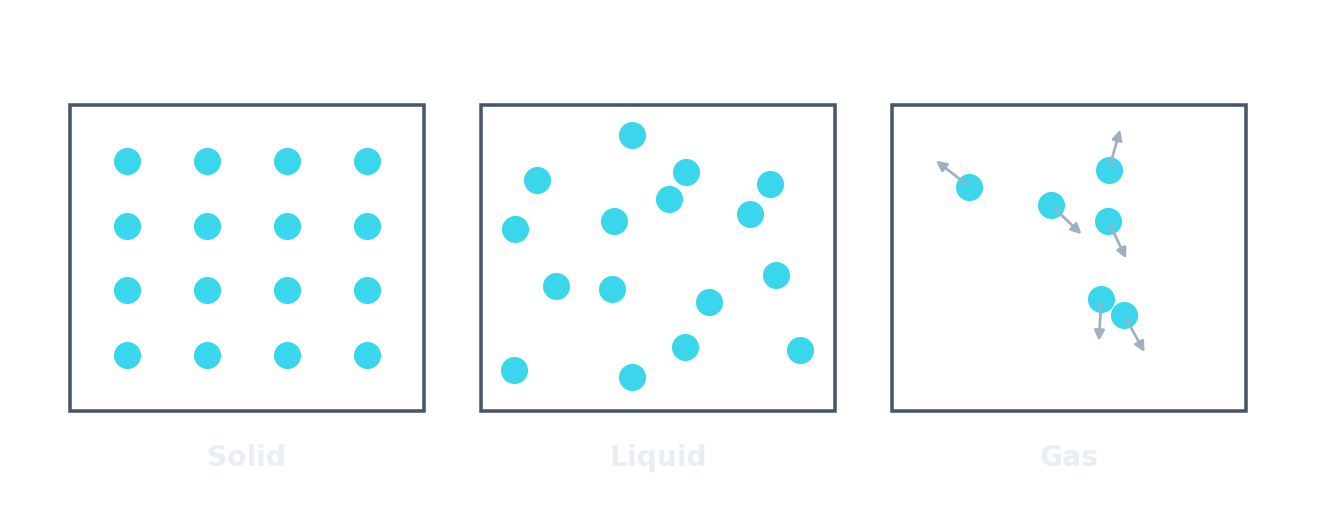
- Solid — particles packed in a regular pattern, only vibrating. Fixed shape and volume.
- Liquid — particles still close but jumbled; they slide past each other. Fixed volume, takes the container's shape.
- Gas — particles far apart, fast and random. Fills the whole container.
挤压一种气体(玻意耳定律)
把活塞滑进去以缩小体积。同样的粒子被塞进更少的空间,所以它们更频繁地撞击壁而压强攀升——而压强 × 体积保持恒定。
在哪种状态中粒子相距很远、快速,并向随机方向运动?
难度 1/5 · 今日首次完成可获 100 金币及少量额外奖励
气体粒子相距很远并向随机方向快速运动,填满容器。固体只振动;液体互相滑过。
Temperature 温度 and particle energy
- Heat a substance and its particles move faster — they gain kinetic energy.
- Temperature is a measure of the average kinetic energy of the particles.
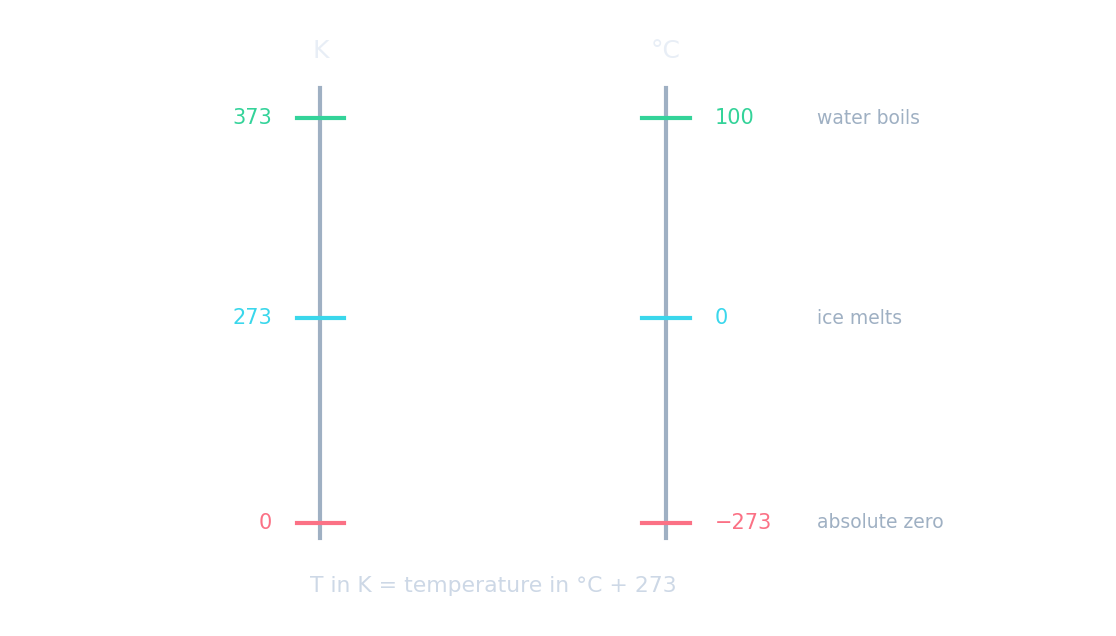
- The lowest possible temperature is absolute zero 绝对零度, $-273\ {}^{\circ}\text{C}$ — particles have the least energy.
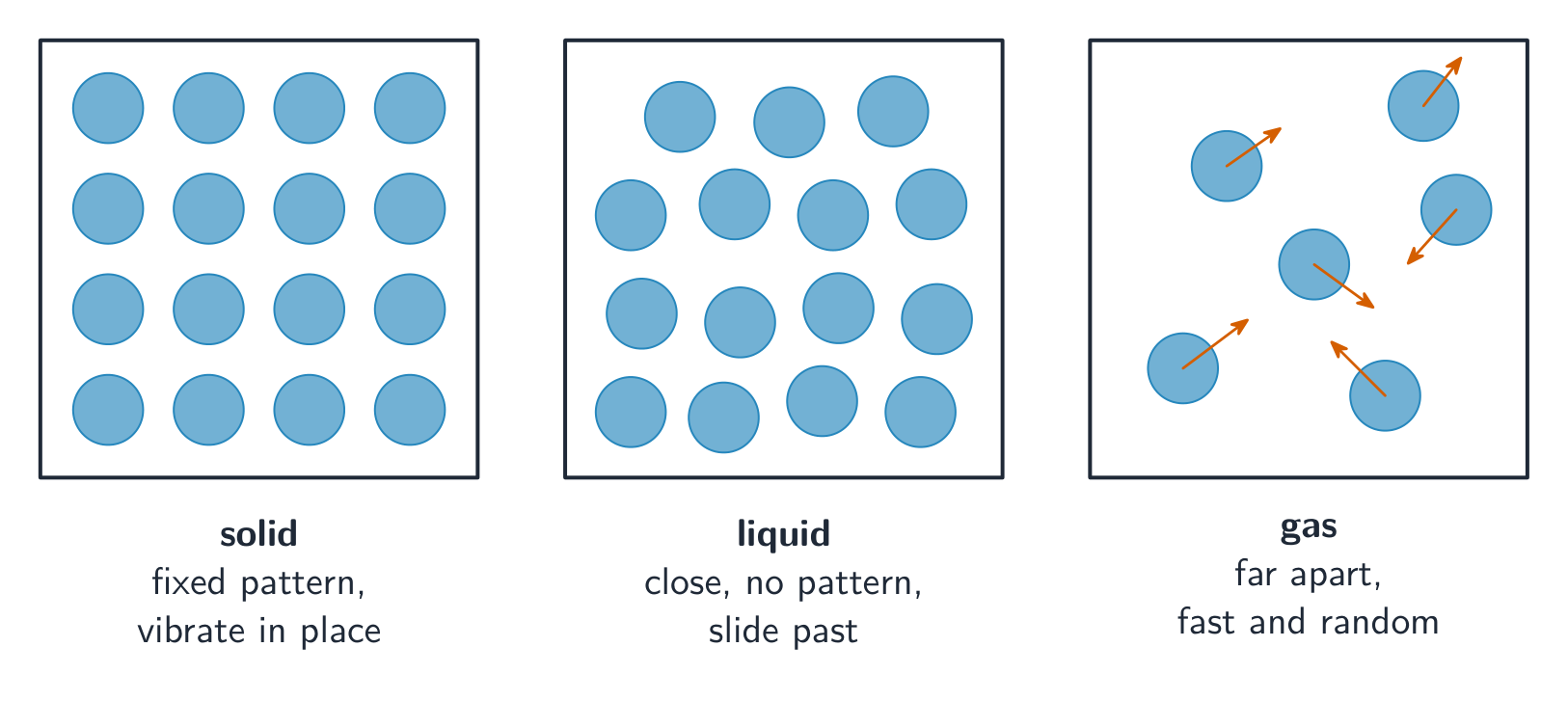
The particle model of solids, liquids and gases
温度是以下的一个量度:
难度 1/5 · 今日首次完成可获 100 金币及少量额外奖励
更热意味着粒子运动更快,所以温度测量它们的平均动能。
The kelvin 开尔文 scale
- Scientists often measure temperature in kelvin (K), starting from absolute zero.
- To convert:
- So $0\ {}^{\circ}\text{C} = 273\ \text{K}$ and $27\ {}^{\circ}\text{C} = 300\ \text{K}$.
将$27\ {}^{\circ}\text{C}$转换为开尔文。
难度 2/5 · 今日首次完成可获 140 金币及少量额外奖励
$T = \theta + 273 = 27 + 273 = 300\ \text{K}$.
Gas pressure
- Gas particles constantly hit the walls of their container. Each hit is a tiny push.
- The pressure is the total force of these hits on each unit of area.
- Heat the gas (fixed volume) → faster, harder, more frequent hits → higher pressure.
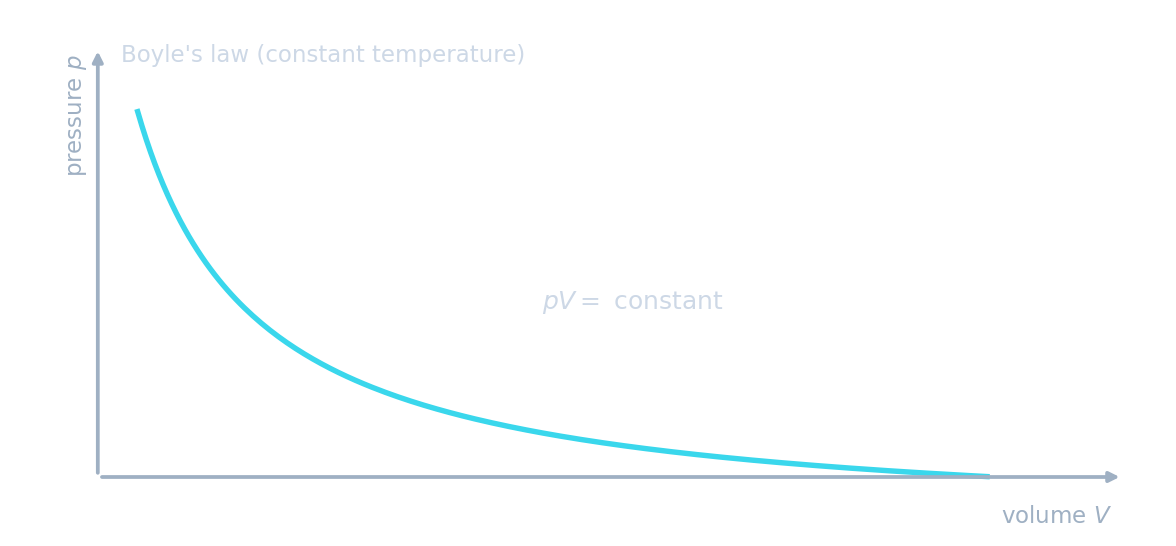
- Squeeze it smaller (fixed temperature) → more hits per second on each area → higher pressure.
- For a fixed mass of gas at constant temperature, $pV = \text{constant}$ (halve the volume → double the pressure).
某气体在 $100\ \text{kPa}$ 时的体积为 $200\ \text{cm}^3$。在恒温条件下被压缩至 $100\ \text{cm}^3$。新压强是多少,单位为 kPa?
难度 2/5 · 今日首次完成可获 140 金币及少量额外奖励
$pV$ 是恒定的:$100 \times 200 = p \times 100$,所以 $p = 200\ \text{kPa}$。体积减半使压强加倍。
在一个密封的、固定体积的罐中加热一种气体增加它的压强。
难度 1/5 · 今日首次完成可获 100 金币及少量额外奖励
更热的粒子运动更快并更猛、更频繁地撞击壁,所以压强上升。
Brownian motion 布朗运动
- Under a microscope, smoke specks in air jiggle along jerky, random paths.
- This is Brownian motion: the big specks are knocked about by fast, invisible air particles.
- It is strong evidence that matter really is made of moving particles.
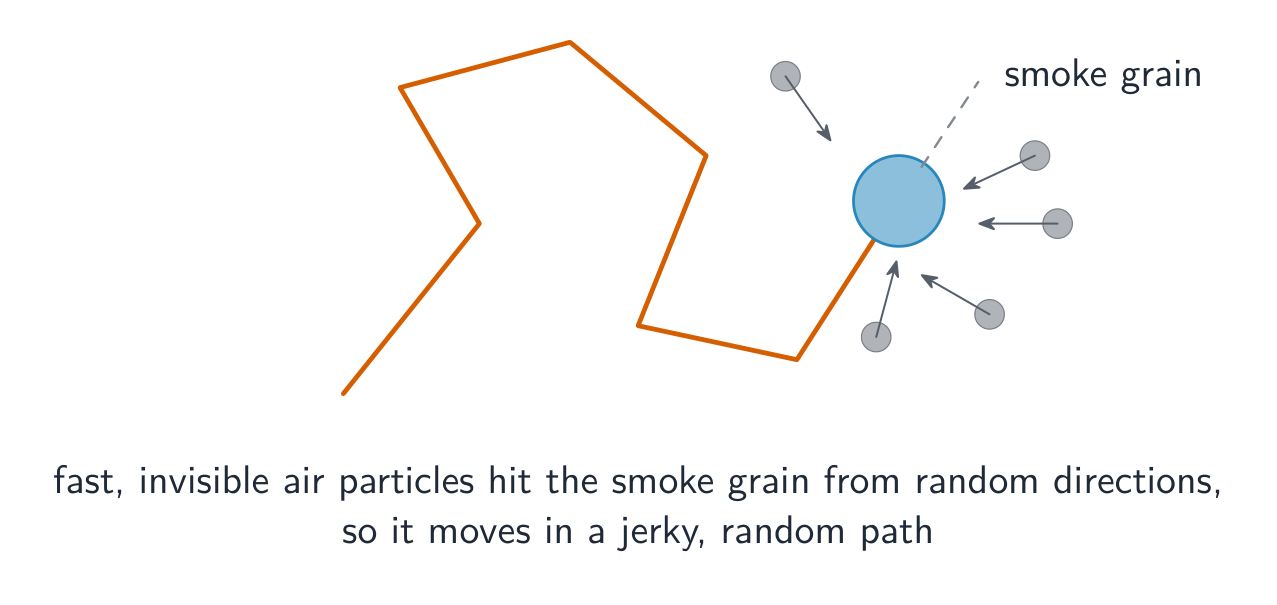
Random hits from fast, invisible air particles push a smoke grain along a jerky, random path
在显微镜下看到的烟粒随机抖动。这是因为:
难度 1/5 · 今日首次完成可获 100 金币及少量额外奖励
布朗运动:微小的快速空气粒子把更大的烟粒撞来撞去,运动粒子的证据。
Worked examples
1. A gas at $100\ \text{kPa}$ fills $2.0\ \text{m}^3$. It is squeezed to $0.50\ \text{m}^3$ at constant temperature. $pV$ stays constant: $100 \times 2.0 = p \times 0.50$, so $p = 400\ \text{kPa}$. A quarter of the volume gives four times the pressure.
2. Convert $27\ {}^{\circ}\text{C}$ and $-73\ {}^{\circ}\text{C}$ to kelvin: add 273, giving $300\ \text{K}$ and $200\ \text{K}$.
Change to kelvin only when the formula needs it. A temperature change is the same in °C and K, but $0\ {}^{\circ}\text{C}$ is not zero energy: absolute zero is $-273\ {}^{\circ}\text{C}$. In $pV = \text{constant}$, keep the units of $p$ and $V$ the same on both sides.
将15摄氏度转换为开尔文。某气体在80千帕下占据60立方厘米,在恒温条件下被压缩至40立方厘米。求新压强。
15加273等于288。80乘以60再除以40等于120千帕。
新压力是多少?
难度 1/5 · 今日首次完成可获 100 金币及少量额外奖励
80乘以1.5等于120千帕。
You've got it
- solid (fixed, vibrating) · liquid (close, sliding) · gas (far apart, fast)
- temperature = average kinetic energy of particles; absolute zero $= -273\ {}^{\circ}\text{C}$
- $T\,(\text{K}) = \theta\,({}^{\circ}\text{C}) + 273$
- gas pressure = particle hits per unit area; at constant temperature $pV = \text{constant}$
Write from the data: find the pressure
- 15 degrees Celsius is converted to kelvin. A gas at 80 kPa occupies 60 cubic centimetres and is squeezed to 40 cubic centimetres at the same temperature.
- Find the kelvin temperature and the new pressure.