| English | 释义 | 拼音 |
|---|---|---|
| speed/spiːd/ | 速率 | sù lǜ |
| velocity/vəˈlɒsɪti/ | 速度 | sù dù |
| acceleration/əkˌseləˈreɪʃn/ | 加速度 | jiā sù dù |
| deceleration/dɪˌseləˈreɪʃn/ | 减速 | jiǎn sù |
| gradient/ˈɡreɪdɪənt/ | 斜率 | xié lǜ |
| free fall/friː fɔːl/ | 自由落体 | zì yóu luò tǐ |
| air resistance/eə rɪˈzɪstəns/ | 空气阻力 | kōng qì zǔ lì |
| terminal velocity/ˈtɜːmɪnl vəˈlɒsɪti/ | 收尾速度 | shōu wěi sù dù |
How fast, and how quickly does it speed up?
- A cheetah sprints at about $30\ \text{m/s}$; a passenger jet cruises near $250\ \text{m/s}$.
- Motion is about two ideas: how fast something goes (its speed 速率), and how quickly its speed changes (its acceleration).
- This lesson gives the formulas for both and shows how to read them from distance–time and speed–time graphs, the most common exam questions in this topic.
Speed and velocity 速度
- Speed is the distance travelled each second:
- Average speed uses the whole journey: $\dfrac{\text{total distance}}{\text{total time}}$.
- Velocity is speed in a given direction. Two cars at 20 m/s, one going north and one going south, have the same speed but different velocities.
- Units: distance in m, time in s, speed in m/s. Change km/h to m/s by dividing by 3.6 (72 km/h = 20 m/s).
Speed, acceleration & graphs
v = u + at
On a speed–time graph the 斜率 is the acceleration and the 面积 underneath is the distance travelled.
A runner covers $100\ \text{m}$ 入 $8.0\ \text{s}$. What is the average speed, in m/s?
难度 2/5 · 今日首次完成可获 140 金币及少量额外奖励
$v = \dfrac{s}{t} = \dfrac{100}{8.0} = 12.5\ \text{m/s}$.
Acceleration 加速度
- Acceleration is how much the velocity changes each second:
- $\Delta v$ means "the change in velocity".
- Units: m/s². An acceleration of 2 m/s² means the velocity rises by 2 m/s every second.
- Slowing down is a deceleration 减速: a negative acceleration. A car going from 20 m/s to 5 m/s in 3 s has a = (5 − 20) ÷ 3 = −5 m/s².
A car speeds up from rest to $20\ \text{m/s}$ 入 $4.0\ \text{s}$. What is its acceleration, in m/s²?
难度 2/5 · 今日首次完成可获 140 金币及少量额外奖励
$a = \dfrac{\Delta v}{\Delta t} = \dfrac{20 - 0}{4.0} = 5.0\ \text{m/s}^2$.
A train slows from 30 m/s to 12 m/s in 6.0 s. What is its acceleration, in m/s²? (Give the sign.)
难度 2/5 · 今日首次完成可获 140 金币及少量额外奖励
a = (12 − 30) ÷ 6.0 = −18 ÷ 6.0 = −3.0 m/s². The minus sign shows a deceleration of 3.0 m/s².
Distance–time graphs
| Shape of the line | What the object is doing |
|---|---|
| flat (horizontal) | at rest |
| straight, sloping up | constant speed; steeper = faster |
| curving upwards (getting steeper) | accelerating |
| curving over (getting less steep) | decelerating |
- The gradient 斜率 of a straight section is the speed: gradient = rise ÷ run = distance ÷ time.
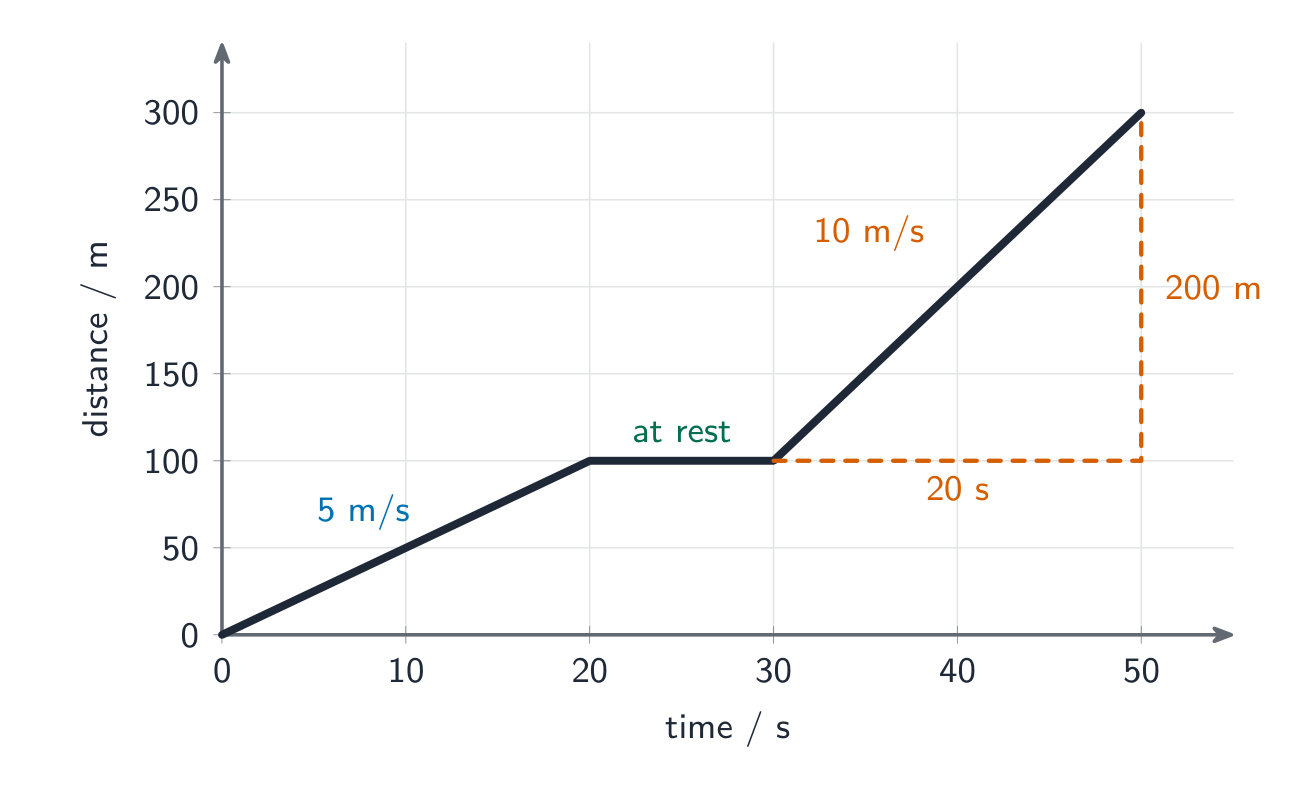
Worked example. Use the cyclist's graph.
- 0–20 s: speed = gradient = 100 m ÷ 20 s = 5 m/s.
- 20–30 s: the line is flat, so the cyclist is at rest.
- 30–50 s: rise = 300 − 100 = 200 m, run = 50 − 30 = 20 s, so speed = 200 ÷ 20 = 10 m/s. The line is steeper, so the cyclist is faster.
- Average speed for the whole trip = total distance ÷ total time = 300 m ÷ 50 s = 6 m/s. The stop counts in the total time.
On a distance–time graph, a flat (horizontal) line means the object is:
难度 1/5 · 今日首次完成可获 100 金币及少量额外奖励
A flat distance–time line means the distance is not changing — the object is at rest.
On a distance–time graph, a straight section goes from (10 s, 40 m) to (25 s, 160 m). What is the speed, in m/s?
难度 2/5 · 今日首次完成可获 140 金币及少量额外奖励
Gradient = rise ÷ run = (160 − 40) ÷ (25 − 10) = 120 ÷ 15 = 8 m/s.
A bus travels 3.0 km in 5 minutes, waits at a stop for 1 minute, then travels 1.8 km in 4 minutes. What is its average speed for the whole trip, in m/s?
难度 2/5 · 今日首次完成可获 140 金币及少量额外奖励
Total distance = 4800 m. Total time = 10 minutes = 600 s, including the stop. Average speed = 4800 ÷ 600 = 8 m/s.
Speed–time graphs
| Shape of the line | What the object is doing |
|---|---|
| flat | constant speed |
| straight, sloping up | constant acceleration |
| straight, sloping down | constant deceleration |
| curved | changing acceleration |
- Gradient = acceleration. Area under the line = distance travelled.
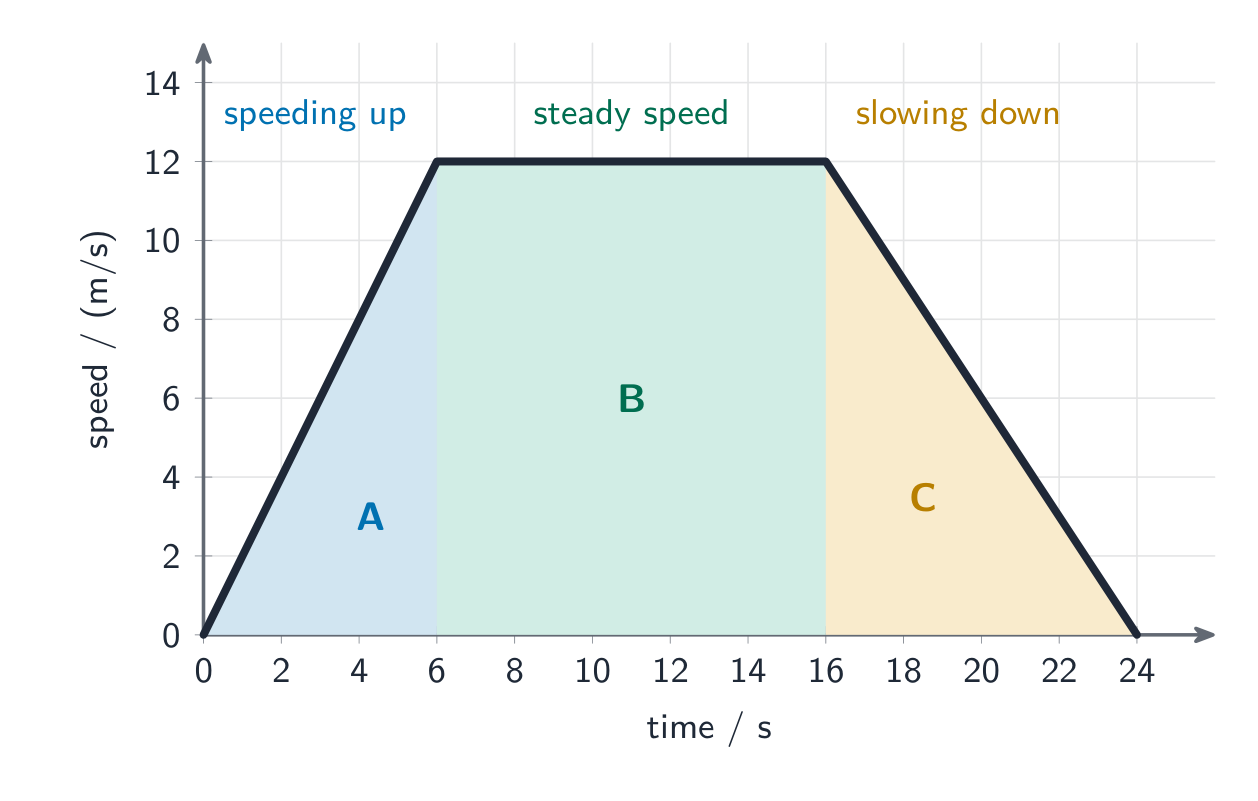
Exam question. The graph shows a bus moving between two stops.
(a) Calculate the acceleration in section A. [2]
- a = change in speed ÷ time = (12 − 0) ÷ 6 = 2 m/s² (2)
(b) Calculate the acceleration in section C. [2]
- a = (0 − 12) ÷ (24 − 16) = −12 ÷ 8 = −1.5 m/s² (2). The minus sign shows a deceleration of 1.5 m/s².
(c) Calculate the total distance between the stops. [3]
- A (triangle): ½ × 6 × 12 = 36 m. B (rectangle): 10 × 12 = 120 m. C (triangle): ½ × 8 × 12 = 48 m (2).
- Total = 36 + 120 + 48 = 204 m (1).
- Mark-scheme reasoning: most lost marks come from using the gradient for distance, or from reading 16 s instead of 16 − 6 = 10 s as the width of B. Write each area separately so the examiner can credit your method.
On a speed–time graph, the area under the line is the distance travelled.
难度 1/5 · 今日首次完成可获 100 金币及少量额外奖励
Speed × time = distance, and that is exactly the area under a speed–time line.
A car travels at a constant $10\ \text{m/s}$ for $6.0\ \text{s}$. From the speed–time graph (area), how far does it go, in m?
难度 2/5 · 今日首次完成可获 140 金币及少量额外奖励
The area is a rectangle: $10 \times 6.0 = 60\ \text{m}$.
On a speed–time graph, the line curves upwards and gets less steep. What is the object doing?
难度 1/5 · 今日首次完成可获 100 金币及少量额外奖励
The line still rises, so the speed increases. The gradient (the acceleration) gets smaller, so the acceleration is decreasing. A straight slope would mean constant acceleration.
A car speeds up steadily from 8 m/s to 20 m/s in 6 s. Using the area under the speed–time graph, how far does it travel in that time, in m?
难度 2/5 · 今日首次完成可获 140 金币及少量额外奖励
The area is a trapezium: ½ × (8 + 20) × 6 = 84 m. Or split it: rectangle 8 × 6 = 48 m plus triangle ½ × 6 × 12 = 36 m.
Falling objects
- Near the Earth's surface, without air resistance, every object falls with the same constant acceleration: the acceleration of free fall 自由落体 $g \approx 9.8\ \text{m/s}^2$. A hammer and a feather dropped on the Moon land together.
- With air resistance 空气阻力 (or resistance from a liquid), the motion has three stages:
| Stage | Forces | Motion |
|---|---|---|
| 1. just after release | only weight acts; air resistance is zero | acceleration = $g$ |
| 2. falling faster | air resistance grows with speed; resultant force = weight − air resistance gets smaller | still speeding up, but the acceleration decreases |
| 3. terminal velocity 收尾速度 | air resistance = weight; resultant force = 0 | constant speed, acceleration = 0 |
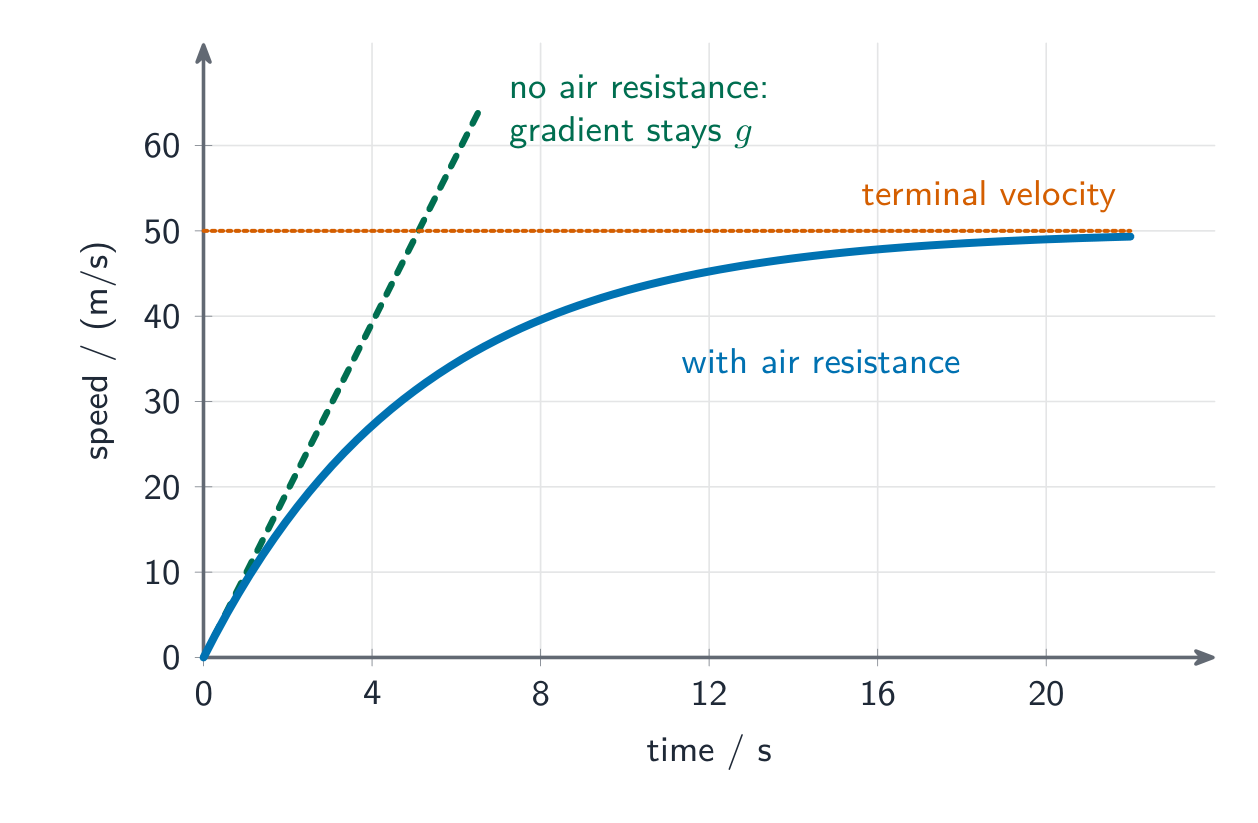
At terminal velocity the object is still moving fast. Zero resultant force means no acceleration, not "no motion". Write "the forces are balanced, so the speed is constant".
A skydiver reaches terminal velocity. This happens because:
难度 1/5 · 今日首次完成可获 100 金币及少量额外奖励
As speed rises, air resistance grows until it balances the weight. The resultant force is then zero, so the speed stays steady.
Put the stages of a skydiver's fall in order, starting at the jump.
难度 3/5 · 今日首次完成可获 200 金币及少量额外奖励
Air resistance grows with speed, which shrinks the resultant force until it is zero at terminal velocity.
You've got it
- speed $v = \dfrac{s}{t}$; average speed = total distance ÷ total time (stops included); velocity = speed in a given direction
- acceleration $a = \dfrac{\Delta v}{\Delta t}$ in m/s²; a deceleration is a negative acceleration
- distance–time: flat = at rest, gradient = speed, curve = speed changing
- speed–time: flat = constant speed, straight slope = constant acceleration, curve = changing acceleration; gradient = acceleration, area = distance
- free fall: $g \approx 9.8\ \text{m/s}^2$; with air resistance the object reaches terminal velocity when air resistance = weight
Velocity changes from 4 to 16 metres per second in 8 s at constant acceleration. What are the acceleration and the displacement?
The change in velocity is 12 metres per second. Average velocity 10 times 8 s is 80 metres.
What is the acceleration?
难度 1/5 · 今日首次完成可获 100 金币及少量额外奖励
12 divided by 8 is 1.5 metres per second squared.