| English | 释义 | 拼音 |
|---|---|---|
| mass/mæs/ | 质量 | zhì liàng |
| weight/weɪt/ | 重力 | zhòng lì |
| density/ˈdensɪti/ | 密度 | mì dù |
| matter/ˈmætə/ | 物质 | wù zhì |
| gravitational field/ˌɡrævɪˈteɪʃənl fiːld/ | 引力场 | yǐn lì chǎng |
| gravitational field strength/ˌɡrævɪˈteɪʃənl fiːld streŋθ/ | 重力场强度 | zhòng lì chǎng qiáng dù |
| displacement/dɪˈspleɪsmənt/ | 排水法 | pái shuǐ fǎ |
Same you, lighter on the Moon
- An astronaut on the Moon can jump high and feels light, yet their body is exactly the same as on Earth.
- Two different ideas explain this: mass 质量 and weight 重力. Then we use mass to find density 密度, which decides whether things float or sink.
Mass
- Mass is the amount of matter 物质 in an object. Its unit is the kilogram (kg).
- Mass does not change when the object moves: on the Moon or in space it is the same.
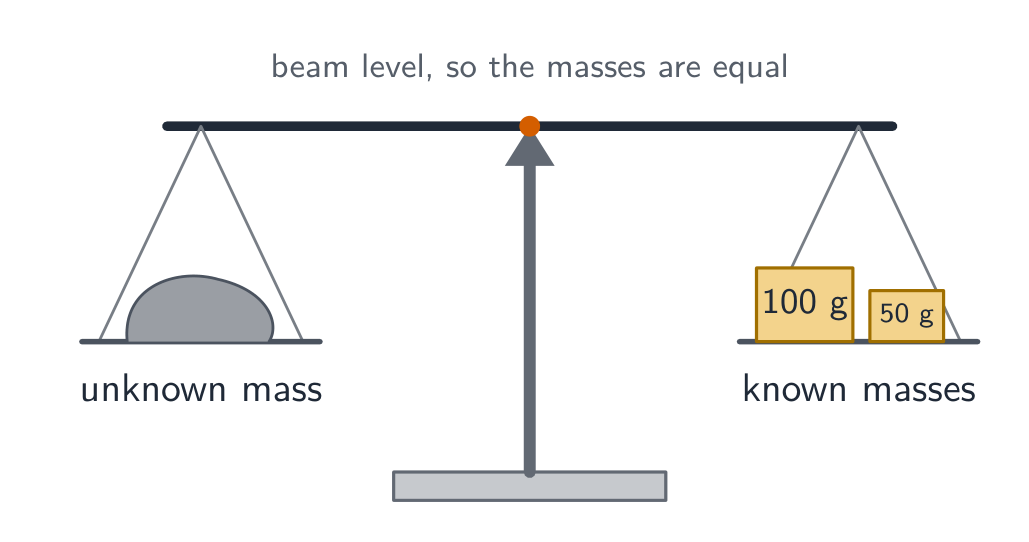
- A balance compares masses. When the beam is level, the unknown mass equals the known masses. Because both pans are in the same gravity, a balance also compares weights.
Weight and gravitational field strength
- Weight is the gravitational force on an object because it has mass. It is a force, so it is measured in newtons (N).
- A planet or moon has a gravitational field 引力场 around it. The gravitational field strength 重力场强度 $g$ is the force on each kilogram:
- On Earth $g$ = 9.8 N/kg; on the Moon $g$ = 1.6 N/kg. $g$ is also the acceleration of free fall: on Earth a falling object speeds up by 9.8 m/s every second.
Worked example. An astronaut has a mass of 70 kg. Find her weight on Earth and on the Moon.
- Earth: W = mg = 70 × 9.8 = 686 N. Moon: W = 70 × 1.6 = 112 N.
- Her mass is 70 kg in both places. Only the weight changes, because the Moon's field is weaker.
Weight is a force, not a mass. "My weight is 60 kg" is everyday language, but in physics it is wrong: 60 kg is a mass, and that person's weight on Earth is about 590 N.
Weight and mass
W = mg
Weight is proportional to mass: the gradient is the gravitational field strength g (9.8 N/kg on Earth).
An astronaut travels from Earth to the Moon. What happens to their 质量 and 重量?
难度 1/5 · 今日首次完成可获 100 金币及少量额外奖励
Mass (amount of matter) never changes. Weight is the force of gravity, and the Moon's gravity is weaker, so the weight is smaller.
A bag has a mass of $5.0\ \text{kg}$. What is its weight on Earth, in N? (Use $g = 9.8\ \text{N/kg}$.)
难度 2/5 · 今日首次完成可获 140 金币及少量额外奖励
$W = mg = 5.0 \times 9.8 = 49\ \text{N}$.
A rover has a mass of 900 kg. What is its weight on the Moon, where g = 1.6 N/kg? Give your answer in N.
难度 2/5 · 今日首次完成可获 140 金币及少量额外奖励
W = mg = 900 × 1.6 = 1440 N. Its mass is still 900 kg; on Earth it would weigh 900 × 9.8 = 8820 N.
A 2.0 kg mass weighs 7.4 N on Mars. What is the gravitational field strength on Mars, in N/kg?
难度 2/5 · 今日首次完成可获 140 金币及少量额外奖励
g = W ÷ m = 7.4 ÷ 2.0 = 3.7 N/kg.
Density
- Density is the mass per unit volume: how much mass is packed into each cm³ or m³.
- $\rho$ is the Greek letter "rho". Units: g/cm³ or kg/m³. To change g/cm³ into kg/m³, multiply by 1000 (water: 1.0 g/cm³ = 1000 kg/m³).
- A small, heavy object (a steel nut) has a high density; a large, light one (a block of foam) has a low density.
A metal block has a mass of $240\ \text{g}$ and a volume of $30\ \text{cm}^3$. What is its density, in g/cm³?
难度 2/5 · 今日首次完成可获 140 金币及少量额外奖励
$\rho = \dfrac{m}{V} = \dfrac{240}{30} = 8.0\ \text{g/cm}^3$.
Aluminium has a density of 2.7 g/cm³. What is this in kg/m³?
难度 2/5 · 今日首次完成可获 140 金币及少量额外奖励
Multiply by 1000: 2.7 g/cm³ = 2700 kg/m³.
Measuring density
| Object | Mass | Volume |
|---|---|---|
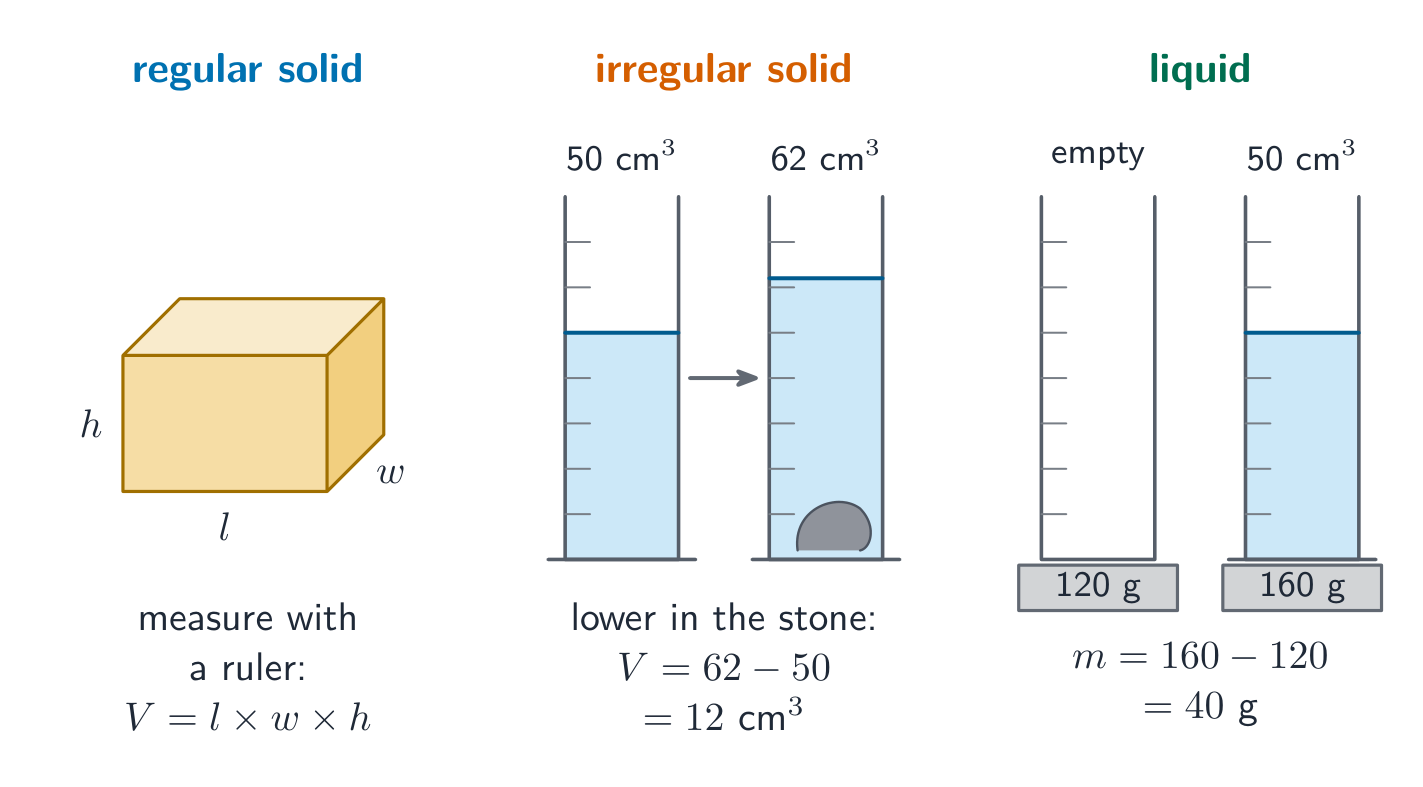
| regular solid (a block) | balance | measure the sides with a ruler; V = l × w × h |
| irregular solid that sinks (a stone) | balance | displacement 排水法: the rise in water level in a measuring cylinder |
| liquid | mass of cylinder + liquid, minus mass of the empty cylinder | read the measuring cylinder (eye level with the bottom of the meniscus) |
Worked example. Use the readings in the diagram.
- Stone: mass 30 g (from a balance), volume = 62 − 50 = 12 cm³. Density = 30 ÷ 12 = 2.5 g/cm³.
- Liquid: mass = 160 − 120 = 40 g, volume 50 cm³. Density = 40 ÷ 50 = 0.80 g/cm³ (800 kg/m³).
- Common mistake: using 62 cm³ as the stone's volume. It is the change in reading.
How do you find the volume of a small, oddly-shaped stone?
难度 1/5 · 今日首次完成可获 100 金币及少量额外奖励
The stone pushes the water up. The rise in the water level equals the stone's volume — the displacement method.
Water in a measuring cylinder reads $50\ \text{cm}^3$. After a stone is added it reads $74\ \text{cm}^3$. What is the volume of the stone, in cm³?
难度 2/5 · 今日首次完成可获 140 金币及少量额外奖励
The volume is the rise in level: $74 - 50 = 24\ \text{cm}^3$.
An empty measuring cylinder has a mass of 95 g. With 80 cm³ of oil in it, the mass is 167 g. Find the density of the oil, in g/cm³.
难度 2/5 · 今日首次完成可获 140 金币及少量额外奖励
Mass of oil = 167 − 95 = 72 g. Density = 72 ÷ 80 = 0.90 g/cm³.
Floating and sinking
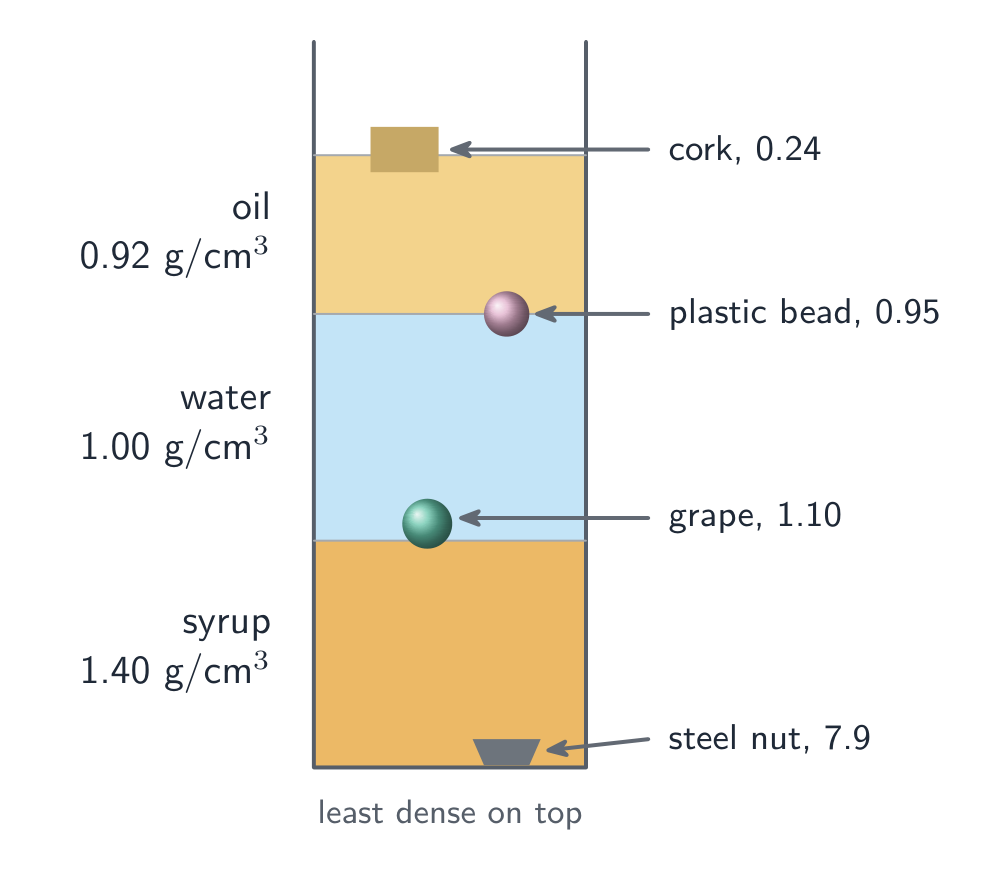
- A solid floats in a liquid if its density is less than the liquid's, and sinks if it is greater. Ice (0.92 g/cm³) floats on water (1.00 g/cm³).
- Liquids that do not mix behave the same way: the less dense liquid floats on top. Oil floats on water.
Exam question. A liquid has density 1.26 g/cm³. A small block has mass 54 g and volume 60 cm³. Does the block float or sink in the liquid? Show your working. [2]
- Density of the block = 54 ÷ 60 = 0.90 g/cm³ (1).
- 0.90 is less than 1.26, so the block floats (1).
- Mark-scheme reasoning: the second mark needs the comparison of the two densities, not just "it floats".
Floating and density
Change the object's density and the liquid: it floats if it's less dense, and the denser it is the more sits underwater. Iron sinks in water but floats on mercury.
An object floats on a liquid if its density is less than the density of the liquid.
难度 1/5 · 今日首次完成可获 100 金币及少量额外奖励
Less dense than the liquid → it floats; denser than the liquid → it sinks.
Three liquids that do not mix are poured into a tube: A (1.26 g/cm³), B (0.79 g/cm³) and C (1.00 g/cm³). Which order do they settle in, from top to bottom?
难度 1/5 · 今日首次完成可获 100 金币及少量额外奖励
The least dense liquid floats on top: B (0.79), then C (1.00), then A (1.26) at the bottom.
A ball has mass 130 g and volume 100 cm³. Does it float in water (1.00 g/cm³)?
难度 1/5 · 今日首次完成可获 100 金币及少量额外奖励
Density = 130 ÷ 100 = 1.3 g/cm³. This is greater than 1.00 g/cm³, so it sinks. (0.77 comes from dividing the wrong way round.)
You've got it
- mass = amount of matter (kg), the same everywhere; weight = gravitational force (N)
- $g = \dfrac{W}{m}$: 9.8 N/kg on Earth, 1.6 N/kg on the Moon; also the acceleration of free fall
- a balance compares masses (and weights)
- density $\rho = \dfrac{m}{V}$; g/cm³ × 1000 = kg/m³
- volume: ruler for a block, displacement for a stone; a liquid's mass = full − empty
- less dense than the liquid → floats; less dense liquids float on denser ones
A block has mass 180 g and volume 20 cubic centimetres. What is its density, and what happens to its mass if it is taken to the Moon?
180 divided by 20 is 9. Mass does not depend on the local gravitational field strength.
A block has mass 180 g and volume 20 cm³. What is its density, and what happens to its mass on the Moon?
难度 1/5 · 今日首次完成可获 100 金币及少量额外奖励
180 divided by 20 is 9 grams per cubic centimetre.