| English | 释义 | 拼音 |
|---|---|---|
| bias/ˈbaɪəs/ | 偏倚 | piān yǐ |
| fair/feə/ | 公平 | gōng píng |
| relative frequency/ˈrelətɪv ˈfriːkwənsi/ | 相对频率 | xiāng duì pín lǜ |
| trial/ˈtraɪəl/ | 试验 | shì yàn |
| random/ˈrændəm/ | 随机 | suí jī |
| ordered pair/ˈɔːdəd peə/ | 有序数对 | yǒu xù shù duì |
| expected frequency/ekˈspektɪd ˈfriːkwənsi/ | 期望频数 | qī wàng pín shù |
Does 60 heads prove a coin is biased 偏倚?
- A club gets 60 heads in 100 coin flips. The observed proportion is $\dfrac{60}{100}=0.6$, but a fair 公平 coin can also give an uneven result by chance.
- A fair coin has probability $\dfrac{1}{2}$ of heads on each flip. Bias means the chances differ from the fair model. More evidence helps us judge the model; a finite experiment does not prove it with certainty.
Use results to estimate probability
- Relative frequency 相对频率 is an estimate based on what happened. Use experiments when a probability is unknown, or to compare results with a known model.
- Count all the trials 试验, including failures. The estimate lies between $0$ and $1$; a percentage needs a further multiplication by $100$.
A drawing pin lands point-up 84 times in 200 drops. Its relative frequency of point-up is $\dfrac{84}{200}=0.42$, or $42\%$. The other 116 drops must stay in the denominator.
相对频率的计算方式是:
难度 1/5 · 今日首次完成可获 100 金币及少量额外奖励
相对频率 = 成功数 ÷ 试验数。
一颗图钉被掉落 200 次,尖朝上落地 84 次。尖朝上的相对频率是(到 2 位小数):
难度 2/5 · 今日首次完成可获 140 金币及少量额外奖励
84/200 = 0.42.
转盘在150次旋转中停在蓝色区域63次。估算P(蓝色),用小数表示。
难度 2/5 · 今日首次完成可获 140 金币及少量额外奖励
63 ÷ 150 = 0.42.
某测试有28次成功和12次失败。哪个计算式能得出成功的相对频率?
难度 1/5 · 今日首次完成可获 100 金币及少量额外奖励
所有40次试验都应计入分母,而不仅仅是失败次数。
More evidence, with limits
- With the same method and stable chances, more trials usually give a more reliable estimate. The next trial can still move the estimate away from the true probability.
- Random 随机 means an individual result is decided by chance. It does not mean equally likely: a biased coin can still give random results. More trials do not repair a bent spinner or an unrepresentative sample.
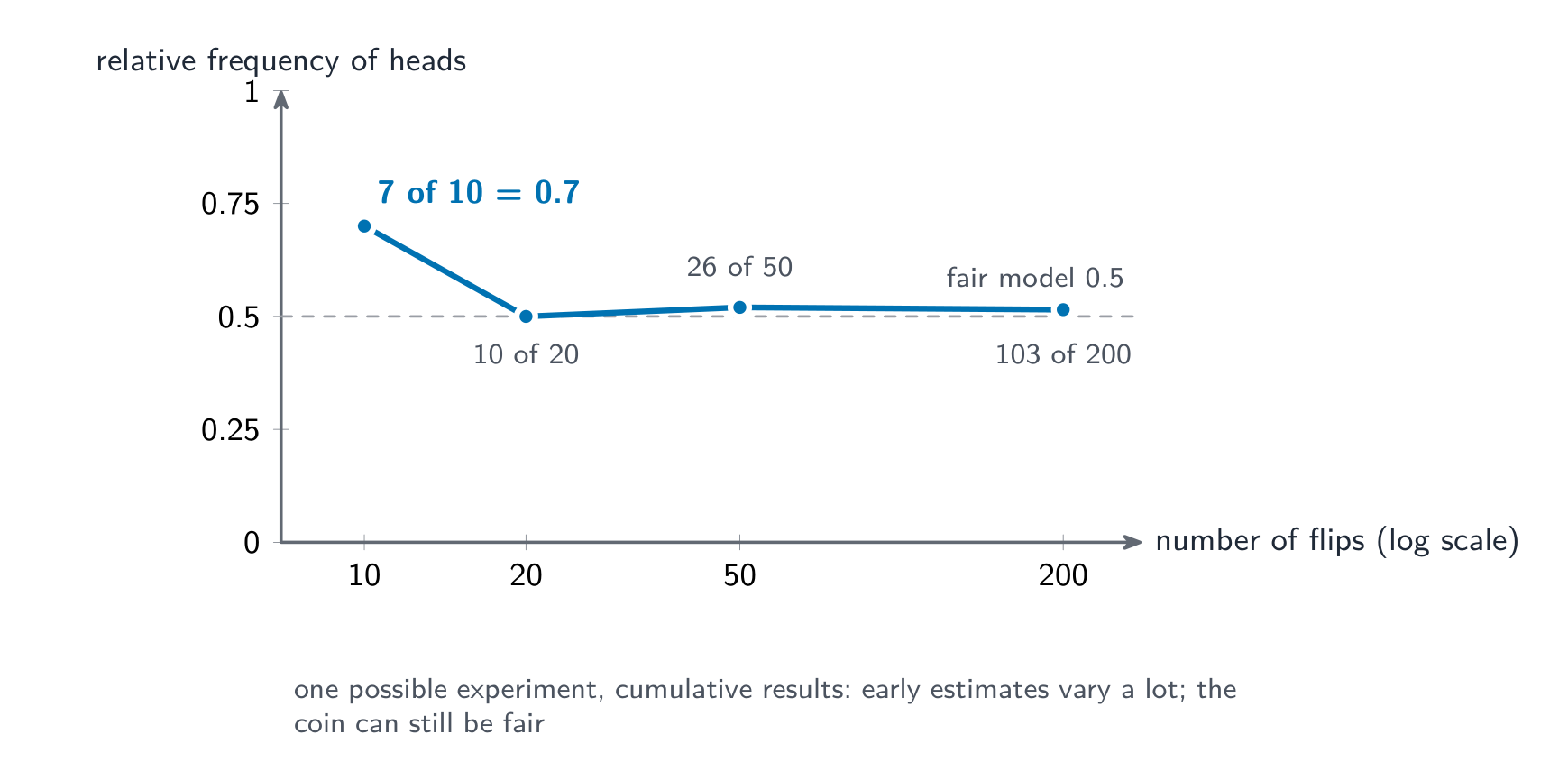
These illustrative results could come from one fair-coin experiment. Between 20 and 50 flips, the estimate moves away from 0.5.
在条件不变的情况下,增加可比较的试验次数通常能提供更可靠的概率估计。
难度 1/5 · 今日首次完成可获 100 金币及少量额外奖励
较大的可比较实验通常会降低比例的偶然波动,但每增加一次试验并不一定使估计值更接近真实值。
每次增加的试验都必须使相对频率更接近真实概率。
难度 1/5 · 今日首次完成可获 100 金币及少量额外奖励
偶然波动可能使其偏离。总体而言,大型可比较实验通常更可靠。
一枚硬币出现正面的概率为0.8,反面的概率为0.2。哪项描述符合该情况?
难度 1/5 · 今日首次完成可获 100 金币及少量额外奖励
随机结果可以具有不相等的概率。公平硬币出现正面和反面的机会相等。
Equally likely pairs, unequal totals
- For two independent fair six-sided dice, there are $6\times6=36$ equally likely ordered pairs 有序数对. A cell records the first die and the second die; $(1,6)$ and $(6,1)$ are different cells.
- The totals $2$ to $12$ are not equally likely. Six cells give $7$, so $\text{P}(7)=\dfrac{6}{36}=\dfrac{1}{6}$. Only one gives $2$, so $\text{P}(2)=\dfrac{1}{36}$.
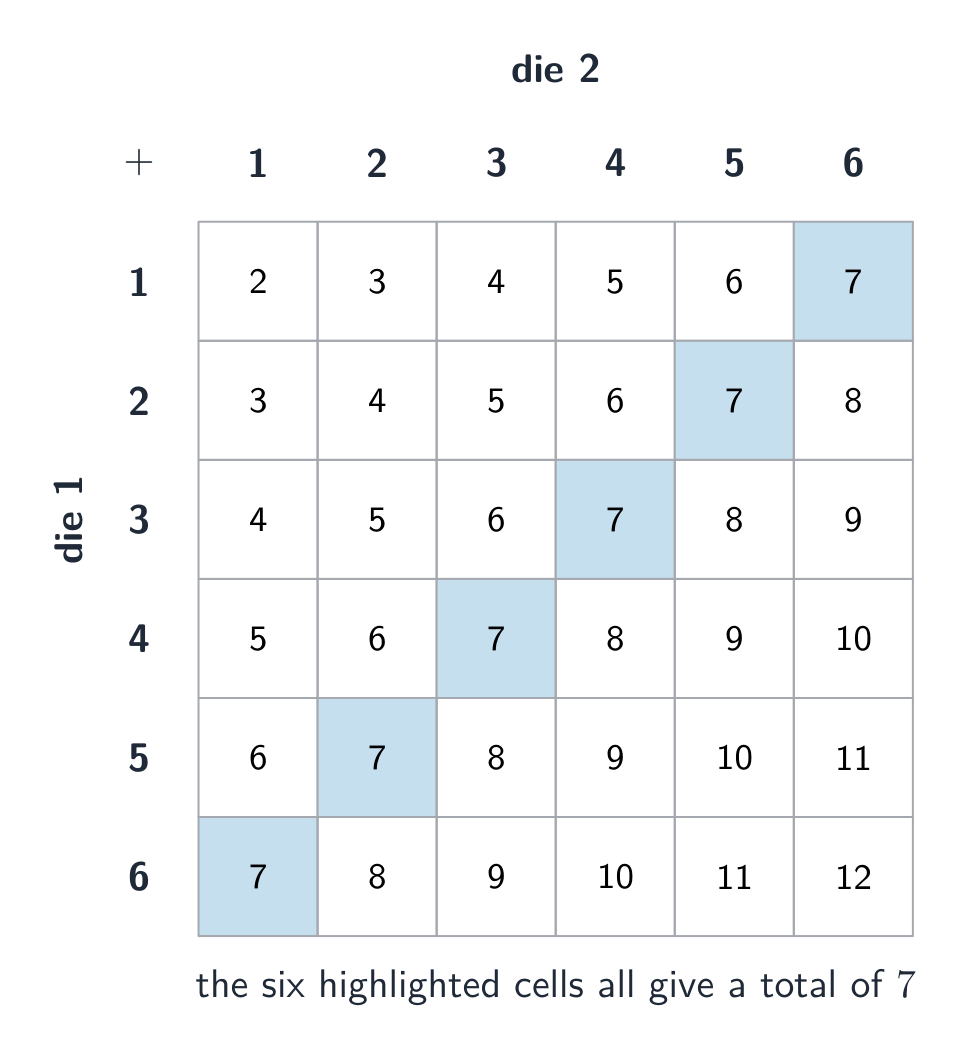
两颗骰子的概率
比较两个独立公平骰子的观测比例与理论概率。每个柱状图及其标记使用相同的概率刻度;有限结果会有所不同。
对于两个独立的公平六面骰子,为什么总和为7比总和为2更有可能?
难度 1/5 · 今日首次完成可获 100 金币及少量额外奖励
每个有序对的概率为1/36。统计特定总和对应的单元格数量,而不仅仅是总和的种类数。
Expected frequency 期望频数 counts future events
- Expected frequency is a predicted count, using a probability and a number of trials. Keep the probability as a fraction or decimal: $20\%=0.2$.
- Use the same probability for the stated trials. For fixed probability, doubling the number of trials doubles the expected count.
Expected does not mean guaranteed. An expected count can be non-integer: $0.3\times15=4.5$. A single experiment has a whole-number count, but its long-run average need not be a whole number.
期望频率 = P(事件) × ______ 数。
难度 1/5 · 今日首次完成可获 100 金币及少量额外奖励
期望频率 = 概率 × 试验次数。
公交车在每个上学日迟到的概率为0.15。在120个上学日内,迟到天数的期望值是多少?
难度 2/5 · 今日首次完成可获 140 金币及少量额外奖励
0.15 × 120 = 18;实际数值可能会有所不同。
某事件在15次试验中每次发生的概率均为0.3。如何理解期望计数为4.5的含义?
难度 1/5 · 今日首次完成可获 100 金币及少量额外奖励
期望计数不是概率,且可以为非整数。除非题目要求,否则不要四舍五入。
Worked examples: choose the right direction
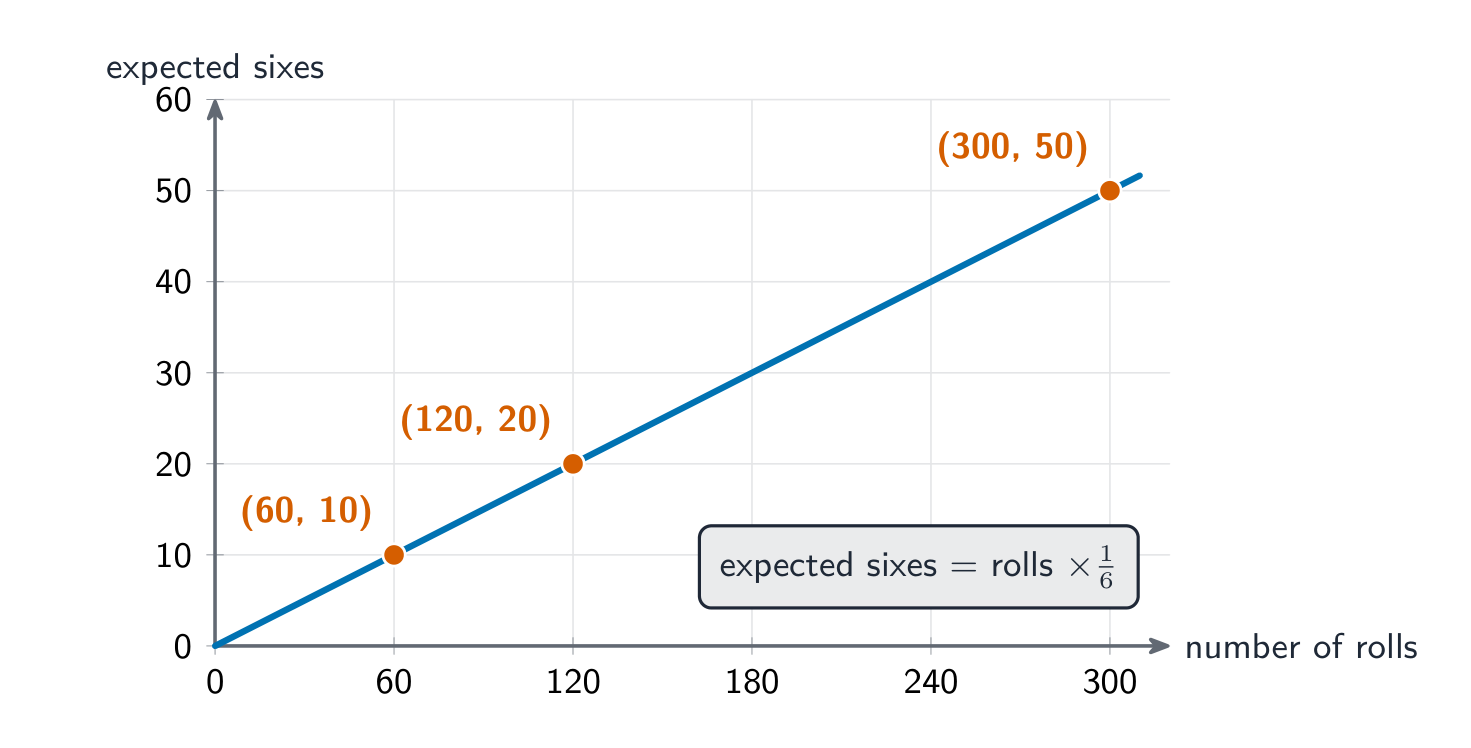
- For a fair die, $\text{P}(\text{six})=\dfrac{1}{6}$. In 300 rolls, the expected count is $\dfrac{1}{6}\times300=50$. It is not a promise of exactly 50 sixes.
- A machine has a constant probability $0.2$ of rejecting an item. In 50 items, the expected rejected count is $0.2\times50=10$. Relative frequency instead starts with an observed count and divides by the total.
掷出一个六的概率是 1/6。在 300 次掷中期望多少个六?
难度 2/5 · 今日首次完成可获 140 金币及少量额外奖励
(1/6) × 300 = 50.
一台机器以恒定概率0.2拒绝每件产品。在50件产品中预计有多少件被拒收?
难度 2/5 · 今日首次完成可获 140 金币及少量额外奖励
0.2 × 50 = 10.
一家工厂估计其产品中约有6%存在缺陷。如果条件保持不变,在450件产品中预计有多少件有缺陷?
难度 2/5 · 今日首次完成可获 140 金币及少量额外奖励
6% 等于 0.06,因此 0.06 × 450 = 27。
Estimate a future count from an experiment
- The drawing pin gave $84$ point-up results in $200$ drops. Use $0.42$ as an estimated probability: in another $500$ drops, predict $0.42\times500=210$ point-up results.
- This prediction assumes similar conditions. For a population estimate, the tested sample must represent that population; selecting only visibly damaged items would not estimate the defect rate of all items fairly.
Combine counts before dividing. Two comparable batches give 12 successes in 40 trials and 36 in 60. Together the relative frequency is $\dfrac{12+36}{40+60}=0.48$, not the unweighted average of $0.3$ and $0.6$.
两个可比较的实验分别在60次试验中出现18次成功和100次试验中出现52次成功。利用所有结果估算概率。
难度 2/5 · 今日首次完成可获 140 金币及少量额外奖励
(18 + 52) ÷ (60 + 100) = 70/160 = 0.4375。应合并计数,而非取未加权的平均值。
从250件物品的随机样本中发现8件有缺陷。估算在2000件类似物品中可能有多少件有缺陷。
难度 2/5 · 今日首次完成可获 140 金币及少量额外奖励
8/250 = 0.032,然后 0.032 × 2000 = 64。这依赖于代表性样本及相似的条件。
Explain your prediction
- Decide whether a question asks for a probability estimate or an expected count. Show the calculation, then interpret the answer in the context.
- Check whether the method and conditions justify using the probability. Explain why an actual count can differ from an expected count.
某事件的概率为4/1。在80次试验中,预计会发生多少次?
80的四分之一是20。
商店从一批到货中抽取了75个明显破损的包裹进行检测,发现其中30件有缺陷。一名学生预测该批货物中每件物品的缺陷率为40%。请解释计算过程并评价该预测。
陈述方法,展示算术过程,并利用所给信息对结论加以限定。
一枚硬币在 20 次投掷中出现了 13 次正面。一名学生声称该硬币必然存在偏差,且另一次 20 投掷必须出现 7 次正面才能与第一组结果相平衡。请评估这两种说法。
陈述方法,展示算术过程,并利用所给信息对结论加以限定。
一个稳定过程的每次试验成功概率为 0.35。需要进行多少次试验才能得到期望的 91 次成功?解释为何这无法保证实际出现恰好 91 次成功。
陈述方法,展示算术过程,并利用所给信息对结论加以限定。
Keep the two calculations separate
- Relative frequency: observed successes divided by all trials. More comparable trials usually help, but not at every step.
- Expected frequency: probability multiplied by trials. It is a count prediction, not a guaranteed result.
- Random does not mean fair. For two fair independent dice, the 36 ordered pairs are equally likely; their totals are not.
回顾同一事件在80次试验中发生的概率为1/4。哪个期望频数是正确的?
难度 1/5 · 今日首次完成可获 100 金币及少量额外奖励
80 × 1/4 = 20。重复练习在此处使用相同数据;实际计数不一定等于20。