Combined events · 复合事件
| English | 中文 | Pinyin · 拼音 |
|---|---|---|
| independent/ˌɪndɪˈpendənt/ | 独立的 | dú lì de |
| mutually exclusive/ˈmjuːtʃuːəli eksˈkluːsɪv/ | 互斥 | hù chì |
| sample space/ˈsæmpl speɪs/ | 样本空间 | yàng běn kōng jiān |
| tree diagram/triː ˈdaɪəɡræm/ | 树状图 | shù zhuàng tú |
| replacement/rɪˈpleɪsmənt/ | 放回 | fàng huí |
Two events at once
- You roll a die and flip a coin. What's the chance of a six AND heads?
- Combined events need two rules: AND (multiply) and OR (add).
同时两个事件
- 你掷一颗骰子并掷一枚硬币。一个六和正面的机会是多少?
- 组合事件需要两条规则:AND(乘)和 OR(加)。
AND — multiply (independent 独立的 events)
- For two independent events (one doesn't affect the other):
$\text{P}(\text{six and heads}) = \dfrac{1}{6} \times \dfrac{1}{2} = \dfrac{1}{12}$.
AND——乘(独立事件)
- 对两个独立(independent)事件(一个不影响另一个):
$\text{P}(\text{six and heads}) = \dfrac{1}{6} \times \dfrac{1}{2} = \dfrac{1}{12}$.
Combined events · 复合事件
P(A ∩ B) = P(A)·P(B|A)
Combine two events: the area model shows AND (overlap) versus OR (union). · 组合两个事件:面积模型显示 AND(重叠)对 OR(并集)。
For two independent events both happening (AND), you: · 对两个独立事件都发生(AND),你:
P(A and B) = P(A) × P(B) for independent events. · 对独立事件 P(A 和 B) = P(A) × P(B)。
OR — add (mutually exclusive 互斥 events)
- For two mutually exclusive events (they can't both happen):
OR——加(互斥事件)
- 对两个互斥(mutually exclusive)事件(它们不能都发生):
Probability tree · 概率树
Multiply the probabilities along each branch; the four outcomes always add up to 1. · 沿每个分支把概率相乘;四个结果加起来总是 1。
For mutually exclusive events, P(A or B) = P(A) + P(B). · 对互斥事件,P(A 或 B) = P(A) + P(B)。
Mutually exclusive events cannot both happen, so you add their probabilities. · 互斥事件不能都发生,所以你把它们的概率相加。
Three ways to show outcomes
- Sample space 样本空间 diagram: a table of every outcome (two dice → $36$ cells).
- Venn diagram: sorts outcomes into overlapping sets.
- Tree diagram 树状图: a branch per stage; multiply along branches, then add the paths you want.
A Venn diagram sorts outcomes: the overlap is $\text{P}(A\text{ and }B)$, and everything inside either circle is $\text{P}(A\text{ or }B)$
Multiply along, add between. On a tree diagram: multiply probabilities along each branch (to get that path's probability), then add the paths you want (to get the total probability).
显示结果的三种方式
- 样本空间图(sample space diagram):每个结果的一个表(两颗骰子 → $36$ 个单元格)。
- 韦恩图(Venn diagram):把结果分类到重叠的集合中。
- 树状图(tree diagram):每个阶段一个分支;沿分支相乘,然后加你想要的路径。
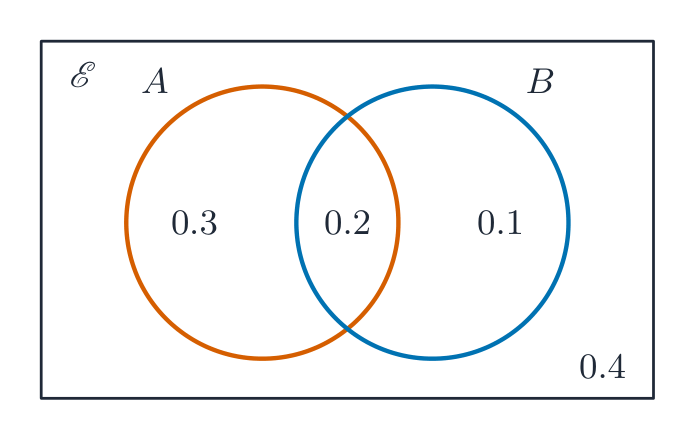
一个韦恩图把结果分类:重叠是 $\text{P}(A\text{ and }B)$,而任一圆内的一切是 $\text{P}(A\text{ or }B)$
沿着相乘,之间相加。 在一个树状图上:沿每个分支相乘概率(得到那条路径的概率),然后加你想要的路径(得到总概率)。
On the 6 by 6 grid of two dice (36 cells), how many cells give a total of 7? · 在两颗骰子的 6 乘 6 网格(36 个单元格)上,多少个单元格给出总和 7?
1+6, 2+5, 3+4, 4+3, 5+2, 6+1 — six cells, so P(7) = 6/36 = 1/6. · 1+6、2+5、3+4、4+3、5+2、6+1——六个单元格,所以 P(7) = 6/36 = 1/6。
On a tree diagram, you ______ along branches and add between paths. · 在一个树状图上,你沿分支______并在路径之间相加。
Multiply along each branch to get that path probability, then add the wanted paths. · 沿每个分支相乘得到那条路径的概率,然后加想要的路径。
With and without replacement 放回
- With replacement: chances stay the same each time.
- Without replacement (Extended): the total and the count change after each draw.
- Bag of $3$ red, $5$ blue: P(red, red) with replacement $= \dfrac{3}{8} \times \dfrac{3}{8} = \dfrac{9}{64}$. Without replacement $= \dfrac{3}{8} \times \dfrac{2}{7} = \dfrac{3}{28}$.
Venn diagrams show combined events: the overlap (intersection) is AND, the whole region (union) is OR.
有放回和无放回
- 有放回(with replacement):机会每次保持相同。
- 无放回(without replacement,扩展):每次抽取后总数和计数改变。
- 袋子有 $3$ 个红、$5$ 个蓝:有放回 P(红,红) $= \dfrac{3}{8} \times \dfrac{3}{8} = \dfrac{9}{64}$。无放回 $= \dfrac{3}{8} \times \dfrac{2}{7} = \dfrac{3}{28}$。
韦恩图显示组合事件:重叠(交集)是 AND,整个区域(并集)是 OR。
Bag of 3 red, 5 blue, two draws WITH replacement. P(red, red) = 9/b. What is b? · 袋子有 3 个红、5 个蓝,两次有放回抽取。P(红,红) = 9/b。b 是多少?
(3/8) × (3/8) = 9/64, so b = 64. · (3/8) × (3/8) = 9/64,所以 b = 64。
Same bag, WITHOUT replacement. After one red is taken, how many reds remain? · 同一个袋子,无放回。取走一个红后,剩多少个红?
Started with 3 red; one taken leaves 2 red (out of 7 counters). · 从 3 个红开始;取走一个剩 2 个红(7 个筹码中)。
Exactly one means two paths
- Draw twice from 2 red and 3 blue counters with replacement. Each stage has red $2/5$ and blue $3/5$. Exactly one red includes RB and BR, so $p=(2/5)(3/5)+(3/5)(2/5)=12/25$.
- At least one red is easier by complement: $p=1-(3/5)^2=16/25$. This includes RR as well as the two mixed paths; do not confuse exactly one with at least one.
“恰好一次”意味着两条路径
- 从袋中有放回地抽取两次,袋中有2个红球和3个蓝球。每次抽取时红球概率为$2/5$,蓝球概率为$3/5$。“恰好一次红球”包含“先红后蓝”(RB)和“先蓝后红”(BR)两种情况,故总概率为$p=(2/5)(3/5)+(3/5)(2/5)=12/25$。
- “至少一次红球”可通过补集计算更为简便:用$p=1-(3/5)^2=16/25$减去对立事件。这包含了RR以及上述两种混合路径;注意不要将“恰好一次”与“至少一次”混淆。

With replacement from 2 red and 3 blue counters, find the probability of exactly one red in two draws. · 从 2 个红色计数器和 3 个蓝色计数器中有放回抽取,求两次抽取中恰好出现一个红色的概率。
RB and BR give 6/25 + 6/25 = 12/25 = 0.48. · RB 和 BR 给出 6/25 + 6/25 = 12/25 = 0.48。
You've got it
- AND → multiply (independent); OR → add (mutually exclusive)
- on a tree: multiply along branches, add the wanted paths
- without replacement, the second probability changes ($\dfrac{3}{8} \to \dfrac{2}{7}$)
你掌握了
- AND → 乘(独立);OR → 加(互斥)
- 在一个树上:沿分支相乘,加想要的路径
- 无放回,第二个概率改变($\dfrac{3}{8} \to \dfrac{2}{7}$)