| English | 释义 | 拼音 |
|---|---|---|
| transformations/trænsfɔːˈmeɪʃnz/ | 变换 | biàn huàn |
| reflection/rɪˈflekʃn/ | 反射 | fǎn shè |
| rotation/rəʊˈteɪʃn/ | 旋转 | xuán zhuǎn |
| enlargement/enˈlɑːdʒmənt/ | 放大 | fàng dà |
| mirror line/ˈmɪrə laɪn/ | 对称轴 | duì chèn zhóu |
| scale factor/skeɪl ˈfæktə/ | 比例因子 | bǐ lì yīn zǐ |
| translation/trænˈsleɪʃn/ | 平移 | píng yí |
| column vector/ˈkɒlʌm ˈvektə/ | 列向量 | liè xiàng liàng |
The mirror, the spin, the zoom, the slide
- Computer graphics use transformations 变换 to animate characters — reflections 反射 for mirror images, rotations 旋转 for spinning, enlargements 放大 for zooming.
- Every transformation needs a complete description to earn full marks.
Reflection
- Flips a shape over a mirror line 对称轴. Give the line's equation.
- Reflect $(3,2)$ in the $y$-axis → $(-3, 2)$ (only $x$'s sign changes).
- Reflect in the $x$-axis → $(3, -2)$ (only $y$'s sign changes).

Reflection in the $y$-axis: flip the sign of $x$. The shape stays the same size — it's congruent.
变换
(x, y) → (x', y')
Translate, reflect, rotate or enlarge a shape — and see what stays the same.
Reflect the point (3, 2) in the y-axis. The image is (a, 2). What is a?
难度 2/5 · 今日首次完成可获 140 金币及少量额外奖励
Reflecting in the y-axis flips the sign of x: a = −3.
Rotation
- Turns a shape about a centre. Give centre, angle, and direction.
- Rotate $(3,1)$ by $90^{\circ}$ anticlockwise about $O$: $(x,y) \to (-y, x) \to (-1, 3)$.
Quick rules about the origin: $90^{\circ}$ clockwise: $(x,y) \to (y, -x)$. $90^{\circ}$ anticlockwise: $(x,y) \to (-y, x)$. $180^{\circ}$: $(x,y) \to (-x, -y)$.
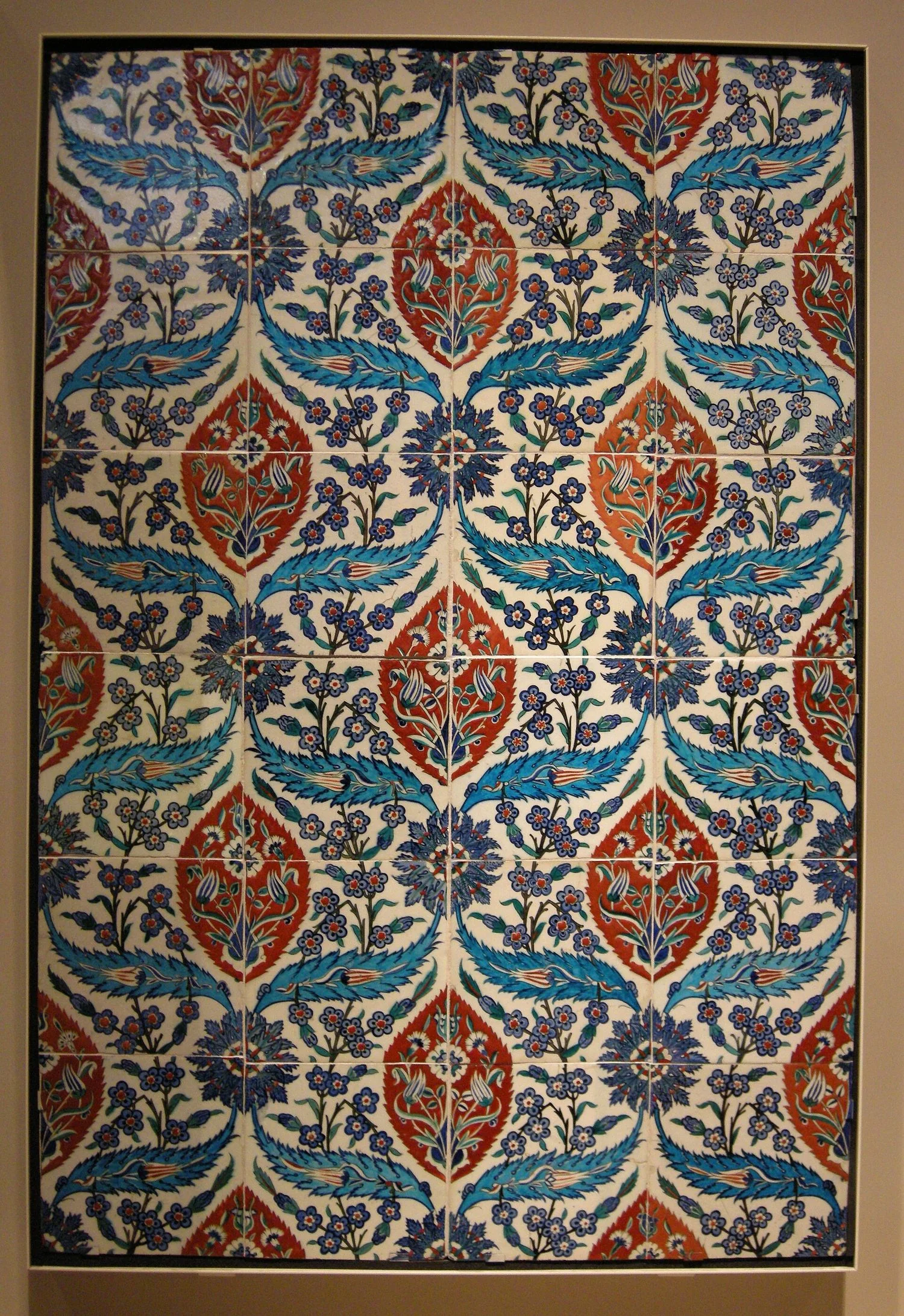
Geometric tiles are built by reflecting, rotating and translating shapes
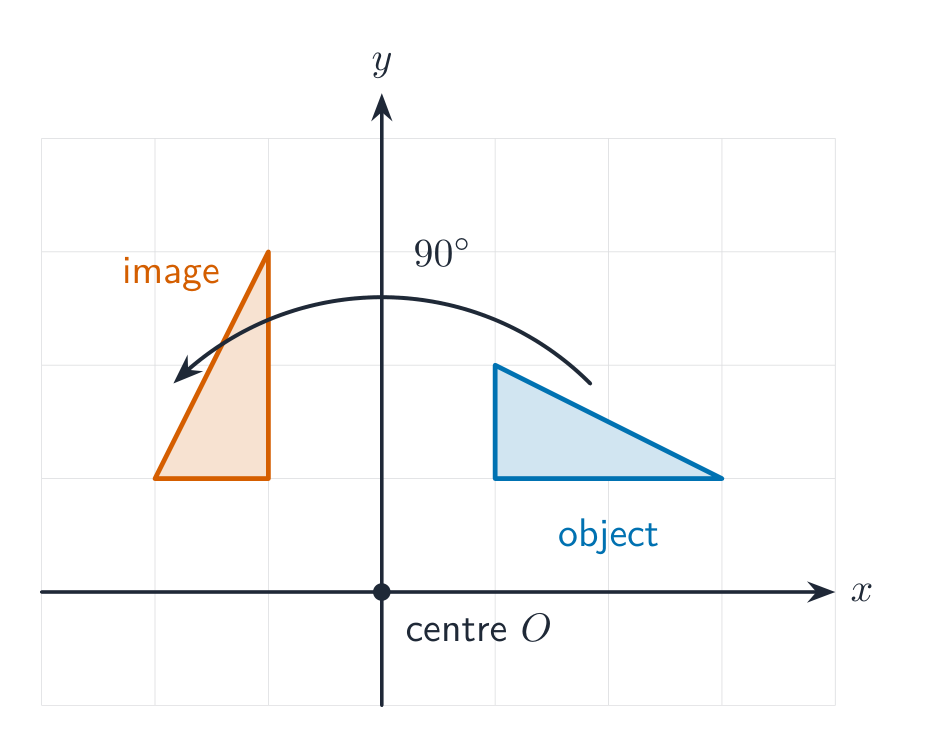
A rotation turns the shape about a fixed centre, here $90^\circ$ anticlockwise about the origin
Rotate (3, 1) by 90° anticlockwise about the origin. The rule is (x, y) → (−y, x). The image is (a, 3). What is a?
难度 2/5 · 今日首次完成可获 140 金币及少量额外奖励
(3, 1) → (−1, 3). So a = −1.
Enlargement
- Changes size by a scale factor 比例因子 $k$ from a centre. Give centre and $k$.
- Enlarge $(1,2)$ from $O$ by $k=2$ → $(2, 4)$.
- Core includes positive fractional factors: $k=\dfrac12$ makes it smaller. Extended also includes negative factors, such as $k=-1$, which puts the image on the opposite side of the centre.
Describe fully. "It got bigger" is not enough. You must give: centre of enlargement AND scale factor. Both are needed for full marks.
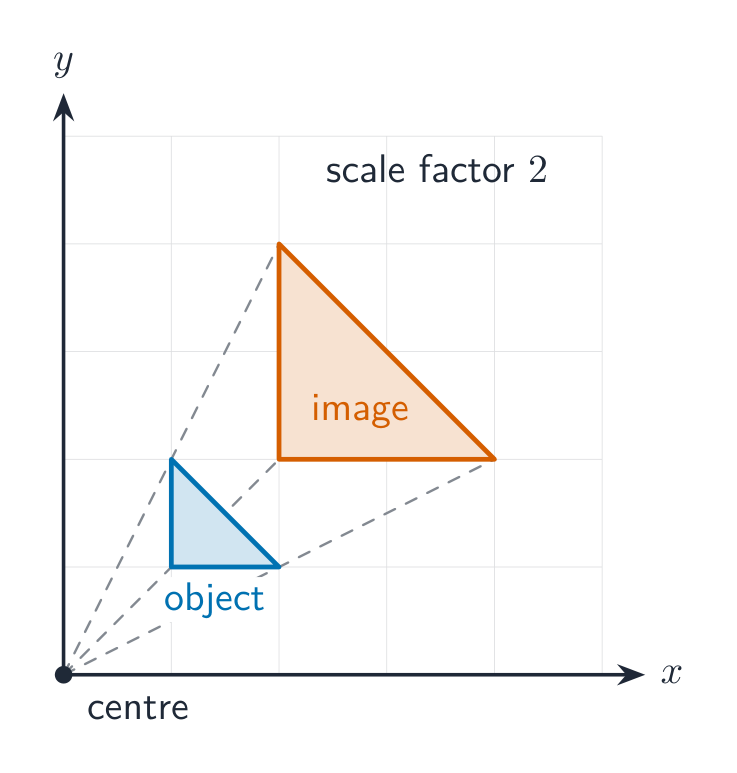
An enlargement multiplies every distance from the centre by the scale factor (here 2)
Which transformation changes the size of a shape?
难度 1/5 · 今日首次完成可获 100 金币及少量额外奖励
Only enlargement changes size; the other three keep it congruent.
Enlarge the point (4, 6) from the origin with scale factor 3. The image is (12, b). What is b?
难度 2/5 · 今日首次完成可获 140 金币及少量额外奖励
Multiply both coordinates by 3: (4×3, 6×3) = (12, 18).
Translation 平移
- Slides every point by the same amount. Describe with a column vector 列向量 $\begin{pmatrix} x \\ y \end{pmatrix}$.
- Translate $(5,3)$ by $\begin{pmatrix} -2 \\ 4 \end{pmatrix}$ → $(5-2, 3+4) = (3, 7)$.
- Translation preserves everything: size, shape, and orientation.
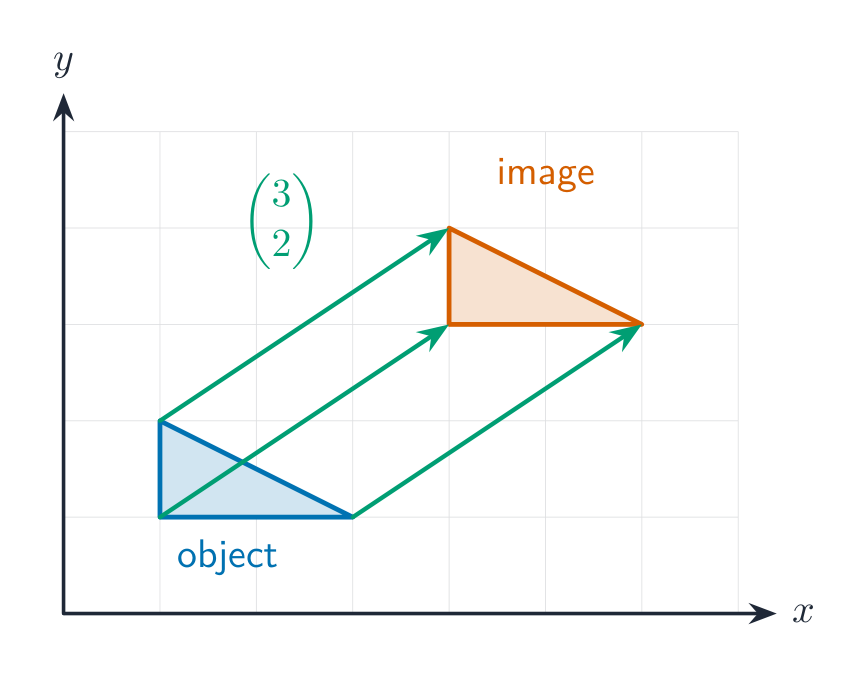
A translation slides every point by the same column vector, with no turning
Translate (5, 3) by the vector (−2, 4). The image is (3, b). What is b?
难度 2/5 · 今日首次完成可获 140 金币及少量额外奖励
Move 4 up: 3 + 4 = 7.
A translation changes the size and shape of an object.
难度 1/5 · 今日首次完成可获 100 金币及少量额外奖励
Translation only changes position — the shape stays congruent (same size and shape).
The centre need not be the origin
- Enlarge $P=(3,2)$ by factor 2 about $C=(1,1)$. Displacement $P-C=(2,1)$ doubles to $(4,2)$, so $P'=C+2(P-C)=(5,3)$.
- To find a centre from a shape and image, rule lines through matching vertices and extend them; they meet at the centre. A factor $1/2$ puts each image point halfway from the centre to its original. Core transformations are single operations, not combinations.
Enlarge P = (3,2) by factor 2 about C = (1,1). Find the image x-coordinate.
难度 2/5 · 今日首次完成可获 140 金币及少量额外奖励
x′ = 1 + 2(3−1) = 5.
Model answers: "Describe fully the single transformation"
Each answer names one transformation and gives every detail. A missing detail loses a mark.
| Transformation | What you must state | Model answer |
|---|---|---|
| Reflection | the mirror line as an equation | Reflection in the line $y = x$ |
| Rotation | centre, angle, direction | Rotation $90°$ clockwise about $(1, 2)$ |
| Enlargement | centre, scale factor | Enlargement, scale factor $\dfrac{1}{2}$, centre $(0, 4)$ |
| Translation | column vector | Translation by $\begin{pmatrix} -3 \\ 5 \end{pmatrix}$ |
- Never write two transformations (for example "reflect then move"): the question asks for a single one.
- A $180°$ rotation needs no direction, but it still needs a centre.
Which is a complete description of a rotation?
难度 1/5 · 今日首次完成可获 100 金币及少量额外奖励
A rotation needs all three: the angle, the direction and the centre.
Shape B is shape A made three times as long, with centre (2, 1). Which description earns full marks?
难度 1/5 · 今日首次完成可获 100 金币及少量额外奖励
Use the word "enlargement" and give both the scale factor and the centre.
You've got it
- reflection (mirror line), rotation (centre, angle, direction)
- enlargement (centre, scale factor $k$), translation (column vector)
- describe each fully — that's what earns the marks
Write from an image x-coordinate of negative 4
- Reflect the point (4, 1) in the y-axis.
- Give the x-coordinate of the image.
Reflect the point (4, 1) in the y-axis. What is the x-coordinate of the image?
The mirror of 4 across the y-axis is negative 4.
What is the image x-coordinate?
难度 1/5 · 今日首次完成可获 100 金币及少量额外奖励
Reflection in the y-axis negates x. Other options — Negative 3 (the lesson image); 4 (the original x-coordinate).