| English | 释义 | 拼音 |
|---|---|---|
| vectors/ˈvektəz/ | 向量 | xiàng liàng |
| scalar/ˈskeɪlə/ | 标量 | biāo liàng |
| magnitude/ˈmæɡnɪtjuːd/ | 大小 | dà xiǎo |
Arrows with attitude
- Wind speed, force, velocity — they all have a size and a direction. That's what makes them vectors 向量.
- A scalar 标量 (like temperature) has only size. A vector needs both.
Writing vectors
- A vector is written as a column $\begin{pmatrix} x \\ y \end{pmatrix}$, as $\overrightarrow{AB}$, or in bold $\mathbf{a}$.
- $x$ is the horizontal component (right is positive), $y$ is the vertical component (up is positive).

Forces like wind are vectors, with both size and direction
向量
resultant = a + b
Vectors add tip-to-tail; the resultant is the single arrow that replaces them.
Adding and subtracting vectors
- Add/subtract component by component: top with top, bottom with bottom.
- $\begin{pmatrix} 3 \\ 1 \end{pmatrix} + \begin{pmatrix} 2 \\ -4 \end{pmatrix} = \begin{pmatrix} 5 \\ -3 \end{pmatrix}$.
Scalar multiply: multiply both components by the number. $3\begin{pmatrix} 3 \\ 1 \end{pmatrix} = \begin{pmatrix} 9 \\ 3 \end{pmatrix}$.
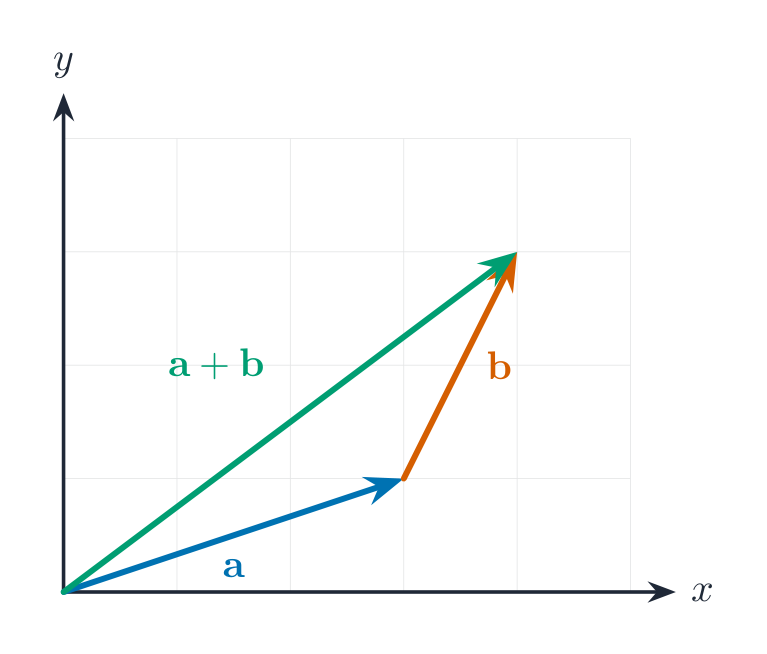
Adding by the triangle law: draw b from the tip of a, and a+b runs from start to finish
a = (3, 1) and b = (2, −4). The top number of a + b is?
难度 2/5 · 今日首次完成可获 140 金币及少量额外奖励
3 + 2 = 5.
a = (3, 1) and b = (2, −4). The bottom number of a + b is?
难度 2/5 · 今日首次完成可获 140 金币及少量额外奖励
1 + (−4) = −3.
If a = (3, 1), the top number of 4a is?
难度 2/5 · 今日首次完成可获 140 金币及少量额外奖励
4 × 3 = 12.
To subtract vectors, you subtract each ______ separately.
难度 1/5 · 今日首次完成可获 100 金币及少量额外奖励
Subtract top from top and bottom from bottom, just like addition.
Magnitude 大小 (length)
- The magnitude of a vector uses Pythagoras:
- $\left|\begin{pmatrix} 3 \\ 4 \end{pmatrix}\right| = \sqrt{9 + 16} = \sqrt{25} = 5$.
Magnitude, not sum. The length of $\begin{pmatrix} 3 \\ 4 \end{pmatrix}$ is $\sqrt{3^2 + 4^2} = 5$, not $3 + 4 = 7$. You must use Pythagoras.
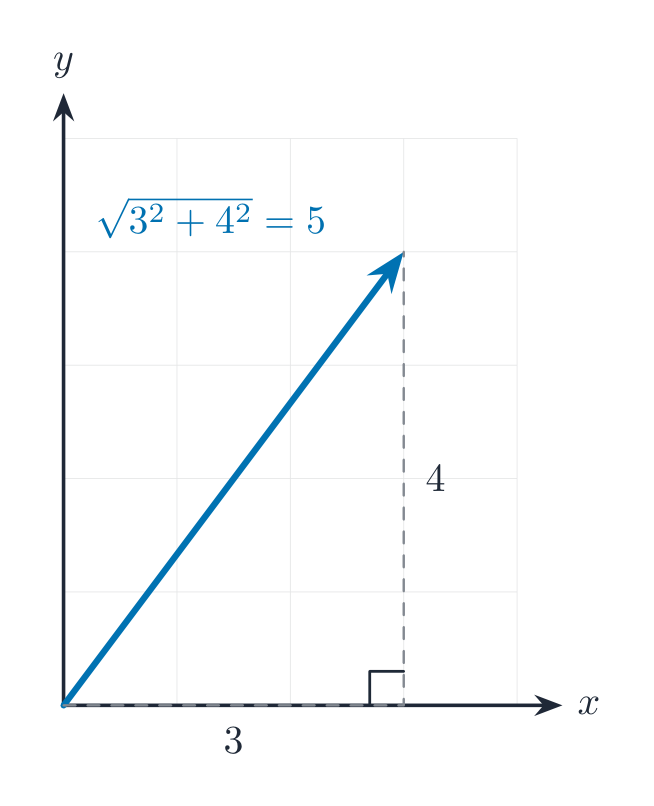
The magnitude of a column vector is found with Pythagoras
Find the magnitude (length) of the vector (3, 4).
难度 2/5 · 今日首次完成可获 140 金币及少量额外奖励
√(3² + 4²) = √25 = 5.
The magnitude of the vector (3, 4) is 3 + 4 = 7.
难度 1/5 · 今日首次完成可获 100 金币及少量额外奖励
Magnitude uses Pythagoras: √(3² + 4²) = 5, not the sum 3 + 4 = 7.
Reverse a direction
- If a vector takes you from A to B, its negative takes you from B to A.
- For $\overrightarrow{AB}=\begin{pmatrix}3\\4\end{pmatrix}$, the reverse is $\overrightarrow{BA}=\begin{pmatrix}-3\\-4\end{pmatrix}$. Both have magnitude 5.
Vector a = (2, −3). Find the vertical component of −2a.
难度 2/5 · 今日首次完成可获 140 金币及少量额外奖励
Multiply the vertical component: −2 × (−3) = 6.
Scalar multiplication and a zero check
- Multiply both components: if $\mathbf a=\begin{pmatrix}2\\-3\end{pmatrix}$, then $3\mathbf a=\begin{pmatrix}6\\-9\end{pmatrix}$ and $-\mathbf a=\begin{pmatrix}-2\\3\end{pmatrix}$. A negative multiplier reverses direction.
- Magnitude remains nonnegative: $|3\mathbf a|=3\sqrt{13}$; the zero vector has magnitude 0. Nonzero parallel vectors are scalar multiples.
Worked example: combine, then find the length
$\mathbf{a} = \begin{pmatrix} 4 \\ -1 \end{pmatrix}$ and $\mathbf{b} = \begin{pmatrix} -2 \\ 3 \end{pmatrix}$. Find $2\mathbf{a} - 3\mathbf{b}$ and its magnitude.
- $2\mathbf{a} = \begin{pmatrix} 8 \\ -2 \end{pmatrix}$ and $3\mathbf{b} = \begin{pmatrix} -6 \\ 9 \end{pmatrix}$.
- $2\mathbf{a} - 3\mathbf{b} = \begin{pmatrix} 8 - (-6) \\ -2 - 9 \end{pmatrix} = \begin{pmatrix} 14 \\ -11 \end{pmatrix}$. Watch the double negative.
- Magnitude $= \sqrt{14^2 + (-11)^2} = \sqrt{196 + 121} = \sqrt{317} = 17.8$ (3 s.f.).
From two points. $A(2, -1)$ and $B(7, 3)$: $\overrightarrow{AB} = \begin{pmatrix} 7 - 2 \\ 3 - (-1) \end{pmatrix} = \begin{pmatrix} 5 \\ 4 \end{pmatrix}$ (end minus start).
p = (3, 2) and q = (−1, 4), written as column vectors. Find the top (x) component of 3p − 2q.
难度 2/5 · 今日首次完成可获 140 金币及少量额外奖励
3p = (9, 6) and 2q = (−2, 8). 9 − (−2) = 11.
A is (1, 5) and B is (7, −3). Find the magnitude of the vector AB.
难度 2/5 · 今日首次完成可获 140 金币及少量额外奖励
AB = (7 − 1, −3 − 5) = (6, −8). Magnitude = √(36 + 64) = 10.
You've got it
- add/subtract vectors component by component; scalar multiply scales both
- $\begin{pmatrix} 3 \\ 1 \end{pmatrix} + \begin{pmatrix} 2 \\ -4 \end{pmatrix} = \begin{pmatrix} 5 \\ -3 \end{pmatrix}$
- magnitude $= \sqrt{x^2 + y^2}$, so $\begin{pmatrix} 3 \\ 4 \end{pmatrix}$ has length $5$
Write from the data: find the magnitude
- Find the magnitude of the vector (6, 8).
- Use Pythagoras.
What is the magnitude of the vector (6, 8)?
100 has square root 10.
What is the magnitude?
难度 1/5 · 今日首次完成可获 100 金币及少量额外奖励
6-8-10 is the length. Other options — 5 (the lesson magnitude); 14 (the components added).