Firms' costs, revenue and objectives · 企业的成本、收入与目标
| English | 中文 | Pinyin · 拼音 |
|---|---|---|
| profit/ˈprɒfɪt/ | 利润 | lì rùn |
| variable costs/ˈveərɪəbl kɒsts/ | 可变成本 | kě biàn chéng běn |
| fixed costs/fɪkst kɒsts/ | 固定成本 | gù dìng chéng běn |
| total cost/ˈtəʊtl kɒst/ | 总成本 | zǒng chéng běn |
| average cost/ˈævrɪdʒ kɒst/ | 平均成本 | píng jūn chéng běn |
| total revenue/ˈtəʊtl ˈrevənjuː/ | 总收益 | zǒng shōu yì |
| economies of scale/ɪˈkɒnəmiz ɒv skeɪl/ | 规模经济 | guī mó jīng jì |
| diseconomies/ˌdɪsɪˈkɒnəmiz/ | 规模不经济 | guī mó bù jīng jì |
What it really costs to make something
- Before a firm can price a product or judge its profit 利润, it must know its costs.
- Costs come in two kinds — and they behave very differently as output changes.
制造某物真正花费多少
- 在一个企业能给一个产品定价或判断它的利润之前,它必须知道它的成本(costs)。
- 成本有两种——而它们随产出变化的行为非常不同。
Which is a fixed cost? · 哪个是一个固定成本?
Rent does not change with the level of output — a fixed cost. · 租金不随产出水平变化——一个固定成本。
Average cost equals total cost divided by . · 平均成本等于总成本除以。
AC = TC / quantity of output. · AC = TC / 产出数量。
Fixed and variable costs 可变成本
- Fixed costs 固定成本 don't change with output: rent, insurance, loan interest.
- Variable costs rise with output: raw materials, wages, power.
- Total cost 总成本 = fixed + variable; average cost 平均成本 = total cost ÷ output.
Average cost is U-shaped: it falls as fixed costs spread, then rises as the firm overstretches.
固定和可变成本
- 固定成本(fixed costs)不随产出变化:租金、保险、贷款利息。
- 可变成本(variable costs)随产出上升:原材料、工资、电力。
- 总成本 = 固定 + 可变;平均成本 = 总成本 ÷ 产出。
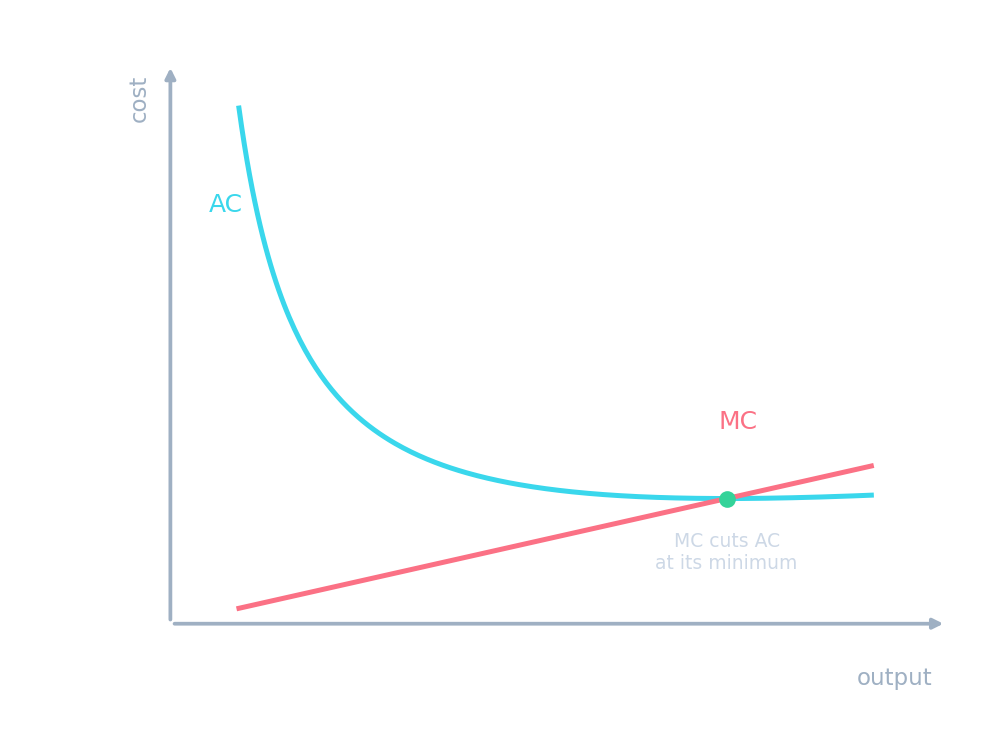
平均成本是 U 形的:它随着固定成本分摊而下降,然后随着企业过度扩张而上升。
Costs, revenue and the firm · 成本、收入与企业
Average cost falls then rises (a U shape); marginal cost crosses it at its lowest point. Firms watch these to decide output. · 平均成本先降后升(一个 U 形);边际成本在它的最低点穿过它。企业观察这些来决定产出。
A firm sells 300 units at 4 each. What is total revenue? · 一个企业以每个 4 卖出 300 单位。总收入是多少?
Revenue = price × quantity = 4 × 300 = 1200. · 收入 = 价格 × 数量 = 4 × 300 = 1200。
Total revenue is 5000 and total cost is 3200. What is profit? · 总收入是 5000,总成本是 3200。利润是多少?
Profit = revenue − total cost = 5000 − 3200 = 1800. · 利润 = 收入 − 总成本 = 5000 − 3200 = 1800。
Revenue and profit
- Total revenue 总收益 = price × quantity sold.
- Profit = total revenue − total cost. It is the entrepreneur's reward and main objective.
Worked example. A firm sells 200 units at 10 each → revenue = 2000. If total cost is 1500, profit = 500.
收入和利润
- 总收入 = 价格 × 售出数量。
- 利润 = 总收入 − 总成本。它是企业家的报酬和主要目标。
例题。 一个企业以每个 10 卖出 200 单位 → 收入 = 2000。如果总成本是 1500,利润 = 500。
Economies of scale mean that, as a firm grows, its: · 规模经济意味着,随着一个企业成长,它的:
Bulk buying and spreading fixed costs lower average cost. · 批量购买和分摊固定成本降低平均成本。
Economies of scale 规模经济
- As a firm grows, average cost falls — bulk buying, specialist machines, spreading fixed costs.
- Grow too big and average cost can rise again (diseconomies 规模不经济 — poor communication, low morale).
Fixed costs aren't "costs that never change ever." They're fixed with respect to output — you pay the same rent whether you make 1 unit or 1000. They still change over time (a rent review).
规模经济
- 随着一个企业成长,平均成本下降——批量购买、专业机器、分摊固定成本。
- 成长得太大,平均成本能再次上升(规模不经济——沟通不良、士气低落)。
固定成本不是"永远不变的成本"。 它们相对于产出是固定的——无论你制造 1 单位还是 1000 单位,你付同样的租金。它们仍然随时间变化(一次租金审查)。
You've got it
- total cost = fixed + variable; average cost = TC ÷ output (U-shaped)
- revenue = price × quantity; profit = revenue − total cost
- growth brings economies of scale (lower average cost), then diseconomies
你掌握了
- 总成本 = 固定 + 可变;平均成本 = TC ÷ 产出(U 形)
- 收入 = 价格 × 数量;利润 = 收入 − 总成本
- 成长带来规模经济(更低的平均成本),然后是规模不经济