| English | 释义 | 拼音 |
|---|---|---|
| equilibrium/ˌiːkwɪˈlɪbrɪəm/ | 均衡 | jūn héng |
| quantity demanded/ˈkwɒntɪti dɪˈmændɪd/ | 需求量 | xū qiú liàng |
| quantity supplied/ˈkwɒntɪti səˈplaɪd/ | 供给量 | gōng jǐ liàng |
| shortage/ˈʃɔːtɪdʒ/ | 短缺 | duǎn quē |
| surplus/ˈsɜːpləs/ | 过剩 | guò shèng |
| clears/klɪəz/ | 出清 | chū qīng |
Where buyers and sellers agree
- Buyers want low prices; sellers want high ones. Yet in a market, one price usually settles where the amount people want to buy is exactly the amount firms want to sell.
- That price is the equilibrium 均衡 price. This lesson shows how to find it from a table and a diagram, and why the market moves back to it.
Market equilibrium
- Equilibrium price: the price at which quantity demanded 需求量 equals quantity supplied 供给量. The amount bought and sold at that price is the equilibrium quantity.
- At equilibrium there is no shortage 短缺 and no surplus 过剩: everything firms bring to market is bought. We say the market clears 出清.
- There is no pressure for the price to change, so it stays there until something shifts demand or supply.
Market equilibrium is where:
难度 1/5 · 今日首次完成可获 100 金币及少量额外奖励
Equilibrium clears the market — Qd = Qs.
At equilibrium there is always a small shortage.
难度 1/5 · 今日首次完成可获 100 金币及少量额外奖励
False. At equilibrium quantity demanded equals quantity supplied, so there is neither a shortage nor a surplus.
When supply exceeds demand at the current price, there is a ______.
难度 1/5 · 今日首次完成可获 100 金币及少量额外奖励
Excess supply is a surplus, which pushes price down.
Finding equilibrium from a table and a diagram
| Price (dollars) | 2 | 4 | 6 | 8 |
|---|---|---|---|---|
| Quantity demanded | 100 | 80 | 60 | 40 |
| Quantity supplied | 20 | 40 | 60 | 80 |
- In the table, look for the price where the two quantities are equal: at 6 dollars, 60 notebooks are demanded and 60 supplied.
- On a diagram, plot each row as a point, join the points, and read off the crossing.
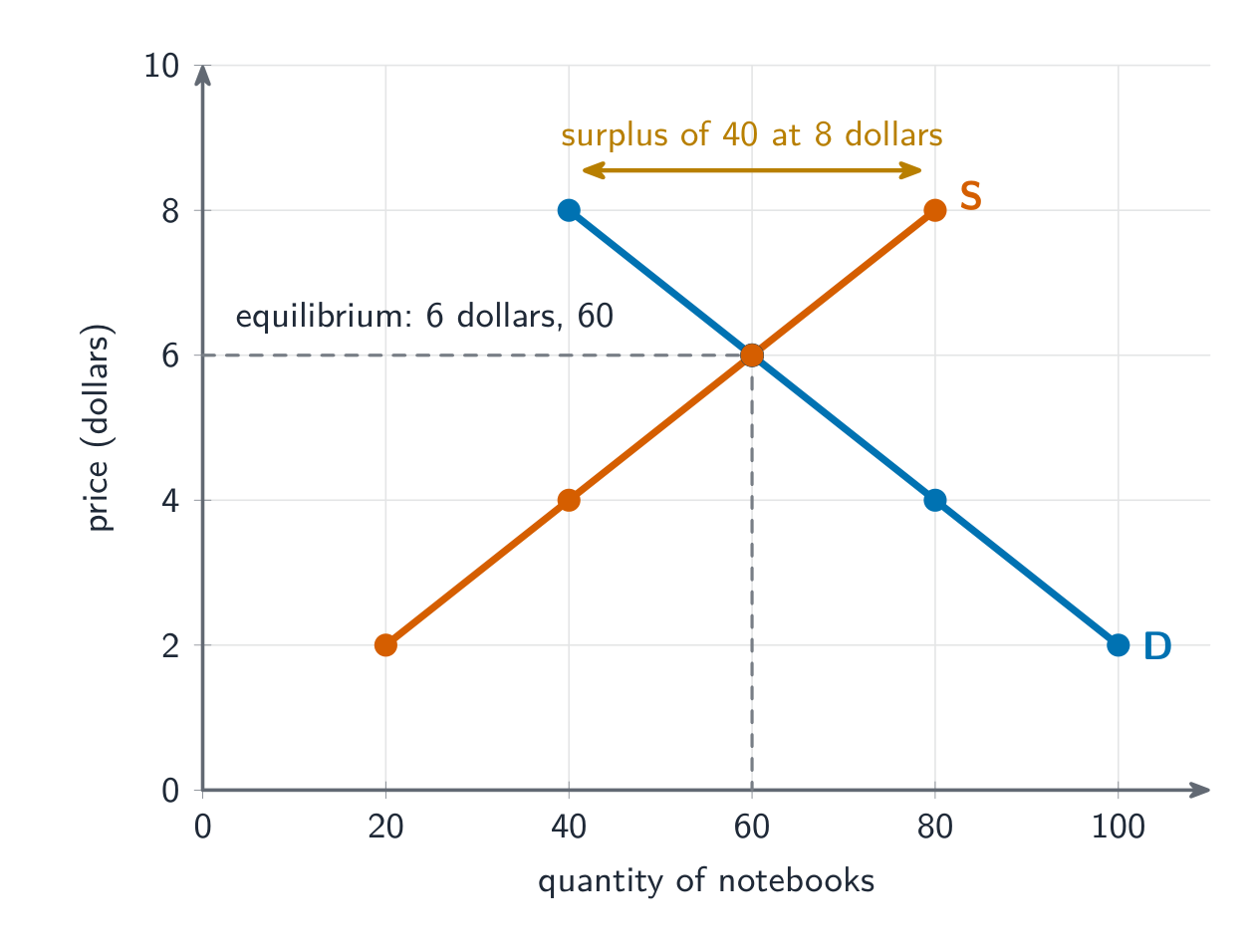
Marks for a diagram: label the axes price (vertical) and quantity (horizontal), label the curves D and S, and mark the equilibrium price and quantity on the axes (for example Pe and Qe). An unlabelled sketch earns little, even if it is the right shape.
需求与供给
平衡 is where demand meets supply.
Price 3, 4, 5, 6 dollars. Quantity demanded 90, 75, 60, 45. Quantity supplied 30, 50, 60, 70. What is the equilibrium price, in dollars?
难度 2/5 · 今日首次完成可获 140 金币及少量额外奖励
At 5 dollars both quantities are 60, so 5 dollars is the equilibrium price and 60 the equilibrium quantity.
On a demand and supply diagram, what goes on the vertical axis?
难度 1/5 · 今日首次完成可获 100 金币及少量额外奖励
Price goes on the vertical axis and quantity on the horizontal axis. D and S are the curves, not the axes.
Above equilibrium: a surplus
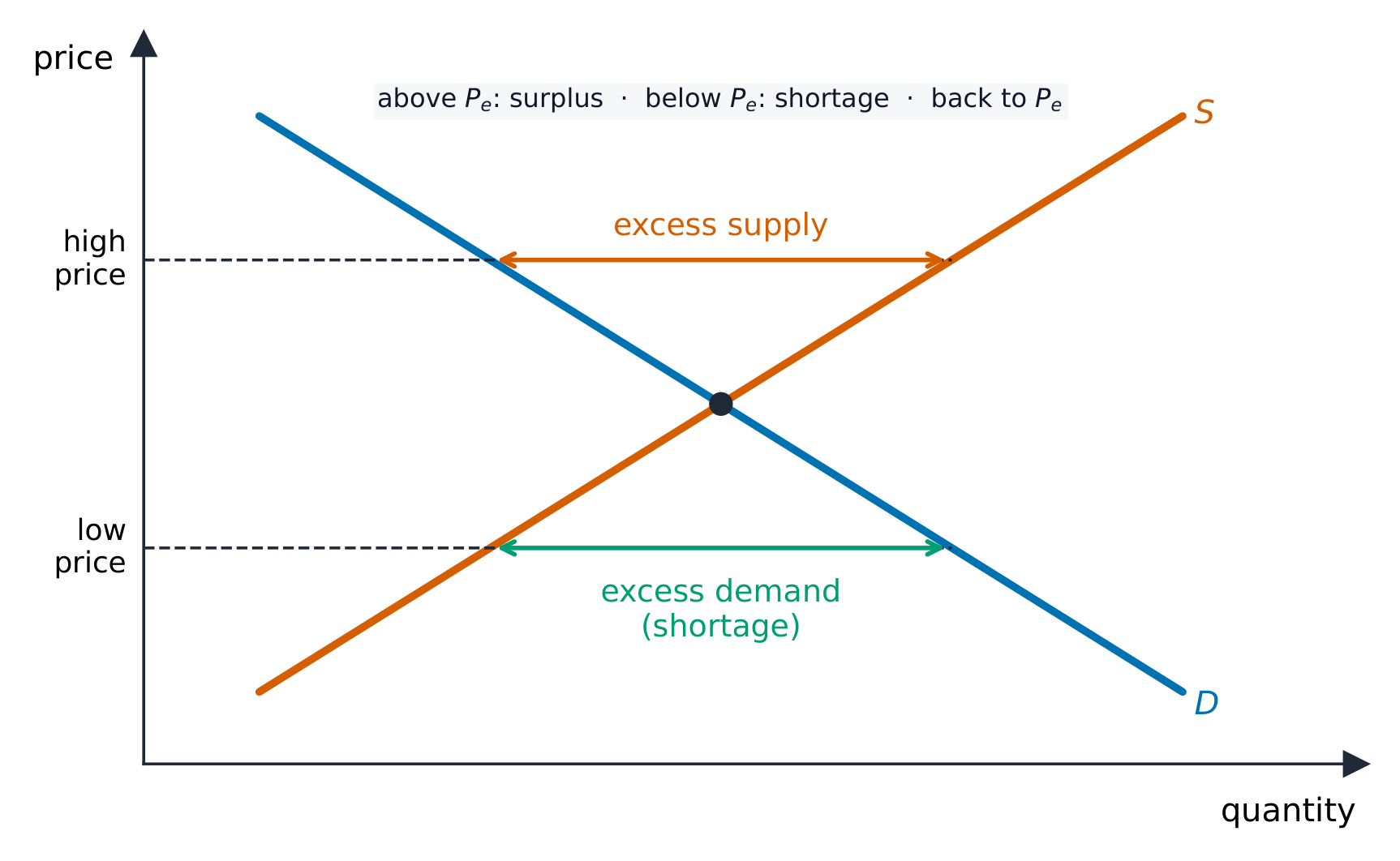
- If the price is above equilibrium, quantity supplied is greater than quantity demanded: a surplus (excess supply).
- Unsold goods pile up, so sellers cut the price. As the price falls, more is demanded and less is supplied, until the two are equal again.
If price is set above equilibrium, the result is a:
难度 1/5 · 今日首次完成可获 100 金币及少量额外奖励
Above equilibrium, supply exceeds demand — a surplus pushes price down.
Using the schedule in the 'find the equilibrium' question (price 6 dollars: demanded 45, supplied 70), how big is the surplus at 6 dollars?
难度 2/5 · 今日首次完成可获 140 金币及少量额外奖励
Surplus = quantity supplied − quantity demanded = 70 − 45 = 25.
Below equilibrium: a shortage
- If the price is below equilibrium, quantity demanded is greater than quantity supplied: a shortage (excess demand).
- Buyers compete for the few goods, queues form, and sellers can raise the price. As it rises, less is demanded and more is supplied, until the shortage disappears.
- Example: concert tickets priced too low sell out in minutes and reappear on resale sites at much higher prices. The resale price is the market moving towards equilibrium.
A shortage occurs when price is:
难度 1/5 · 今日首次完成可获 100 金币及少量额外奖励
Below equilibrium, demand exceeds supply — a shortage pushes price up.
Using the notebook table, what is the size of the shortage at a price of 4 dollars?
难度 2/5 · 今日首次完成可获 140 金币及少量额外奖励
At 4 dollars, demand is 80 and supply is 40, so the shortage is 80 − 40 = 40.
At 4 dollars there is a shortage of notebooks. What happens next?
难度 1/5 · 今日首次完成可获 100 金币及少量额外奖励
In a shortage, buyers bid the price up until quantity demanded equals quantity supplied at 6 dollars.
Worked exam questions
1. Using the notebook table. A government orders shops to sell notebooks at 2 dollars. What is the result, and what may happen? [2]
- At 2 dollars, quantity demanded is 100 but quantity supplied is only 20: a shortage of 80 (1).
- Shops run out; queues form, and some notebooks are resold unofficially at higher prices (1).
2. Explain why a market moves to its equilibrium price if the price starts too high. [4]
- Model answer: At a price above equilibrium, quantity supplied is greater than quantity demanded (1), so there is a surplus of unsold goods (1). Sellers lower the price to sell their stock (1). As the price falls, quantity demanded rises and quantity supplied falls until they are equal at the equilibrium price (1).
- Mark-scheme reasoning: each mark is one link in the chain. Saying only "the price falls back to equilibrium" earns one mark at most: you must explain why it falls and what happens to the two quantities.
Put the steps in order for a market where the price starts above equilibrium.
难度 3/5 · 今日首次完成可获 200 金币及少量额外奖励
Each step causes the next: the imbalance creates a surplus, sellers react by cutting the price, the two quantities move towards each other, and they meet at equilibrium.
You've got it
- equilibrium: the price where quantity demanded = quantity supplied; the market clears
- find it in a table (equal quantities) or on a diagram (where D and S cross); label axes, curves, Pe and Qe
- price above equilibrium → surplus → sellers cut the price
- price below equilibrium → shortage → the price rises
- explain the move as a chain: imbalance → what sellers or buyers do → how both quantities change
At a price of 12 dollars, quantity supplied is 80 and quantity demanded is 50. What is the imbalance, and what is likely to happen to price?
80 minus 50 is 30, and sellers cut price to clear stock.
At a price of 12 dollars, quantity supplied is 80 and quantity demanded is 50. What is the imbalance?
难度 1/5 · 今日首次完成可获 100 金币及少量额外奖励
Supply is 30 above demand, so the price is too high.