| English | 释义 | 拼音 |
|---|---|---|
| law of demand/lɔː ɒv dɪˈmænd/ | 需求定律 | xū qiú dìng lǜ |
| demand/dɪˈmænd/ | 需求 | xū qiú |
| quantity demanded/ˈkwɒntɪti dɪˈmændɪd/ | 需求量 | xū qiú liàng |
| extension/ekˈstenʃn/ | 扩张 | kuò zhāng |
| contraction/kənˈtrækʃn/ | 收缩 | shōu suō |
| income/ˈɪŋkʌm/ | 收入 | shōu rù |
| tastes/teɪsts/ | 偏好 | piān hǎo |
Why cheaper means more
- Cut the price of pizza in half and you'd probably buy more of it. So would everyone else.
- That everyday instinct is the law of demand 需求定律 — and it shapes every market.
The law of demand states that, other things equal, as price falls:
难度 1/5 · 今日首次完成可获 100 金币及少量额外奖励
Lower price, more demanded — the curve slopes down.
Wanting a good is enough to count as demand, even without the money to buy it.
难度 1/5 · 今日首次完成可获 100 金币及少量额外奖励
False. Demand requires being both willing and able to pay; wanting a good without the means to buy it is not demand.
The law of demand 需求
- Demand = the quantity buyers are willing and able to buy at each price.
- Law of demand: as price falls, quantity demanded 需求量 rises (and vice versa) — other things equal.
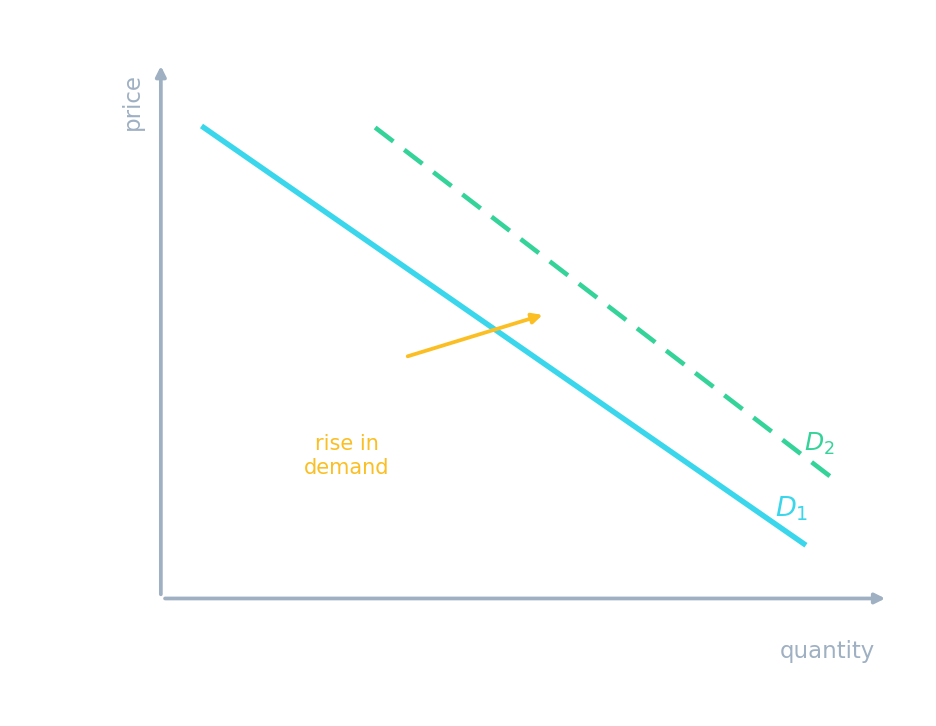
The demand curve slopes down — lower price, more bought.
需求与供给
需求 slopes down — cheaper means more wanted.
A fall in the good's own price causes an ______ of demand (a movement down the curve).
难度 1/5 · 今日首次完成可获 100 金币及少量额外奖励
Price fall → extension; price rise → contraction.
Movement along the curve
- A change in the good's own price causes a movement along the demand curve.
- A price fall → an extension 扩张 (more demanded); a price rise → a contraction 收缩 (less demanded).
Shifts in demand
- A change in a non-price factor shifts the whole curve: income 收入, tastes 偏好, prices of related goods, population, advertising.
- Right shift = more demanded at every price; left shift = less.
| Condition of demand changes | Example → demand shifts |
|---|---|
| income rises | people can afford more meals out → right |
| tastes move towards the good | a health trend makes oat milk popular → right |
| price of a substitute rises | tea becomes dearer, so some people switch to coffee → coffee right |
| price of a complement rises | petrol becomes dearer, so fewer people buy large cars → large cars left |
| population grows | more children need school uniforms → right |
| successful advertising | a famous athlete promotes a brand of trainers → right |
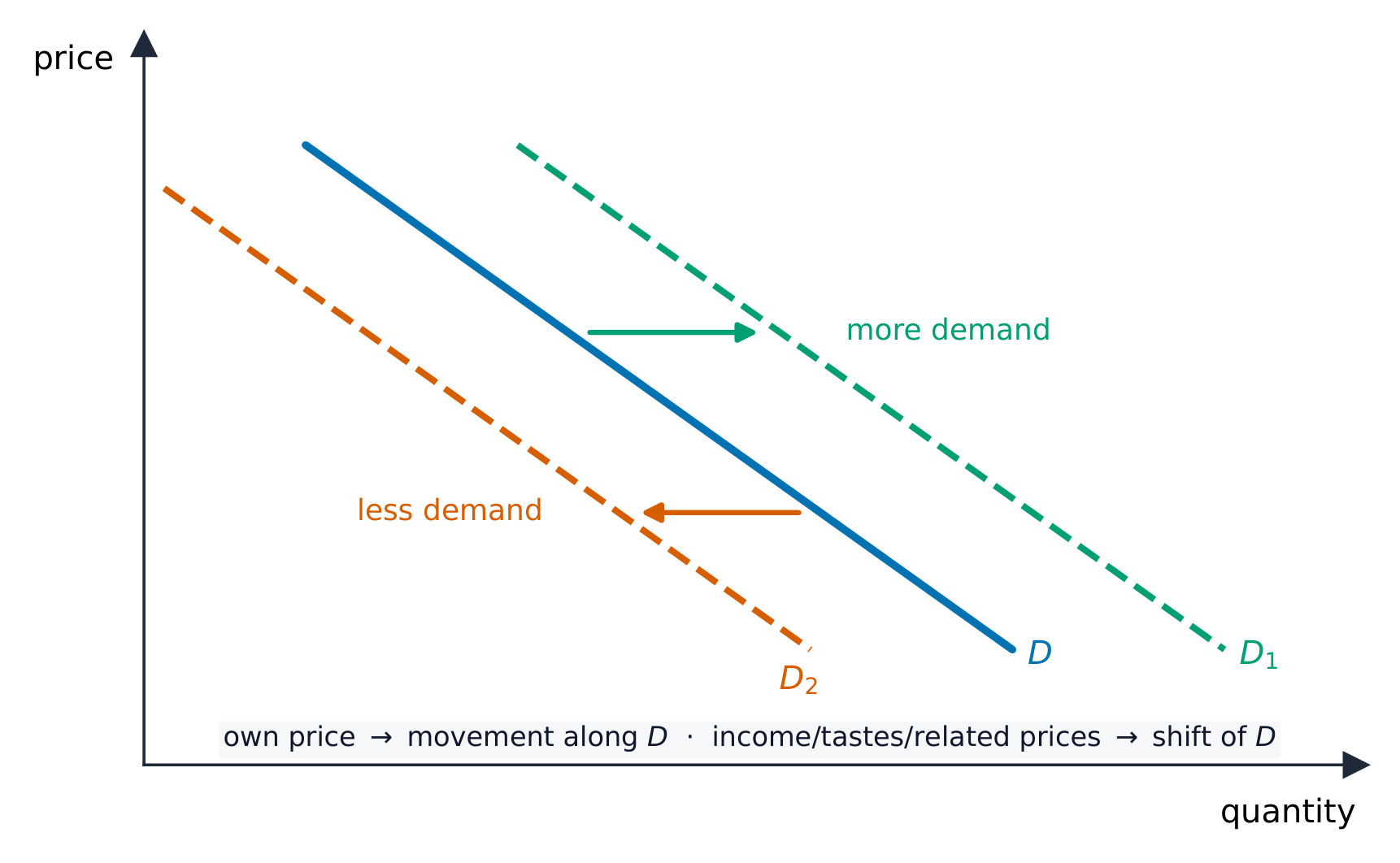
A change in income, tastes or related prices shifts the whole demand curve right or left
Movement vs shift. Only the good's own price moves you along the curve. Everything else (income, tastes…) shifts the whole curve. Mixing these up is the most common demand error.
Which causes a SHIFT of the demand curve (not a movement along it)?
难度 1/5 · 今日首次完成可获 100 金币及少量额外奖励
Income is a non-price factor, so it shifts the whole curve.
Which factors shift the demand curve? (Select all that apply.)
难度 2/5 · 今日首次完成可获 140 金币及少量额外奖励
Income, tastes and advertising shift the curve; the own price moves you along it.
Worked example: movement or shift?
Decide whether each causes a movement along the demand curve for coffee or a shift: (a) the price of coffee falls; (b) incomes rise; (c) the price of tea (a substitute) falls.
- (a) The coffee's own price changes, so there is a movement along the curve: an extension of demand.
- (b) A non-price factor: higher incomes shift demand to the right. (c) Tea becomes cheaper, so some people switch to tea: demand for coffee shifts left.
The price of printers falls sharply. What happens to demand for printer ink?
难度 1/5 · 今日首次完成可获 100 金币及少量额外奖励
Printers and ink are complements: cheaper printers mean more ink is wanted at every price.
A successful advertising campaign shifts the demand curve to the right.
难度 1/5 · 今日首次完成可获 100 金币及少量额外奖励
Tastes change in favour of the good, so more is demanded at every price.
You've got it
- demand = willing and able to buy at each price
- law of demand: price down → quantity demanded up (curve slopes down)
- own price → move along; other factors → shift the curve
Write from the data: find the movement
- The price of juice falls from 5 dollars to 4 dollars.
- Quantity demanded rises from 20 cartons to 26.
The price of juice falls from 5 dollars to 4 dollars and quantity demanded rises from 20 cartons to 26. Is this a movement or a shift, and by how many cartons?
26 minus 20 is 6, and only the juice price changed.
What happens in the juice market?
难度 1/5 · 今日首次完成可获 100 金币及少量额外奖励
A lower own price moves quantity demanded along the curve.