| English | 释义 | 拼音 |
|---|---|---|
| chromatography/krəʊməˈtɒɡrəfi/ | 色谱法 | sè pǔ fǎ |
| solvent/ˈsɒlvənt/ | 溶剂 | róng jì |
| Rf value/ˌɑːˈref ˈvæljuː/ | 比移值 | bǐ yí zhí |
Separating colours and substances
- How do forensic scientists separate the dyes in an ink, or the colours in a food?
- With a simple, powerful technique: chromatography 色谱法.
色谱法路径
Watch a mixture separate as the solvent front moves.
Chromatography separates a mixture because its components:
难度 1/5 · 今日首次完成可获 100 金币及少量额外奖励
Different speeds separate the substances.
How chromatography works
- A spot of the mixture is placed on paper, and a solvent 溶剂 moves up through it.
- Different substances travel at different speeds, so they separate into spots.
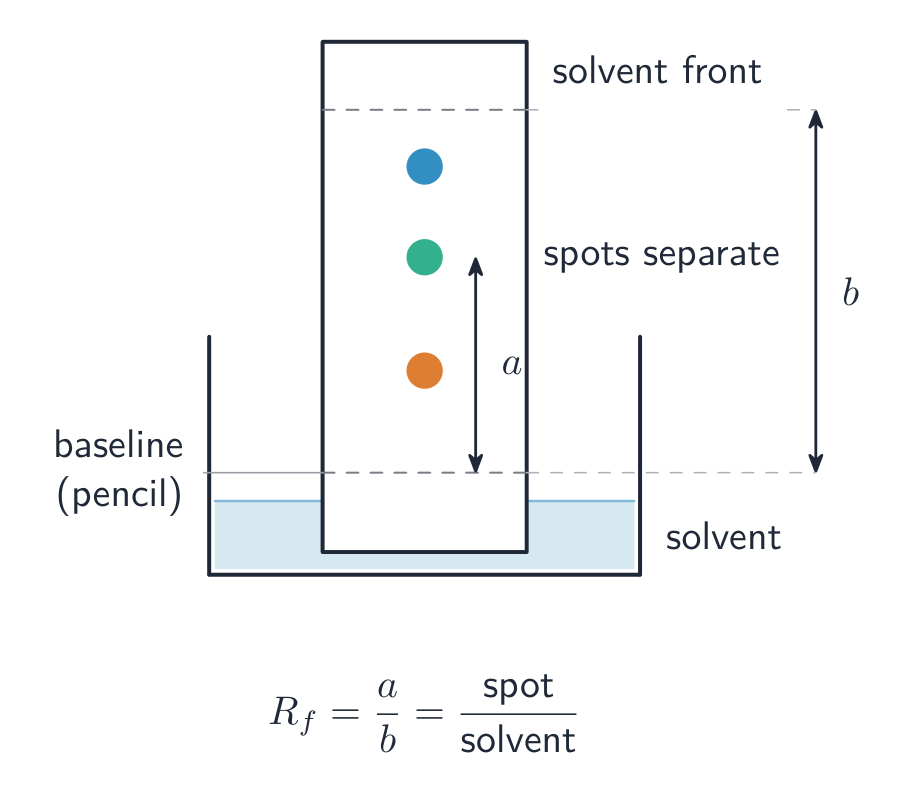
Paper chromatography separates a mixture as the solvent rises up the paper
A more soluble substance will travel:
难度 1/5 · 今日首次完成可获 100 金币及少量额外奖励
More soluble components move further.
Reading a chromatogram
- Substances that are more soluble (or less attracted to the paper) travel further.
- Comparing with known substances identifies the components.
A mixture separates into coloured spots that rise different distances up the paper
A spot moves 3 cm; the solvent moves 6 cm. What is the Rf value?
难度 2/5 · 今日首次完成可获 140 金币及少量额外奖励
Rf = 3 ÷ 6 = 0.5.
An Rf value is always between 0 and 1.
难度 1/5 · 今日首次完成可获 100 金币及少量额外奖励
The spot cannot move further than the solvent.
Rf = distance moved by the spot ÷ distance moved by the ______.
难度 1/5 · 今日首次完成可获 100 金币及少量额外奖励
Rf compares the spot's distance to the solvent's.
Rf value 比移值
- The Rf value = distance moved by the spot ÷ distance moved by the solvent.
- It is always between 0 and 1, and is the same for a substance under the same conditions.
Worked example. A spot moves 4 cm while the solvent moves 8 cm. Rf = 4 ÷ 8 = 0.5. This value identifies the substance when compared with known samples.
Worked example: reading a food-colouring chromatogram
A brown food colouring (X) is run beside three known dyes. The solvent front moves 10.0 cm.
| Spot | Distance moved / cm | Rf |
|---|---|---|
| X, spot 1 | 3.0 | 0.30 |
| X, spot 2 | 7.5 | 0.75 |
| red dye | 3.0 | 0.30 |
| yellow dye | 7.5 | 0.75 |
| blue dye | 5.0 | 0.50 |
- X has two spots, so it is a mixture. Its Rf values match the red and yellow dyes, so X contains red and yellow, but no blue.
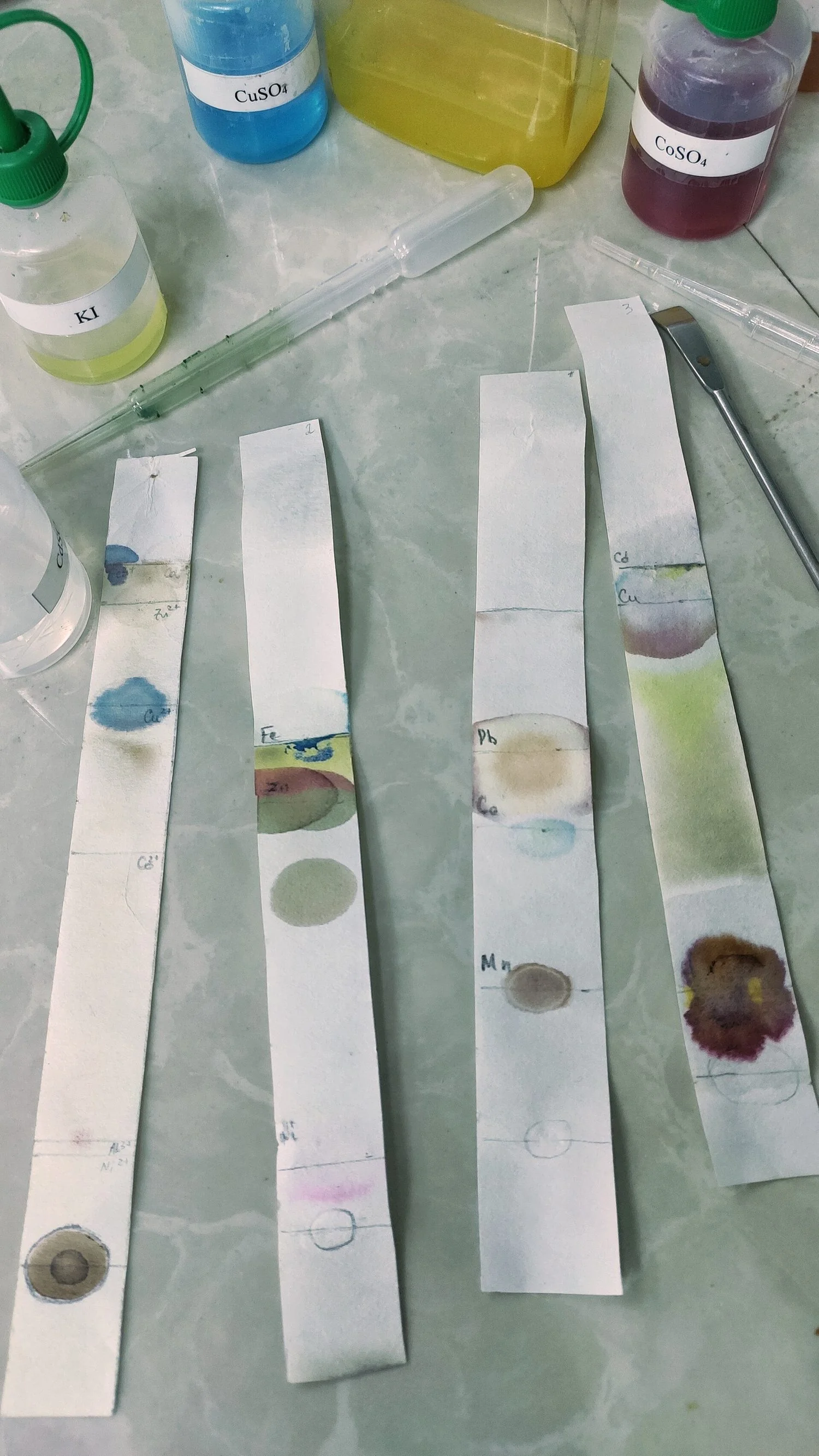
- Draw the start line in pencil (ink would itself separate) and keep it above the solvent level, so the spots do not dissolve away into the solvent.
- A pure substance gives only one spot. Colourless substances (e.g. amino acids) are made visible with a locating agent.
A spot moves 4.2 cm while the solvent front moves 12.0 cm. Calculate its Rf value.
难度 2/5 · 今日首次完成可获 140 金币及少量额外奖励
Rf = 4.2 ÷ 12.0 = 0.35.
Why is the start line drawn in pencil, not ink?
难度 1/5 · 今日首次完成可获 100 金币及少量额外奖励
Graphite is insoluble in the solvent, so it stays put and does not add extra spots.
You've got it
- chromatography separates a mixture as a solvent carries components at different speeds
- more soluble substances travel further up the paper
- Rf = distance of spot ÷ distance of solvent (always between 0 and 1)
Write from the data: find the Rf
- A spot moves 2 cm.
- The solvent front moves 8 cm. The lesson spot of 3 cm in a 6 cm front has Rf 0.5.
What is the Rf value?
Rf is spot distance divided by solvent distance.
What is the Rf of this spot?
难度 1/5 · 今日首次完成可获 100 金币及少量额外奖励
2 divided by 8 is 0.25. Other options — 0.5 (the lesson chromatogram); 2 (the spot distance in centimetres).