Changes of state · 状态变化
| English | 中文 | Pinyin · 拼音 |
|---|---|---|
| melting/ˈmeltɪŋ/ | 熔化 | róng huà |
| boiling/ˈbɔɪlɪŋ/ | 沸腾 | fèi téng |
| changes of state/ˈtʃeɪndʒɪz ɒv steɪt/ | 状态变化 | zhuàng tài biàn huà |
| freezing/ˈfriːzɪŋ/ | 凝固 | níng gù |
| evaporating/ɪˈvæpəreɪtɪŋ/ | 蒸发 | zhēng fā |
| condensing/kənˈdensɪŋ/ | 凝结 | níng jié |
| subliming/sʌˈblaɪmɪŋ/ | 升华 | shēng huá |
| boiling point/ˈbɔɪlɪŋ pɔɪnt/ | 沸点 | fèi diǎn |
| melting point/ˈmeltɪŋ pɔɪnt/ | 熔点 | róng diǎn |
Melting 熔化, boiling 沸腾 and back again
- Heat ice and it melts; heat water and it boils. Cool steam and it turns back.
- These changes of state 状态变化 are all about giving or taking energy from the particles.
熔化、沸腾再变回来
- 加热冰,它熔化;加热水,它沸腾。冷却蒸汽,它变回来。
- 这些状态变化都关乎给予或取走粒子的能量。
The change from solid to liquid is called: · 从固体到液体的变化被称为:
Solid → liquid is melting. · 固体 → 液体是熔化。
The change from gas to liquid is called: · 从气体到液体的变化被称为:
Gas → liquid is condensing. · 气体 → 液体是凝结。
The named changes
- Melting (solid → liquid) and freezing 凝固 (liquid → solid).
- Evaporating 蒸发/boiling (liquid → gas) and condensing 凝结 (gas → liquid).
- Subliming 升华 (solid → gas directly).
Heating moves matter solid to liquid to gas; cooling reverses each change
命名的变化
- 熔化(melting,固体 → 液体)和凝固(freezing,液体 → 固体)。
- 蒸发/沸腾(evaporating/boiling,液体 → 气体)和凝结(condensing,气体 → 液体)。
- 升华(subliming,固体 → 气体直接)。

加热把物质从固体移到液体到气体;冷却反转每个变化
Heating a substance through its states · 加热一种物质穿过它的各状态
Step up the temperature. Adding heat gives the particles more energy until they break free — and the temperature pauses at each change of state while the energy does that work. · 逐步提高温度。加热给粒子更多能量直到它们挣脱——而温度在每个状态变化处暂停,同时能量做那个功。
Heating a substance gives its particles: · 加热一种物质给它的粒子:
Heat increases particle energy and movement. · 热增加粒子能量和运动。
Energy and changes of state
- Heating gives particles more energy, so they move more and break apart — melting then boiling.
- Cooling removes energy, so particles move less and come together — condensing then freezing.
Ice melting to water: a change of state as the solid warms
能量与状态变化
- 加热给粒子更多能量,所以它们运动更多并分开——先熔化然后沸腾。
- 冷却移除能量,所以粒子运动更少并聚在一起——先凝结然后凝固。

冰熔化成水:固体变暖时的一个状态变化
During melting, the temperature stays constant until all the solid has melted. · 在熔化期间,温度保持恒定,直到所有的固体都熔化。
The energy is used to separate particles, not raise temperature. · 能量被用来分离粒子,而不是提高温度。
A pure substance boils at a fixed temperature called its ______ point. · 一种纯物质在一个固定的温度沸腾,叫做它的______点。
Pure substances have sharp melting and boiling points. · 纯物质有明确的熔点和沸点。
Melting and boiling points 沸点
- A pure substance melts and boils at fixed temperatures — its melting point 熔点 and boiling point.
- During a change of state, the temperature stays constant while the energy breaks the bonds between particles.
Worked example. When ice at 0 °C melts, you add heat but the temperature stays at 0 °C until all the ice has melted. The energy is used to separate the particles, not to raise the temperature.
While the substance melts and while it boils the temperature stays flat, even though energy is still being added
熔点和沸点
- 一种纯物质在固定的温度熔化和沸腾——它的熔点(melting point)和沸点(boiling point)。
- 在一个状态变化期间,温度保持恒定,而能量打破粒子之间的键。
例题。 当 0 °C 的冰熔化时,你加热但温度保持在 0 °C,直到所有的冰都熔化。能量被用来分离粒子,而不是提高温度。
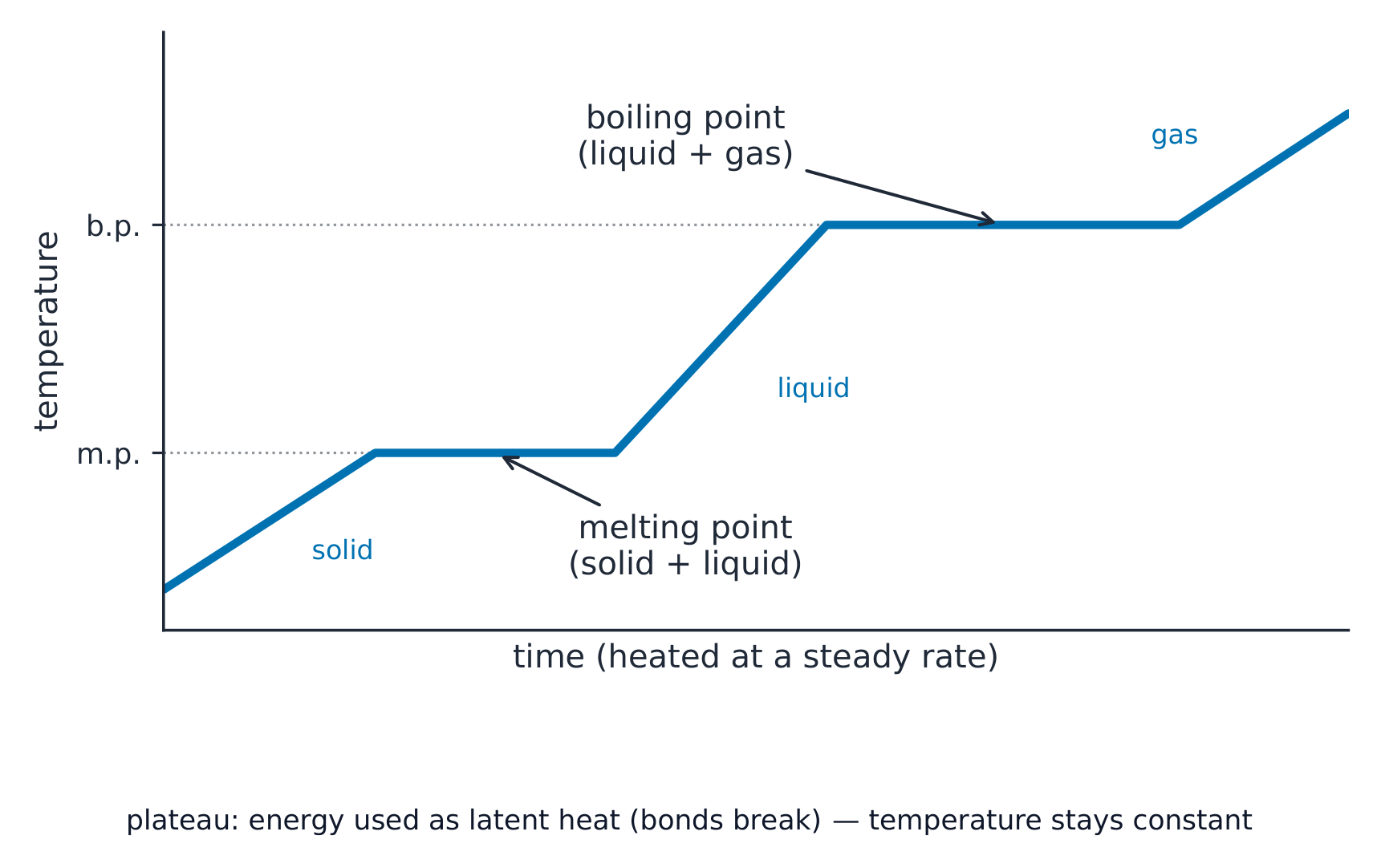
在物质熔化时和沸腾时温度保持平稳,即使仍在加入能量
You've got it
- melting/freezing, boiling/condensing, subliming are changes of state
- heating adds energy (particles separate); cooling removes it (particles come together)
- temperature stays constant during a change of state (energy breaks bonds)
你掌握了
- 熔化/凝固、沸腾/凝结、升华是状态变化
- 加热增加能量(粒子分开);冷却移除它(粒子聚在一起)
- 在一个状态变化期间温度保持恒定(能量打破键)