| English | 释义 | 拼音 |
|---|---|---|
| pressure/ˈpreʃə/ | 压强 | yā qiáng |
| volume/ˈvɒljuːm/ | 体积 | tǐ jī |
| Boyle's law/bɔɪlz lɔː/ | 玻意耳定律 | bō yì ěr dìng lǜ |
较热的气体需要可移动边界才能膨胀
- 推动密封自行车打气筒的活塞:被封闭的气体会产生反作用力。气体压强 压强源于粒子撞击容器壁。
- 预测体积 体积时,需明确哪些因素可变、哪些保持恒定。确保气体量固定;切勿让气体泄漏。
Gas pressure is caused by particles:
难度 1/5 · 今日首次完成可获 100 金币及少量额外奖励
Collisions with the walls create pressure.
在恒温下改变压强
- 在恒定温度下增加定量的气体压强会减小其体积。粒子间距变小并更频繁地撞击器壁,从而产生更大的压强。
- 降低压力会使气体膨胀。若温度不变,粒子的平均速率保持不变;粒子既不会变大也不会增多。这种压强与体积的反比关系称为玻意耳定律 玻意耳定律。
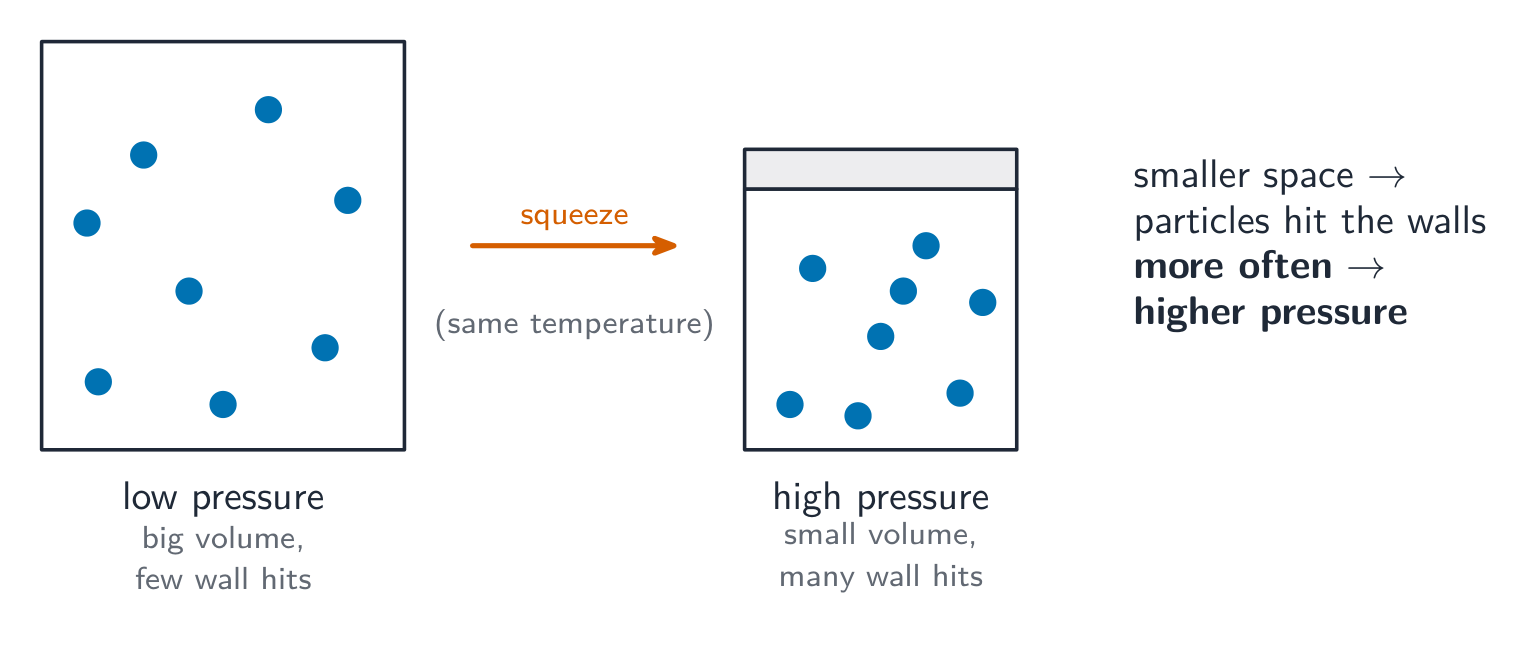
用粒子间距和粒子与器壁碰撞来解释这一变化;粒子本身并未变小。
Compress a fixed amount of gas
At constant temperature, decreasing volume increases pressure because the same particles hit the walls more frequently. Particle size and number stay unchanged.
At constant temperature, if the volume of a gas decreases, the pressure:
难度 1/5 · 今日首次完成可获 100 金币及少量额外奖励
Smaller volume → more frequent collisions → higher pressure.
Increasing the pressure on a fixed amount of gas at constant temperature increases its volume.
难度 1/5 · 今日首次完成可获 100 金币及少量额外奖励
False. The gas is compressed: volume decreases, the particles are closer together and wall collisions are more frequent.
For a fixed amount of gas at constant temperature, decreasing the external pressure allows its volume to ______.
难度 1/5 · 今日首次完成可获 100 金币及少量额外奖励
At constant temperature the gas expands when the pressure on it is reduced.
在恒定压强下改变温度
- 在恒定外压下加热装有自由移动活塞的密封注射器中的气体。粒子获得动能并运动加快。活塞向外移动,直到气体压力再次平衡外压:体积增大。
- 保持压强不变而冷却气体时,其体积减小。运动加快是温度的影响;体积可以变大是因为边界能够移动。
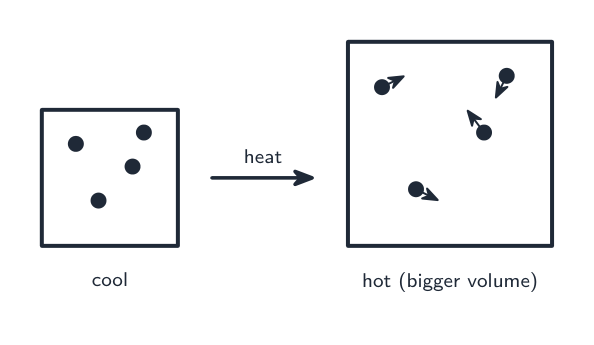
粒子数量保持不变。这种容器膨胀模型要求恒定压强以及可移动的边界。
A fixed amount of gas is warmed in a sealed syringe with a freely moving plunger under constant external pressure. Its volume:
难度 1/5 · 今日首次完成可获 100 金币及少量额外奖励
The boundary can move. Heating increases particle speed; the gas expands until pressure again balances the constant external pressure. Particle size and number stay unchanged.
Treat the following as separate changes to sealed gas syringes. A: temperature decreases while external pressure stays constant. B: external pressure decreases while temperature stays constant. Predict each volume change and explain the different particle causes.
A: volume decreases; particles lose kinetic energy and move more slowly, and the plunger moves in until the gas pressure balances the same external pressure. B: volume increases as the lower external pressure allows expansion; particle speed stays the same because temperature is unchanged. Both changes keep the gas amount fixed.
在刚性容器中验证预测
- 密封的刚性容器体积固定。加热使粒子运动加快,其与器壁的碰撞更频繁且更猛烈,因此压强增大而非体积增大。
- “加热总是使气体膨胀”忽略了容器条件。温度-体积预测需使用恒定压强;压强-体积预测需使用恒定温度。
一个可移动活塞的注射器和一个刚性烧瓶装有同种气体,两者均在无气体泄漏的情况下被加热。在外压恒定时,注射器的体积增大。在此模型中烧瓶无法膨胀,因此其体积保持不变而压强升高。
A sealed rigid flask and a sealed syringe with a freely moving plunger are both warmed. The syringe has constant external pressure. Predict the change in volume and pressure for each. Explain why the same heating does not give the same volume result.
Rigid flask: volume stays constant and pressure rises because faster particles hit its walls more frequently and harder. Syringe: volume increases until internal pressure balances the constant external pressure again, so final pressure is unchanged. Both keep the same amount of gas; only the syringe has a movable boundary.
仅在证据允许时合并变化
- 恒定压强下加热会增大体积;恒定温度下降低压强也会增大体积。若两种变化同时发生,它们均支持向同一方向的膨胀。
- 若温度和压强均升高,它们对体积的影响相互抵消。若无更多信息,不应断言体积必然增大或减小。
For a fixed amount of gas, both temperature and external pressure increase. A student predicts a larger volume because the gas was heated. Is that conclusion justified from these facts alone? Contrast this with heating while reducing external pressure.
The conclusion is not justified. Heating tends to increase volume at constant pressure, but increasing pressure tends to decrease it at constant temperature; their combined result needs more information. Heating and reducing external pressure both favour increased volume, so they support expansion in the same direction.
你掌握了
- 定量、定温条件下:增大压强会使气体体积减小。
- 定量、定压条件下:升高温度会使气体体积增大。
- 定容条件下:加热会升高压强。请用粒子运动和粒子与器壁碰撞来解释,而非粒子长大。