| English | 释义 | 拼音 |
|---|---|---|
| motivated/ˈməʊtɪveɪtɪd/ | 有积极性的 | yǒu jī jí xìng de |
| productivity/ˌprɒdəkˈtɪvɪti/ | 生产率 | shēng chǎn lǜ |
| recognition/ˌrekəɡˈnɪʃn/ | 认可 | rèn kě |
| hierarchy/ˈhaɪərɑːki/ | 层级 | céng jí |
| self-actualisation/self ˌæktʃuːəlaɪˈzeɪʃn/ | 自我实现 | zì wǒ shí xiàn |
| financial/faɪˈnænʃl/ | 金钱激励 | jīn qián jī lì |
| bonuses/ˈbəʊnəsɪz/ | 奖金 | jiǎng jīn |
| commission/kəˈmɪʃn/ | 佣金 | yòng jīn |
| non-financial/nɒn faɪˈnænʃl/ | 非金钱激励 | fēi jīn qián jī lì |
| job enrichment/dʒɒb enˈrɪtʃmənt/ | 工作丰富化 | gōng zuò fēng fù huà |
Why motivation matters
- A motivated 有积极性的 worker turns up on time, works hard and stays. An unmotivated one is slow, careless and soon leaves.
- Keeping staff motivated lifts productivity 生产率, quality and loyalty — so every business cares about it.

A well-motivated workforce is likely to have:
难度 1/5 · 今日首次完成可获 100 金币及少量额外奖励
Motivation raises productivity and retention.
Why people work
- People work for money, but also for security, belonging, recognition 认可 and achievement.
- Understanding these needs helps managers motivate staff.
Maslow's hierarchy of needs
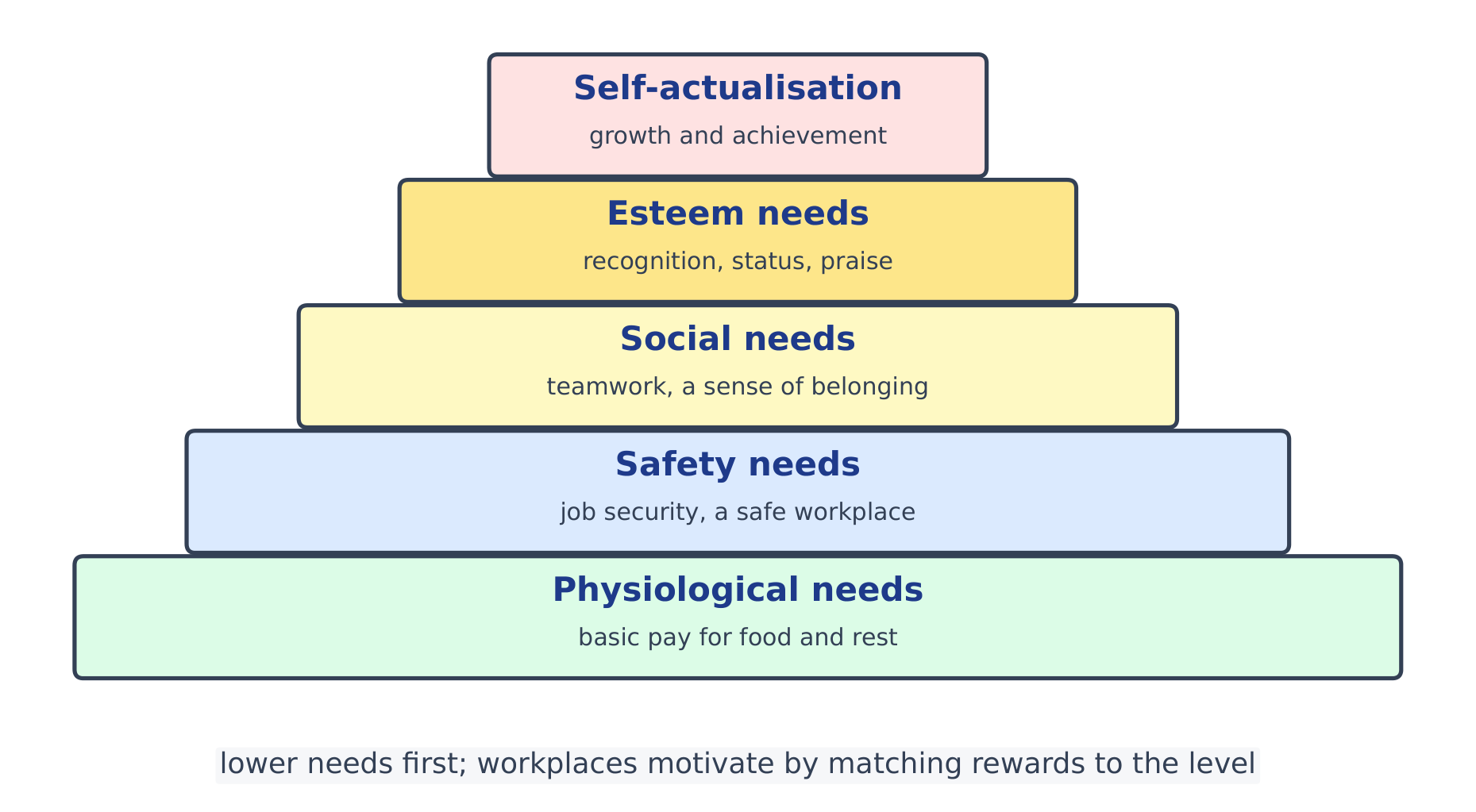
People are motivated by a ladder of needs — a business motivates staff by helping them up it.
In Maslow's hierarchy, which need must be met first?
难度 1/5 · 今日首次完成可获 100 金币及少量额外奖励
Basic needs come first in the hierarchy.
Maslow arranged needs in a ______, with basic needs at the bottom.
难度 1/5 · 今日首次完成可获 100 金币及少量额外奖励
Each level must be met before the next motivates.
Maslow's hierarchy of needs
- Maslow said needs come in a hierarchy, lowest first.
- Once a level is met, the next becomes the motivator — up to self-actualisation 自我实现.
Which are financial methods of motivation? (Select all that apply.)
难度 2/5 · 今日首次完成可获 140 金币及少量额外奖励
Praise is non-financial; the others are financial.
Job enrichment is a non-financial method of motivation.
难度 1/5 · 今日首次完成可获 100 金币及少量额外奖励
It motivates by making work more rewarding, not by pay.
Ways to motivate
- Financial 金钱激励: wages, salaries, bonuses 奖金, commission 佣金, piece rates, profit-sharing.
- Non-financial 非金钱激励: praise, job rotation, job enrichment 工作丰富化, teamwork, promotion.
Money is not the only motivator. Once pay is enough, factors like recognition, responsibility and good teamwork often matter more. The best approach mixes financial and non-financial methods.
Worked example: motivating a call-centre team
A call centre pays its staff well, but many leave after a few months, saying the job is boring. Suggest how to motivate them.
- Pay already meets the physiological and safety needs in Maslow's hierarchy, so more money is unlikely to help much. Staff now want social, esteem and achievement needs met.
- Job rotation (switching between tasks) reduces boredom. Job enrichment (giving them more responsibility, such as handling complaints) and praise for good work meet esteem needs, so staff are more likely to stay.
A worker is paid £2 for each shirt sewn. This is:
难度 1/5 · 今日首次完成可获 100 金币及少量额外奖励
Piece rate pays per item made.
Which need is at the top of Maslow's hierarchy?
难度 1/5 · 今日首次完成可获 100 金币及少量额外奖励
Self-actualisation, reaching your full potential, comes once the lower needs are met.
You've got it
- motivation lifts productivity, quality and loyalty
- Maslow's hierarchy: lower needs first, up to self-actualisation
- motivate with financial (pay, bonus) and non-financial (praise, enrichment) methods
Write from a non-financial motivator
- Pay already covers rent and food.
- A new title and extra responsibility is job enrichment. It does not replace pay that is too low to live on.
Pay already covers an employee's rent and food. The firm then offers a new title and more responsibility. What kind of motivator is that, and when is it not enough?
Money matters, and so do recognition and responsibility. The useful mix depends on whether basic needs are already met.
Once basic pay is enough, what is extra responsibility?
难度 1/5 · 今日首次完成可获 100 金币及少量额外奖励
Responsibility is job enrichment. It adds to pay that is already enough. It does not replace missing basic pay.