| English | 释义 | 拼音 |
|---|---|---|
| root hair cells/ruːt heə selz/ | 根毛细胞 | gēn máo xì bāo |
| osmosis/ɒzˈməʊsɪs/ | 渗透 | shèn tòu |
| active transport/ˈæktɪv ˈtrænspɔːt/ | 主动运输 | zhǔ dòng yùn shū |
| transpiration/trænspəˈreɪʃn/ | 蒸腾作用 | zhēng téng zuò yòng |
| transpiration stream/trænspəˈreɪʃn striːm/ | 蒸腾流 | zhēng téng liú |
Drinking through roots
- A plant takes in all its water through its roots — then moves it up to every leaf.
- It starts at specialised root hair cells 根毛细胞.
Water enters a root hair cell by:
难度 1/5 · 今日首次完成可获 100 金币及少量额外奖励
Water moves in by osmosis down the water gradient.
Minerals are taken into root hair cells by:
难度 1/5 · 今日首次完成可获 100 金币及少量额外奖励
Minerals are scarce in soil, so active transport pulls them in.
A root hair cell's long shape gives it a large:
难度 1/5 · 今日首次完成可获 100 金币及少量额外奖励
Large surface area speeds water and mineral uptake.
Root hair cells
- Root hair cells have a long, thin extension giving a large surface area.
- Water enters them by osmosis 渗透; minerals enter by active transport 主动运输.
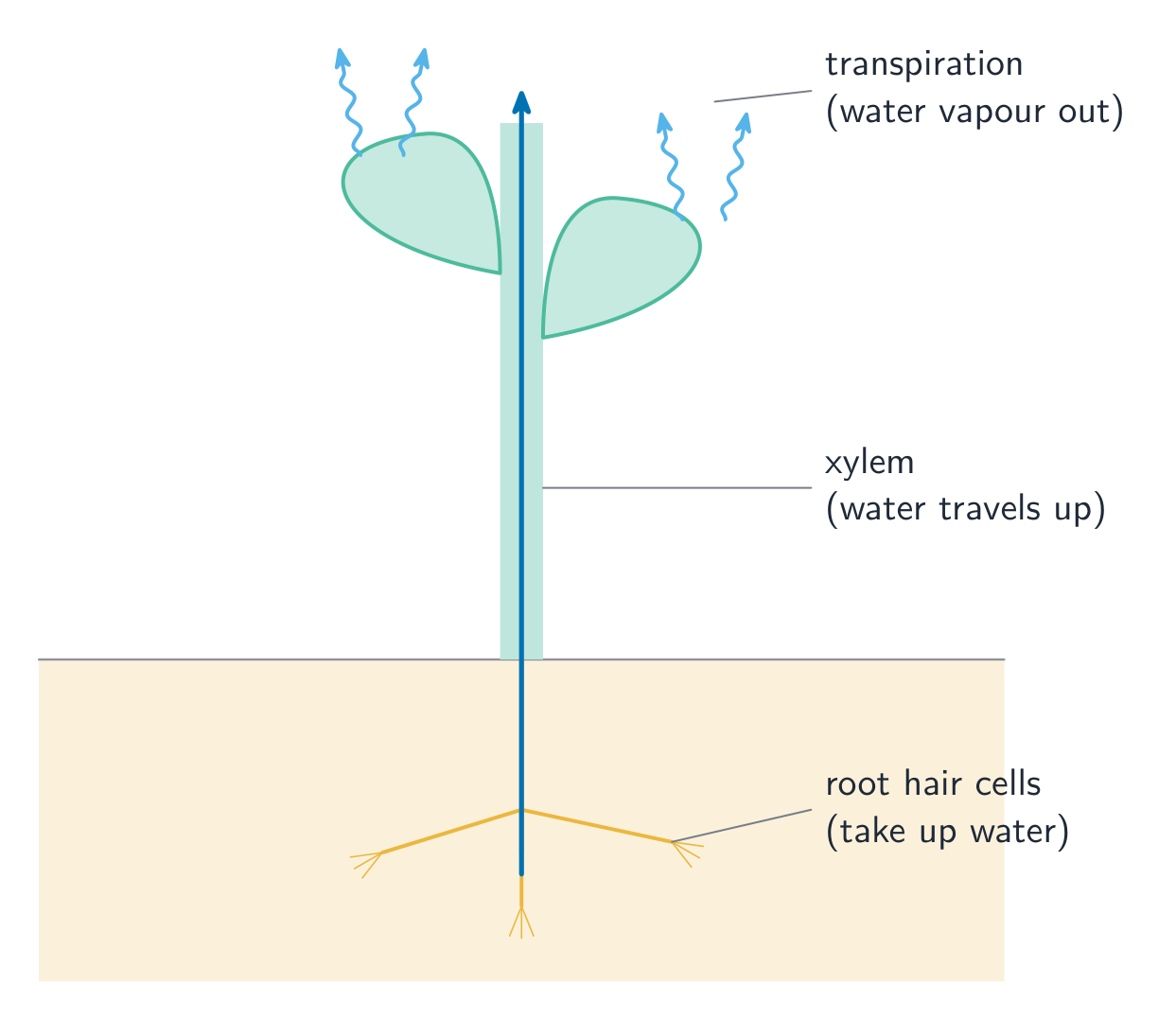
Water is taken up by root hairs, carried up the xylem, and lost from the leaves
根毛对水的摄取
Root hair cells take in water by osmosis — water moves from the dilute soil into the more concentrated cell.
After crossing the root, water enters the ______ to travel up the plant.
难度 1/5 · 今日首次完成可获 100 金币及少量额外奖励
Xylem carries water up to the leaves.
A root has thousands of root hairs. What is the main advantage?
难度 1/5 · 今日首次完成可获 100 金币及少量额外奖励
More surface means more water can enter by osmosis and more ions by active transport at the same time.
The path of water
- Water passes from the soil → root hair cell → across the root → into the xylem.
- From there it travels up to the leaves.
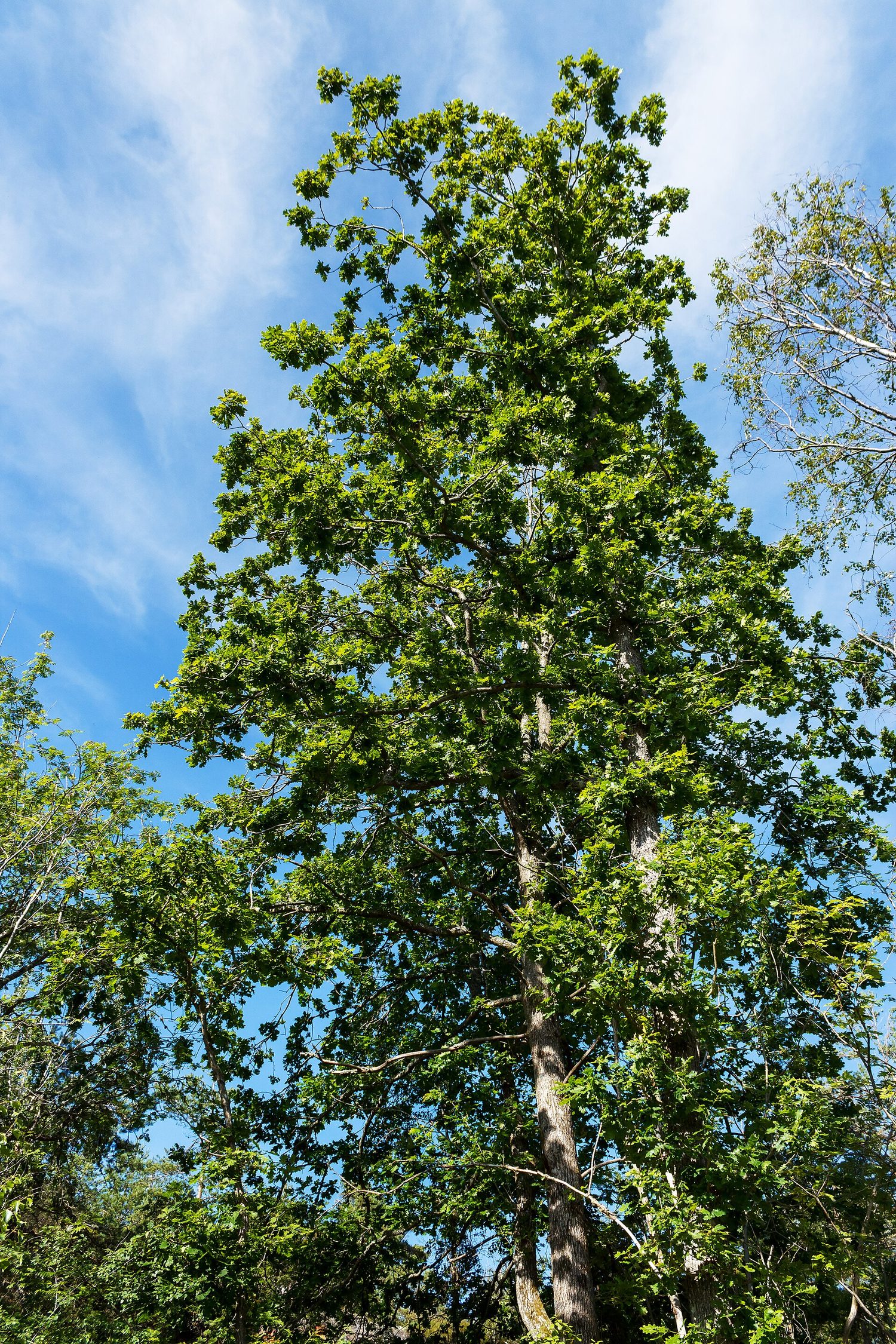
A tree moves water up from its roots through xylem vessels
Evaporation of water from the leaves helps pull water up the plant.
难度 1/5 · 今日首次完成可获 100 金币及少量额外奖励
This creates the transpiration stream.
The pull from above
- Water is pulled up because it evaporates from the leaves (transpiration 蒸腾作用), creating a pull.
- This continuous column of water is the transpiration stream 蒸腾流.
Worked example. A root hair cell sits in dilute soil water. Water moves in by osmosis (down the water gradient), while scarce minerals are pulled in by active transport (against their gradient, using energy).
See the pathway: the coloured-dye test
- Stand a celery stalk (or a white flower) in water with a coloured dye for a few hours. Then cut across the stalk and look.
- Only small dots near the outside are coloured: these are the xylem vessels, which carry the water and dye up the plant.
A student puts a celery stalk in red dye. After 2 hours, the leaves have red veins, and the cut stalk shows red spots in a ring.
- Water moved up the xylem, carrying the dye. The red spots in the cut stalk are the xylem vessels.
- At a higher temperature the leaves turn red sooner, because faster transpiration pulls water up faster.
A stalk stood in coloured dye is cut across. Which tissue is coloured?
难度 1/5 · 今日首次完成可获 100 金币及少量额外奖励
Water and the dissolved dye travel up the xylem, so only the xylem vessels are stained.
You've got it
- root hair cells (large surface area) take in water by osmosis, minerals by active transport
- water travels: soil → root → xylem → leaves
- evaporation from leaves pulls water up — the transpiration stream
Write from root hair uptake
- Soil water is more dilute than the root hair cell contents.
- Mineral ions are scarcer in the soil than inside the cell.
How does each substance enter the root hair?
Water and ions use different processes at the same cell.
How do mineral ions enter a root hair against the gradient?
难度 1/5 · 今日首次完成可获 100 金币及少量额外奖励
Uphill ion movement needs active transport.