| English | 释义 | 拼音 |
|---|---|---|
| stomata/ˈstəʊmətə/ | 气孔 | qì kǒng |
| transpiration/trænspəˈreɪʃn/ | 蒸腾作用 | zhēng téng zuò yòng |
| humidity/hjuːˈmɪdɪti/ | 湿度 | shī dù |
| guard cells/ɡɑːd selz/ | 保卫细胞 | bǎo wèi xì bāo |
The price of open pores
- To let carbon dioxide in, a leaf must open its stomata 气孔 — but water vapour escapes at the same time.
- This loss of water is transpiration 蒸腾作用.
Transpiration is the loss of:
难度 1/5 · 今日首次完成可获 100 金币及少量额外奖励
Transpiration is water vapour loss, mainly through stomata.
Most water vapour is lost through pores called ______.
难度 1/5 · 今日首次完成可获 100 金币及少量额外奖励
Stomata are the main route for transpiration.
What transpiration is
- Transpiration is the loss of water vapour from a plant's leaves, mainly through the stomata.
- It pulls the transpiration stream of water up from the roots.
The transpiration stream
Water is pulled up the plant in a continuous stream, from the roots to the leaves where it evaporates.
Which increase the rate of transpiration? (Select all that apply.)
难度 2/5 · 今日首次完成可获 140 金币及少量额外奖励
Higher humidity slows transpiration; the others speed it up.
Increasing the humidity of the air around a leaf will:
难度 1/5 · 今日首次完成可获 100 金币及少量额外奖励
Moist air reduces evaporation, slowing transpiration.
Factors affecting the rate
- Transpiration speeds up with more light, higher temperature, more wind, and lower humidity 湿度.
- Each makes evaporation from the leaf faster.
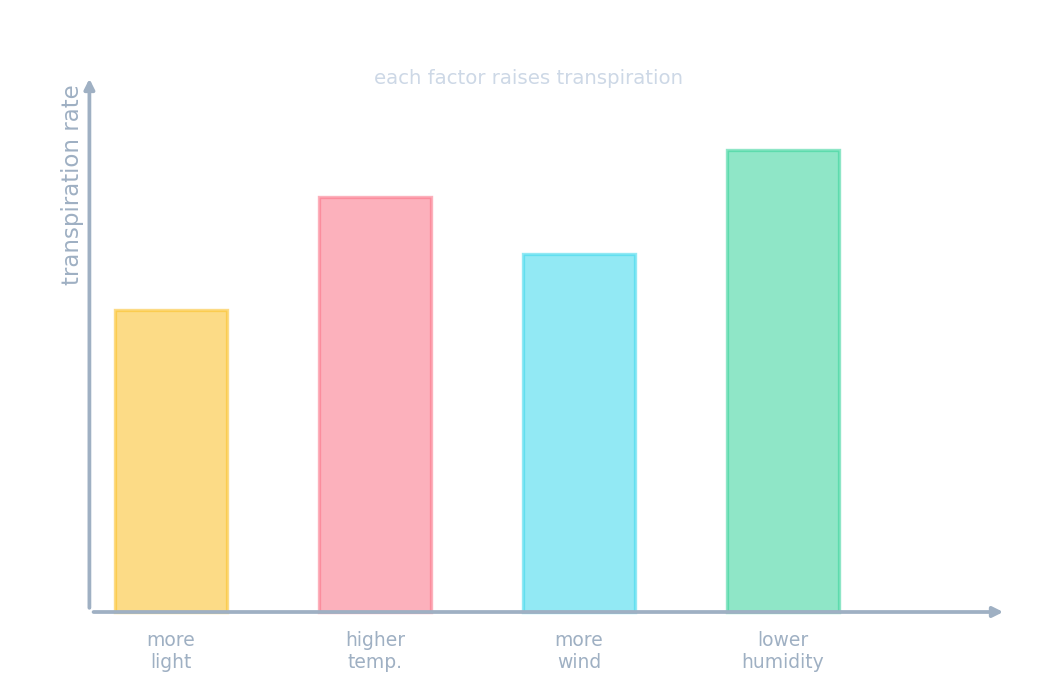
Each environmental factor that speeds up evaporation raises the transpiration rate.
A plant wilts if it loses water faster than it can take it up.
难度 1/5 · 今日首次完成可获 100 金币及少量额外奖励
Flaccid cells can no longer support the plant.
Wilting and control
- If a plant loses water faster than it takes it up, cells become flaccid and it wilts.
- Guard cells 保卫细胞 can close the stomata to reduce water loss.
Higher humidity SLOWS transpiration. When the air is already moist, there's less difference between the leaf and the air, so less water evaporates. Dry, windy, hot, bright conditions speed it up.
Worked example: a potometer reading
A leafy shoot is set up in a potometer. In still air the air bubble moves 15 mm in 5 minutes; with a fan blowing on the leaves it moves 40 mm in 5 minutes. Calculate both rates and explain the difference.
- Rate = distance ÷ time: still air $\dfrac{15}{5} = 3$ mm per minute; with the fan $\dfrac{40}{5} = 8$ mm per minute.
- Wind carries water vapour away from the leaf surface, keeping the air outside the stomata dry. This makes the concentration gradient steeper, so water vapour diffuses out faster and the shoot takes up more water to replace it.
In bright light the bubble moves 36 mm in 4 minutes. What is the rate in mm per minute?
难度 2/5 · 今日首次完成可获 140 金币及少量额外奖励
$\dfrac{36}{4} = 9$ mm per minute.
A clear plastic bag is tied over the shoot. What happens to the transpiration rate, and why?
难度 1/5 · 今日首次完成可获 100 金币及少量额外奖励
Water vapour builds up in the bag, so less diffuses out of the leaf.
You've got it
- transpiration = loss of water vapour from leaves (through stomata)
- rate rises with more light, higher temperature, more wind, lower humidity
- excessive loss causes wilting; guard cells close stomata to reduce it
Write from dry air
- A plant stands in warm, windy, dry air.
- Its stomata are open.
What happens to the transpiration rate, and how can the plant slow the loss?
A steep vapour gradient out of the leaf speeds the loss.
Which change increases transpiration?
难度 1/5 · 今日首次完成可获 100 金币及少量额外奖励
Dry air keeps the outside humidity low.