| English | 释义 | 拼音 |
|---|---|---|
| incisors/ɪnˈsaɪzəz/ | 门齿 | mén chǐ |
| canines/ˈkeɪnaɪnz/ | 犬齿 | quǎn chǐ |
| molars/ˈməʊləz/ | 臼齿 | jiù chǐ |
| emulsification/ɪˌmʌlsɪfɪˈkeɪʃn/ | 乳化 | rǔ huà |
| lipase/ˈlɪpeɪs/ | 脂肪酶 | zhī fáng méi |
| physical digestion/ˈfɪzɪkl daɪˈdʒestʃn/ | 物理消化 | wù lǐ xiāo huà |
Breaking food apart — physically
- Before chemicals can act, big lumps of food must be broken into smaller pieces.
- This physical (mechanical) digestion doesn't change the food chemically — it just makes it smaller.
Which teeth are used for cutting?
难度 1/5 · 今日首次完成可获 100 金币及少量额外奖励
Incisors cut; canines tear; molars and premolars grind.
Chewing food into smaller pieces helps digestion because it:
难度 1/5 · 今日首次完成可获 100 金币及少量额外奖励
Smaller pieces give enzymes more surface to act on.
Teeth
- Incisors 门齿 cut, canines 犬齿 tear, premolars and molars 臼齿 grind.
- Chewing breaks food into smaller pieces with a larger surface area for enzymes.
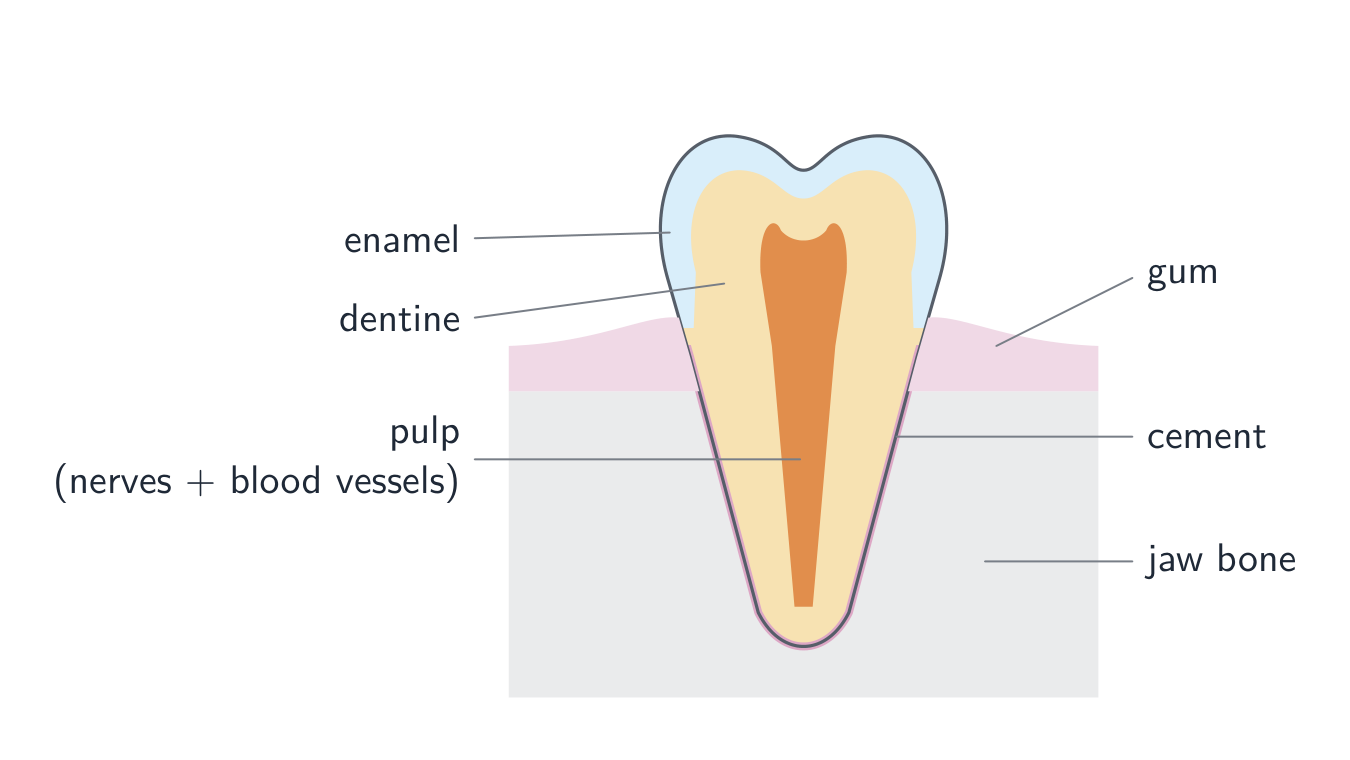
A tooth in section: enamel over dentine, a soft pulp, and a root held by cement
Physical (mechanical) digestion
Physical digestion breaks food into smaller pieces WITHOUT changing it chemically — it just increases the surface area for enzymes.
Physical digestion changes the chemical structure of food molecules.
难度 1/5 · 今日首次完成可获 100 金币及少量额外奖励
Physical digestion only makes food smaller; enzymes do the chemical change.
The stomach
- The stomach's muscular walls churn food, mixing it with acid and enzymes.
- This continues the physical breakdown.
Bile emulsifies fat, which means it:
难度 1/5 · 今日首次完成可获 100 金币及少量额外奖励
Emulsification is physical: bigger surface area for lipase.
Breaking large fat droplets into smaller ones is called ______.
难度 1/5 · 今日首次完成可获 100 金币及少量额外奖励
Bile emulsifies fats to speed up lipase action.
Bile and emulsification 乳化
- Bile breaks large fat droplets into many tiny ones — emulsification.
- This greatly increases the fat's surface area for the enzyme lipase 脂肪酶.
Physical digestion 物理消化 doesn't change the molecules. Chewing and churning only make food smaller. The chemical change — breaking molecules into smaller ones — is done by enzymes (chemical digestion).
Worked example: why bile helps lipase
A large fat droplet is 8 mm across. Bile breaks it into 8 equal droplets, each 4 mm across. Explain why lipase now digests the fat faster.
- Total volume of fat is unchanged, but the surface area doubles: each small droplet has $\dfrac{1}{4}$ of the big one's surface, and $8 \times \dfrac{1}{4} = 2$ times the area in total.
- Lipase works only at the surface of a droplet, so more surface means more enzyme–fat contact and faster digestion. Bile also neutralises stomach acid, giving the alkaline pH that intestinal enzymes need. Bile is not an enzyme: it breaks no bonds.
Where is bile made, and where is it stored?
难度 1/5 · 今日首次完成可获 100 金币及少量额外奖励
The liver makes bile; the gall bladder stores it and releases it into the duodenum.
Bile is an enzyme that breaks fat into fatty acids and glycerol.
难度 1/5 · 今日首次完成可获 100 金币及少量额外奖励
Bile only emulsifies fat into small droplets; lipase does the chemical digestion.
You've got it
- physical digestion makes food smaller without changing it chemically
- teeth cut/tear/grind; the stomach churns food
- bile emulsifies fats — increasing surface area for lipase
Write from bile and fat droplets
- Bile is added to a mixture of fat and water.
- The fat breaks into many tiny droplets.
What is this physical change called, and why does it help?
Smaller droplets give lipase more surface to work on.
What does bile do to fats?
难度 1/5 · 今日首次完成可获 100 金币及少量额外奖励
Bile is the emulsifier, and lipase does the chemical split.