Most people still farmed, 1900
- In 1900 Britain had railways, factories and electric light, and most of its people lived in towns. But across the whole world, about two people in three still worked on the land, many with tools their grandparents had used.
- So how much did industrialisation change the world between 1750 and 1900? A lot — but not everywhere, and not for everyone.
In 1900, about what share of the world's people still worked on the land?
难度 1/5 · 今日首次完成可获 100 金币及少量额外奖励
Industry had not reached most people.
Large change: production
- Machines driven by steam multiplied what one worker could make. Britain's share of world manufacturing rose from about 2% in 1750 to about 23% in 1880.
- China and India had made more than half of the world's manufactured goods in 1750; by 1900 they made less than a tenth, as cheap factory cloth replaced hand-made cloth.
Britain's share of world manufacturing rose from about 2% in 1750 to about ____% in 1880.
难度 1/5 · 今日首次完成可获 100 金币及少量额外奖励
Bairoch's estimates.
Large change: connections
- Railways, steamships and the telegraph opened the interiors of continents, increased trade and carried tens of millions of migrants.
- New classes appeared: an industrial middle class and an urban working class, with trade unions and new political parties.
Industrialisation created new social classes.
难度 1/5 · 今日首次完成可获 100 金币及少量额外奖励
An industrial middle class and an urban working class.
Limited change
- Industry was concentrated in western Europe, the United States, and later Russia and Japan. Most of Africa, Asia and Latin America sent raw materials to these regions instead.
- In industrial countries too, living standards rose slowly: early factory workers worked 12 or more hours a day, and life in crowded cities was short.
Which are limits on the extent of change?
难度 2/5 · 今日首次完成可获 140 金币及少量额外奖励
Railways are evidence of change.
Worked example: an "extent" judgement. "Industrialisation changed production and trade to a great extent: Britain's share of world manufacturing grew from about 2% to about 23% by 1880, and China's fell from about a third to about 6% by 1900. But the change was uneven. By 1900 most of the world's people still farmed, so for them industry changed what they sold and bought more than how they lived." The answer gives a degree and evidence for both sides.
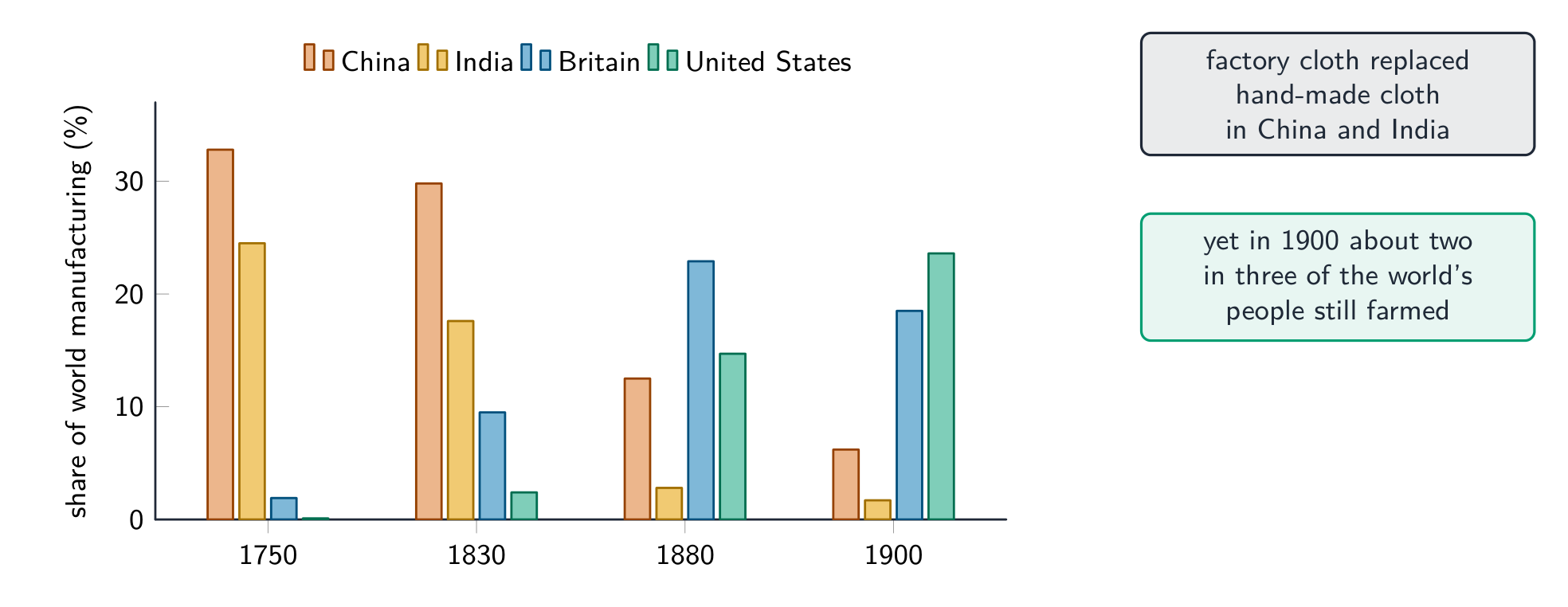
What happened to China's share of world manufacturing by 1900?
难度 1/5 · 今日首次完成可获 100 金币及少量额外奖励
Factory cloth replaced hand-made cloth.
Revolutions happened at the same time
- The same period saw political revolutions in North America (1776), France (1789), Haiti (1791–1804) and Latin America (1810–26), driven by Enlightenment ideas and nationalism.
- Industry and revolution fed each other: new wealth and new classes gave new ideas such as liberalism and socialism their supporters.
Change or continuity?
Sort each piece of evidence about the world by 1900.
Put the revolutions in order.
难度 3/5 · 今日首次完成可获 200 金币及少量额外奖励
1776, 1789, 1804, 1826.
"To what extent" asks for a degree, not a list. Say how much things changed, for whom and where, and give evidence for both change and continuity.
A good "to what extent" answer is a list of changes.
难度 1/5 · 今日首次完成可获 100 金币及少量额外奖励
It gives a degree with evidence on both sides.
From 1750 to 1900 industrialisation changed production, transport and society on a huge scale: Britain's share of world manufacturing rose from about 2% to about 23% by 1880, while China's and India's collapsed. But the change was uneven. Most people in 1900 still farmed, and industry was concentrated in a few regions, so the answer to "how much?" depends on where and for whom.
To what extent did industrialisation change the world between 1750 and 1900?
Give a degree, then weigh both sides.