| English | 释义 | 拼音 |
|---|---|---|
| Nationalism/ˈnæʃənəlɪzəm/ | 民族主义 | mín zú zhǔ yì |
| liberalism/ˈlɪbərəlɪzəm/ | 自由主义 | zì yóu zhǔ yì |
A nation of former slaves, January 1804
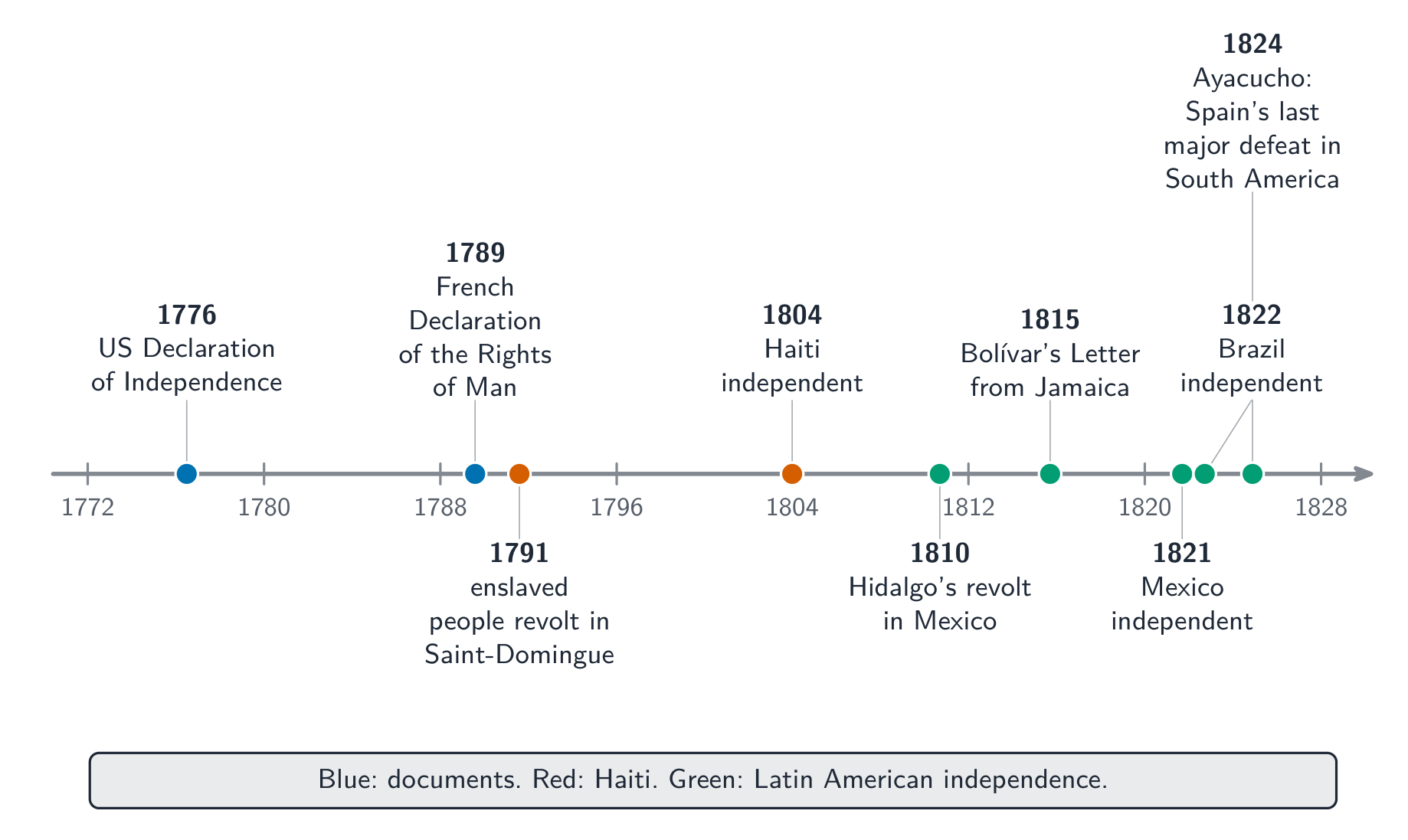
- On 1 January 1804, at Gonaïves, Jean-Jacques Dessalines declared the independence of Haiti, the former French colony of Saint-Domingue. Thirteen years earlier, in August 1791, enslaved people had risen in revolt; they defeated French, Spanish and British armies, including a force Napoleon sent in 1802. Haiti became the first state founded by formerly enslaved people, and it abolished slavery for good.
- From 1750 to 1900, Enlightenment ideas inspired revolutions in the Americas and Europe, and nationalism created new states.
The Haitian revolt began in 1791 and independence came in 1804. How many years?
难度 2/5 · 今日首次完成可获 140 金币及少量额外奖励
1804 − 1791.
An age of revolution
- People challenged kings and empires using ideas of rights, equality and government by consent.
- Liberalism 自由主义 in this period meant constitutions, rights and limits on kings.
Documents carried the ideas
- The American Declaration of Independence (1776) and the French Declaration of the Rights of Man and of the Citizen (1789).
- Simón Bolívar's Letter from Jamaica (1815) argued that Spanish America must win independence.
Document, American movement, or nationalism?
Sort each item in the revolutionary age.
Match each document to its year.
难度 2/5 · 今日首次完成可获 140 金币及少量额外奖励
Documents carried ideas.
Worked example: three linked movements in the Americas
- United States (1775–83): colonists won independence but kept slavery.
- Haiti (1791–1804): enslaved people won freedom and independence — a revolution against slavery itself.
- Latin America (1810–25): creole elites led by Bolívar and San Martín won independence from Spain; most new states abolished slavery gradually over the following decades.
What made the Haitian Revolution different from the American?
难度 1/5 · 今日首次完成可获 100 金币及少量额外奖励
Formerly enslaved people founded the state.
Nationalism
- Nationalism 民族主义 was a new sense of belonging to a nation, based on shared language, history and culture.
- It united Italy (1861) and Germany (1871) under leaders like Cavour and Bismarck.
Identity and borders
- Nationalism also broke empires apart: Greece won independence from the Ottomans in 1830, and Balkan nations followed.
- The same idea could build a new state or destroy an old one.
Match each to its category.
难度 2/5 · 今日首次完成可获 140 金币及少量额外奖励
Three categories.
Put these in order.
难度 3/5 · 今日首次完成可获 200 金币及少量额外奖励
1804, 1830, 1861, 1871.
The revolutions did not bring rights to everyone. The US kept slavery until 1865, and women were excluded from voting almost everywhere.
The revolutions brought equal rights to everyone.
难度 1/5 · 今日首次完成可获 100 金币及少量额外奖励
Slavery and women's exclusion continued.
From 1750, Enlightenment ideas in documents such as the Declaration of Independence inspired revolutions in the US, France, Haiti and Latin America. Haiti in 1804 was the first state founded by formerly enslaved people. Nationalism united Italy and Germany but broke up the Ottoman Empire.
Compare the American and Haitian revolutions.
Comparison.