| English | 释义 | 拼音 |
|---|---|---|
| détente | 缓和 | huǎn hé |
| glasnost/ˈɡlæsnɒst/ | 公开化 | gōng kāi huà |
| perestroika/ˈperɪstrɔɪkə/ | 经济重建 | jīng jì chóng jiàn |
"Tear down this wall!", 1987
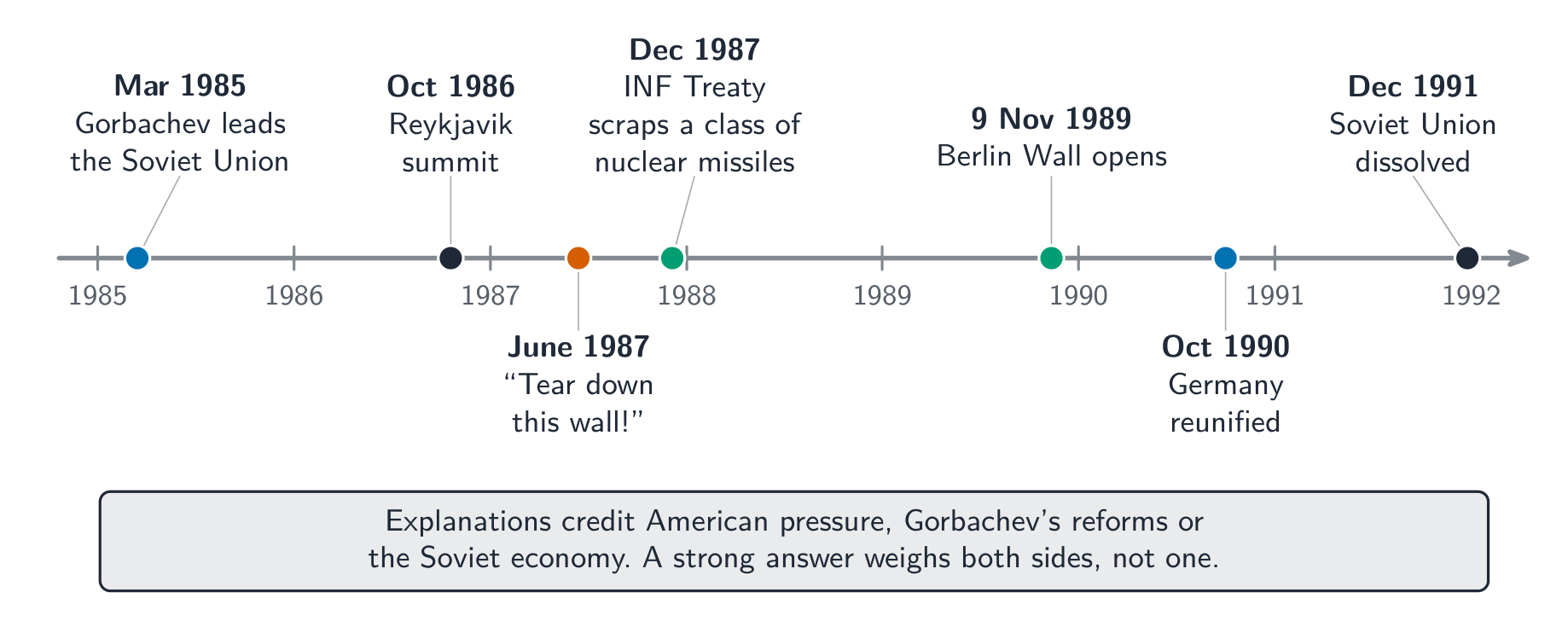
- In June 1987, standing at the Berlin Wall, President Ronald Reagan called on the Soviet leader: "Mr. Gorbachev, tear down this wall!" Two and a half years later, on 9 November 1989, East German guards opened the crossings, and Berliners began breaking the wall apart. In December 1991 the Soviet Union itself dissolved.
- Why did the Cold War end — and who deserves the credit?
Reagan's pressure
- Reagan rejected détente 缓和 — the 1970s easing of tensions — calling the Soviet Union an "evil empire" (1983). Military spending rose sharply, and he proposed a space-based missile defence, the Strategic Defense Initiative.
- Under the Reagan Doctrine, the US armed anti-communist rebels in Afghanistan, Nicaragua and Angola.
Which were parts of Reagan's Cold War policy?
难度 2/5 · 今日首次完成可获 140 金币及少量额外奖励
He rejected détente.
Gorbachev's reforms
- Mikhail Gorbachev, leader from 1985, faced a failing economy and a costly war in Afghanistan. He introduced glasnost 公开化 (openness) and perestroika 经济重建 (economic restructuring).
- He also refused to use force to keep Eastern European communist governments in power.
Match each term to its meaning.
难度 2/5 · 今日首次完成可获 140 金币及少量额外奖励
Key terms.
Worked example: weighing the causes
- Reagan's role: the arms build-up and pressure raised the cost of competing for a struggling Soviet economy.
- Soviet problems: falling oil prices, a stagnant economy, Afghanistan and nationalist movements in the republics weakened the USSR from within.
- Diplomacy: Reagan and Gorbachev met five times and signed the INF Treaty (1987), removing a whole class of nuclear missiles. The best answer links them: pressure mattered because the Soviet system was already weak, and Gorbachev chose reform over force.
Follow the Cold War to its end
The end has several pressures acting together rather than one decisive cause.
Put these events in order.
难度 3/5 · 今日首次完成可获 200 金币及少量额外奖励
1985, 1987, 1989, 1991.
Which was an internal Soviet problem in the 1980s?
难度 1/5 · 今日首次完成可获 100 金币及少量额外奖励
Weakness from within.
What the end produced
- Germany reunified in 1990; fifteen new states replaced the USSR; NATO later expanded eastwards.
- The US was left as the only superpower, with debates about its role — as in the 1991 Gulf War.
Problems at home
- Reagan's tax cuts and defence spending tripled the national debt during the 1980s.
- The Iran–Contra affair (1986) revealed secret arms sales to Iran used to fund Nicaraguan rebels, against a law passed by Congress.
The Iran–Contra affair involved secret arms sales to Iran to fund Nicaraguan rebels.
难度 1/5 · 今日首次完成可获 100 金币及少量额外奖励
Revealed in 1986.
"Reagan won the Cold War" is one argument, not the whole answer. Soviet economic weakness, Gorbachev's choices and Eastern European protest movements all mattered. Weigh the causes rather than giving all credit to one side.
Historians agree the Cold War ended only because of Reagan's policies.
难度 1/5 · 今日首次完成可获 100 金币及少量额外奖励
Several causes are weighed.
Reagan's arms build-up and pressure, combined with Soviet economic weakness and Gorbachev's reforms and refusal to use force, ended the Cold War between 1989 and 1991. The US emerged as the sole superpower, but faced debt at home and new questions about its global role.
Evaluate the relative importance of US policy and Soviet internal problems in ending the Cold War.
Argumentation.