| English | 释义 | 拼音 |
|---|---|---|
| encomienda | 委托监护制 | wěi tuō jiān hù zhì |
| mestizo | 梅斯蒂索人 | méi sī dì suǒ rén |
| caste system/kæst ˈsɪstəm/ | 种姓制度 | zhǒng xìng zhì dù |
A colonist changes sides
- Bartolomé de las Casas arrived in the Caribbean in 1502 and held Taíno people as forced labourers. In 1514 he gave them up and spent fifty years condemning Spanish cruelty. His 1552 Short Account of the Destruction of the Indies was read across Europe.
- Spain's empire rested on systems of forced labour and a legal ranking of people by birth.
The encomienda system
- Under the encomienda 委托监护制, the Spanish Crown granted colonists the labour and tribute of native people, in return for "protecting" them and teaching Christianity.
- In practice it meant forced labour in mines and fields. The Crown's New Laws of 1542 tried to limit it, with little success.
What was the encomienda system?
难度 1/5 · 今日首次完成可获 100 金币及少量额外奖励
Forced labour under a legal grant.
Enslaved Africans
- As native populations collapsed, Spain and Portugal imported enslaved Africans, especially for sugar plantations in the Caribbean and Brazil.
- Portuguese traders bought captives through partnerships with some West African rulers.
Why did Spain and Portugal import enslaved Africans?
难度 1/5 · 今日首次完成可获 100 金币及少量额外奖励
Disease and forced labour destroyed native populations.
Worked example: reading the casta hierarchy
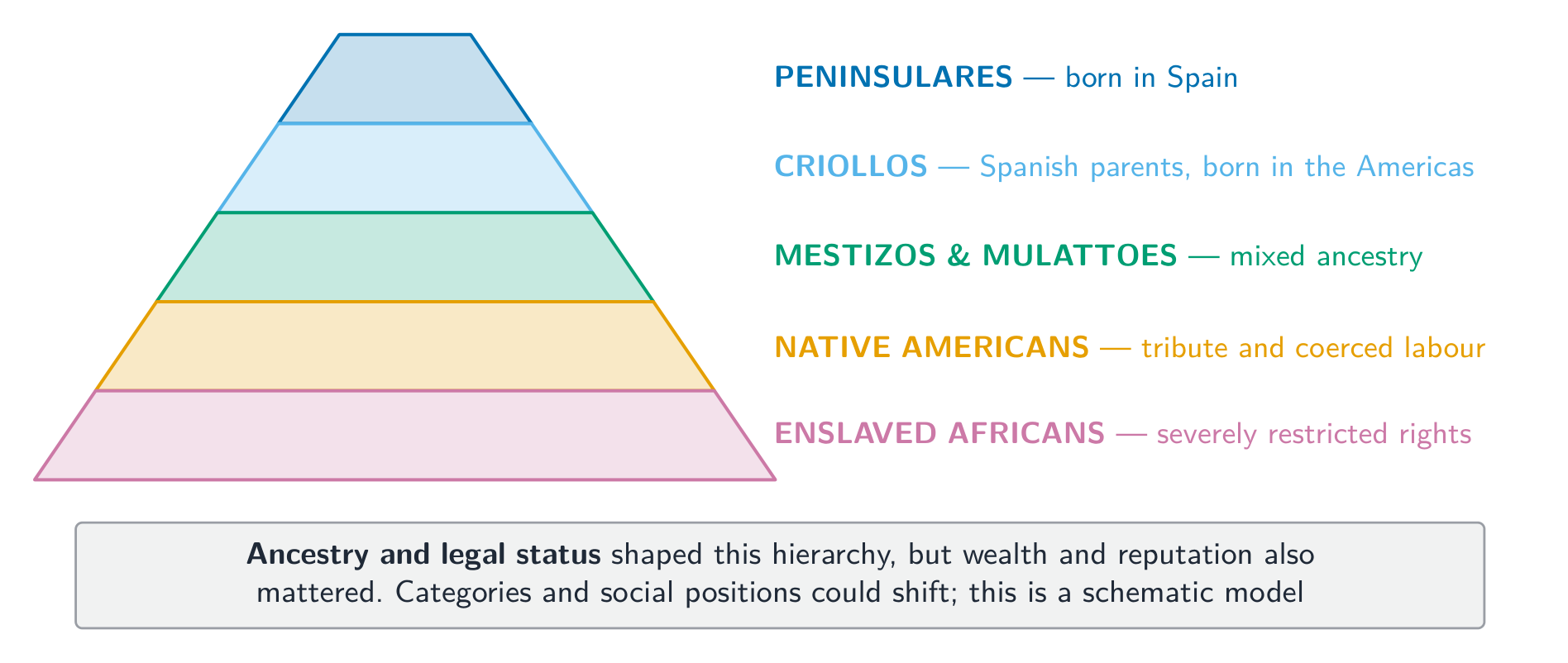
Spanish law ranked people by ancestry.
- Top: peninsulares (born in Spain), then criollos (Spanish parents, born in the Americas).
- Middle: mestizos 梅斯蒂索人 (Spanish and native ancestry) and mulatos (Spanish and African ancestry).
- Bottom: native people and enslaved Africans. Taxes, jobs and legal rights depended on rank — so the hierarchy served Spanish control of land and labour.
Labour system, forced trade, or legal hierarchy?
Sort each structure of the Spanish Empire.
Put these groups in order from highest to lowest legal status in the casta system.
难度 3/5 · 今日首次完成可获 200 金币及少量额外奖励
Rank by birthplace and ancestry.
The Valladolid debate, 1550–51
- Las Casas argued that native people were fully human and had rights. Juan Ginés de Sepúlveda argued they could be conquered and forced to work.
- The debate shows that Spaniards disagreed about how to treat native peoples — but the labour systems continued.
Match each person to their argument.
难度 2/5 · 今日首次完成可获 140 金币及少量额外奖励
The Valladolid debate.
Mixing and resisting
- Spanish, native and African cultures blended in religion, food and language, as in the Virgin of Guadalupe.
- Native people also resisted: in 1680 the Pueblo Revolt drove the Spanish out of New Mexico for twelve years.
The Pueblo Revolt of 1680 drove the Spanish out of New Mexico for a time.
难度 1/5 · 今日首次完成可获 100 金币及少量额外奖励
For about twelve years.
The caste system was not just prejudice — it was law. Ancestry decided taxes, jobs and legal rights. Describe it as a structure that organized the colonial economy, not only as attitudes.
The casta system was an informal custom with no legal effect.
难度 1/5 · 今日首次完成可获 100 金币及少量额外奖励
It decided taxes and rights.
Spain built its empire on the encomienda, the importation of enslaved Africans and a legal casta hierarchy based on ancestry. Critics such as Las Casas challenged the abuse, but the systems lasted, while cultures blended and native peoples resisted.
Explain how Spanish colonial systems organized labour in the Americas in the 1500s.
Social and economic structures.