| English | 释义 | 拼音 |
|---|---|---|
| social learning theory/ˈsəʊʃl ˈlɜːnɪŋ ˈθɪəri/ | 社会学习理论 | shè huì xué xí lǐ lùn |
| observation/ɒbzəˈveɪʃn/ | 观察 | guān chá |
| modelling/ˈmɒdəlɪŋ/ | 示范 | shì fàn |
| model/ˈmɒdl/ | 榜样 | bǎng yàng |
| vicarious reinforcement/vɪˈkeərɪəs ˌriːɪnˈfɔːsmənt/ | 替代强化 | tì dài qiáng huà |
| insight learning/ˈɪnsaɪt ˈlɜːnɪŋ/ | 顿悟学习 | dùn wù xué xí |
| latent learning/ˈleɪtənt ˈlɜːnɪŋ/ | 潜伏学习 | qián fú xué xí |
| cognitive map/ˈkɒɡnɪtɪv mæp/ | 认知地图 | rèn zhī dì tú |
Learning without doing
- A child who has never cooked watches a parent make dumplings for years, then folds them correctly the first time. There was no practice, no reward and no trial and error.
- Classical and operant conditioning both need the learner to experience something directly. This topic adds three routes they leave out: learning by watching, by sudden insight, and learning that stays hidden until it is needed.
Social learning: the Bobo doll study
- Social learning theory 社会学习理论 (Albert Bandura) says we learn by observation 观察 of others. Modelling 示范 is copying a model 榜样, the person observed. In 1961 Bandura's preschool children watched an adult hit and shout at an inflatable "Bobo" doll. Left alone with the doll, they copied the attack, often the exact words and actions; children who saw a calm adult were much less aggressive.
- In a later version, children saw the model rewarded or punished. Those who saw punishment copied less, but when they were then offered a reward, they reproduced the attack just as well. They had learned it; the consequence for the model only changed whether they showed it.
Select 所有 that belong to social learning theory.
难度 2/5 · 今日首次完成可获 140 金币及少量额外奖励
The Law of Effect belongs to operant conditioning.
In Bandura's study, children who saw the model punished copied less, until they were offered a reward. What does this show?
难度 1/5 · 今日首次完成可获 100 金币及少量额外奖励
When given a reason, they reproduced the behaviour well, so the learning was already there. Learning and performance are different.
Four conditions for copying, and vicarious consequences
- Bandura's four steps: attention (you notice the model), retention (you remember what you saw), reproduction (you are able to do it) and motivation (you have a reason to do it). If any step fails, no copying happens: a toddler may watch a pianist closely and still be unable to reproduce the music.
- Vicarious reinforcement 替代强化: seeing a model rewarded makes you more likely to copy; vicarious punishment makes you less likely. Models can be prosocial (a coach who helps others up) or antisocial (a violent video-game hero).
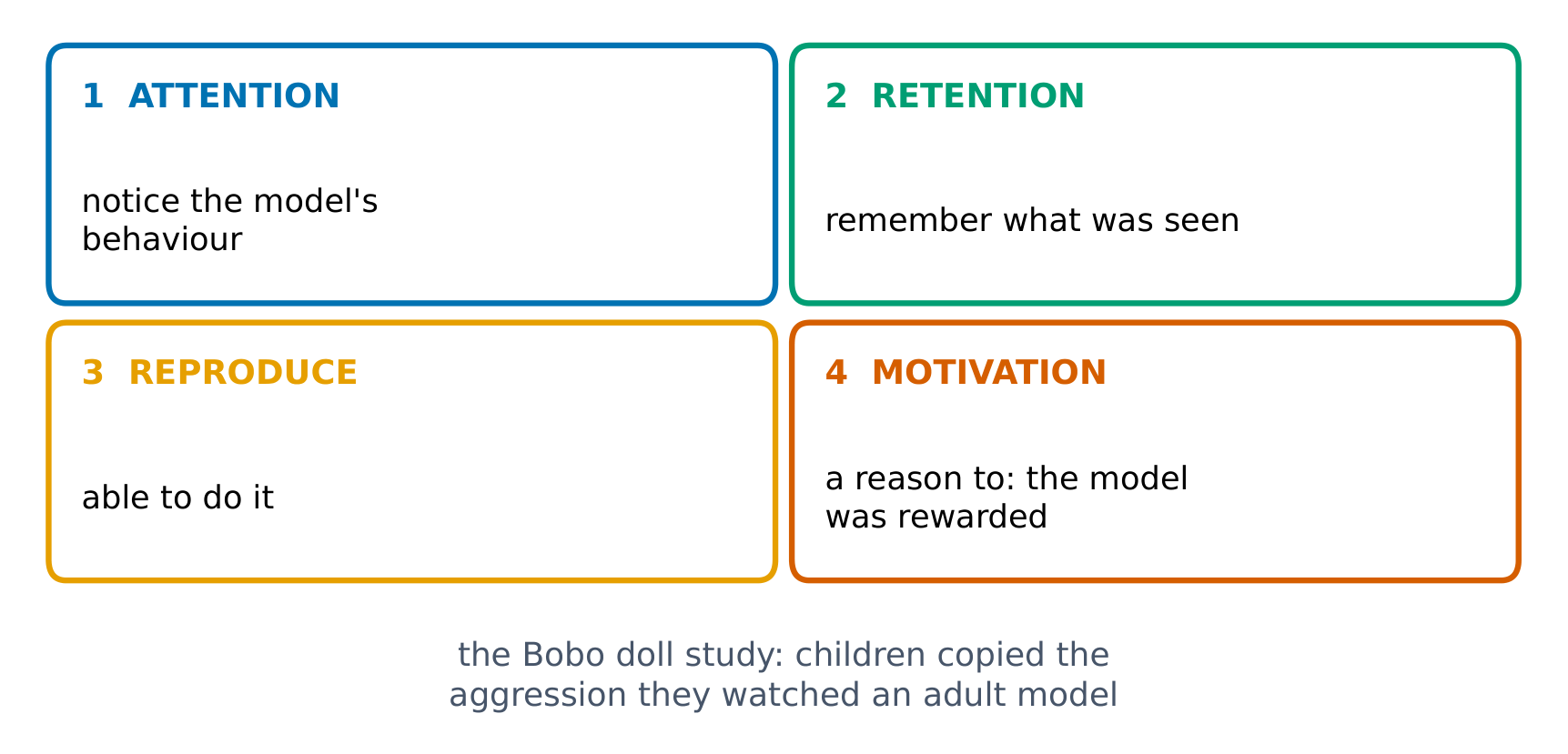
Bandura's four steps of observational learning
Changing your behaviour after seeing someone else rewarded is called...
难度 1/5 · 今日首次完成可获 100 金币及少量额外奖励
Vicarious reinforcement works through observation, not personal consequence.
Put Bandura's four conditions for observational learning in order.
难度 3/5 · 今日首次完成可获 200 金币及少量额外奖励
You must notice the model, remember what you saw, be able to do it, and have a reason to do it.
Insight learning: Köhler's chimpanzees
- Insight learning 顿悟学习 is a sudden, complete understanding of how to solve a problem, without step-by-step trial and error. Wolfgang Köhler placed bananas out of reach of his chimpanzee Sultan. After failed attempts, Sultan stopped, then joined two short sticks into a long one and pulled the bananas in.
- The solution came all at once ("aha!"), and Sultan used it again straight away. Gradual trial-and-error learning would show slow, steady improvement instead.
Insight learning is a gradual improvement built up by trial and error.
难度 1/5 · 今日首次完成可获 100 金币及少量额外奖励
It arrives suddenly and completely, without association, consequence or a model.
Latent learning and cognitive maps
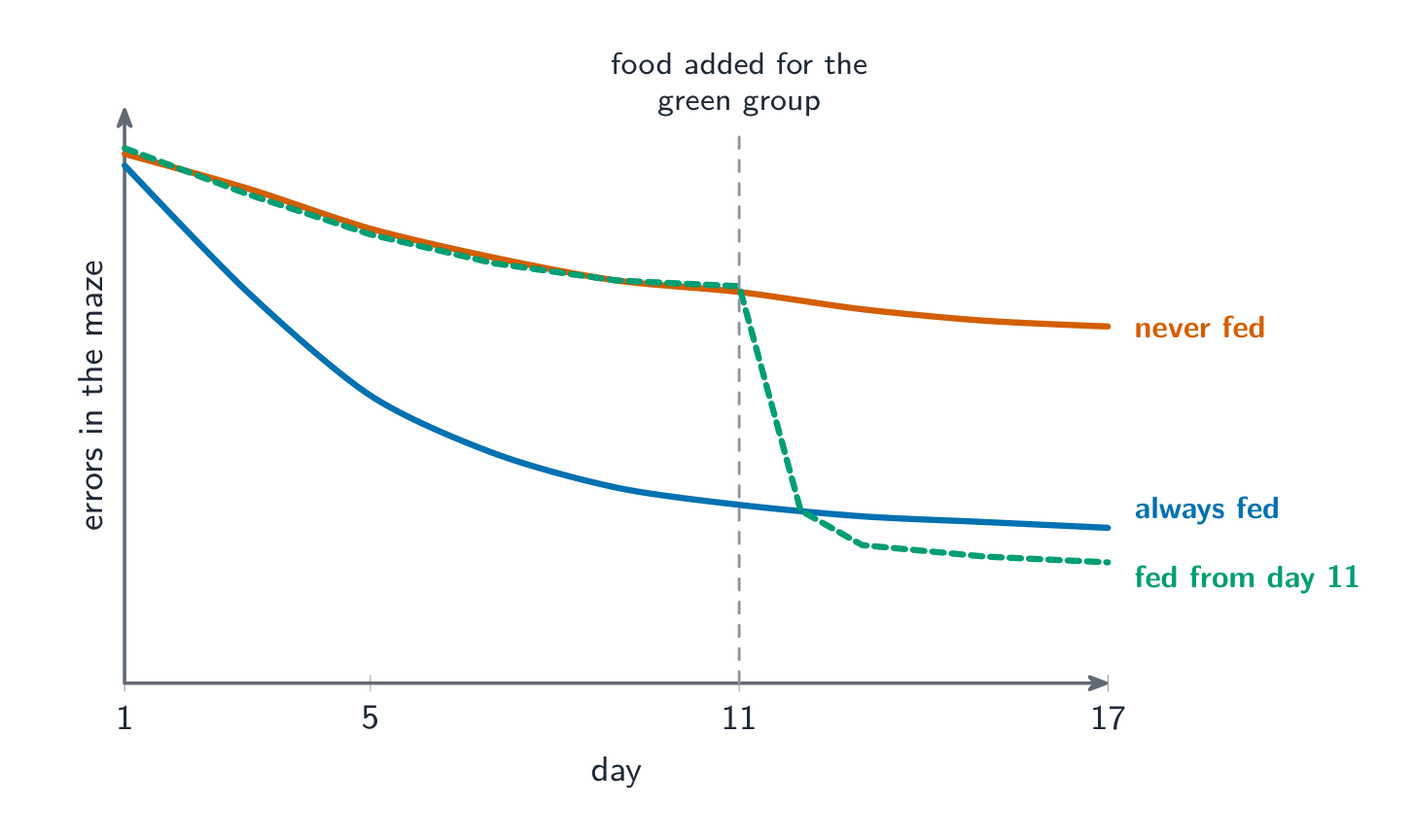
- Latent learning 潜伏学习 is learning that happens without reinforcement and stays hidden until there is a reason to show it. Edward Tolman let three groups of rats run a maze: one always found food at the end, one never did, and one found food only from day 11.
- The third group's errors dropped sharply the day after food appeared, to the level of the always-fed group or better. They had built a cognitive map 认知地图, a mental picture of the maze, while exploring without reward.
Learning that happens without reinforcement and is not immediately visible is ____ learning.
难度 1/5 · 今日首次完成可获 100 金币及少量额外奖励
Latent learning already happened; it appears once there is a reason to use it.
Latent learning is not slow learning. The learning had already happened; what was missing was a reason to show it. The same idea explains the Bobo doll children who saw the model punished: learning and performance are not the same thing.
Telling the routes apart
- Two stimuli paired → classical. A behaviour followed by a consequence → operant. Watching someone else → observational.
- A sudden, complete solution → insight. Knowledge gained without reward and shown later → latent, often as a cognitive map.
通过观察学习的四个条件
Observational learning needs all four steps — a learner can attend and remember and still not perform.
Match each signature to its kind of learning.
难度 2/5 · 今日首次完成可获 140 金币及少量额外奖励
Each kind of learning has one signature; identify the signature and the label follows.
Worked AP-style question
Question: Mei has just moved to a new city. Explain how each concept could apply to her: (a) observational learning; (b) latent learning; (c) vicarious punishment.
(a) On her first day, Mei watches other passengers tap their cards on the bus reader, then does the same. She learned the behaviour by watching models, not by trial and error.
(b) On walks with no goal, Mei passes a pharmacy several times without noticing it much. Weeks later she has a headache and walks straight there. She learned the route without reinforcement, and it appeared only when she needed it.
(c) Mei sees a cyclist fined by police for riding on the pavement, so she rides only on the road. Seeing a model punished made her less likely to do the same.
- Why it scores: each answer gives a concrete action by Mei and links it to the defining feature (watching a model; no reinforcement, shown later; a model's punishment lowering her behaviour). A definition without Mei's behaviour earns nothing.
AP practice. Tom is learning to play basketball. Explain how each concept could apply to him: (a) vicarious reinforcement; (b) insight learning; (c) the reproduction step of observational learning.
Each answer needs Tom's behaviour plus the defining feature of the concept.
Social learning theory: we learn by observation of models (Bandura's Bobo doll study), through attention, retention, reproduction and motivation; vicarious reinforcement and vicarious punishment affect whether we act. Insight learning is a sudden whole solution (Köhler's chimpanzees). Latent learning happens without reinforcement and appears when needed (Tolman's rats and cognitive maps).
Write from 5 days in a maze with no food
- Rats explore a maze for 5 days with no food. On day 6 food is added and they take a short path.
- Name the learning.
Rats explore a maze for 5 days without food. On day 6, when food is added, they take a short path. What kind of learning is this?
Learning can occur before a reward and show up when the reward makes it useful.
What appeared on day 6?
难度 1/5 · 今日首次完成可获 100 金币及少量额外奖励
The maze learning was hidden until food made it visible. That is latent learning.