| English | 释义 | 拼音 |
|---|---|---|
| Law of Effect/lɔː ɒv ɪˈfekt/ | 效果律 | xiào guǒ lǜ |
| operant conditioning/ˈɒpərənt kənˈdɪʃənɪŋ/ | 操作性条件反射 | cāo zuò xìng tiáo jiàn fǎn shè |
| reinforcement/ˌriːɪnˈfɔːsmənt/ | 强化 | qiáng huà |
| punishment/ˈpʌnɪʃmənt/ | 惩罚 | chéng fá |
| positive/ˈpɒzɪtɪv/ | 正 | zhèng |
| negative/ˈneɡətɪv/ | 负 | fù |
| shaping/ˈʃeɪpɪŋ/ | 塑造 | sù zào |
| primary reinforcer/ˈpraɪməri ˌriːɪnˈfɔːsə/ | 原级强化物 | yuán jí qiáng huà wù |
| secondary reinforcer/ˈsekəndəri ˌriːɪnˈfɔːsə/ | 次级强化物 | cì jí qiáng huà wù |
| successive approximations/səkˈsesɪv əˌprɒksɪˈmeɪʃnz/ | 逐步接近 | zhú bù jiē jìn |
| continuous reinforcement/kənˈtɪnjuːəs ˌriːɪnˈfɔːsmənt/ | 连续强化 | lián xù qiáng huà |
| extinction/ekˈstɪŋkʃn/ | 消退 | xiāo tuì |
| ratio/ˈreɪʃɪəʊ/ | 比率 | bǐ lǜ |
| interval/ˈɪntəvl/ | 时距 | shí jù |
| variable ratio/ˈveərɪəbl ˈreɪʃɪəʊ/ | 可变比率 | kě biàn bǐ lǜ |
| discriminative stimulus | 辨别性刺激 | biàn bié xìng cì jī |
| instinctive drift/ɪnˈstɪŋktɪv drɪft/ | 本能漂移 | běn néng piāo yí |
| superstitious behaviour/ˌsuːpəˈstɪʃəs bɪˈheɪvjə/ | 迷信行为 | mí xìn xíng wéi |
| learned helplessness/lɜːnd ˈhelpləsnəs/ | 习得性无助 | xí dé xìng wú zhù |
Behaviour that pays is behaviour that repeats
- Around 1900, Edward Thorndike put hungry cats in a puzzle box with food outside. At first they escaped by chance; each time, the action that opened the door came a little faster. His Law of Effect 效果律: behaviour followed by a satisfying outcome becomes more likely, and behaviour followed by an unpleasant one less likely.
- B. F. Skinner built on this with the operant chamber (Skinner box), where a rat presses a lever for food. Operant conditioning 操作性条件反射 links a voluntary behaviour to its consequence. In classical conditioning the learner receives stimuli; here the learner acts.
Four cells, two questions
-
Ask two separate questions. Does the behaviour increase or decrease? Increase = reinforcement 强化; decrease = punishment 惩罚. Is something added or removed? Added = positive 正; removed = negative 负. "Positive" and "negative" never mean good or bad.
-
Examples: praise for homework (positive reinforcement); an aspirin that removes a headache (negative reinforcement); a fine for speeding (positive punishment); a phone taken away (negative punishment).
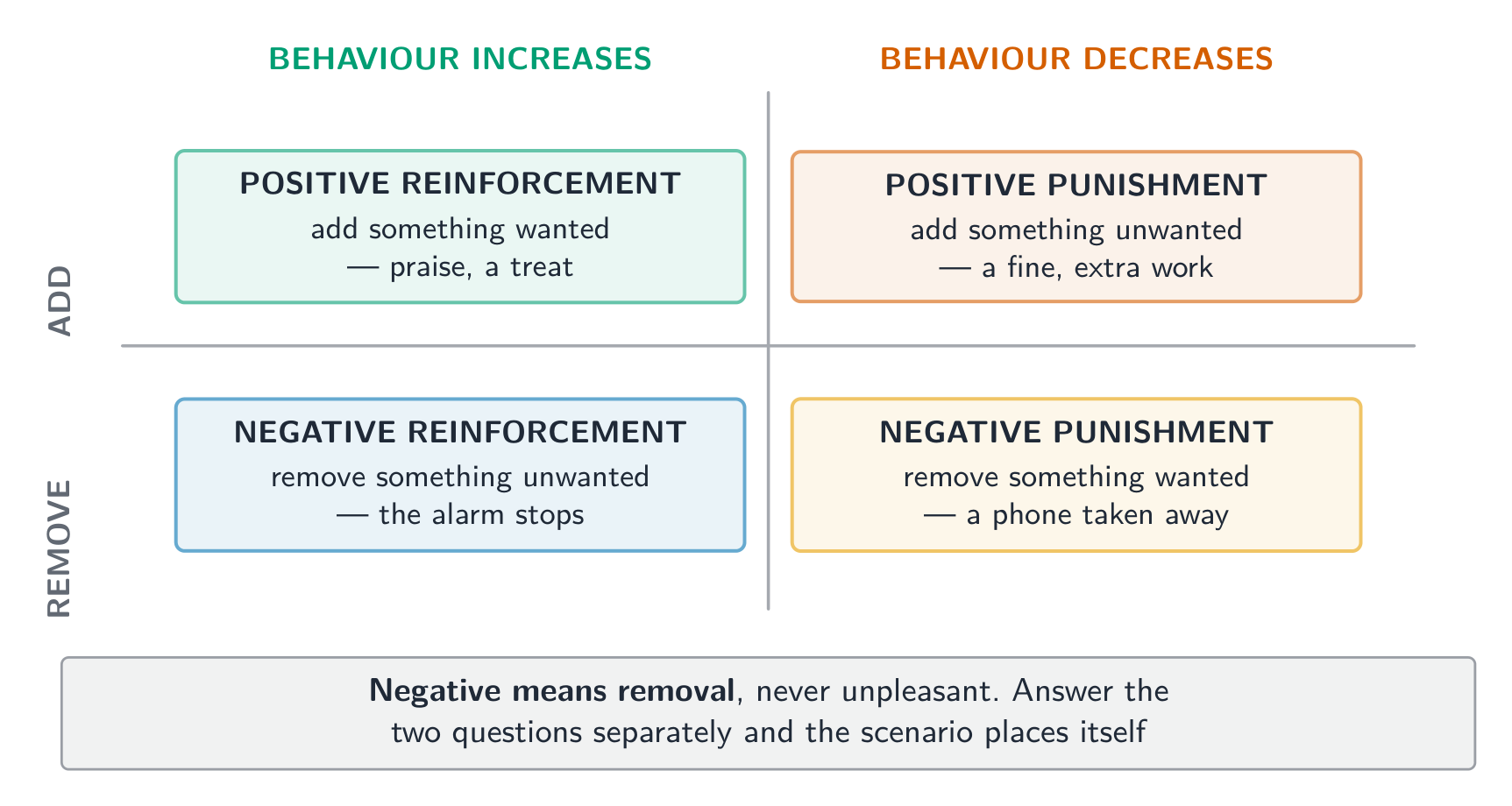
Negative means removal, never unpleasant: answer the two questions separately.
Which cell of the grid?
Sort each consequence by whether it adds or removes, and increases or decreases.
Match each case to its consequence.
难度 2/5 · 今日首次完成可获 140 金币及少量额外奖励
First ask whether the behaviour increases or decreases; then whether something was added or removed.
Negative reinforcement is not punishment. Negative means something is removed; reinforcement means the behaviour increases. Taking an aspirin to remove a headache is negative reinforcement, and you are more likely to do it again.
Taking a painkiller to remove a headache, and doing it again next time, is an example of...
难度 1/5 · 今日首次完成可获 100 金币及少量额外奖励
Something unpleasant was 被移除 and the behaviour increased — negative reinforcement.
Primary, secondary, and shaping
- A primary reinforcer 原级强化物 meets a biological need (food, water, warmth). A secondary reinforcer 次级强化物 (conditioned reinforcer) gains its power by being linked with primary ones: money, grades, a dog trainer's clicker, points in a game.
- Shaping 塑造 teaches a behaviour that never happens on its own by reinforcing successive approximations 逐步接近: closer and closer steps. To teach a dog to roll over, reward lying down, then lying on its side, then a half roll, then the full roll.
Reinforcing successive approximations to build a complex behaviour is called ____.
难度 1/5 · 今日首次完成可获 100 金币及少量额外奖励
Shaping is how a behaviour that never occurs spontaneously can be reinforced into existence.
Select 所有 that are true of a secondary reinforcer.
难度 2/5 · 今日首次完成可获 140 金币及少量额外奖励
A 第一产业 (primary) reinforcer satisfies a biological need directly; a secondary one is learned.
Schedules of reinforcement
- Continuous reinforcement 连续强化 rewards every response: learning is fast, but so is extinction once rewards stop. Partial (intermittent) reinforcement rewards only some responses: learning is slower but lasts longer. Ratio 比率 schedules count responses; interval 时距 schedules count time.
| Schedule | Reward comes after… | Example |
|---|---|---|
| Fixed ratio | a set number of responses | coffee card: 10th cup free |
| Variable ratio 可变比率 | an unpredictable number | slot machine, fishing |
| Fixed interval | the first response after a set time | weekly test, monthly pay |
| Variable interval | the first response after an unpredictable time | checking for messages, pop quizzes |
- Variable ratio gives the highest response rate and the most resistance to extinction. Fixed interval gives a "scallop": little effort just after a reward, a burst just before the next one (studying the night before the weekly test).
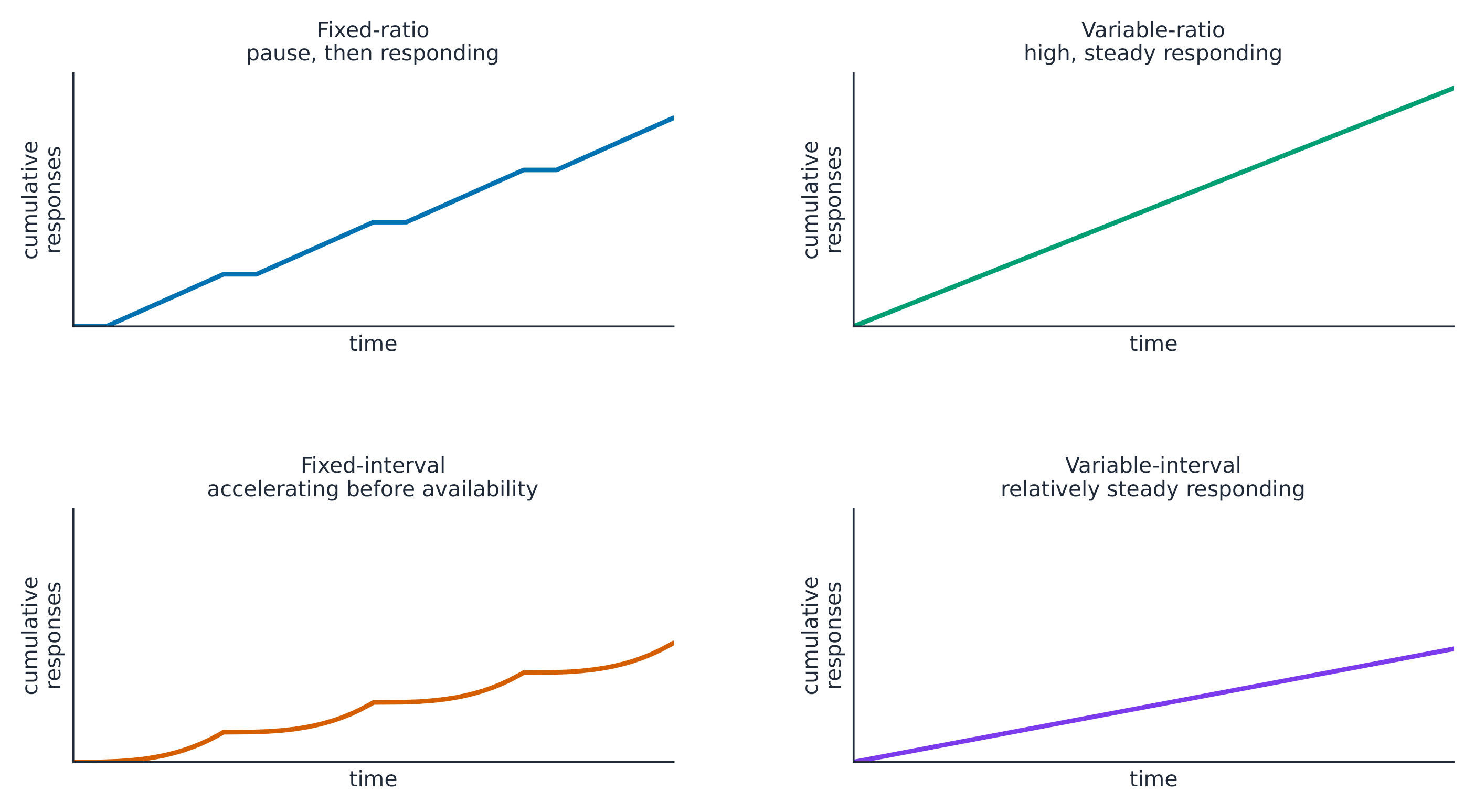
Schematic response patterns for the four schedules (teaching curves, not study data).
Which schedule produces the highest and most extinction-resistant response rate?
难度 1/5 · 今日首次完成可获 100 金币及少量额外奖励
Variable ratio — an unpredictable number of responses per reward.
Match each case to its schedule of reinforcement.
难度 2/5 · 今日首次完成可获 140 金币及少量额外奖励
Ratio counts responses; interval counts time. Fixed is predictable; variable is not.
A teacher gives a quiz every Friday. Students study little on Monday and a lot on Thursday night. This pattern is typical of which schedule?
难度 1/5 · 今日首次完成可获 100 金币及少量额外奖励
Responding rises as the time for the reward approaches, then drops after it: the fixed-interval scallop.
Extinction, discrimination and biological limits
- Extinction 消退: when a behaviour stops being reinforced, it fades. A discriminative stimulus 辨别性刺激 signals that a response will be reinforced: drivers slow down when they see a police car, not elsewhere. Responding to similar signals is generalisation.
- Biology limits what can be conditioned. In instinctive drift 本能漂移, trained animals slide back to natural behaviour: raccoons taught to drop coins in a bank kept rubbing the coins together, as they do with food.
Pigs trained to put wooden coins in a box kept dropping the coins and pushing them with their snouts, as they do when rooting for food. This is an example of
难度 1/5 · 今日首次完成可获 100 金币及少量额外奖励
The animals drifted back towards natural, food-related behaviour, which limits what conditioning can do.
When consequences mislead
- Superstitious behaviour 迷信行为: a reward that follows by chance strengthens whatever the learner happened to be doing. A player who scores while wearing certain socks keeps wearing them.
- Learned helplessness 习得性无助: after repeated outcomes they cannot control, people (and animals) stop trying even when escape becomes possible. Martin Seligman's dogs, shocked without escape, later did not jump a low barrier to avoid shocks.
Superstitious behaviour occurs when a consequence reinforces a behaviour that did not cause it.
难度 1/5 · 今日首次完成可获 100 金币及少量额外奖励
The learner tracks what followed, not what actually caused the outcome.
Worked example: classify the consequence
For each case, name the consequence and say why: (a) a child stops whining because her parent gives her the toy, and the parent gives toys more often; (b) a teenager's curfew is moved earlier after he arrives home late, and he is late less often; (c) a student gets a sticker for every 5 books read.
- (a) For the parent: negative reinforcement. The whining (an unpleasant stimulus) is removed, and the parent's giving increases. For the child, the toy is positive reinforcement of whining.
- (b) Negative punishment: freedom (something pleasant) is removed, and being late decreases. (c) Positive reinforcement on a fixed-ratio schedule: a sticker is added after a set number of responses (5 books).
Worked AP-style question
Question: Lin wants to get her younger brother to practise the piano each day. Explain how each concept could help her or affect the result: (a) shaping; (b) a variable-ratio schedule; (c) negative reinforcement.
(a) Lin could reinforce small steps towards full practice: first sitting at the piano for 5 minutes, then playing one scale, then 20 minutes of practice, giving praise at each new step.
(b) If she gives a small treat after an unpredictable number of practice sessions, his practising should be steady and keep going even when treats stop for a while, because he cannot tell which session will be rewarded.
(c) Lin could stop reminding him to practise (an unpleasant nagging) as soon as he sits down to play. Because the nagging is removed, sitting down to practise becomes more likely.
- Why it scores: each answer applies the term to Lin and her brother; a correct definition with no link to the scenario earns nothing. (c) says what is removed and that the behaviour increases; describing nagging as the consequence of not practising would be punishment, not negative reinforcement.
AP-style practice. A coach wants a team to arrive on time for training. Explain how each could be applied: (a) positive reinforcement; (b) negative punishment; (c) a discriminative stimulus.
Every answer must apply the term to the coach and the team, not only define it.
Operant conditioning links behaviour to consequence (Law of Effect, Skinner box). Reinforcement increases and punishment decreases behaviour; positive adds and negative removes. Shaping rewards successive approximations. Partial schedules resist extinction; variable ratio gives the highest, steadiest rate. Watch for instinctive drift, superstitious behaviour and learned helplessness.
Write from a beep that stops
- A seatbelt beep stops when the belt is clicked, and the clicking increases. A separate parking fine of 40 is added after late payment.
- Classify both consequences.
A beep stops when a seatbelt is clicked, and clicking increases. A parking fine of 40 is added for late payment, and late payment decreases. Classify both.
Removal that increases a behaviour is negative reinforcement. An added penalty that decreases a behaviour is positive punishment.
What is the seatbelt beep that stops?
难度 1/5 · 今日首次完成可获 100 金币及少量额外奖励
The beep is removed and clicking increases. That is negative reinforcement.