| English | 释义 | 拼音 |
|---|---|---|
| sensation/senˈseɪʃn/ | 感觉 | gǎn jué |
| transduction/trænsˈdʌkʃn/ | 换能 | huàn néng |
| absolute threshold/ˈæbsəluːt ˈθreʃəʊld/ | 绝对阈限 | jué duì yù xiàn |
| Weber's law/ˈwebəz lɔː/ | 韦伯定律 | wéi bó dìng lǜ |
| just-noticeable difference/dʒʌst ˈnəʊtɪsəbl ˈdɪfrəns/ | 最小可觉差 | zuì xiǎo kě jué chà |
| sensory adaptation/ˈsensəri ˌædæpˈteɪʃn/ | 感觉适应 | gǎn jué shì yìng |
| retina/ˈretɪnə/ | 视网膜 | shì wǎng mó |
| visual accommodation/ˈvɪʒuːəl əˌkɒməˈdeɪʃn/ | 视觉调节 | shì jué tiáo jié |
| rods/rɒdz/ | 视杆细胞 | shì gān xì bāo |
| cones/kəʊnz/ | 视锥细胞 | shì zhuī xì bāo |
| trichromatic theory/ˌtrɪkrəʊˈmætɪk ˈθɪəri/ | 三色理论 | sān sè lǐ lùn |
| opponent-process theory/əˈpəʊnənt ˈprəʊses ˈθɪəri/ | 对立过程理论 | duì lì guò chéng lǐ lùn |
| pitch/pɪtʃ/ | 音高 | yīn gāo |
| loudness/ˈlaʊdnəs/ | 响度 | xiǎng dù |
| olfaction/ɒlˈfækʃn/ | 嗅觉 | xiù jué |
| gustation/ɡʌˈsteɪʃn/ | 味觉 | wèi jué |
| gate control theory/ɡeɪt kənˈtrəʊl ˈθɪəri/ | 闸门控制理论 | zhá mén kòng zhì lǐ lùn |
| vestibular sense/veˈstɪbjʊlə sens/ | 前庭觉 | qián tíng jué |
| kinesthesis/ˈkaɪnsθəsɪs/ | 动觉 | dòng jué |
You stop noticing the clock after a minute
- When you enter a quiet room, the ticking clock is obvious. A minute later you no longer hear it, although it is just as loud. Your senses mainly report change, not everything that is there.
- This lesson follows how the body turns physical energy (light, sound waves, chemicals, pressure) into nerve signals, and which signals it lets through.
Sensation, transduction and thresholds
- Sensation 感觉 is detecting physical energy from the environment with sense receptors. Transduction 换能 is the conversion of that energy into neural signals the brain can use: in the eye, light becomes electrical signals.
- The absolute threshold 绝对阈限 is the weakest stimulus a person can detect 50% of the time (a candle flame seen from far away on a dark night). Below threshold, the stimulus is present but no signal reaches awareness.
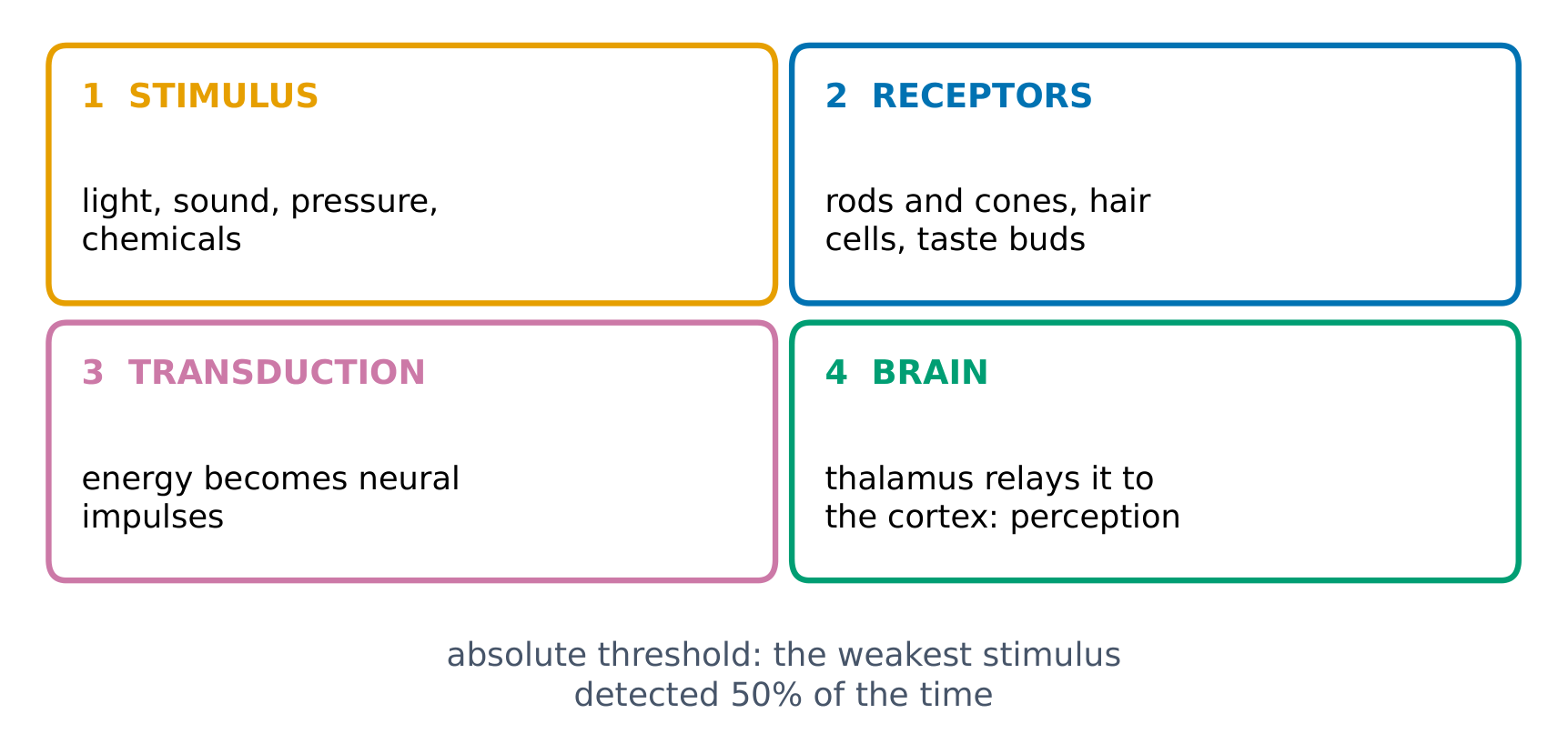
Sensation: receptors transduce energy into neural signals that travel to the brain
Converting a physical stimulus into a neural signal is called ____.
难度 1/5 · 今日首次完成可获 100 金币及少量额外奖励
Transduction is the conversion step; below threshold no signal is produced at all.
The absolute threshold for a sound is the softest sound a person can detect
难度 1/5 · 今日首次完成可获 100 金币及少量额外奖励
Detection is not all-or-nothing across trials, so the threshold is set where the stimulus is detected half the time.
Detecting change: Weber's law and adaptation
- The just-noticeable difference 最小可觉差 (difference threshold) is the smallest change detected 50% of the time. Weber's law 韦伯定律: it is a constant proportion of the original, not a fixed amount. If 2 g is noticed on 100 g (2%), about 20 g is needed on 1,000 g.
- Sensory adaptation 感觉适应: receptors respond less to a stimulus that does not change, like the ticking clock or a watch on your wrist. Sensory interaction: one sense affects another, as smell does to taste when you have a cold.
Weber's law says the just-noticeable difference is...
难度 1/5 · 今日首次完成可获 100 金币及少量额外奖励
One spoon of sugar is detectable in a cup and not in a jug — the 比例 is what matters.
Sensory adaptation is not the same as habituation. Adaptation happens in the sense organ itself — the receptors stop responding. Habituation is a learned drop in response that happens in the brain. The exam distinguishes them.
Vision: eye, receptors and colour
- The lens focuses light on the retina 视网膜 by changing shape (visual accommodation 视觉调节). Rods 视杆细胞, mostly at the edges, work in dim light and detect movement but not colour; cones 视锥细胞, packed in the centre (the fovea), detect colour and fine detail. Where the optic nerve leaves the eye there are no receptors: the blind spot.
- Trichromatic theory 三色理论: three types of cone respond most to red, green and blue light, and their mix gives all colours (missing one type causes colour blindness). Opponent-process theory 对立过程理论: cells work in pairs (red–green, blue–yellow); after staring at red, you see a green afterimage. Both theories are needed: cones at the retina, opponent cells further along.
属于哪个感觉系统?
Sort each structure or term into the sense it belongs to.
The CED says colour vision is explained by the trichromatic theory alone.
难度 1/5 · 今日首次完成可获 100 金币及少量额外奖励
Colour vision is explained by 两者 the trichromatic and the opponent-process theories.
Hearing: pitch and loudness
- The frequency of a sound wave (how many waves per second) gives its pitch 音高; the amplitude (height of the wave) gives its loudness 响度. Hair cells in the cochlea transduce the vibrations.
- Place theory: different places along the cochlea respond to different pitches (best for high pitches). Frequency theory: the nerve fires at the same rate as the sound wave (low pitches). Volley theory: groups of neurons fire in turns to code middle pitches. Conduction deafness is damage to the eardrum or small bones; sensorineural deafness is damage to hair cells or the auditory nerve.
A very high-pitched whistle is best explained by which theory of pitch?
难度 1/5 · 今日首次完成可获 100 金币及少量额外奖励
High pitches are coded by where along the cochlea the hair cells respond most; neurons cannot fire fast enough to match very high frequencies.
Chemical and body senses
- Olfaction 嗅觉 (smell) is the only sense not routed through the thalamus; gustation 味觉 (taste) detects sweet, sour, salty, bitter, umami and oleogustus (fat). Gate control theory 闸门控制理论: the spinal cord can "close a gate" on pain signals, which is why rubbing a bumped knee helps.
- The vestibular sense 前庭觉 (in the inner ear) gives balance and head position; kinesthesis 动觉 senses the position and movement of your own body parts, so you can touch your nose with your eyes closed.
Select 所有 that belong to the body senses rather than vision or hearing.
难度 2/5 · 今日首次完成可获 140 金币及少量额外奖励
The retina is part of the visual system; the other three are body senses.
Match each term to the sense it belongs to.
难度 2/5 · 今日首次完成可获 140 金币及少量额外奖励
Rods and cones code light, place theory codes pitch, and olfaction bypasses the thalamus.
Worked AP-style question
Question: Explain how each concept applies to Jun, who is cooking dinner: (a) sensory adaptation; (b) Weber's law; (c) the opponent-process theory.
(a) When Jun first enters the kitchen, he notices the strong smell of garlic; after twenty minutes he hardly smells it, because his smell receptors respond less to an unchanging stimulus.
(b) Adding one pinch of salt to a small cup of soup changes the taste clearly, but one pinch in a large pot does not, because the change he can detect is a proportion of the amount already there.
(c) After staring at a bright red tomato under the kitchen light, Jun looks at the white wall and sees a green afterimage, because the red–green opponent cells rebound.
- Why it scores: each answer names a specific experience of Jun's and the mechanism (receptors adapting; a proportion; paired opponent cells). In (b), saying "small changes are hard to notice" without the idea of a proportion misses the law.
AP practice. Explain how each concept applies to Sara at a concert: (a) the amplitude of sound waves; (b) the vestibular sense; (c) gate control theory, after she bumps her elbow on a seat.
Link each concept to one specific experience of Sara's.
Sensation detects energy with receptors and transduces it into neural signals. The absolute threshold is detected 50% of the time; the just-noticeable difference follows Weber's law (a constant proportion). Sensory adaptation fades unchanging stimuli. Vision: rods (dim light, movement), cones (colour, detail), trichromatic and opponent-process theories. Hearing: frequency → pitch, amplitude → loudness; place, frequency and volley theories. Gate control explains pain; the vestibular sense gives balance and kinesthesis body position.
Write from the data: find the just-noticeable difference
- A 100 g weight needs an extra 2 g before the change is noticed. A 1000 g weight is judged by the same proportion.
- Find the extra mass needed on the heavier weight.
A change of 2 g is just noticeable on a 100 g weight. Using the same proportion, what change is just noticeable on a 1000 g weight?
2 percent of 1000 g is 20 g. The heavier starting stimulus needs a larger absolute change.
What change is just noticeable on the 1000 g weight?
难度 1/5 · 今日首次完成可获 100 金币及少量额外奖励
The proportion stays 2 percent, so 1000 g needs 20 g. Other options — 2 g (the same absolute spoon of sugar as in the lesson); 1000 g (the whole weight).