Market Equilibrium, Disequilibrium, and Changes · 市场均衡、失衡与均衡的变动
| English | 中文 | Pinyin · 拼音 |
|---|---|---|
| equilibrium/ˌiːkwɪˈlɪbrɪəm/ | 均衡 | jūn héng |
| surplus/ˈsɜːpləs/ | 过剩 | guò shèng |
| shortage/ˈʃɔːtɪdʒ/ | 短缺 | duǎn quē |
| disequilibrium/ˌdɪˌsiːkwɪˈlɪbrɪəm/ | 非均衡 | fēi jūn héng |
Where buyers and sellers agree
- Demand pulls the price down; supply pushes it up.
- Somewhere between, the two forces meet and settle.
- At that one price, buyers' and sellers' plans match exactly.
- This is equilibrium 均衡 — the heart of the supply-and-demand model.
买卖双方达成一致的地方
- 需求把价格往下拉;供给把价格往上推。
- 在两者之间的某处,两股力量相遇并稳定下来。
- 在那一个价格上,买卖双方的计划恰好吻合。
- 这就是均衡(equilibrium)——供求模型的核心。
Equilibrium, surplus, and shortage
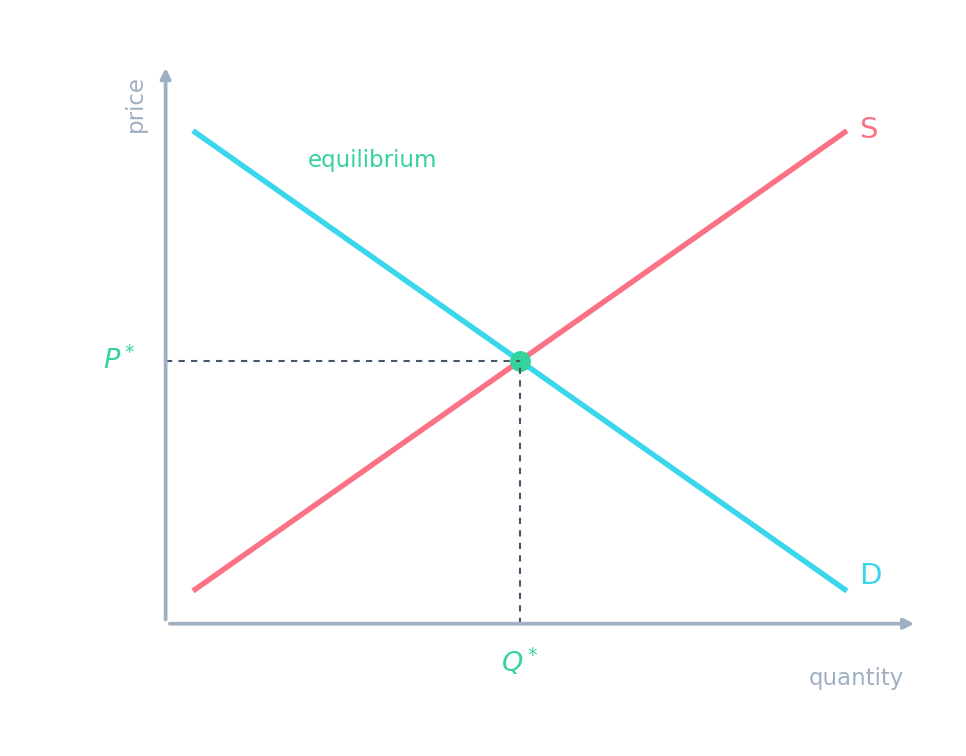
- Equilibrium is where demand and supply cross — the equilibrium price and quantity.
- Away from it the market is in disequilibrium 非均衡, and prices are pushed back.
- Above equilibrium: quantity supplied exceeds quantity demanded — a surplus 过剩, so sellers cut the price.
- Below equilibrium: quantity demanded exceeds quantity supplied — a shortage 短缺, so buyers bid the price up.
均衡、过剩与短缺
- 均衡是需求与供给相交的地方——均衡价格和数量。
- 偏离它,市场就处于非均衡(disequilibrium),价格会被推回。
- 高于均衡:供给量超过需求量——出现过剩(surplus),于是卖家降价。
- 低于均衡:需求量超过供给量——出现短缺(shortage),于是买家抬价。
Find the equilibrium · 找到均衡
Equilibrium sits where supply crosses demand. Above it there is a surplus; below it a shortage — the price is pushed back to where the curves meet. · 均衡就在供给与需求相交处。它上方有过剩,下方有短缺——价格被推回两条曲线相遇的地方。
At market equilibrium: · 在市场均衡处:
Equilibrium is where the two quantities match and the curves cross. · 均衡是两个数量相等、曲线相交之处。
If the price is set above equilibrium, the market has a: · 如果价格定在均衡之上,市场会出现:
Above equilibrium, unsold stock piles up — a surplus, so sellers cut the price. · 高于均衡时,卖不掉的存货堆积——过剩,于是卖家降价。
When the price is below equilibrium, excess demand creates a . · 当价格低于均衡时,超额需求造成一个。
A shortage makes buyers bid the price up toward equilibrium. · 短缺促使买家抬高价格,回到均衡。
The four shift cases
- Demand rises → price up, quantity up. Demand falls → price down, quantity down.
- Supply rises → price down, quantity up. Supply falls → price up, quantity down.
- When a determinant shifts a curve, the equilibrium simply moves to the new crossing point.
四种移位情形
- 需求上升 → 价格升、数量升。需求下降 → 价格降、数量降。
- 供给上升 → 价格降、数量升。供给下降 → 价格升、数量降。
- 当决定因素移动一条曲线,均衡就移到新的相交点。
Demand shifts right (supply unchanged). Price and quantity: · 需求右移(供给不变)。价格和数量:
A rightward demand shift raises both the equilibrium price and quantity. · 需求右移使均衡价格和数量都上升。
Put the steps to find the new equilibrium after a change in order. · 把变化后求新均衡的步骤按顺序排列。
Name the shifter, move the right curve the right way, then read the new crossing point. · 说出移位因素,把正确的曲线朝正确方向移动,再读出新的相交点。
A supply curve shifts left (demand unchanged). The equilibrium price and quantity: · 供给曲线左移(需求不变)。均衡价格和数量:
Less supply at every price pushes the price up and the quantity down. · 每个价格下供给减少,把价格顶上、数量压下。
A worked case
- A hot summer raises demand for ice cream (demand shifts right).
- At the old price a shortage appears, so the price rises to a new, higher equilibrium — with a higher quantity too.
- If at the same time a dairy shortage raises input costs (supply shifts left), the price rises even more.
- But the change in quantity is now ambiguous — it depends on which shift is larger.
一个例子
- 炎热的夏天提高对冰淇淋的需求(需求右移)。
- 在旧价格下出现短缺,于是价格升到新的、更高的均衡——数量也更高。
- 如果同时奶源短缺抬高投入成本(供给左移),价格涨得更多。
- 但此时数量的变化变得不确定——取决于哪次移位更大。
A market settles at equilibrium (demand meets supply). In disequilibrium, a surplus (above) pushes the price down and a shortage (below) pushes it up. A single shift moves price and quantity predictably; when both curves shift, one result is clear and the other is ambiguous.
市场稳定在均衡(需求遇上供给)。在非均衡中,过剩(上方)把价格压下,短缺(下方)把价格顶上。单次移位可预测地移动价格和数量;当两条曲线都移位时,一个结果明确,另一个不确定。