Demand · 需求
| English | 中文 | Pinyin · 拼音 |
|---|---|---|
| demand/dɪˈmænd/ | 需求 | xū qiú |
| law of demand/lɔː ɒv dɪˈmænd/ | 需求定律 | xū qiú dìng lǜ |
| quantity demanded/ˈkwɒntɪti dɪˈmændɪd/ | 需求量 | xū qiú liàng |
| substitutes/ˈsʌbstɪtjuːts/ | 替代品 | tì dài pǐn |
| complements/ˈkɒmplɪmənts/ | 互补品 | hù bǔ pǐn |
| normal good/ˈnɔːml ɡʊd/ | 正常品 | zhèng cháng pǐn |
| inferior good/ɪnˈfɪərɪə ɡʊd/ | 低档品 | dī dàng pǐn |
The buyers' side of every market
- Before we build the whole economy, we need its most basic tool.
- Start with buyers: how much do they want at each price?
- Get this right and you can predict how markets move.
- It begins with demand 需求 and the law behind it.
每个市场的买方
- 在搭建整个经济之前,我们需要它最基本的工具。
- 从买家开始:在每个价格下他们想要多少?
- 弄懂这一点,你就能预测市场如何变动。
- 一切从需求(demand)和它背后的规律开始。
The law of demand
- Demand is the quantity buyers are willing and able to buy at each price.
- The law of demand 需求定律: a higher price means a lower quantity demanded 需求量 — so the curve slopes down.
- Two reasons: buyers substitute toward cheaper goods, and higher prices cut their real purchasing power.
需求定律
- 需求是买家在每个价格下愿意且能够购买的数量。
- 需求定律(law of demand):价格越高,需求量(quantity demanded)越低——所以曲线向下倾斜。
- 两个原因:买家转向更便宜的商品,而更高的价格削弱了他们的实际购买力。
Demand and supply · 需求与供给
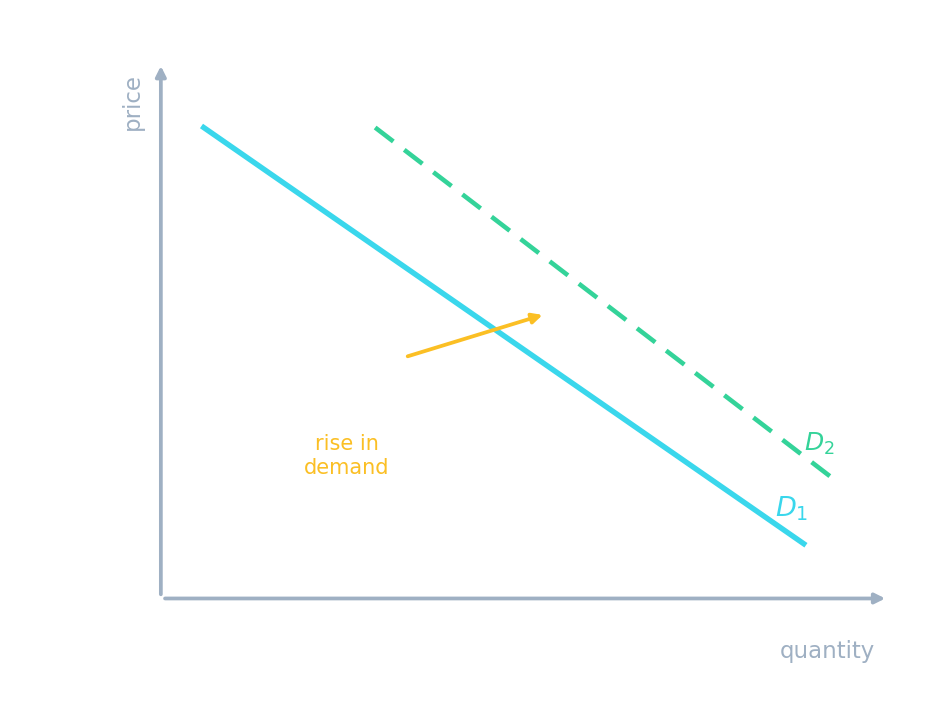
The demand curve slopes down — a lower price, more is wanted. A change in income or tastes shifts the whole curve. · 需求曲线向下倾斜——价格更低,想要的更多。收入或偏好的变化会移动整条曲线。
The law of demand says a higher price leads to a: · 需求定律说,更高的价格导致:
Price and quantity demanded move in opposite directions — the curve slopes down. · 价格与需求量方向相反——曲线向下倾斜。
Movement vs shift
- A change in the good's own price moves you along the curve — a change in quantity demanded.
- A change in something else shifts the whole curve — a change in demand.
This distinction is heavily tested. Only the good's own price moves you along the curve. Everything else shifts it. Label your diagram before you answer.
沿曲线移动 vs 曲线移位
- 商品自身价格的变化让你沿曲线移动——即需求量的变化。
- 其他任何东西的变化则移动整条曲线——即需求的变化。
这个区分是重点考点。只有商品的自身价格让你沿曲线移动,其余一切都移动它。回答前先把图标清楚。
A change in the good's own price causes a movement along the demand curve, not a shift. · 商品自身价格的变化引起沿需求曲线的移动,而不是移位。
Own price → movement along; TRIBE determinants → shift. · 自身价格 → 沿曲线移动;TRIBE 决定因素 → 移位。
What shifts demand — TRIBE
- Tastes; number of Related goods' prices; Income; Buyers; Expectations.
- Substitutes 替代品 (tea and coffee): a dearer coffee raises demand for tea.
- Complements 互补品 (cars and petrol): a dearer petrol lowers demand for cars.
- Income matters too: higher income raises demand for a normal good 正常品 but lowers it for an inferior good 低档品.
什么会移动需求 —— TRIBE
- T 偏好(tastes);R 相关商品价格;I 收入(income);B 买家(buyers);E 预期(expectations)。
- 替代品(substitutes,茶与咖啡):咖啡更贵会提高对茶的需求。
- 互补品(complements,汽车与汽油):汽油更贵会降低对汽车的需求。
- 收入也重要:收入更高会提高对正常品(normal good)的需求,却降低对低档品(inferior good)的需求。
Tea and coffee are substitutes. If the price of coffee rises, demand for tea: · 茶和咖啡是替代品。如果咖啡价格上升,对茶的需求:
Buyers switch from dearer coffee to tea, so demand for tea rises. · 买家从更贵的咖啡转向茶,所以对茶的需求上升。
Cars and petrol are used together, so they are . · 汽车和汽油一起使用,所以它们是。
A rise in the price of one lowers demand for the other. · 一个的价格上升降低对另一个的需求。
Select all · 所有 that shift the demand curve (TRIBE determinants). · 选出所有会移动需求曲线的因素(TRIBE 决定因素)。
TRIBE factors shift the curve; the good's own price only moves you along it. · TRIBE 因素移动曲线;商品自身价格只让你沿曲线移动。
As income rises, demand for an inferior good (like instant noodles): · 收入上升时,对低档品(如方便面)的需求:
Richer buyers switch to better options, so demand for the inferior good falls. · 更富的买家转向更好的选择,所以对低档品的需求下降。
Demand slopes down (the law of demand). The good's own price = a movement along; any TRIBE determinant = a shift. Substitutes and higher income (normal goods) raise demand; complements and income (inferior goods) can lower it.
需求向下倾斜(需求定律)。商品的自身价格 = 沿曲线移动;任何 TRIBE 决定因素 = 移位。替代品和更高收入(正常品)提高需求;互补品和收入(低档品)可能降低它。