| English | 释义 | 拼音 |
|---|---|---|
| world cities/wɜːld ˈsɪtiz/ | 世界城市 | shì jiè chéng shì |
| hierarchy/ˈhaɪərɑːki/ | 等级体系 | děng jí tǐ xì |
A bank in London, a factory in Vietnam
- When a bank in London decides to lend to a clothing company, which then orders shirts from a factory in Vietnam for sale in shops in New York, three cities in three continents are linked in one decision. The decision itself was made in London.
- World cities 世界城市 (also called global cities) are the places where the world economy is controlled: they hold the headquarters, banks, stock exchanges, law firms and media that connect the global system.
What makes a world city
| Function | What it looks like | Example |
|---|---|---|
| Economic | stock exchanges, banks, headquarters of global companies | New York (Wall Street), London (the City) |
| Political | international organisations, embassies, national governments | New York (UN), Brussels (EU), Geneva |
| Cultural | global media, universities, art, fashion | Paris, Los Angeles |
| Connectivity | major airport hubs and internet links | Dubai, Singapore |
- A world city is defined by its connections and functions, not its population. Zurich has under half a million people but is a major financial centre.

World city or ordinary big city?
Sort each trait by whether it marks a top world city or just a large city.
Match each world-city function to an example.
难度 2/5 · 今日首次完成可获 140 金币及少量额外奖励
World cities combine several global functions.
A city must have more than 10 million people to be a world city.
难度 1/5 · 今日首次完成可获 100 金币及少量额外奖励
Zurich has under half a million people but is a major financial centre.
A hierarchy of world cities
- World cities form a hierarchy 等级体系. At the top (alpha) are London and New York; below them are regional hubs such as Shanghai, Dubai and São Paulo (beta); then national centres (gamma), then other cities.
- World cities are often more tightly linked to each other than to their own countryside: London's finance firms deal with New York and Hong Kong every minute.
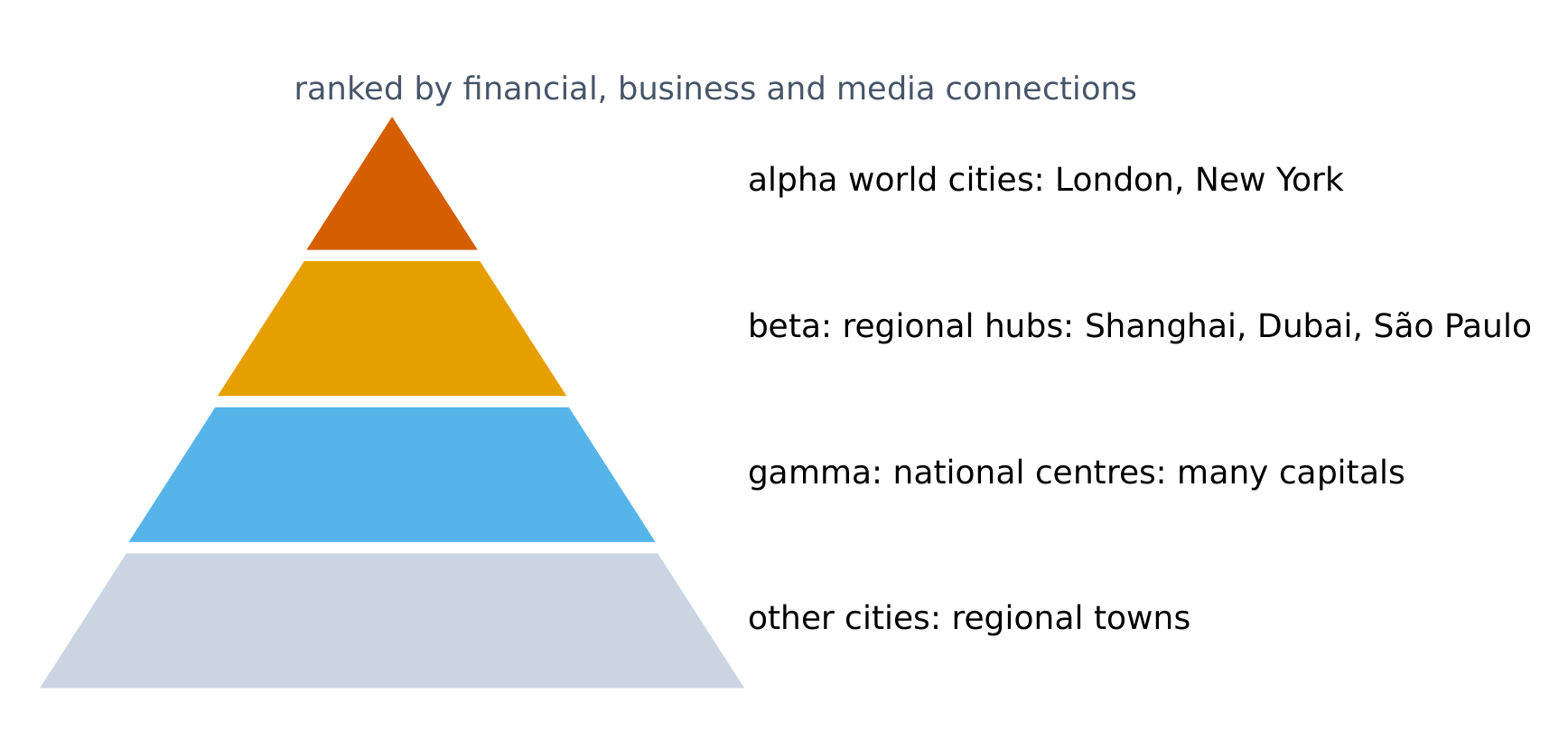
Order these tiers from most to least globally connected.
难度 3/5 · 今日首次完成可获 200 金币及少量额外奖励
The hierarchy ranks cities by financial, business and media connections.
Globalization strengthens the top
- Cause → effect: globalization spreads production around the world → companies need a few places to coordinate it → finance and headquarters cluster in world cities → those cities gain jobs, wealth and power.
- The result can be inequality: high-paid finance jobs and very expensive housing in world cities, while manufacturing regions that lost factories fall behind.
How does globalization strengthen world cities?
难度 1/5 · 今日首次完成可获 100 金币及少量额外奖励
Coordination of global production clusters in world cities.
Worked FRQ answer
(A) Identify ONE characteristic of a world city. It contains the headquarters of many global companies and major financial institutions such as a stock exchange.
(B) Explain why a world city may have more influence than a larger city. Influence comes from global connections and control of finance and business, not population size; Lagos is larger than London, but London's banks and markets make decisions that affect economies worldwide.
(C) Explain ONE way globalization reinforces the hierarchy of cities. Firms that operate worldwide place their headquarters and financial services in a few well-connected cities, so these cities attract even more firms, skilled workers and investment, widening their lead.
- Why it scores: (B) separates size from influence with a comparison; (C) explains a self-reinforcing process.
World city ≠ megacity. A world city is about global functions and connections; a megacity is about population. Some cities are both (Tokyo, New York); many are only one.
World cities control the global economy through finance, headquarters, politics, culture and connections. They form a hierarchy (alpha, beta, gamma) and are tightly linked to each other. Globalization strengthens the top cities and can widen inequality with other places.
FRQ practice. (A) Identify ONE world city outside Europe and North America. (B) Explain ONE factor that helped it become a world city. (C) Explain ONE negative consequence of world-city status for its residents.
Functions and connections, not size.