| English | 释义 | 拼音 |
|---|---|---|
| relativity | 相对论 | xiāng duì lùn |
| uncertainty principle | 不确定性原理 | bù què dìng xìng yuán lǐ |
| lost generation/lɒst ˌdʒenəˈreɪʃn/ | 迷惘的一代 | mí wǎng de yí dài |
| Dada | 达达主义 | dá dá zhǔ yì |
An eclipse proves Einstein right, 1919
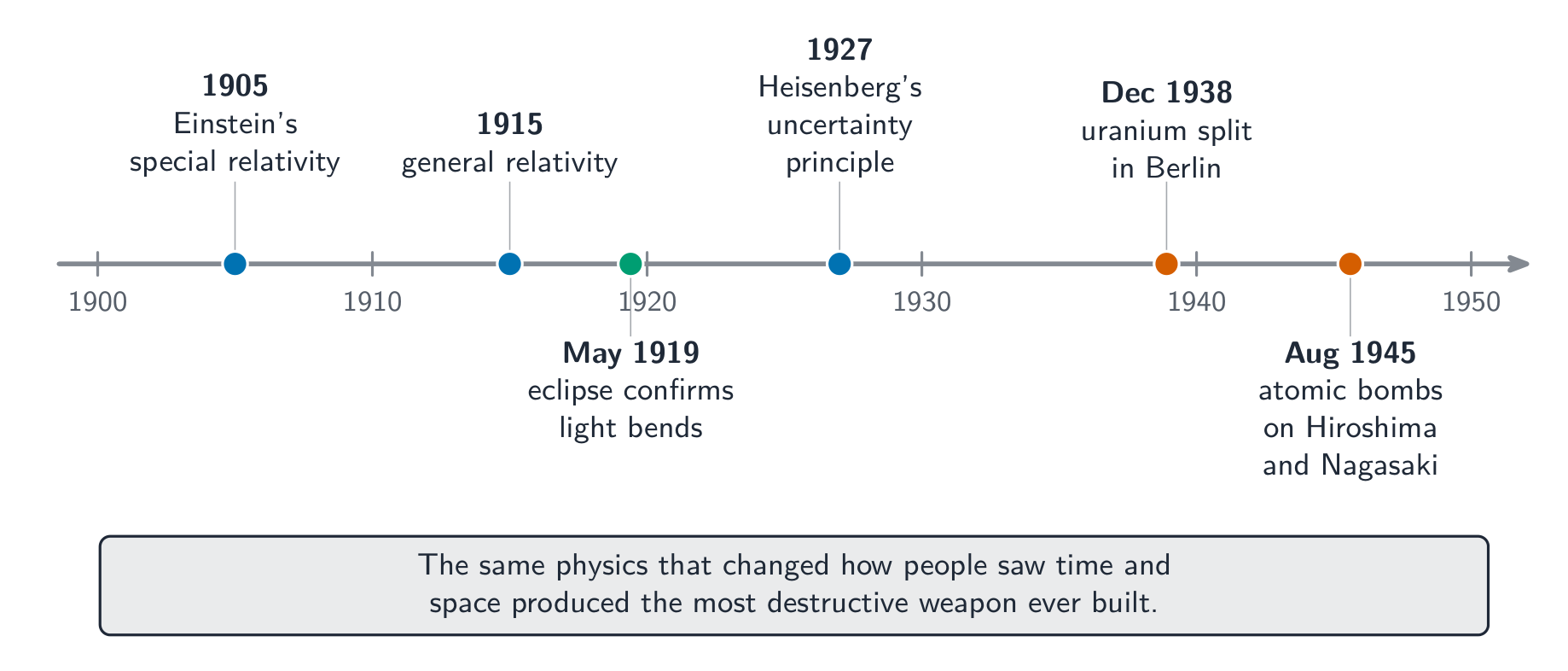
- On 29 May 1919, British astronomers photographed a total eclipse of the Sun from an island off West Africa and from Brazil. Stars near the Sun appeared slightly out of place — their light had been bent by the Sun's gravity, just as Einstein's theory of relativity predicted. "Revolution in science," said The Times in November. Newton's universe was no longer the whole truth.
- In the early twentieth century, war and new science undermined Europeans' certainty about progress and reason.
What did the 1919 eclipse show?
难度 1/5 · 今日首次完成可获 100 金币及少量额外奖励
Evidence for Einstein.
Faith in progress cracks
- Before 1914, many Europeans believed science and industry would make life steadily better.
- The First World War, with about 10 million soldiers killed by modern weapons, shattered that belief. Oswald Spengler's The Decline of the West (1918) was a best-seller.
The First World War strengthened Europeans' belief in steady progress.
难度 1/5 · 今日首次完成可获 100 金币及少量额外奖励
It shattered that belief.
Physics opens doors
- Relativity 相对论 showed that time and space depend on the observer. Heisenberg's uncertainty principle 不确定性原理 (1927) said some things could never be measured exactly.
- In 1938, scientists in Berlin split the uranium atom. This discovery of nuclear fission led to the atomic bomb.
Before the war, from physics, or from the war itself?
Sort each challenge to existing understandings.
Match each idea to its scientist or date.
难度 2/5 · 今日首次完成可获 140 金币及少量额外奖励
New physics.
Worked example: a lost generation
- Literature: Erich Maria Remarque's All Quiet on the Western Front (1929) described soldiers destroyed by the war; it sold about 2.5 million copies in 18 months.
- Art: the Dada 达达主义 movement, founded in Zurich in 1916, made deliberately absurd art to mock a society that had produced the war.
- The term: writers who came of age in the war were called the lost generation 迷惘的一代.
About how many million copies did All Quiet on the Western Front sell in 18 months?
难度 2/5 · 今日首次完成可获 140 金币及少量额外奖励
A best-seller.
Why did Dada artists make absurd art?
难度 1/5 · 今日首次完成可获 100 金币及少量额外奖励
Zurich, 1916.
A change for women
- Many women won the vote after the war, and younger women cut their hair short, wore shorter skirts and worked in offices.
- Radio and cinema created a new mass culture in the 1920s.
Confidence and uncertainty together
- Science also brought radio, aircraft and new medicines. Many people still trusted technology even as they feared it.
- Political movements such as fascism and communism offered new certainties in place of the old.
Uncertainty did not replace confidence completely. Europeans held both: belief in new technology and fear of its power. Show the mix.
Europeans in the 1920s both trusted and feared new technology.
难度 1/5 · 今日首次完成可获 100 金币及少量额外奖励
Two beliefs at once.
The First World War broke faith in steady progress. Relativity and quantum physics showed the universe was stranger than Newton's, and fission led to the bomb. The lost generation, Dada and new roles for women reflected a changed culture, while confidence in technology continued alongside the fear.
Explain how the First World War and new science challenged Europeans' certainty.
Change.