| English | 释义 | 拼音 |
|---|---|---|
| Civil Code | 民法典 | mín fǎ diǎn |
| liberalism/ˈlɪbərəlɪzəm/ | 自由主义 | zì yóu zhǔ yì |
| nationalism/ˈnæʃənəlɪzəm/ | 民族主义 | mín zú zhǔ yì |
The emperor goes, the Code stays, 1815
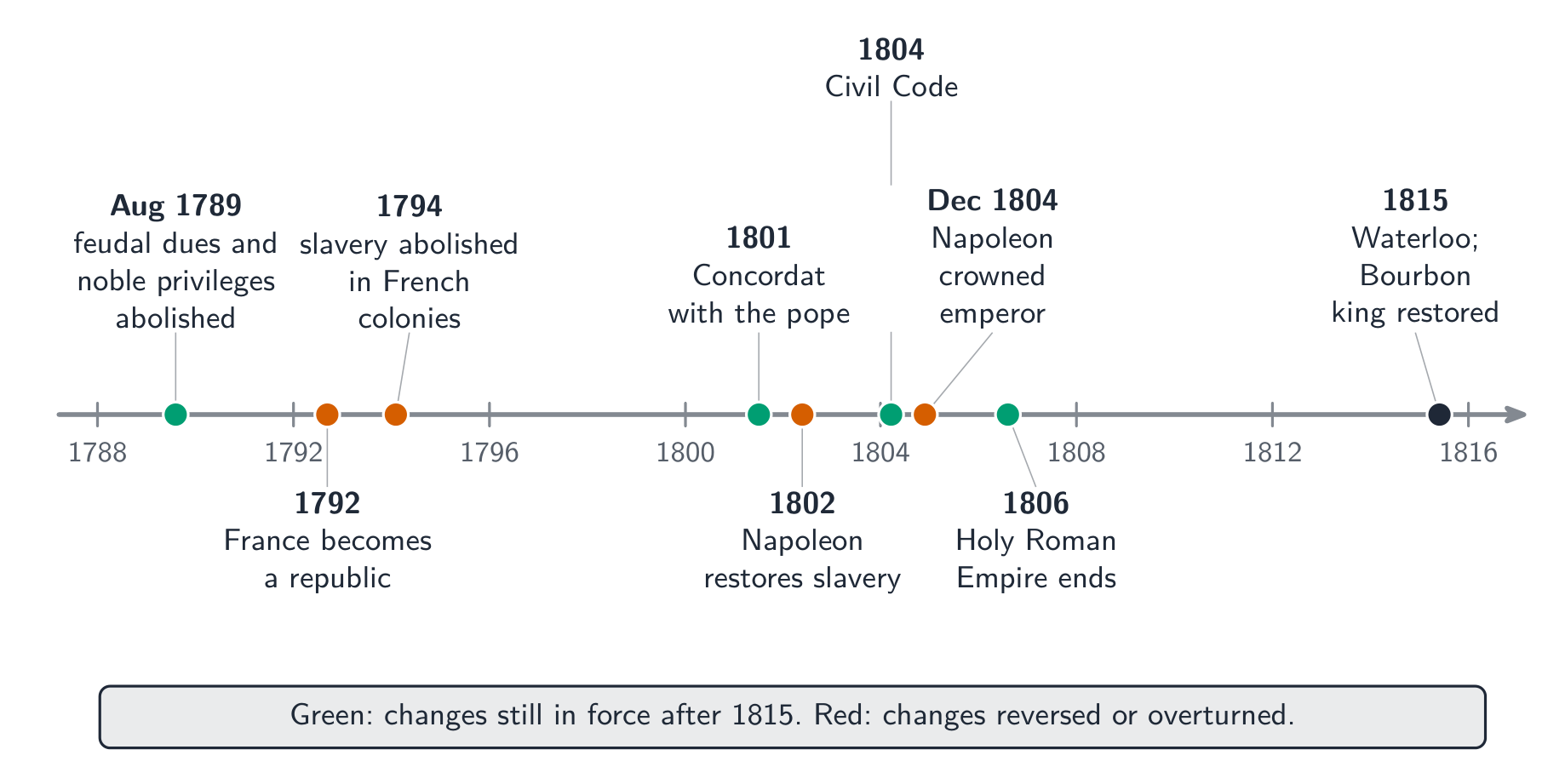
- On 18 June 1815, Napoleon was defeated at Waterloo and sent to the island of St Helena in the South Atlantic. Louis XVIII, brother of the executed Louis XVI, became king of France again.
- But Louis XVIII kept Napoleon's Civil Code 民法典 of 1804. Its rules on property, contracts and equality before the law stayed in force in France, Belgium and parts of Germany and Italy.
What did Louis XVIII keep from Napoleon's rule?
难度 1/5 · 今日首次完成可获 100 金币及少量额外奖励
Its rules on property and equality before the law stayed.
What returned
- Kings came back in France, Spain, Naples and Piedmont, and the Congress of Vienna gave France its 1790 borders.
- The Catholic Church regained much of its influence, and conservative rulers watched universities, newspapers and secret societies closely.
In 1815 France returned to its 1790 borders.
难度 1/5 · 今日首次完成可获 100 金币及少量额外奖励
It was treated mildly so it would not seek revenge.
What stayed
- Nobles did not get back their old feudal dues, and land sold during the Revolution stayed with its new owners. Careers in the army and government were now more open to talent.
- The Holy Roman Empire, ended in 1806, was not restored. Its roughly 300 states became a German Confederation of 39.
The German Confederation of 1815 had ____ states.
难度 1/5 · 今日首次完成可获 100 金币及少量额外奖励
The Holy Roman Empire had about 300.
New ideas that could not be removed
- Liberalism 自由主义 — constitutions, elected parliaments and rights for individuals — and nationalism 民族主义 — the idea that each nation should rule itself — had spread with French armies.
- Conservatives such as Edmund Burke, who wrote Reflections on the Revolution in France (1790), argued for tradition instead. All three ideas competed for the next century.
Match each idea to its meaning.
难度 2/5 · 今日首次完成可获 140 金币及少量额外奖励
All three competed after 1815.
Worked example: a continuity-and-change sentence. "Although monarchy was restored in France in 1815, it was not the monarchy of 1789: Louis XVIII had to accept a written constitution, a parliament and the Civil Code." The sentence names the continuity (monarchy), the change (a limited monarchy and equal laws), and the evidence for each.
Which sentence shows both continuity and change?
难度 1/5 · 今日首次完成可获 100 金币及少量额外奖励
It names what stayed and what changed.
Who gained less
- The Civil Code made a wife legally subject to her husband, so women lost some rights they had briefly gained in the 1790s.
- Napoleon restored slavery in the French colonies in 1802; France abolished it for good only in 1848. Haiti, independent since 1804, was the exception.
Returned or stayed?
Sort each feature of Europe in 1815.
The Civil Code made wives legally subject to their husbands.
难度 1/5 · 今日首次完成可获 100 金币及少量额外奖励
Women gained least from the period.
Avoid "nothing changed" and "everything changed". The map and the thrones of 1815 looked like the old order, but the laws, the land and the ideas of many Europeans had changed for good. Give evidence for both.
France abolished slavery in its colonies for good in ____.
难度 1/5 · 今日首次完成可获 100 金币及少量额外奖励
Napoleon had restored it in 1802.
In 1815 kings were restored and France returned to its 1790 borders, but much of the Revolution stayed: the Civil Code, the end of feudal dues, careers open to talent and a German Confederation of 39 states instead of about 300. Liberalism and nationalism had spread, and conservatives opposed them. Women and enslaved people gained least.
To what extent did the settlement of 1815 restore the Europe of 1789?
Weigh continuity against change.