| English | 释义 | 拼音 |
|---|---|---|
| Anabaptist | 再洗礼派 | zài xǐ lǐ pài |
| subordination/ˌsʌbɔːdɪˈneɪʃn/ | 从属 | cóng shǔ |
| Huguenot | 胡格诺派 | hú gé nuò pài |
| censorship/ˈsensəʃɪp/ | 审查制度 | shěn chá zhì dù |
Pamphlets faster than censors, 1520
- In 1520 alone, Martin Luther published about 30 pamphlets in German; about 300 000 copies were printed. Many had woodcut pictures for people who could not read — one showed the pope as the Antichrist. Church censors could not stop them all.
- Printing let reformers reach ordinary people and made religion a political question.
About how many copies of Luther's pamphlets were printed in 1520?
难度 2/5 · 今日首次完成可获 140 金币及少量额外奖励
About 300 000.
Using the press deliberately
- Reformers wrote in everyday German, French and English, not Latin, so more people could understand. Luther's German New Testament (1522) sold thousands of copies.
- Catholic writers answered with pamphlets of their own, so print became a battlefield.
Why did reformers write in German, French and English?
难度 1/5 · 今日首次完成可获 100 金币及少量额外奖励
Reaching ordinary people.
Faith against the state
- Some Protestants, such as the Anabaptists 再洗礼派, believed the Church should be separate from the state. They refused to swear oaths or serve as soldiers.
- Both Catholic and Protestant rulers persecuted them; thousands were executed.
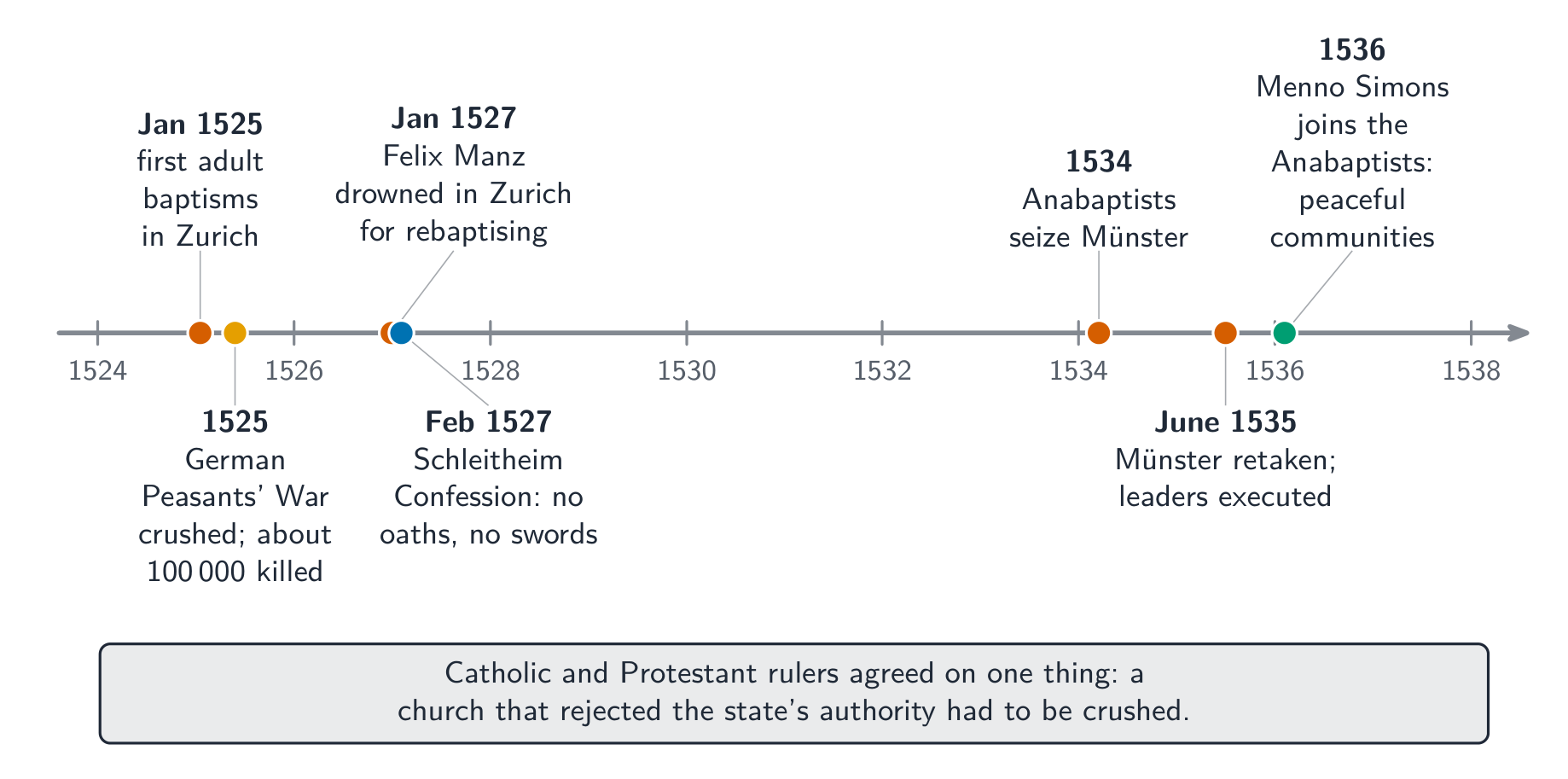
Which relationship to the state is this?
Sort each position on church and secular authority.
Both Catholic and Protestant rulers persecuted the Anabaptists.
难度 1/5 · 今日首次完成可获 100 金币及少量额外奖励
Thousands were executed.
Worked example: three relationships to the state
- The state controls the Church: in England and Lutheran Germany, rulers headed the Church — the Church's subordination 从属 to the state.
- The Church guides the state: in Calvin's Geneva, Church leaders supervised morals and influenced the city government.
- Separation: Anabaptists rejected any link between the Church and the state.
Match each case to its Church–state relationship.
难度 2/5 · 今日首次完成可获 140 金币及少量额外奖励
Three relationships.
Religion and rebellion
- In the Dutch Revolt (from 1566), Calvinists fought Catholic Spain for religious and political freedom.
- French Calvinists, the Huguenots 胡格诺派, became a political party with their own nobles and armies.
The rulers' response
- Rulers used censorship 审查制度: the Catholic Church published an Index of forbidden books from 1559.
- Some rulers allowed limited toleration to keep peace, as in the Edict of Nantes in France (1598).
How did rulers respond to religious division?
难度 2/5 · 今日首次完成可获 140 金币及少量额外奖励
Censorship, toleration and persecution.
The Reformation was not only about belief. Religion became a way to challenge rulers or strengthen them. Show the political side as well as the religious side.
The Reformation had no political consequences.
难度 1/5 · 今日首次完成可获 100 金币及少量额外奖励
Religion became political.
Reformers used printing in everyday languages to spread their ideas widely. Protestants disagreed about the Church's relationship with the state — control, guidance or separation — and religion became a language of rebellion in the Netherlands and France, while rulers used censorship and sometimes toleration.
Explain how printing helped the Protestant Reformation spread.
Causation.