| English | 释义 | 拼音 |
|---|---|---|
| state system | 国家体系 | guó jiā tǐ xì |
Peace after thirty years, 1648
- In October 1648, diplomats at Münster and Osnabrück signed the Peace of Westphalia, ending the Thirty Years' War, which had killed perhaps a third of Germany's people. The treaties let each ruler choose Calvinism, Lutheranism or Catholicism, and they recognized the Dutch Republic and Switzerland as independent. Religion would no longer be the main reason for war between European states.
- The changes of 1450–1648 — in ideas, exploration, economy and power — were connected, and their results reached far beyond 1648.
What did the Peace of Westphalia do?
难度 2/5 · 今日首次完成可获 140 金币及少量额外奖励
1648.0
The four threads, revisited
- Ideas: humanism and printing led to the Reformation and, later, the Scientific Revolution.
- Exploration and capitalism: Atlantic empires and trade enriched Western Europe; sovereignty: monarchs gained power over nobles and churches.
Each thread caused the others
- Printing spread Luther's ideas; Protestant princes used the Reformation to take Church land and gain sovereignty.
- American silver paid Spain's armies in the religious wars; the wars' costs pushed states to raise taxes and build bureaucracies.
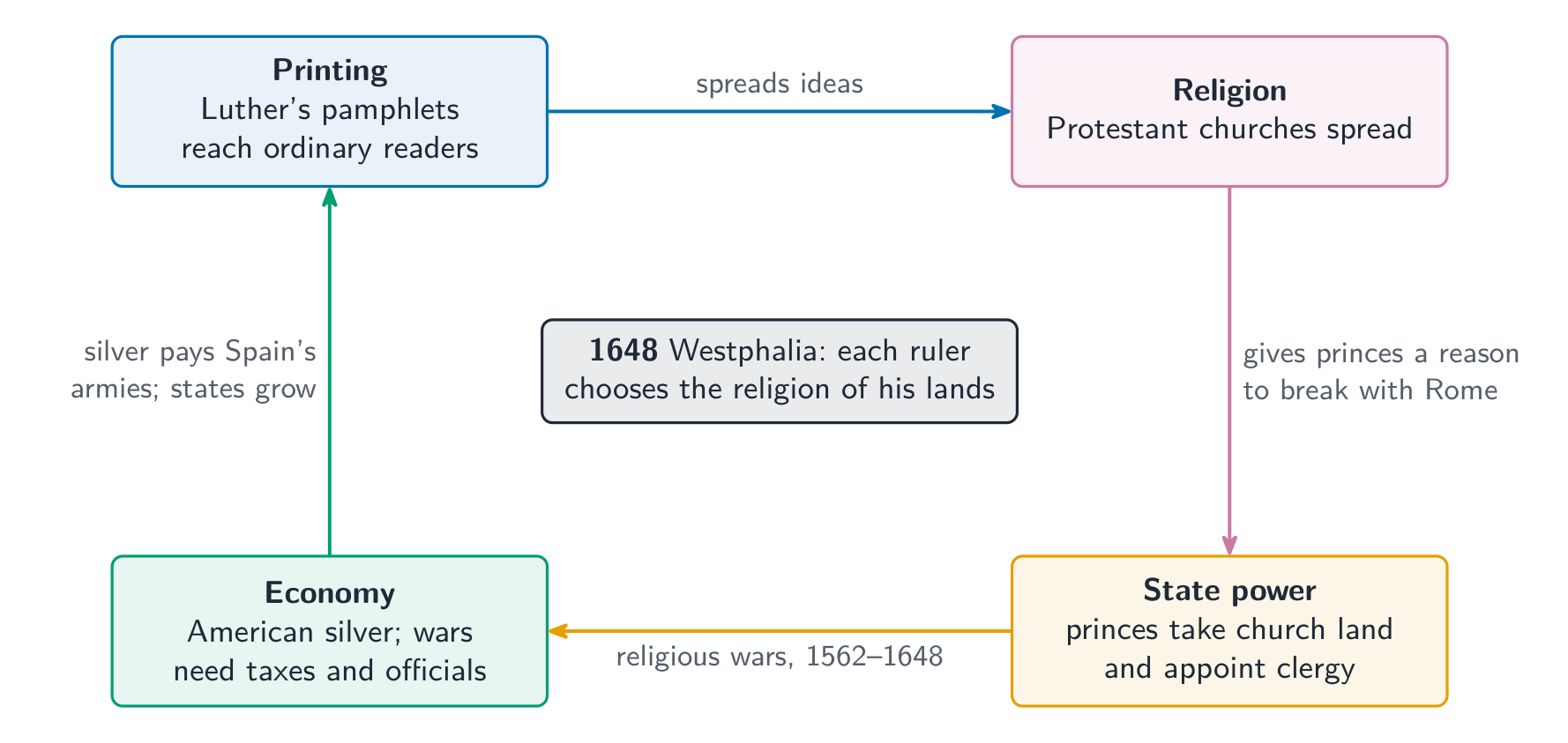
Cause, consequence, or a cross-thread link?
Sort each statement in a unit-review answer.
Match each cause to its effect.
难度 2/5 · 今日首次完成可获 140 金币及少量额外奖励
The threads are connected.
Worked example: one sentence across threads
- Claim: the Reformation strengthened the power of rulers.
- Evidence: Henry VIII made himself head of the English Church in 1534 and sold its monasteries; the Peace of Augsburg (1555) let German princes choose their territory's religion.
- Cross-thread link: printing (ideas) spread the Reformation, which gave rulers new authority (sovereignty) and new wealth from Church lands (economy).
How did Henry VIII's break with Rome strengthen royal power?
难度 1/5 · 今日首次完成可获 100 金币及少量额外奖励
Sovereignty and wealth.
Put these events in order.
难度 3/5 · 今日首次完成可获 200 金币及少量额外奖励
1517, 1534, 1555, 1648.
Consequences beyond 1648
- The state system 国家体系 created at Westphalia — sovereign states balancing each other's power — lasted into the twentieth century.
- Religious division remained, and Atlantic trade grew into empires and the slave trade.
The state system created at Westphalia was based on sovereign states balancing each other.
难度 1/5 · 今日首次完成可获 100 金币及少量额外奖励
It lasted centuries.
The costs
- Wars of religion, witch hunts (about 40 000–60 000 executions) and the conquest of the Americas cost millions of lives.
- The enslavement of Africans grew alongside European wealth.
Do not treat the threads separately in an essay. The best answers show how one development caused another — for example, how printing spread religious reform that rulers used to gain power.
The best essays discuss each thread completely separately.
难度 1/5 · 今日首次完成可获 100 金币及少量额外奖励
Show connections.
From 1450 to 1648, new ideas, exploration and capitalism, and the growth of state sovereignty caused and reinforced each other. The Peace of Westphalia created a system of sovereign states, while the period's costs included religious war, witch hunts, conquest and slavery.
Explain how one development of 1450–1648 helped cause another.
Cross-thread causation.