| English | 释义 | 拼音 |
|---|---|---|
| movable type | 活字 | huó zì |
| edition/ɪˈdɪʃn/ | 版次 | bǎn cì |
| vernacular | 本国语言 | běn guó yǔ yán |
| literacy/ˈlɪtərəsi/ | 识字率 | shí zì lǜ |
| Index of Prohibited Books | 禁书目录 | jìn shū mù lù |
| censorship/ˈsensəʃɪp/ | 审查 | shěn chá |
A Bible in 180 copies, Mainz 1455
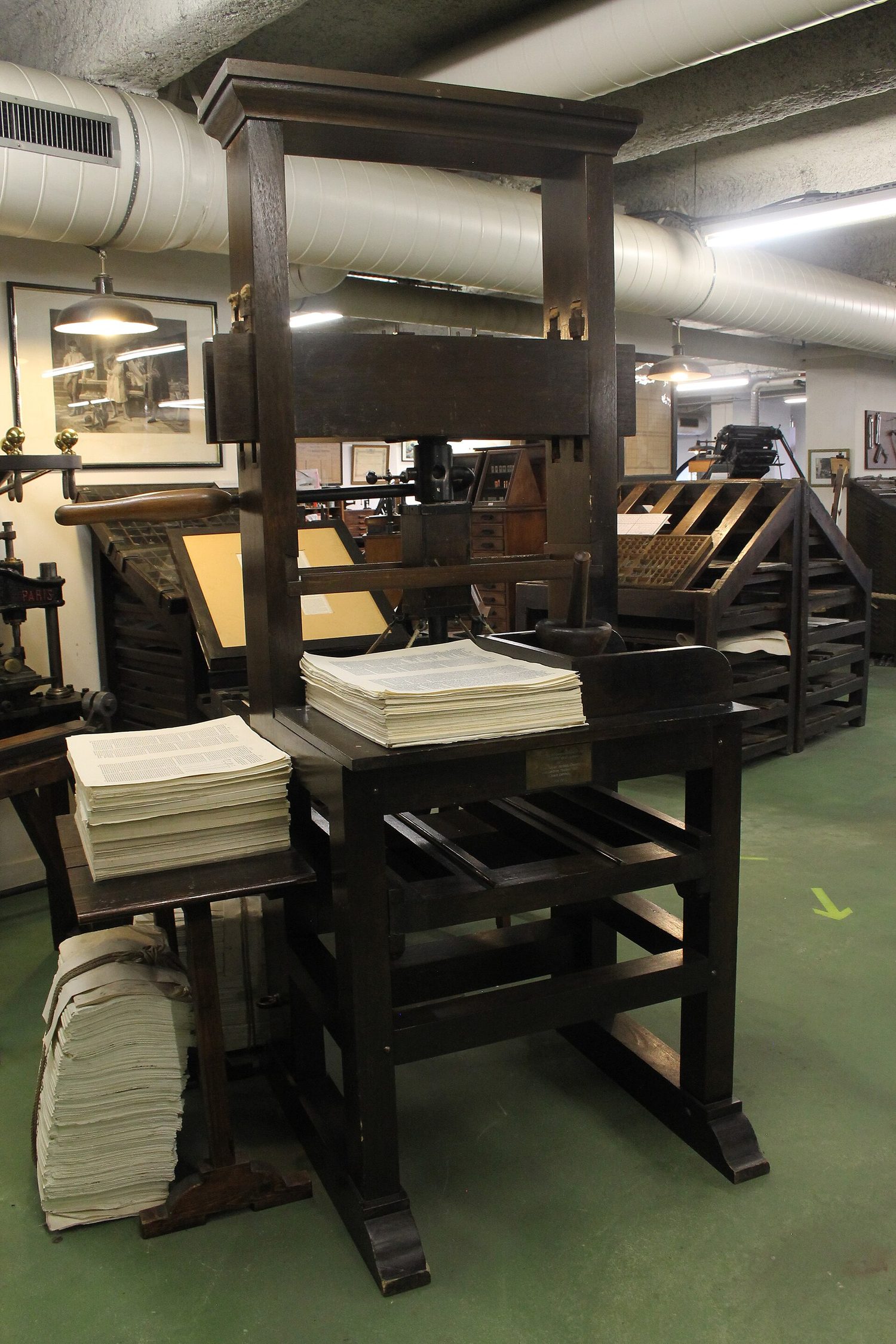
- In about 1455, Johannes Gutenberg finished printing a Bible in Mainz, Germany. His workshop made about 180 copies in roughly three years. A scribe copying by hand needed about the same time to finish just one.
- The printing press did not invent new ideas. It made copies of ideas fast, cheaply and exactly, and that changed how ideas spread.
About how long did a scribe need to copy one Bible by hand?
难度 1/5 · 今日首次完成可获 100 金币及少量额外奖励
Gutenberg's workshop made about 180 copies in about the same time.
How the press worked
- Gutenberg used movable type 活字: single metal letters that could be arranged into a page, inked, printed and then used again for the next page.
- He combined this with an oil-based ink and a screw press like those used to press grapes for wine. A team at one press could print thousands of sheets a day.
Single metal letters that can be arranged, printed and used again are called ____ type.
难度 1/5 · 今日首次完成可获 100 金币及少量额外奖励
Movable type was the key part of Gutenberg's system.
The press spread fast
- By 1500, presses worked in about 250 European towns, and Venice alone had printed about 4000 editions. Printers went where there were readers and money: universities, trading cities and courts.
- Books became much cheaper, so more people could own them, including merchants, lawyers and some craftsmen.
By 1500, printing presses worked in only a few German towns.
难度 1/5 · 今日首次完成可获 100 金币及少量额外奖励
About 250 towns across Europe had presses by 1500.
Identical copies
- A hand-copied text changed a little with every copy, and errors built up. Every printed copy of an edition 版次 was the same, so a scholar in Paris and one in Venice could argue about the same sentence on the same page.
- Maps, tables and drawings could also be copied exactly. Vesalius's book on human anatomy (1543) gave every reader the same detailed pictures of the body.
Why did printed editions help scholars argue with each other?
难度 1/5 · 今日首次完成可获 100 金币及少量额外奖励
Hand copies differed; a printed edition did not.
Worked example: measuring a change. Historians estimate that about 12.6 million printed books were produced in western Europe between 1454 and 1500. In the next fifty years the number was about 79 million, and by 1651–1700 it was about 331 million. So within two centuries, printed books had become an ordinary object rather than a treasure, and a cause such as the Reformation could reach people who had never seen a manuscript.
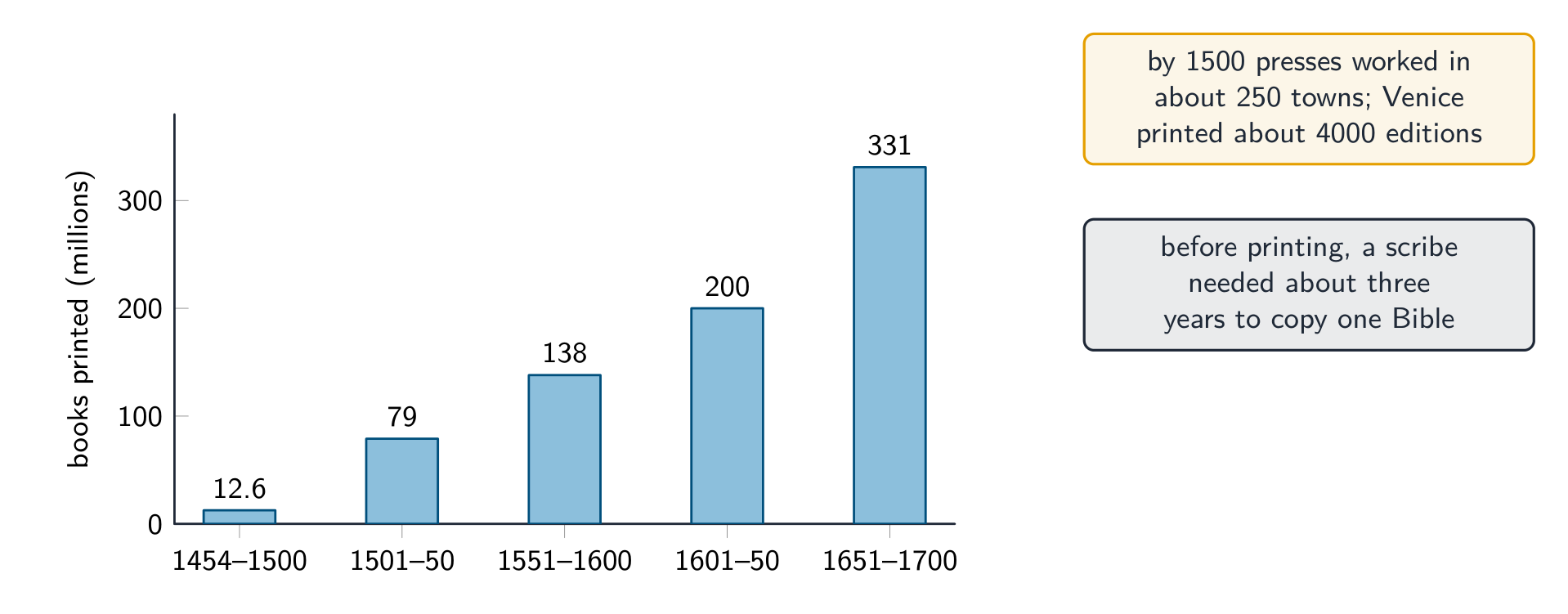
About 12.6 million books were printed in 1454–1500 and about ____ million in 1501–1550.
难度 1/5 · 今日首次完成可获 100 金币及少量额外奖励
Output grew more than six times in fifty years.
New readers, new languages
- Most early books were in Latin, the language of scholars and the Church. Soon printers sold more books in the vernacular 本国语言 — the everyday language of a country, such as German, French or English.
- Luther's German Bible (New Testament 1522, whole Bible 1534) and cheap pamphlets with pictures reached people who could not read Latin, and literacy 识字率 slowly rose, especially in towns.
What did printing change?
Sort each effect of the printing press.
Which were written in a vernacular language?
难度 2/5 · 今日首次完成可获 140 金币及少量额外奖励
Latin was the language of scholars, not the everyday language of any country.
Printing spread errors and attacks as easily as truth. Rulers and the Church tried to control it: the Catholic Church published an Index of Prohibited Books 禁书目录 in 1559. But a book banned in one state could be printed in another, such as Geneva or, later, the Dutch Republic. Censorship 审查 became much harder.
Why was censorship of printed books hard?
难度 1/5 · 今日首次完成可获 100 金币及少量额外奖励
Europe was divided into many states with different rules.
Gutenberg's press (about 1455) used movable metal type to make many identical copies quickly. By 1500 it worked in about 250 towns; books became cheaper, more were written in vernacular languages, and scholars could share exact texts and pictures. This helped the Renaissance, the Reformation and later the Scientific Revolution, and it made censorship far harder.
Explain how the printing press affected intellectual life in Europe after 1450.
Name the mechanism, then the effect.