| English | 释义 | 拼音 |
|---|---|---|
| ocean acidification/ˈəʊʃn əˌsɪdɪfɪˈkeɪʃn/ | 海洋酸化 | hǎi yáng suān huà |
| carbonic acid/kɑːˈbɒnɪk ˈæsɪd/ | 碳酸 | tàn suān |
| carbonate/ˈkɑːbəneɪt/ | 碳酸盐 | tàn suān yán |
| pH/piː eɪtʃ/ | 酸碱度 | suān jiǎn dù |
Oysters that could not build shells
- In 2007–2008, oyster hatcheries in Oregon, USA, saw billions of baby oysters die. Scientists traced the deaths to seawater that had become too acidic: the larvae could not build their first shells.
- Ocean acidification 海洋酸化 is the decrease in the pH of the oceans, mainly because of rising CO₂ in the atmosphere. It is often called "the other CO₂ problem".
The cause: more CO₂ in the air
- The ocean absorbs roughly a quarter of the CO₂ that humans release. The more CO₂ in the atmosphere, the more dissolves into seawater.
- So the human causes are the activities that raise atmospheric CO₂: burning fossil fuels, vehicle emissions and deforestation 森林砍伐 (fewer trees take up CO₂, and burning or rotting trees release it).
Ocean acidification is caused by the ocean absorbing extra…
难度 1/5 · 今日首次完成可获 100 金币及少量额外奖励
The ocean absorbs extra 二氧化碳, which reacts with water to form acid.
Select 所有 human activities that contribute to ocean acidification.
难度 2/5 · 今日首次完成可获 140 金币及少量额外奖励
Anything that raises atmospheric CO₂ adds to acidification. CFCs damage the ozone layer; they do not acidify the ocean.
The chemistry in three equations
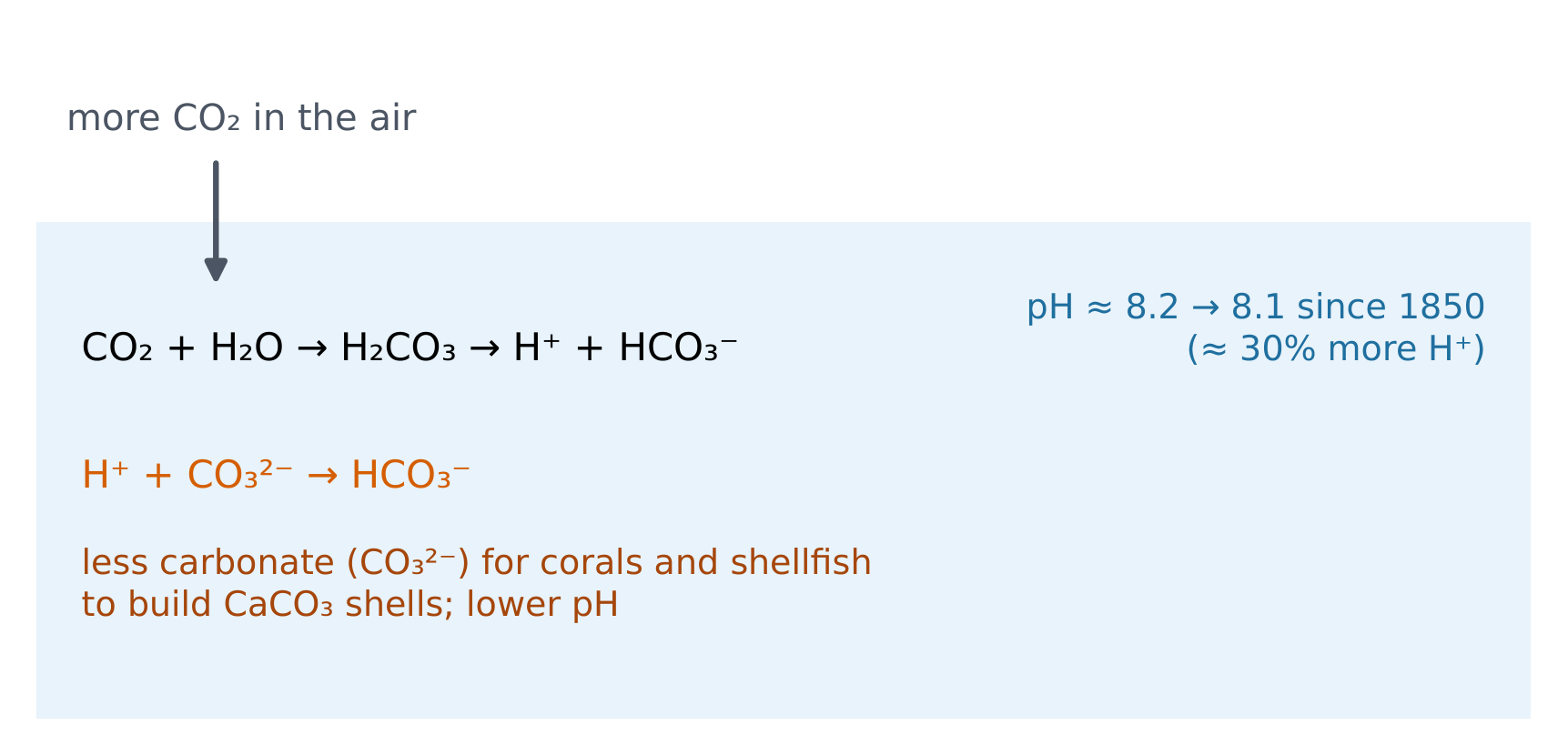
- Step 1. CO₂ dissolves and reacts with water to make carbonic acid 碳酸, which releases hydrogen ions (H⁺). More H⁺ means a lower pH 酸碱度:
- Step 2. The extra H⁺ grabs carbonate ions 碳酸根离子 (CO₃²⁻) from the water, turning them into bicarbonate. Carbonate becomes scarce:
How CO2 acidifies the ocean
Follow carbon dioxide into the sea, where it forms acid and dissolves shells.
When CO2 dissolves in seawater, it forms…
难度 1/5 · 今日首次完成可获 100 金币及少量额外奖励
CO2 plus water makes carbonic acid, so more CO2 means a lower (more acidic) ocean pH.
Why shells and coral suffer
- Corals, oysters, clams and tiny shelled plankton build their shells and skeletons from calcium carbonate 碳酸钙:
- With less carbonate in the water, building shells costs more energy and grows slower; in very acidic water existing shells and coral skeletons start to dissolve.
Acidic water makes it hard for animals to build shells out of calcium ____.
难度 1/5 · 今日首次完成可获 100 金币及少量额外奖励
Shells and coral are made of calcium carbonate, which dissolves more easily in acidic water.
Why does more dissolved CO₂ make it harder for corals to build skeletons?
难度 1/5 · 今日首次完成可获 100 金币及少量额外奖励
H⁺ + CO₃²⁻ → HCO₃⁻. With less carbonate in the water, Ca²⁺ + CO₃²⁻ → CaCO₃ is harder.
A small pH change is a big change
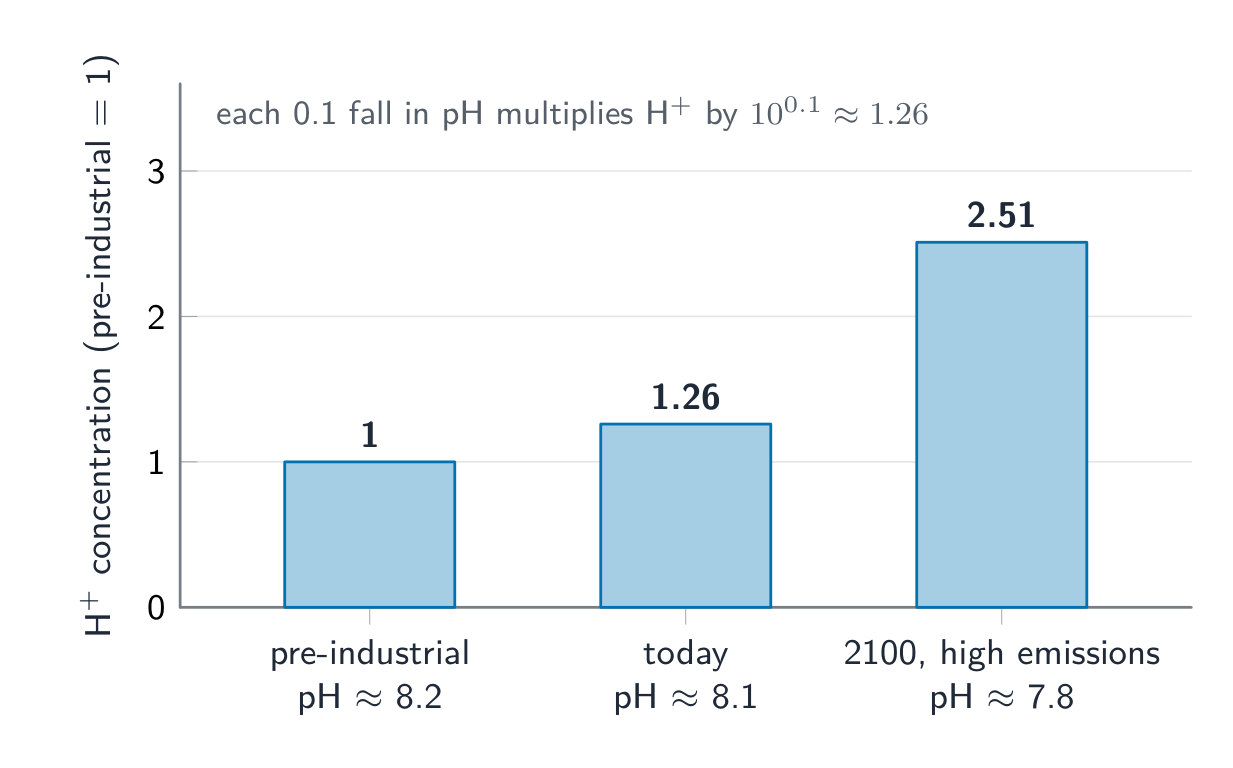
- pH is a logarithmic scale: each fall of 1 pH unit means 10 times more H⁺. A fall of 0.1 means about 1.26 times (26% more) H⁺.
- Surface ocean pH has fallen from about 8.2 before the industrial age to about 8.1 today. The ocean is still slightly basic, not acidic, but it is moving towards acid.
Seawater pH falls from 8.2 to 7.2. How many times greater is its H⁺ concentration?
难度 2/5 · 今日首次完成可获 140 金币及少量额外奖励
A fall of 1 pH unit means 10¹ = 10 times more H⁺.
Effects across the ocean
- Coral reefs grow more slowly and break down more easily. Combined with coral bleaching from warmer water, this threatens the most biodiverse ecosystem in the sea.
- Plankton with carbonate shells (such as pteropods and coccolithophores) are at the base of many food webs, so fish, whales and people who depend on them are affected. Shellfish farms lose money and jobs.
Ocean acidification threatens shellfish, corals, and the tiny plankton at the base of food webs.
难度 1/5 · 今日首次完成可获 100 金币及少量额外奖励
Anything that builds a calcium carbonate shell is at risk — including plankton that feed the whole ocean.
Select 所有 true statements about ocean acidification.
难度 2/5 · 今日首次完成可获 140 金币及少量额外奖励
Absorbed CO2 lowers pH and harms shelled life. It makes the ocean more acidic, not more basic.
Worked FRQ answer
(A) Identify ONE human activity that contributes to ocean acidification. Burning fossil fuels (also accepted: vehicle emissions, deforestation).
(B) Describe how increasing atmospheric CO₂ lowers the pH of the ocean. CO₂ dissolves in seawater and reacts with water to form carbonic acid, which releases hydrogen ions. More hydrogen ions mean a lower pH.
(C) Explain why ocean acidification harms coral reefs. The extra hydrogen ions react with carbonate ions, so less carbonate is available. Corals need carbonate to build calcium carbonate skeletons, so they grow more slowly and their skeletons can dissolve.
- Why it scores: (B) gives the full chain CO₂ → carbonic acid → H⁺ → lower pH. (C) names calcium carbonate and says why it is harder to get; "the acid hurts the coral" earns nothing.
Worked multiple-choice question
Ocean pH falls from 8.1 to 7.8. By what factor does the H⁺ concentration change? (A) It falls to 0.3 times. (B) It rises about 1.04 times. (C) It rises about 2 times. (D) It rises 30 times.
Answer: C. The pH falls by 0.3, so H⁺ rises by 10^0.3 ≈ 2. Lower pH always means more H⁺, which rules out A. B treats pH as a linear scale (7.8 is about 4% less than 8.1); D multiplies by 100 instead of using a power of 10.
- Acidification is not warming. Both come from CO₂, but warming is caused by heat-trapping; acidification is a chemical reaction with seawater. On an FRQ, do not explain acidification with the greenhouse effect.
- "Acidification" does not mean the ocean is acidic. pH 8.1 is still basic. The word means the pH is falling.
- Do not confuse acidification with acid rain: acid rain comes from SO₂ and NO$_x$; ocean acidification comes from CO₂.
Ocean acidification is mainly caused by acid rain falling on the ocean.
难度 1/5 · 今日首次完成可获 100 金币及少量额外奖励
Ocean acidification comes from CO₂ dissolving in seawater. Acid rain (from SO₂ and NO$_x$) affects lakes, soils and forests far more.
Ocean acidification is the fall in ocean pH caused mainly by rising atmospheric CO₂, from burning fossil fuels, vehicle emissions and deforestation. CO₂ + H₂O → carbonic acid → H⁺ + HCO₃⁻; the H⁺ then takes up carbonate, so corals and shelled organisms struggle to build calcium carbonate. Surface pH has fallen from about 8.2 to 8.1, which is about 26% more H⁺ because pH is a logarithmic scale.