| English | 释义 | 拼音 |
|---|---|---|
| Aquaculture/ˈækwəkʌltʃə/ | 水产养殖 | shuǐ chǎn yǎng zhí |
More farmed fish than wild fish
- In 2022, for the first time, the world produced more fish and shellfish by farming them than by catching them in the wild (UN Food and Agriculture Organization). China alone produces more than half of all farmed seafood.
- Aquaculture 水产养殖 is the raising of fish, shellfish and aquatic plants (such as seaweed) in tanks, ponds, or net pens 网箱 in rivers, lakes and the sea.
水产养殖 is…
难度 1/5 · 今日首次完成可获 100 金币及少量额外奖励
水产养殖 is raising fish, shellfish, or seaweed in ponds, tanks, or ocean pens.
Why aquaculture has expanded
- Highly efficient: fish are cold-blooded and float in water, so they use little energy to keep warm or hold up their bodies. Farmed fish need only about 1–2 kg of feed per kg of fish, compared with roughly 6–8 kg for beef cattle.
- It needs only small areas of water and little fuel: no fishing fleet has to sail far out to sea and search for fish. It also takes pressure off overfished wild stocks.
A major benefit of aquaculture is that it…
难度 1/5 · 今日首次完成可获 100 金币及少量额外奖励
Farming fish can supply seafood without catching wild fish, easing overfishing.
Select 所有 reasons the AP course gives for the expansion of aquaculture.
难度 2/5 · 今日首次完成可获 140 金币及少量额外奖励
Efficiency, small areas of water and little fuel. It can pollute water, which is one of its drawbacks.
Three drawbacks
- Contaminated wastewater 废水: fish waste, uneaten feed, antibiotics and pesticides flow out of the farm. The extra nutrients cause algal blooms and low oxygen (eutrophication 富营养化) around the farm.
- Escaped fish may compete with wild fish for food and habitat, or breed with them, which weakens the wild population's genetic adaptations. Disease: fish are packed at high density, so diseases and parasites spread quickly, and can then pass to wild fish swimming past the pens.
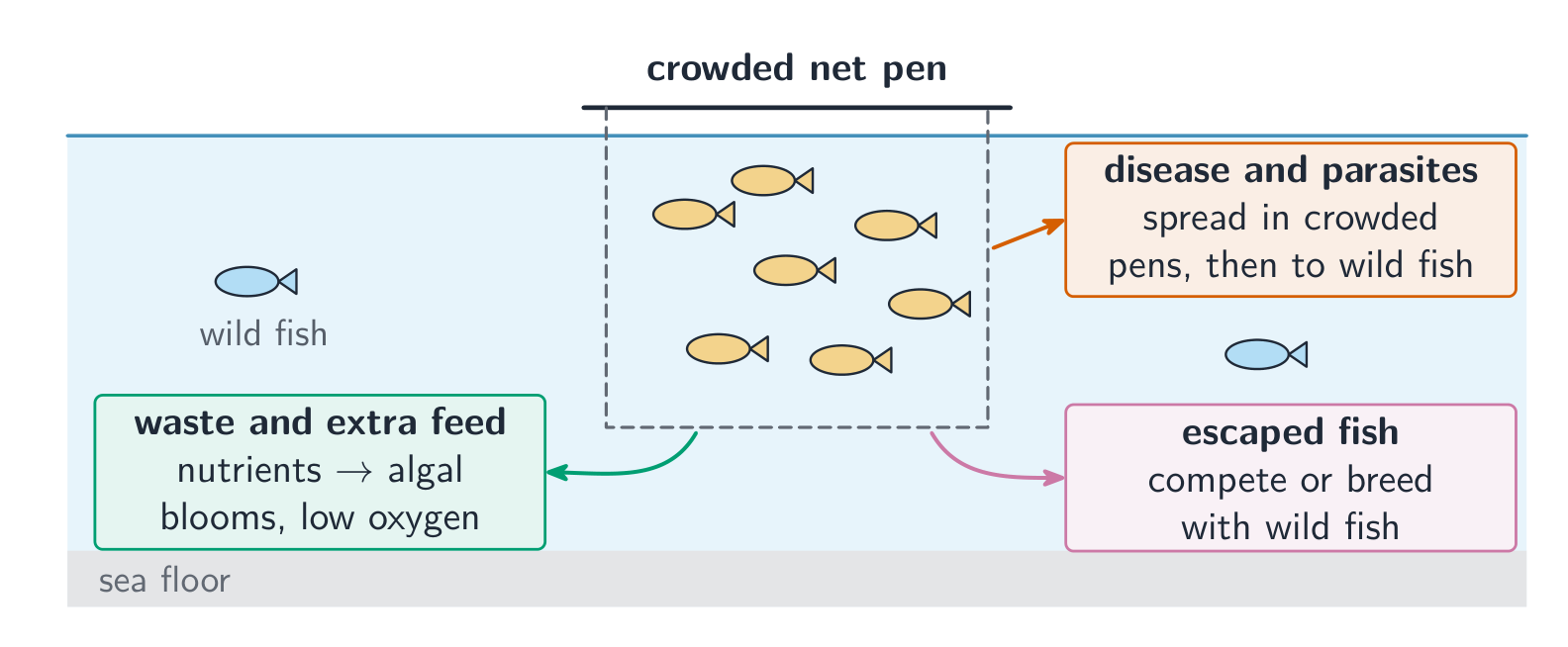
Crowded fish farms can pollute nearby water with concentrated fish ____.
难度 1/5 · 今日首次完成可获 100 金币及少量额外奖励
Concentrated fish 粪便 and leftover feed pollute the water and can cause algal blooms.
Farmed fish that escape or spread disease can harm wild fish populations.
难度 1/5 · 今日首次完成可获 100 金币及少量额外奖励
Escaped farmed fish and diseases from crowded pens can damage wild populations nearby.
Why do diseases spread more easily on fish farms than in the wild?
难度 1/5 · 今日首次完成可获 100 金币及少量额外奖励
Crowding (high density) is the cause. The disease can then spread to wild fish near the pens.
Match each drawback to the problem it causes.
难度 2/5 · 今日首次完成可获 140 金币及少量额外奖励
Name the cause and its effect, the way FRQs ask for.
Other costs to know
- Habitat loss: in Southeast Asia and Latin America, large areas of mangrove forest have been cleared for shrimp ponds, removing nursery habitat for wild fish and storm protection for coasts.
- Wild fish as feed: carnivorous farmed fish, such as salmon, are fed fishmeal made from small wild fish, so they do not fully relieve fishing pressure.
Benefit or cost of aquaculture?
Sort each effect of fish farming into a benefit or a cost.
Making it more sustainable
- Farm plant-eating or filter-feeding species (carp, tilapia, oysters, mussels, seaweed); shellfish and seaweed even clean the water by filtering it.
- Use closed tanks that treat their wastewater, keep stocking densities lower, and place sea pens where currents spread waste and away from wild-salmon routes.
Select 所有 true statements about aquaculture.
难度 2/5 · 今日首次完成可获 140 金币及少量额外奖励
Aquaculture brings both benefits and real costs. The other three are correct.
Worked calculation
A farm produces 2000 kg of tilapia using 3000 kg of feed. A cattle ranch needs 7 kg of feed per kg of beef. How much feed would the ranch need to produce the same 2000 kg of meat, and how much more is that?
- Tilapia feed ratio: 3000 ÷ 2000 = 1.5 kg feed per kg fish.
- Beef: 2000 kg × 7 = 14 000 kg of feed.
- 14 000 − 3000 = 11 000 kg more feed (about 4.7 times as much).
A salmon farm uses 1200 kg of feed to produce 1000 kg of salmon. How many kg of feed are needed per kg of salmon?
难度 2/5 · 今日首次完成可获 140 金币及少量额外奖励
1200 ÷ 1000 = 1.2 kg of feed per kg of fish.
Worked FRQ answer
(A) Describe ONE reason aquaculture has expanded in recent decades. It is highly efficient: farmed fish turn feed into body mass with little waste, so a lot of food is produced from a small area of water.
(B) Explain ONE way an open-water salmon farm can harm wild salmon nearby. The high density of fish in the pens lets diseases and parasites spread quickly; wild salmon swimming past the pens can become infected.
(C) Propose ONE solution to reduce water pollution from a fish farm. Raise the fish in closed tanks whose wastewater is filtered before release, so the extra nutrients do not cause algal blooms in nearby waters.
- Why it scores: (B) links density → disease → transfer to wild fish, the chain the course names. (C) gives a solution and what it prevents.
- Aquaculture is not fishing. Catching wild fish with nets or lines is fishing (topic 5.8, overfishing); aquaculture means raising the fish yourself.
- The disease problem comes from density. Say "fish are crowded at high density", not just "the fish get sick".
- Escaped fish cause two different problems: competition (for food and space) and interbreeding (genetic). Name the one you mean.
Aquaculture is raising fish, shellfish and aquatic plants in tanks, ponds or net pens. It has expanded because it is highly efficient, needs small areas of water and little fuel. Drawbacks: it can contaminate wastewater (causing algal blooms), escaped fish may compete or breed with wild fish, and the high density of fish increases disease, which can spread to wild fish. Mangrove loss and wild-caught feed are other costs.