| English | 释义 | 拼音 |
|---|---|---|
| ecological footprint/ˌekəˈlɒdʒɪkl ˈfʊtprɪnt/ | 生态足迹 | shēng tài zú jì |
| biocapacity/ˌbaɪəʊkəˈpæsɪti/ | 生物承载力 | shēng wù chéng zài lì |
How many Earths do we use?
- Every year, the Global Footprint Network calculates Earth Overshoot Day: the date when humanity has used all the resources Earth can renew in that year. In recent years it has fallen in late July, so for the rest of the year we use more than the planet can replace.
- The tool behind this is the ecological footprint 生态足迹: it compares the resources a person or society demands and the waste it produces with what the land and water can supply.
What a footprint measures
- An ecological footprint is the area of biologically productive land and water needed to supply what a person or society uses and to absorb its wastes. It is measured in global hectares (gha) per person.
- Biocapacity 生物承载力 is the area actually available. When footprint > biocapacity, there is an ecological deficit (overshoot) 生态赤字.
An ecological footprint measures…
难度 1/5 · 今日首次完成可获 100 金币及少量额外奖励
An ecological footprint is the area of land and water needed to supply a person's resources and absorb their waste.
When humanity uses resources faster than Earth can renew them, we ____ Earth's capacity.
难度 1/5 · 今日首次完成可获 100 金币及少量额外奖励
When our total footprint exceeds Earth's biocapacity, we overshoot — using more than the planet can sustain.
The parts of a footprint
| Part of the footprint | What it supplies or absorbs |
|---|---|
| cropland | food crops, animal feed, fibre (cotton) |
| grazing land | meat, milk, leather, wool |
| fishing grounds | fish and seafood |
| forest land | timber, paper, fuelwood |
| built-up land | houses, roads, factories |
| carbon uptake land | forest needed to absorb CO₂ from burning fossil fuels |
- Carbon is the largest part of the world's footprint, about 60%. A carbon footprint counts only greenhouse-gas emissions; an ecological footprint counts all of the parts above.
Which component is the largest part of humanity's ecological footprint?
难度 1/5 · 今日首次完成可获 100 金币及少量额外奖励
Carbon makes up about 60% of the world's footprint.
A person's carbon footprint and ecological footprint measure the same thing.
难度 1/5 · 今日首次完成可获 100 金币及少量额外奖励
The carbon footprint counts only greenhouse-gas emissions. The ecological footprint also counts cropland, grazing land, fishing grounds, forest and built-up land.
Footprints are unequal
- Footprints per person differ hugely between countries, mainly because of energy use, diet (especially meat) and consumption of goods.
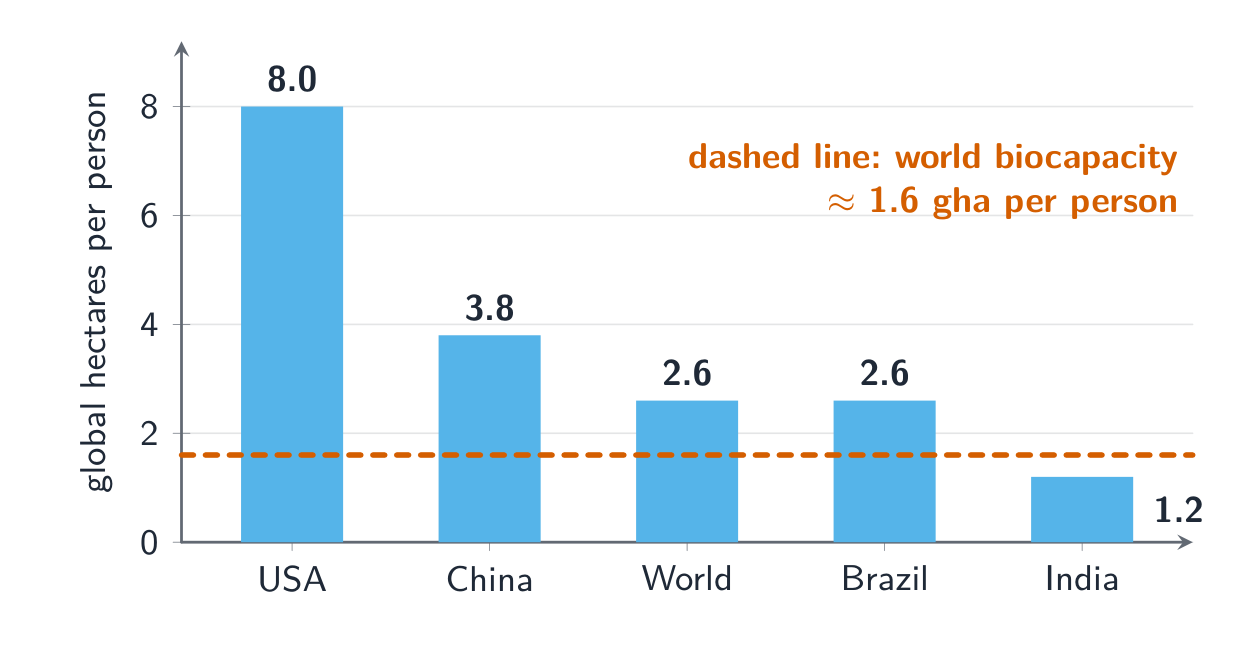
How many Earths? Number of Earths needed $=\dfrac{\text{footprint per person}}{\text{world biocapacity per person}}$. World: $2.6\div1.6\approx$ 1.6 Earths. If everyone lived like the average US resident: $8.0\div1.6=$ 5 Earths.
Which lifestyle tends to have the largest ecological footprint?
难度 1/5 · 今日首次完成可获 100 金币及少量额外奖励
Using lots of energy, meat, and cars gives a large footprint; simple, low-resource living lowers it.
Select 所有 true statements about ecological footprints.
难度 2/5 · 今日首次完成可获 140 金币及少量额外奖励
Footprints vary hugely between people and countries. The other three are correct.
A country's footprint is 5.6 gha per person. World biocapacity is 1.6 gha per person. How many Earths would be needed if everyone lived like this?
难度 2/5 · 今日首次完成可获 140 金币及少量额外奖励
5.6 ÷ 1.6 = 3.5 Earths.
Shrinking a footprint
- Energy: use less, switch to renewables, insulate homes. This shrinks the carbon part, the largest one.
- Food and goods: eat less meat (it needs far more cropland and grazing land per calorie), waste less food, buy fewer and longer-lasting products, reuse and recycle.
Bigger or smaller footprint?
Sort each choice by whether it raises or lowers a person's ecological footprint.
Eating more meat and using more energy lowers your ecological footprint.
难度 1/5 · 今日首次完成可获 100 金币及少量额外奖励
False. Both increase the resources you use. Using less energy, eating less meat and reducing waste shrink your ecological footprint.
Match each change to the part of the footprint it mainly reduces.
难度 2/5 · 今日首次完成可获 140 金币及少量额外奖励
Each choice reduces the demand on one specific part of the footprint.
Worked FRQ answer
A student's ecological footprint is 6.4 gha. World biocapacity is 1.6 gha per person.
(A) Calculate how many Earths would be needed if everyone had this footprint. $6.4\div1.6=$ 4 Earths.
(B) Identify the component that is usually the largest part of a footprint in a wealthy country, and explain why. Carbon uptake land: burning large amounts of fossil fuels for electricity, heating and transport releases CO₂, and a large forest area would be needed to absorb it.
(C) Describe one change the student could make to reduce the footprint, and explain how it works. Eat less beef: cattle need large areas of grazing land and cropland for feed, so less beef reduces both of those parts of the footprint.
- Why it scores: (A) shows the division. (B) and (C) link a choice to a specific part of the footprint, not just "use fewer resources".
- Ecological footprint ≠ carbon footprint. The carbon footprint is only one component.
- Footprint is an area (gha), not a mass of waste or an amount of money.
- A country can live beyond its own biocapacity by importing resources; the world as a whole cannot.
An ecological footprint compares the resource demands and waste production of a person or society with Earth's ability to supply them, as an area in global hectares. Parts: cropland, grazing land, fishing grounds, forest, built-up land and carbon uptake (the largest). Footprint ÷ biocapacity gives the number of Earths needed; humanity now needs about 1.6.