| English | 释义 | 拼音 |
|---|---|---|
| protonated | 质子化的 | zhì zi huà de |
Which form wins at this pH?
- Aspirin is a weak acid with $\text{p}K_a=3.5$. In the stomach (pH about 2) it is mostly in its neutral HA form; in the blood (pH 7.4) almost all of it is the ion $\text{A}^-$. The same molecule behaves differently in each place.
- Comparing the solution's pH with the acid's pKa tells you at once which form dominates. This lesson shows how, and by how much.
pKa: a log scale for acid strength
- $\text{p}K_a=-\log K_a$, just as $\text{pH}=-\log[\text{H}^+]$. A larger $K_a$ gives a smaller $\text{p}K_a$, so the lower the $\text{p}K_a$, the stronger the acid.
- Ethanoic acid: $K_a=1.8\times10^{-5}$, $\text{p}K_a=4.74$. HF: $K_a=6.8\times10^{-4}$, $\text{p}K_a=3.17$, so HF is stronger. Each unit of $\text{p}K_a$ is a factor of 10 in $K_a$.
Benzoic acid has $K_a=6.3\times10^{-5}$. Find its $\text{p}K_a$.
难度 2/5 · 今日首次完成可获 140 金币及少量额外奖励
$\text{p}K_a=-\log(6.3\times10^{-5})=4.20$.
Which acid is strongest?
难度 1/5 · 今日首次完成可获 100 金币及少量额外奖励
The smallest $\text{p}K_a$ means the largest $K_a$, so Q is the strongest.
pH below pKa: mostly HA
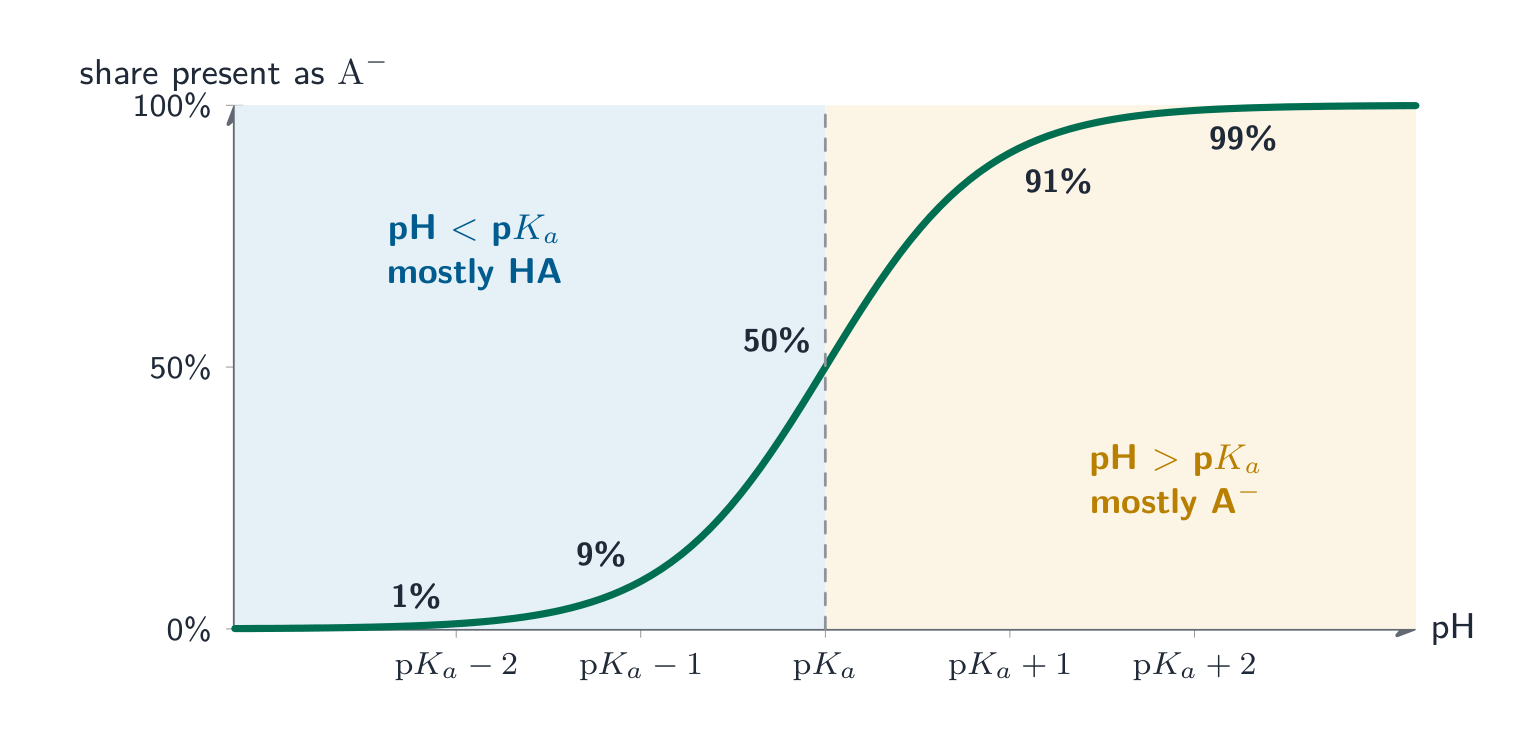
- Rearranging $K_a$ gives $\dfrac{[\text{A}^-]}{[\text{HA}]}=\dfrac{K_a}{[\text{H}^+]}=10^{\,\text{pH}-\text{p}K_a}$. When pH $<$ $\text{p}K_a$, the power is negative, so $[\text{HA}]>[\text{A}^-]$: the protonated 质子化的 form dominates.
- When pH $>$ $\text{p}K_a$, the power is positive and $\text{A}^-$ dominates. When pH $=$ $\text{p}K_a$, the two are equal.
An acid has $\text{p}K_a=6.0$. Match each pH with the main form.
难度 2/5 · 今日首次完成可获 140 金币及少量额外奖励
Below the $\text{p}K_a$ the acid stays protonated; above it, it loses its proton.
Each pH unit is a factor of ten
- One unit above the $\text{p}K_a$: $[\text{A}^-]:[\text{HA}]=10:1$ (91% $\text{A}^-$). Two units above: $100:1$ (99%).
- One unit below: $1:10$ (9% $\text{A}^-$). Two units below: $1:100$ (1%).
Read strength from pKa
Sort each acid by its pKa. A smaller pKa means a stronger acid.
Ethanoic acid ($\text{p}K_a=4.74$) is in a solution buffered at pH $5.74$. What is the ratio $[\text{CH}_3\text{COO}^-]:[\text{CH}_3\text{COOH}]$, and which form dominates?
- $\dfrac{[\text{A}^-]}{[\text{HA}]}=10^{\,5.74-4.74}=10^{1}=10$
- The ion dominates: about 91% is $\text{CH}_3\text{COO}^-$ and 9% is $\text{CH}_3\text{COOH}$.
A weak acid with $\text{p}K_a=7.20$ is in a solution at pH $9.20$. Find the ratio $[\text{A}^-]/[\text{HA}]$.
难度 2/5 · 今日首次完成可获 140 金币及少量额外奖励
$10^{\,9.20-7.20}=10^2=100$.
Aspirin ($\text{p}K_a=3.5$) in stomach acid at pH $1.5$: what fraction is ionized?
- $\dfrac{[\text{A}^-]}{[\text{HA}]}=10^{\,1.5-3.5}=10^{-2}=\dfrac1{100}$
- Only about 1% is ionized; 99% is the neutral HA form.
A weak acid with $\text{p}K_a=4.0$ is at pH $3.0$. What percentage is present as $\text{A}^-$? (Give the answer to the nearest whole number.)
难度 2/5 · 今日首次完成可获 140 金币及少量额外奖励
比率 $10^{-1}=1:10$, so $\text{A}^-$ is(是) $\tfrac{1}{11}\approx9\%$.
Indicators are weak acids too
- An indicator HIn has one colour and its ion $\text{In}^-$ another. You see the HIn colour when pH $<\text{p}K_a-1$ and the $\text{In}^-$ colour when pH $>\text{p}K_a+1$.
- So an indicator changes colour over about 2 pH units centred on its $\text{p}K_a$. Phenolphthalein ($\text{p}K_a\approx9.3$) is colourless in acid and pink above about pH 10.
An indicator has $\text{p}K_a=5.0$. Over roughly which pH range does it change colour?
难度 1/5 · 今日首次完成可获 100 金币及少量额外奖励
About one unit either side of the $\text{p}K_a$.
Molecules with several acidic groups
- Each group follows its own $\text{p}K_a$. An amino acid has a $-\text{COOH}$ group ($\text{p}K_a\approx2$) and an $-\text{NH}_3^+$ group ($\text{p}K_a\approx9$).
- At pH 7, $7>2$ so the COOH group has lost its proton ($\text{COO}^-$), and $7<9$ so the amine group keeps its extra proton ($\text{NH}_3^+$).
At pH 7, the $-\text{COOH}$ group of an amino acid ($\text{p}K_a\approx2$) is mostly protonated.
难度 1/5 · 今日首次完成可获 100 金币及少量额外奖励
pH 7 is well above 2, so the group is mostly $-\text{COO}^-$.
Do not mix up the direction. pH below $\text{p}K_a$ (more acidic solution): the acid keeps its proton, so HA dominates. pH above $\text{p}K_a$: A$^-$ dominates. A quick check: in strong acid, there is plenty of $\text{H}^+$ to keep everything protonated.
$\text{p}K_a=-\log K_a$; smaller $\text{p}K_a$ means a stronger acid. $\dfrac{[\text{A}^-]}{[\text{HA}]}=10^{\,\text{pH}-\text{p}K_a}$: pH $<$ $\text{p}K_a$ → mostly HA; pH $=$ $\text{p}K_a$ → equal; pH $>$ $\text{p}K_a$ → mostly $\text{A}^-$. Each pH unit changes the ratio by a factor of 10.