| English | 释义 | 拼音 |
|---|---|---|
| energy profile/ˈenədʒi ˈprəʊfaɪl/ | 能量图 | néng liàng tú |
| activation energy/ˌæktɪˈveɪʃn ˈenədʒi/ | 活化能 | huó huà néng |
| transition state/trænˈsɪʃn steɪt/ | 过渡态 | guò dù tài |
A hill the reaction must climb
- Every reaction has a hill to get over before it can finish.
- A graph draws that hill as the atoms rearrange.
- Its height tells you how hard the reaction is to start.
- Its two ends tell you whether heat is released or absorbed.
The reaction-coordinate diagram
- An energy profile 能量图 plots energy along the reaction's progress.
- Reactants sit on the left and products on the right.
- A hill rises between them.
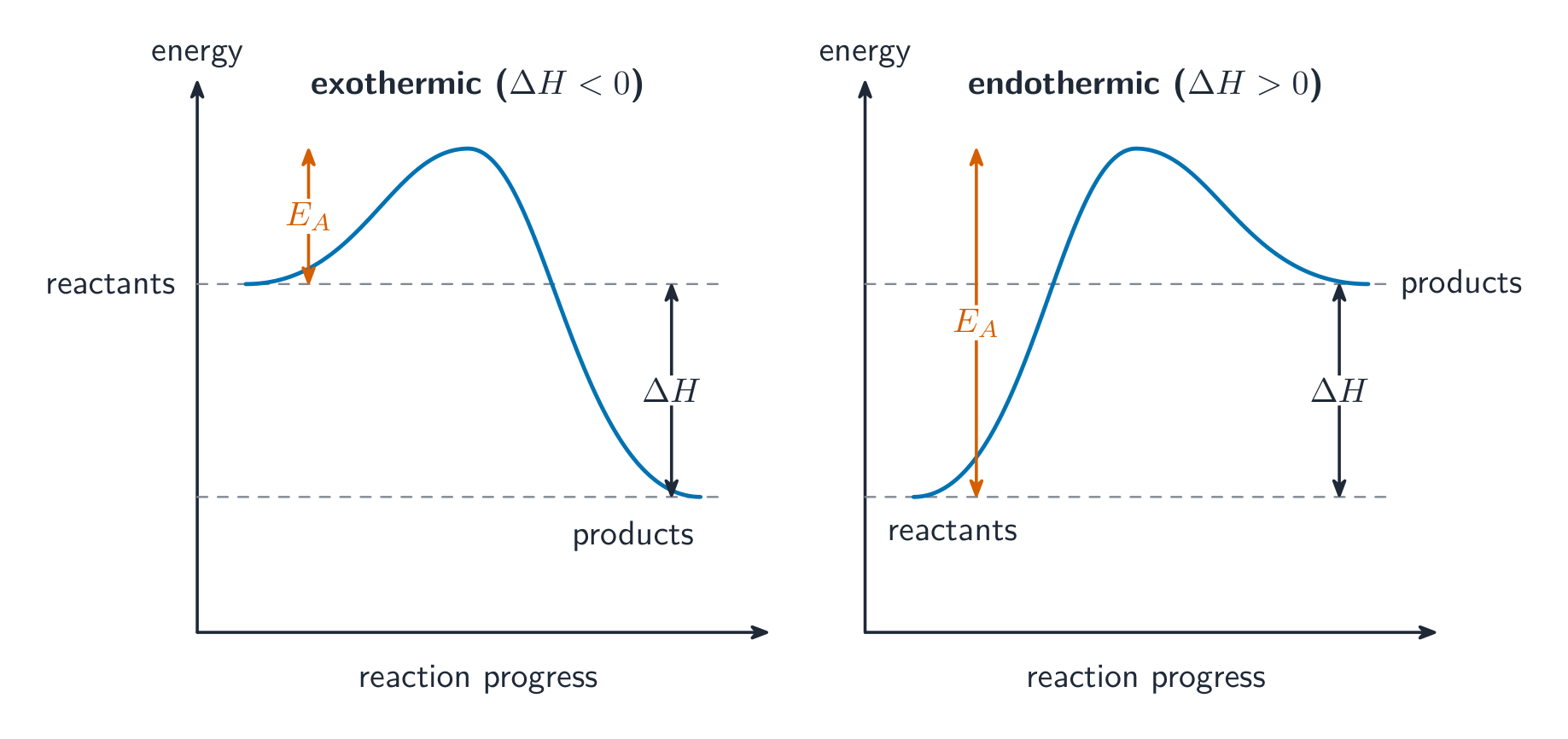
Exothermic reactions end lower than the reactants; endothermic end higher
The peak is the barrier
- The peak height above the reactants is the activation energy 活化能.
- At the very top sits the transition state 过渡态.
- At the same temperature and comparable collision factors, a larger barrier above the starting level means a smaller rate constant; absolute peak height is not enough.
The transition state is located at the...
难度 1/5 · 今日首次完成可获 100 金币及少量额外奖励
The transition state sits at the very top of the barrier.
A higher activation energy makes a reaction faster.
难度 1/5 · 今日首次完成可获 100 金币及少量额外奖励
False. Fewer collisions have enough energy to clear a taller barrier, so a higher activation energy makes the reaction slower.
Uphill or downhill overall
- If products sit lower than reactants, energy is released (exothermic).
- If products sit higher, energy is absorbed (endothermic).
- For an enthalpy profile, $\Delta H=H_{\mathrm{products}}-H_{\mathrm{reactants}}$; the horizontal axis is reaction progress, not elapsed time.
读取能量分布图
Find the activation energy, the enthalpy change, and how the reactants climb to the transition state.
Reactants at $40\ \text{kJ}$, products at $25\ \text{kJ}$. The value of $\Delta H$ (in kJ)?
难度 2/5 · 今日首次完成可获 140 金币及少量额外奖励
On this enthalpy profile, $\Delta H=H_{\mathrm{products}}-H_{\mathrm{reactants}}=25-40=-15\ \text{kJ}$. Products are lower, so the reaction releases 15 kJ for the stated reaction amount.
If the products are lower in energy than the reactants, the reaction is...
难度 1/5 · 今日首次完成可获 100 金币及少量额外奖励
Lower products mean net energy is released -- exothermic.
Reactants at $50\ \text{kJ}$, peak at $120\ \text{kJ}$, products at $30\ \text{kJ}$.
- Forward activation energy: $E_{a,f}=H_{\mathrm{peak}}-H_{\mathrm{reactants}}=120-50=70\ \text{kJ}$. Reverse activation energy: $E_{a,r}=120-30=90\ \text{kJ}$.
- $\Delta H = 30 - 50 = -20\ \text{kJ}$, so it is exothermic.
Reactants at $40\ \text{kJ}$, peak at $100\ \text{kJ}$. The activation energy (in kJ)?
难度 2/5 · 今日首次完成可获 140 金币及少量额外奖励
Use $E_a=H_{\mathrm{peak}}-H_{\mathrm{reactants}}$. Thus $E_a=100-40=60\ \text{kJ}$; the zero of the vertical axis is irrelevant.
Activation energy is measured from the reactants up to the ____.
难度 1/5 · 今日首次完成可获 100 金币及少量额外奖励
It is the height of the peak above the reactants.
Activation energy is measured from the reactants up to the peak, not from zero. $\Delta H$ is the difference between products and reactants (the two ends), independent of the peak height. And a large activation energy makes a reaction slow even if it is strongly exothermic.
An energy profile plots energy along a reaction. The peak above the reactants is the activation energy, with the transition state at the top. Whether products end lower (exothermic) or higher (endothermic) than reactants gives $\Delta H$. Barrier height sets speed; the end difference sets $\Delta H$.