| English | 释义 | 拼音 |
|---|---|---|
| solute/ˈsɒljuːt/ | 溶质 | róng zhì |
| solvent/ˈsɒlvənt/ | 溶剂 | róng jì |
| solution/səˈluːʃn/ | 溶液 | róng yè |
| molarity/məʊˈlærɪti/ | 摩尔浓度 | mó ěr nóng dù |
When one thing vanishes into another
- Stir sugar into tea and it disappears — but it is still there.
- The sweet, clear liquid tastes uniform everywhere.
- One substance has spread evenly through another.
- We measure exactly how crowded that spread is.
Solute and solvent
- A solution 溶液 is a uniform mixture of two or more substances.
- The solute 溶质 is what dissolves; the solvent 溶剂 does the dissolving.
- In salt water, salt is the solute and water is the solvent.
In salt water, the salt is the...
难度 1/5 · 今日首次完成可获 100 金币及少量额外奖励
The dissolved substance is the solute; water is the solvent.
Measuring concentration
- Molarity 摩尔浓度 measures concentration:
- More solute per litre means a more concentrated solution.
Dissolve $2\ \text{mol}$ of solute to make $4\ \text{L}$ of solution. The molarity (in M)?
难度 2/5 · 今日首次完成可获 140 金币及少量额外奖励
$M = \text{moles}/\text{liters} = 2/4 = 0.5\ \text{M}$.
Dilute and concentrated
- Adding solvent dilutes a solution, lowering $M$.
- Removing solvent or adding solute concentrates it, raising $M$.
- Dilution keeps the moles of solute the same: $M_1V_1 = M_2V_2$.
Concentration links moles and volume
Molarity is moles of solute per litre of solution: at fixed concentration, moles scale with volume.
Dilute $100\ \text{mL}$ of $2\ \text{M}$ solution to $200\ \text{mL}$. The new molarity (in M)?
难度 2/5 · 今日首次完成可获 140 金币及少量额外奖励
Dilution conserves solute: $M_1V_1=M_2V_2$. The 200 mL is the final solution volume. Rearrange: $M_2=M_1V_1/V_2=(2)(100)/200=1\ \text{M}$. The common mL units cancel.
Diluting a solution with more solvent increases the number of moles of solute.
难度 1/5 · 今日首次完成可获 100 金币及少量额外奖励
False. Only solvent is added, so the moles of solute stay the same; the concentration falls because the volume rises.
Removing solvent from a solution makes it more ____.
难度 1/5 · 今日首次完成可获 100 金币及少量额外奖励
Less solvent for the same solute raises the molarity.
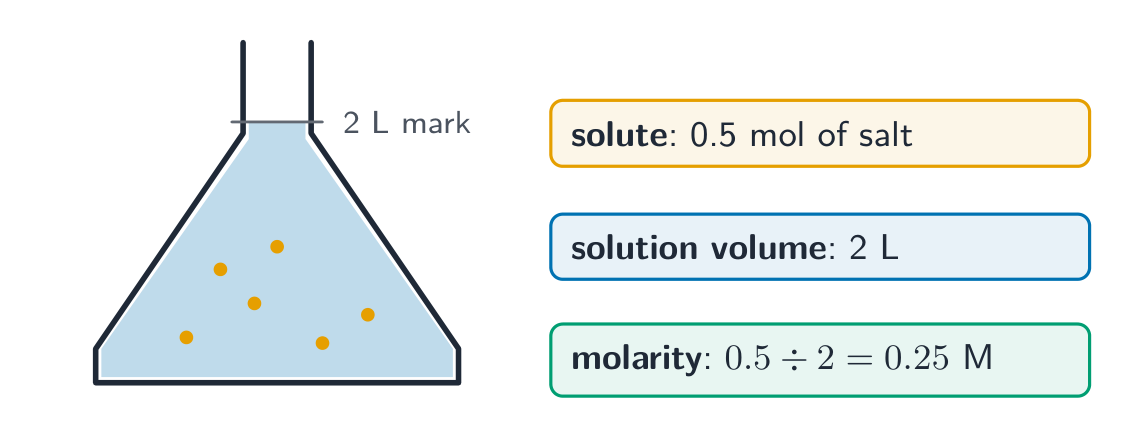
Dissolve $0.5\ \text{mol}$ of salt in enough water to make $2\ \text{L}$.
- $M = \dfrac{\text{moles}}{\text{liters}} = \dfrac{0.5}{2} = 0.25\ \text{M}$.
- Add water until the final solution volume is $4\ \text{L}$. From $M_1V_1=M_2V_2$, $M_2=(0.25)(2)/4=0.125\ \text{M}$; the solute remains $0.5\ \text{mol}$.
Molarity is moles of solute divided by litres of...
难度 1/5 · 今日首次完成可获 100 金币及少量额外奖励
It uses the total volume of solution, not just the solvent.
Molarity uses litres of solution, not litres of solvent — the final total volume. Diluting changes the concentration but not the moles of solute, which is why $M_1V_1 = M_2V_2$. And "concentrated" just means high molarity, not necessarily saturated.
A solution is a uniform mixture where a solute dissolves in a solvent. Its concentration is the molarity $M = \text{moles} / \text{litres of solution}$. Adding solvent dilutes it (moles unchanged, so $M_1V_1 = M_2V_2$); adding solute concentrates it.