DNA and RNA Structure · DNA 与 RNA 的结构
| English | 中文 | Pinyin · 拼音 |
|---|---|---|
| sugar-phosphate backbone/ˈʃʊɡə ˈfɒsfeɪt ˈbækbəʊn/ | 糖磷酸骨架 | táng lín suān gǔ jià |
| nucleotide/ˈnjuːklɪɒtaɪd/ | 核苷酸 | hé gān suān |
| base pair/beɪs peə/ | 碱基对 | jiǎn jī duì |
A closer look at the code
- You have met DNA as the molecule of information.
- Now look closely at how it is built.
- Its structure is what lets it store a code and be copied exactly.
- The shape holds the secret of how genes work.
更近地看这段密码
- 你已经把 DNA 认识为信息的分子。
- 现在近距离看看它是怎么构建的。
- 正是它的结构让它能储存一段密码并被精确复制。
- 这个形状藏着基因如何工作的秘密。
The sugar-phosphate backbone
- DNA is built from nucleotide 核苷酸 units, each a sugar, a phosphate, and a base.
- The sugars and phosphates link into a sugar-phosphate backbone 糖磷酸骨架.
- Two backbones form the long sides of a twisted ladder.
- The bases point inward, forming the rungs.
糖磷酸骨架
- DNA 由核苷酸(nucleotide)单元构建,每个是一个糖、一个磷酸和一个碱基。
- 糖和磷酸连成一条糖磷酸骨架(sugar-phosphate backbone)。
- 两条骨架构成一个扭曲梯子的两条长边。
- 碱基朝内指,形成横档。
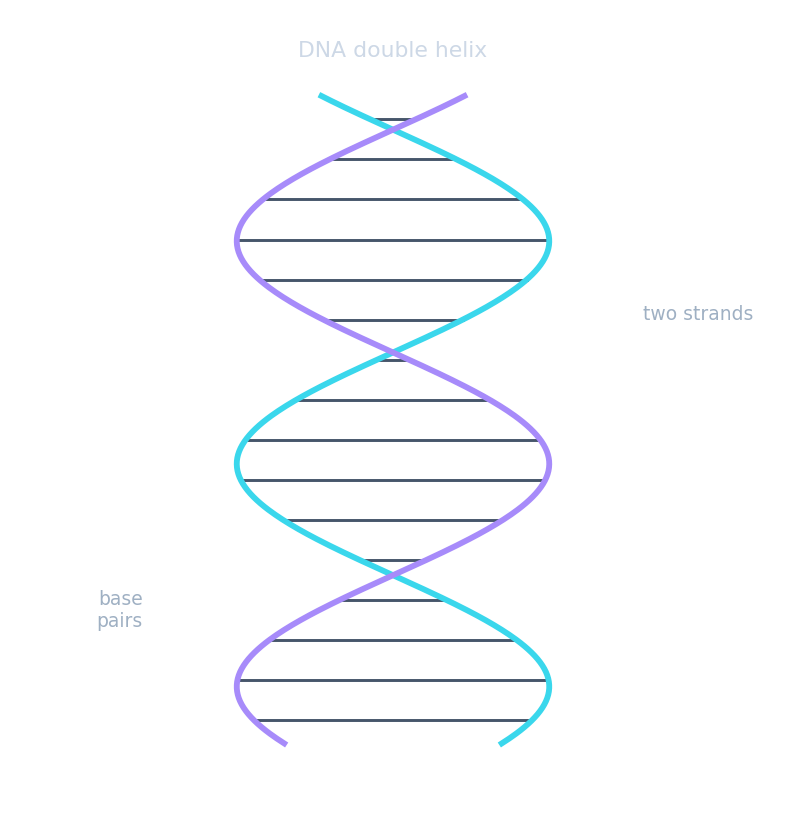
The two long sides of the DNA ladder are made of a repeating… · DNA 梯子的两条长边由重复的……构成。
Each strand's backbone is an alternating sugar-phosphate chain; the bases stick out from it. · 每条链的骨架是交替的糖磷酸链;碱基从它上面伸出来。
The repeating unit of a nucleic acid — a sugar, phosphate, and base — is a ____. · 核酸的重复单元——一个糖、一个磷酸和一个碱基——是一个 ____。
Each · 每个 nucleotide is one sugar + one phosphate + one base; many joined make a strand. · 每个核苷酸是一个糖 + 一个磷酸 + 一个碱基;许多个连起来构成一条链。
Base pairs make the rungs
- Each rung is a base pair 碱基对 joining the two strands.
- A always pairs with T, and G always pairs with C.
- So the two strands carry matching, complementary information.
- Read one strand and you know the other exactly.
碱基对构成横档
- 每一个横档是连接两条链的一个碱基对(base pair)。
- A 总是与 T 配对,G 总是与 C 配对。
- 所以两条链携带匹配的、互补的信息。
- 读一条链,你就精确地知道另一条。
In a DNA base pair, guanine (G) always pairs with… · 在一个 DNA 碱基对中,鸟嘌呤(G)总是与……配对。
G pairs with C, and A pairs with T — the rungs of the DNA ladder are these base pairs. · G 与 C 配对,A 与 T 配对——DNA 梯子的横档就是这些碱基对。
How RNA differs
- RNA is usually a single strand, not a double helix.
- Its sugar is ribose, not the deoxyribose of DNA.
- It uses the base uracil (U) where DNA uses thymine (T).
- These differences suit RNA to its job of carrying copies of the code.
RNA 有何不同
- RNA 通常是单链,不是双螺旋。
- 它的糖是核糖,不是 DNA 的脱氧核糖。
- 它在 DNA 用胸腺嘧啶(T)的地方用碱基尿嘧啶(U)。
- 这些差异让 RNA 适合它携带密码副本的工作。
A DNA or an RNA feature? · DNA 还是 RNA 的特征?
Sort each structural feature by whether it belongs to DNA or RNA. · 按照每个结构特征属于 DNA 还是 RNA,给它们分类。
RNA is usually single-stranded and uses uracil instead of thymine. · RNA 通常是单链,并用尿嘧啶代替胸腺嘧啶。
RNA differs from DNA: single strand, ribose sugar, and uracil in place of thymine. · RNA 与 DNA 不同:单链、核糖、并用尿嘧啶代替胸腺嘧啶。
Select all · 所有 true statements about DNA and RNA structure. · 选出关于 DNA 和 RNA 结构的所有正确说法。
Nucleic acids are made of nucleotides, not amino acids. The other three are correct. · 核酸由核苷酸构成,不是氨基酸。其余三条正确。
The base pairing rules are fixed: A–T and G–C in DNA (A–U and G–C when RNA is involved). A never pairs with G, and C never pairs with T. These strict rules are what make copying and reading the code reliable.
碱基配对规则是固定的:DNA 中 A–T 和 G–C(涉及 RNA 时是 A–U 和 G–C)。A 绝不与 G 配对,C 绝不与 T 配对。正是这些严格的规则,让复制和读取密码变得可靠。
Writing the partner strand:
- Suppose one DNA strand reads $\text{G–C–A–T}$.
- Its partner must read $\text{C–G–T–A}$ — each base matched to its pair.
- This exact matching is why a cell can copy DNA without errors.
写出伙伴链:
- 假设一条 DNA 链读作 $\text{G–C–A–T}$。
- 它的伙伴一定读作 $\text{C–G–T–A}$——每个碱基与它的配对相匹配。
- 这种精确的匹配,就是细胞能无错地复制 DNA 的原因。
DNA is a double helix of two sugar-phosphate backbones, with nucleotide bases forming base pairs (A–T, G–C) as the rungs. RNA differs: it is usually single-stranded, uses ribose sugar, and has uracil in place of thymine. The structure is what lets the code be stored and copied exactly.
DNA 是两条糖磷酸骨架的双螺旋,核苷酸碱基构成碱基对(A–T、G–C)作为横档。RNA 有所不同:它通常是单链、用核糖、并用尿嘧啶代替胸腺嘧啶。正是这个结构,让密码能被精确地储存和复制。