| English | 释义 | 拼音 |
|---|---|---|
| replication/ˌreplɪˈkeɪʃn/ | 复制 | fù zhì |
| template/ˈtempleɪt/ | 模板 | mú bǎn |
| DNA polymerase/ˌdiː en ˈeɪ ˌpɒlɪməˈreɪz/ | DNA聚合酶 | DNA jù hé méi |
| semi-conservative/ˈsemi kənˈsɜːvətɪv/ | 半保留 | bàn bǎo liú |
| helicase/ˈhelɪkeɪs/ | 解旋酶 | jiě xuán méi |
| topoisomerase/ˈtɒpɔɪsəʊmreɪz/ | 拓扑异构酶 | tuò pū yì gòu méi |
| RNA primer/ˌɑː en ˈeɪ ˈpraɪmə/ | RNA引物 | RNA yǐn wù |
| leading strand/ˈliːdɪŋ strænd/ | 前导链 | qián dǎo liàn |
| lagging strand/ˈlæɡɪŋ strænd/ | 后随链 | hòu suí liàn |
| ligase/ˈlɪɡeɪs/ | 连接酶 | lián jiē méi |
Copy two opposite strands before one cell becomes two
- A dividing cell must copy both strands of its DNA. The strands run in opposite directions, but its copying enzyme can extend a new strand in only one direction.
- Replication 复制 solves this with continuous synthesis on one side and fragments on the other. Follow the enzymes and primers to see why both daughter DNA molecules retain an original strand.
Unzipping the helix
- Replication begins by breaking the base pairs.
- The two strands separate, like a zip opening.
- This exposes the bases along each strand.
- Now each strand can guide the building of a new partner.
Why must a cell copy its DNA before dividing?
难度 1/5 · 今日首次完成可获 100 金币及少量额外奖励
Replication ensures both daughter cells receive a complete, identical copy of the DNA.
Each strand is a template 模板
- Each old strand acts as a template.
- Its base sequence decides the new strand by base pairing.
- The enzyme DNA polymerase DNA聚合酶 adds matching bases along it.
- A pairs with T and G with C, so the copy is exact.
How DNA is copied
Step through replication — the helix unzips and each old strand is used as a template for a new one.
During replication, each old strand acts as a…
难度 1/5 · 今日首次完成可获 100 金币及少量额外奖励
Each old strand is a template: its base sequence decides the new strand by base pairing.
The enzyme RNA polymerase builds the new DNA strand during replication.
难度 1/5 · 今日首次完成可获 100 金币及少量额外奖励
False. DNA polymerase builds the new DNA strand by adding complementary bases. RNA polymerase makes RNA during transcription.
Semi-conservative 半保留 copying
- Replication makes two DNA molecules from one.
- Each new molecule has one old strand and one brand-new strand.
- Because each keeps half of the original, it is semi-conservative.
- The two copies are identical to the starting DNA.
Because each new DNA keeps one old strand, replication is called ____-conservative.
难度 1/5 · 今日首次完成可获 100 金币及少量额外奖励
Replication is semi-conservative: each copy has one original strand and one new strand.
Select 所有 true statements about DNA replication.
难度 2/5 · 今日首次完成可获 140 金币及少量额外奖励
Replication keeps the old strands (semi-conservative); it does not discard them. The other three are correct.
Opening a moving replication fork
- Helicase 解旋酶 separates the paired DNA strands. Topoisomerase 拓扑异构酶 reduces twisting ahead of the opening, so the DNA can keep unwinding.
- A short RNA primer RNA引物 supplies a free end. DNA polymerase cannot start a new strand alone: it extends from that primer.
DNA polymerase is present but no RNA primer has formed. What is blocked?
难度 1/5 · 今日首次完成可获 100 金币及少量额外奖励
Polymerase requires an existing free end supplied by a primer.
Both new strands grow in one direction
- DNA polymerase adds nucleotides only to the 3′ end: every new strand grows 5′ → 3′. The two template strands run in opposite directions.
- The leading strand 前导链 grows continuously towards the moving fork. The lagging strand 后随链 grows in short pieces away from the fork; each piece needs its own primer.
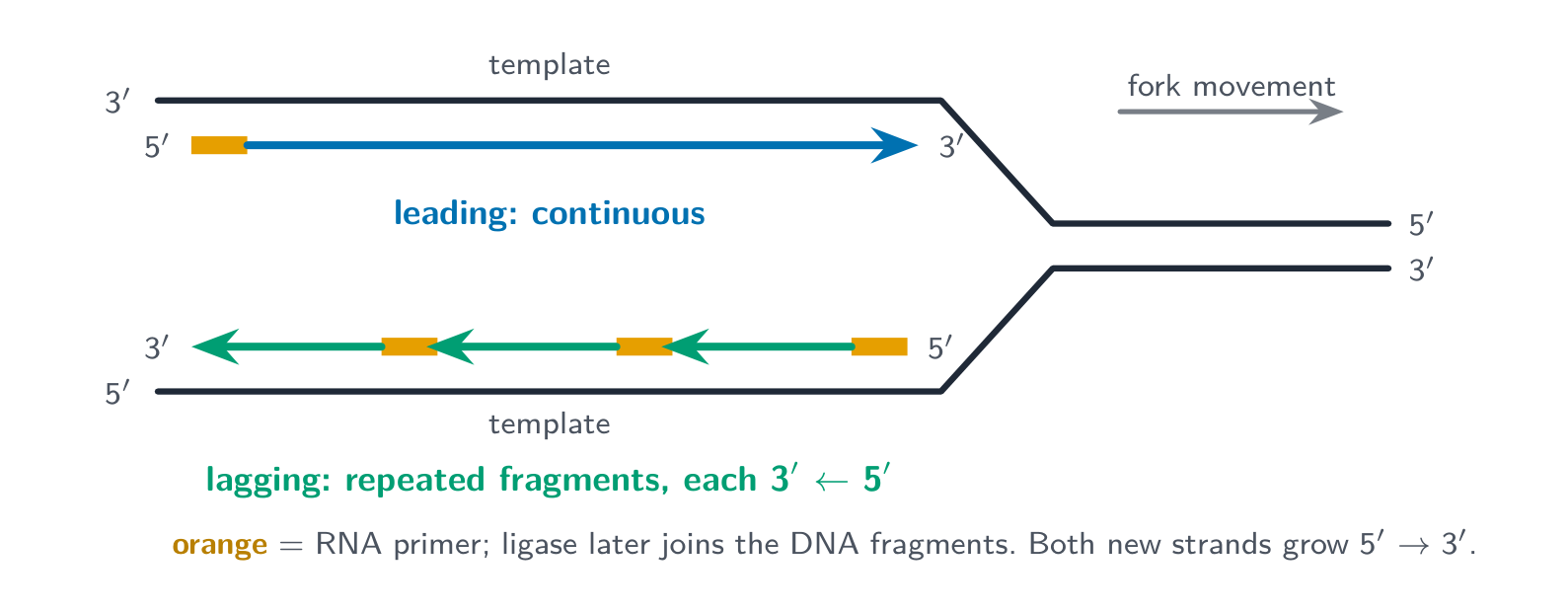
The lagging strand is synthesized 3′ → 5′.
难度 1/5 · 今日首次完成可获 100 金币及少量额外奖励
Each fragment grows 5′ → 3′; discontinuous synthesis solves the opposite template direction.
Joining the pieces
- After RNA primers are removed and replaced with DNA, ligase 连接酶 joins the DNA fragments into a continuous strand. It joins the sugar–phosphate backbone, rather than choosing complementary bases.
- Worked trace: a template runs 3′–A T G C–5′. Its new partner is 5′–T A C G–3′. Both leading and lagging synthesis obey the same 5′ → 3′ rule.
Short DNA fragments have formed but remain unjoined. Which enzyme is most directly missing?
难度 1/5 · 今日首次完成可获 100 金币及少量额外奖励
Ligase seals breaks in the backbone between adjacent DNA fragments.
Replication is semi-conservative: it does not build two entirely new molecules and throw the old one away. Each daughter DNA keeps one original strand and pairs it with a new one. Half old, half new — that is the key idea.
Right before a cell divides:
- The cell copies all of its DNA during interphase.
- Each chromosome becomes two identical copies, joined together.
- When the cell divides, each daughter gets one full copy — thanks to replication.
DNA replication copies the genetic code before cell division. The helix unzips, and each old strand serves as a template while DNA polymerase adds matching bases. The result is semi-conservative: each new DNA has one old strand and one new strand, giving two identical copies.
Write from this case
- Replication opens a fork.
- Polymerase can add nucleotides only in the 5 prime to 3 prime direction.
Which new strand is made continuously toward the fork?
One new strand can follow the fork continuously.
Which new strand is continuous?
难度 1/5 · 今日首次完成可获 100 金币及少量额外奖励
Only the strand growing toward the fork is continuous.