| English | 释义 | 拼音 |
|---|---|---|
| medium/ˈmiːdɪəm/ | 介质 | jiè zhì |
| oscillate/ˈɒsɪleɪt/ | 振动 | zhèn dòng |
| progressive wave/prəˈɡresɪv weɪv/ | 行波 | xíng bō |
| amplitude/ˈæmplɪtjuːd/ | 振幅 | zhèn fú |
| wavelength/ˈweɪvleŋθ/ | 波长 | bō cháng |
| period/ˈpɪərɪəd/ | 周期 | zhōu qī |
| frequency/ˈfriːkwənsi/ | 频率 | pín lǜ |
| phase difference/feɪz ˈdɪfrəns/ | 相位差 | xiàng wèi chà |
| in phase/ɪn feɪz/ | 同相 | tóng xiāng |
| out of phase/ˈaʊtəv feɪz/ | 反相 | fǎn xiāng |
| time-base/taɪm beɪs/ | 时基 | shí jī |
| intensity/ɪnˈtensɪti/ | 强度 | qiáng dù |
体育场的人浪
- 在体育场的"人浪"里,人们站起又坐下——但没有人绕着体育场跑。
- 波 在传播;人留在原地。
- 波把 能量 从一处带到另一处,而物质整体不移动。
波是什么
- 介质的粒子绕着固定的平衡位置 振动。
- 只有扰动——以及它的能量——沿着传播。这就是 行波(progressive wave)。
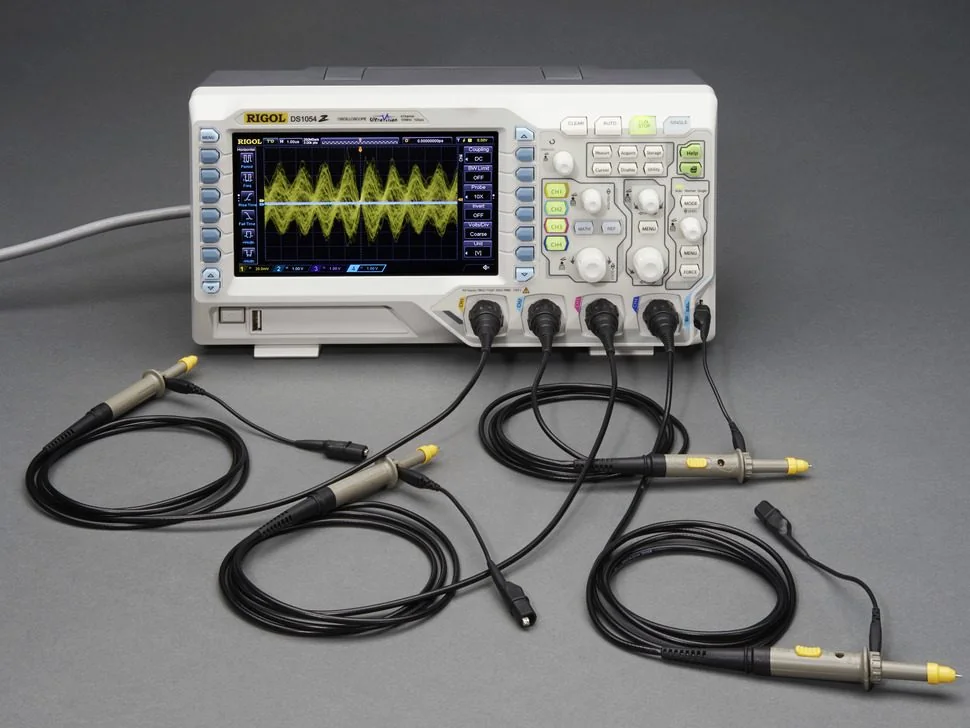
一台数字示波器画出电压信号随时间的变化
行波
y = a sin(bx + c)
A wave: a is amplitude, b sets the wavelength, c the phase.
A progressive wave carries energy without moving matter along overall.
难度 1/5 · 今日首次完成可获 100 金币及少量额外奖励
Yes — the particles only oscillate about fixed points; the disturbance and its energy are what travel.
关键词
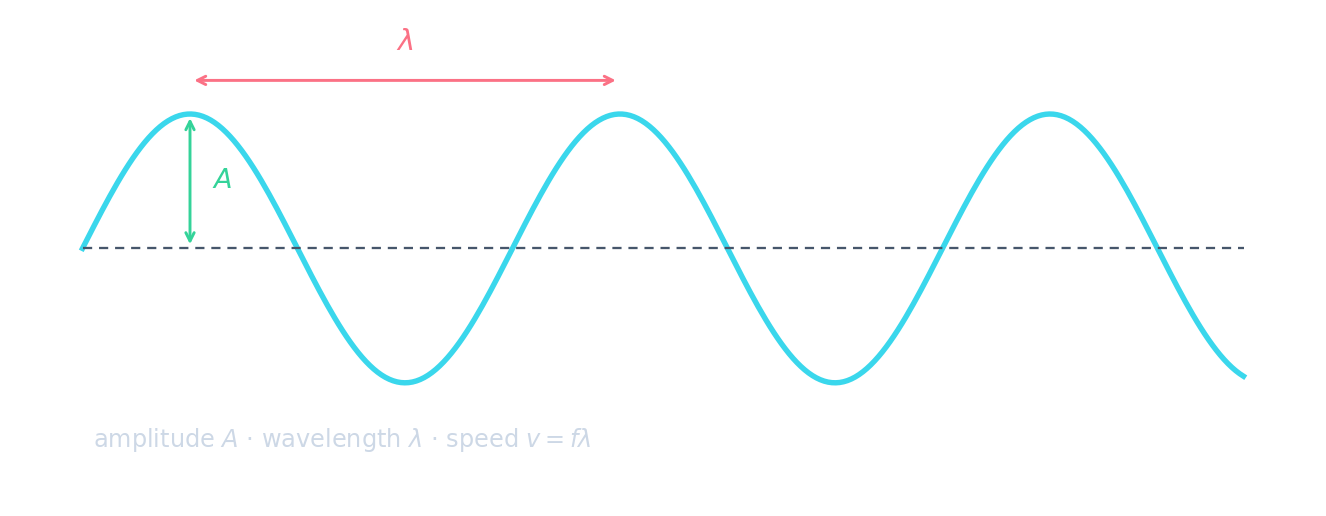
- 振幅(amplitude) $A$——偏离平衡的最大位移;波长(wavelength) $\lambda$——重复之间的距离。
- 周期(period) $T$——一个循环的时间;频率(frequency) $f = \dfrac{1}{T}$(单位 Hz)。
A wave has a period of $0.020\ \text{s}$. What is its frequency?
难度 2/5 · 今日首次完成可获 140 金币及少量额外奖励
$f = \dfrac{1}{T} = \dfrac{1}{0.020} = 50\ \text{Hz}$.
两张看起来一样的图
- 位移–距离 图是一张快照:重复的距离是 波长。
- 位移–时间 图跟踪一个点:重复的时间是 周期。
- 形状相同,坐标轴不同——读数之前先看清坐标轴的标签。
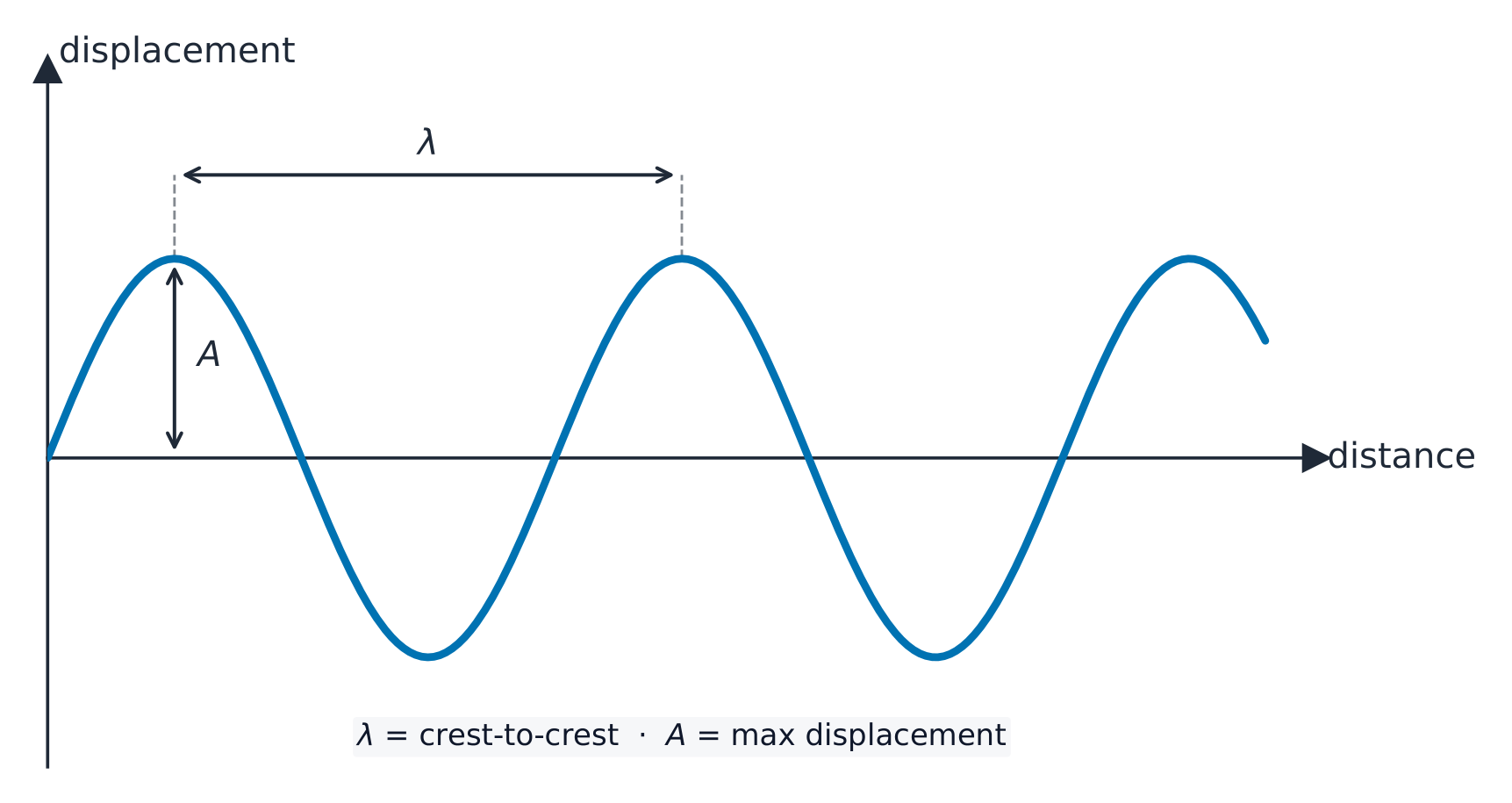
位移–距离图显示波的振幅和波长;把横轴换成时间,同样的形状显示的就是周期
A graph of displacement against 时间 for one point on a wave repeats every $4.0\ \text{ms}$. What does that $4.0\ \text{ms}$ tell you?
难度 1/5 · 今日首次完成可获 100 金币及少量额外奖励
A time axis gives the period. $f = \dfrac{1}{T} = \dfrac{1}{4.0 \times 10^{-3}} = 250\ \text{Hz}$. The wavelength needs a distance axis.
相位差
- 相距 一个波长 的点一起运动——它们 同相(in phase)。
- 相距 半个波长 的点恰好 反相(out of phase)。
- 一般地,间距 $\Delta x$ 对应的相位差是 $\dfrac{\Delta x}{\lambda} \times 360^\circ$(或 $\times 2\pi$ rad)。
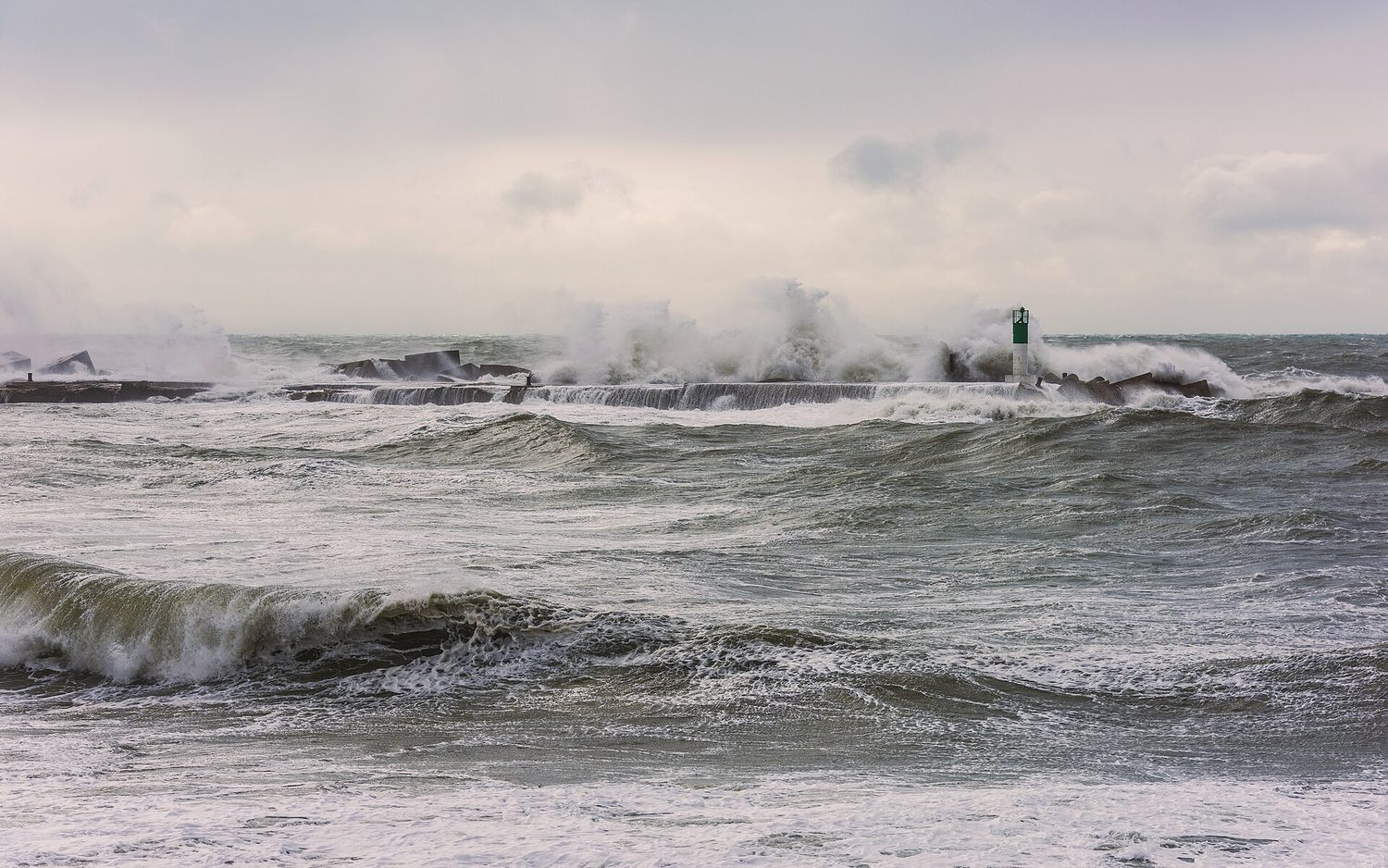
水面的涟漪是向外携带能量的行波
Two points exactly one wavelength apart on a wave are:
难度 1/5 · 今日首次完成可获 100 金币及少量额外奖励
One whole wavelength is one full cycle ($2\pi$), so the two points move together — in phase.
Match each separation along a wave to the phase difference between the two points.
难度 2/5 · 今日首次完成可获 140 金币及少量额外奖励
相位差 $= \dfrac{\Delta x}{\lambda} \times 360^\circ$, so each fraction of a wavelength is the same fraction of a full cycle.
波动方程
- 速率是距离除以时间。在一个周期 $T$ 内,波前进一个波长 $\lambda$,所以 $v = \dfrac{\lambda}{T}$。
- 因为 $f = \dfrac{1}{T}$,这就是 $v = f\lambda$——它对 每一种 行波都成立。
A wave has frequency $50\ \text{Hz}$ and wavelength $4.0\ \text{m}$. What is its speed?
难度 2/5 · 今日首次完成可获 140 金币及少量额外奖励
$v = f\lambda = 50 \times 4.0 = 200\ \dfrac{\text{m}}{\text{s}}$.
例题:读示波器
一个话筒接到示波器上。时基(time-base)设为 $0.20\ \dfrac{\text{ms}}{\text{div}}$,$2.5$ 个完整周期占满 $10$ 格。测得声波的波长为 $0.27\ \text{m}$。求频率和声速。
- 屏幕跨越的时间: $10 \times 0.20 = 2.0\ \text{ms}$。
- 周期: $T = \dfrac{2.0\ \text{ms}}{2.5} = 0.80\ \text{ms} = 8.0 \times 10^{-4}\ \text{s}$。
- 频率: $f = \dfrac{1}{T} = 1250\ \text{Hz}$。
- 速率: $v = f\lambda = 1250 \times 0.27 = 340\ \dfrac{\text{m}}{\text{s}}$。
- 检查: 空气中的声速约为 $340\ \dfrac{\text{m}}{\text{s}}$,所以读数合理。忘记除以 $2.5$ 个周期会得到 $500\ \text{Hz}$ 和 $135\ \dfrac{\text{m}}{\text{s}}$ 的速率——对声音来说不可能。
An oscilloscope time-base is $0.50\ \dfrac{\text{ms}}{\text{div}}$ and 4 complete cycles fill 8 divisions. What is the frequency of the signal, in Hz?
难度 2/5 · 今日首次完成可获 140 金币及少量额外奖励
Screen time $= 8 \times 0.50 = 4.0\ \text{ms}$; one cycle takes $\dfrac{4.0}{4} = 1.0\ \text{ms}$, so $f = \dfrac{1}{1.0 \times 10^{-3}} = 1000\ \text{Hz}$.
频率由波源决定。 当波进入另一种介质(medium)时,$f$ 保持不变,而 $v$ 和 $\lambda$ 一起改变。另外,位移–时间图给出的是 周期,绝不是波长。
When a wave passes from air into water, its speed and wavelength change but its ____ stays the same.
难度 1/5 · 今日首次完成可获 100 金币及少量额外奖励
The frequency is set by the source and cannot change at a boundary; $v = f\lambda$ then forces $\lambda$ to change with $v$.
强度
- 强度(intensity) 是单位面积上的功率:$I = \dfrac{P}{A}$(单位 $\dfrac{\text{W}}{\text{m}^2}$)。
- 它随振幅的 平方 增长:$I \propto A^{2}$。
If the amplitude of a wave doubles, its intensity becomes:
难度 1/5 · 今日首次完成可获 100 金币及少量额外奖励
$I \propto A^{2}$, so doubling $A$ multiplies the intensity by $2^{2} = 4$.
从点源扩散
- 点源把能量散布在一个球面上:$I = \dfrac{P}{4\pi r^{2}}$,所以 $I \propto \dfrac{1}{r^{2}}$。
- 距离加倍 → 强度变为 四分之一。
A point source gives an intensity of $100\ \dfrac{\text{W}}{\text{m}^2}$ at distance $r$. What is the intensity at $2r$?
难度 2/5 · 今日首次完成可获 140 金币及少量额外奖励
$I \propto \dfrac{1}{r^{2}}$, so at twice the distance the intensity is $\dfrac{100}{2^{2}} = 25\ \dfrac{\text{W}}{\text{m}^2}$.
例题:振幅与距离
一个小扬声器向各个方向均匀辐射 $20\ \text{W}$。求 $2.0\ \text{m}$ 处的强度,并说明那里声音的振幅与 $4.0\ \text{m}$ 处的振幅相比如何。
- $2.0\ \text{m}$ 处的强度: $I = \dfrac{P}{4\pi r^{2}} = \dfrac{20}{4\pi \times 2.0^{2}} = 0.40\ \dfrac{\text{W}}{\text{m}^2}$。
- 在 $4.0\ \text{m}$ 处 距离加倍,所以强度是四分之一:$0.10\ \dfrac{\text{W}}{\text{m}^2}$。
- 振幅: $I \propto A^{2}$,所以强度变为四分之一意味着振幅变为 一半。
- 检查: 强度按 $\dfrac{1}{r^{2}}$ 减小,但振幅只按 $\dfrac{1}{r}$ 减小——是强度之比的平方根。
你掌握了
- 波携带 能量,而不是物质;$f = \dfrac{1}{T}$;频率由波源决定
- 波动方程:$v = f\lambda$(每个周期前进一个波长)
- 相位差 $= \dfrac{\Delta x}{\lambda} \times 360^\circ$;强度 $I = \dfrac{P}{A}$,点源有 $I \propto A^{2}$ 和 $I \propto \dfrac{1}{r^{2}}$