Transverse and longitudinal waves · 横波与纵波
| English | 中文 | Pinyin · 拼音 |
|---|---|---|
| transverse/trænsˈvɜːs/ | 横波 | héng bō |
| longitudinal/ˌlɒŋɡɪˈtjuːdɪnl/ | 纵波 | zòng bō |
| perpendicular/ˌpɜːpənˈdɪkjʊlə/ | 垂直 | chuízhí |
| electromagnetic waves/ɪˌlektrəʊməɡˈnetɪk weɪvz/ | 电磁波 | diàn cí bō |
| compressions/kəmˈpreʃnz/ | 压缩 | yā suō |
| rarefactions/ˌreərɪˈfækʃnz/ | 稀疏 | xī shū |
| energy transfer/ˈenədʒi ˈtrænsfɜː/ | 能量传递 | néng liàng chuán dì |
| propagation/ˌprɒpəˈɡeɪʃn/ | 传播 | chuán bō |
Two ways to make a wave
- Shake a rope up and down — the wiggle runs along it.
- Push and pull a slinky end-on — a squash runs along it instead.
- Both carry energy, but the particles move in different directions.
制造波的两种方式
- 把一根绳子上下抖动——摆动沿着它传播。
- 把弹簧(slinky)端对端地推拉——一段挤压沿着它传播。
- 两者都携带能量,但粒子的运动方向不同。
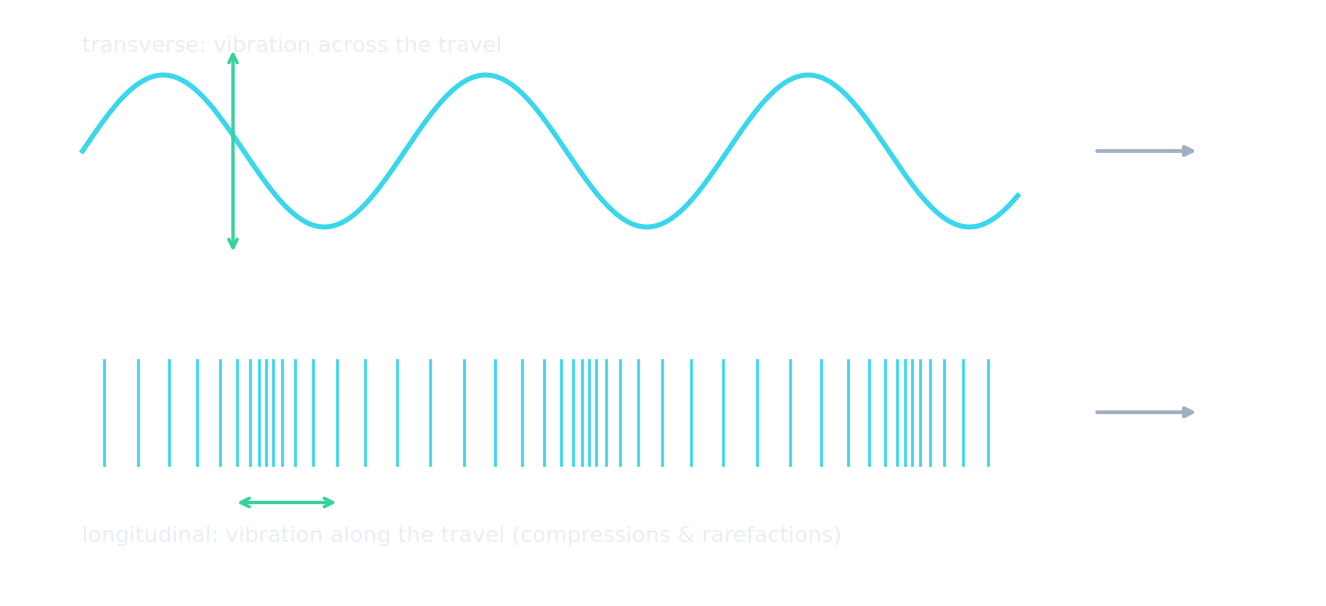
Transverse 横波 waves
- The particles vibrate perpendicular 垂直 to the direction the energy travels.
- Examples: a wave on a rope, all electromagnetic waves 电磁波, ripples on water.
Transverse wave on a rope
横波
- 粒子振动的方向 垂直于 能量传播的方向。
- 例子:绳子上的波、所有 电磁波、水面的涟漪。

绳子上的横波
Transverse waves · 横波
y = a sin(bx + c)
Change the amplitude · 振幅 and wavelength · 波长 of the wave. · 改变波的 振幅 和 波长。
In a transverse wave, the particles vibrate: · 在横波中,粒子振动的方向是:
Transverse = vibration at right angles to the energy flow (a rope wave, light, water ripples). · 横波 = 振动与能量流动成直角(绳子上的波、光、水面涟漪)。
Longitudinal 纵波 waves
- The particles vibrate parallel to the direction of travel.
- Made of compressions 压缩 (squashed together) and rarefactions 稀疏 (spread out). Sound is longitudinal.
Longitudinal wave on a slinky spring
纵波
- 粒子振动的方向 平行于 传播方向。
- 由 压缩(compressions)(挤在一起)和 稀疏(rarefactions)(散开)组成。声音是纵波。

弹簧上的纵波
Sound travelling through air is a longitudinal wave. · 在空气中传播的声音是纵波。
Yes — the air particles vibrate back and forth along the travel direction, making compressions and rarefactions. · 是的——空气粒子沿传播方向来回振动,形成压缩和稀疏。
Select all · 所有 the waves that are transverse · 横波. · 选出所有是 横波 的波。
Light, water ripples and a rope wave are transverse. Sound and an end-on slinky wave are longitudinal. · 光、水面涟漪和绳子上的波是横波。声音和端对端的弹簧波是纵波。
A longitudinal wave is made of compressions and ____. · 纵波由压缩和 ____ 组成。
Compressions are where particles bunch up; rarefactions are where they spread out. · 压缩是粒子挤在一起的地方;稀疏是它们散开的地方。
Say it the way the examiner wants
- The mark is for two directions in one sentence: the direction the particles vibrate, and the direction of energy transfer 能量传递 (the direction of propagation 传播).
- Transverse: "the vibrations are perpendicular to the direction of energy transfer."
- Longitudinal: "the vibrations are parallel to the direction of energy transfer."
- "The particles move up and down" scores nothing on its own — up and down relative to what?
按阅卷人想要的方式说
- 得分点是一句话里的 两个 方向:粒子 振动 的方向,和 能量传递(energy transfer) 的方向(即传播方向)。
- 横波:"振动 垂直于 能量传递的方向。"
- 纵波:"振动 平行于 能量传递的方向。"
- 单说"粒子上下运动"不得分——相对于 什么 上下?
Match each term to the definition the examiner marks. · 把每个术语与评分认可的定义配对。
Every one of these is marked against a fixed wording. "Energy transfer", not "the wave's motion", is the phrase in the two wave-type definitions. · 每一条都按固定措辞评分。两种波型的定义里用的是"能量传递",而不是"波的运动"。
Reading a longitudinal wave's graph
- The graph plots displacement along the direction of travel: positive means the particle has moved forward, negative means back.
- Two particles exactly one wavelength apart have the same displacement and move the same way.
- A compression sits where the particle behind has moved forward and the one ahead has moved back — the graph crosses zero going downwards.
- Which way is a particle moving now? Look at the graph just behind it (the side the wave comes from): that displacement is where it is heading.
读纵波的图
- 图上画的是 沿 传播方向的位移:正表示粒子向 前 移动了,负表示向 后。
- 恰好相距 一个波长 的两个粒子位移相同,运动方向也相同。
- 压缩 处于后面的粒子向前、前面的粒子向后的位置——图线向 下 穿过零点。
- 一个粒子此刻朝哪个方向运动? 看它 后方 一点点的图线(波来的那一侧):那个位移就是它要去的地方。
A longitudinal wave travels to the right. On its displacement–distance graph, particle P is at zero displacement on a part of the curve that rises from left to right. Which way is P moving now? · 一列纵波向右传播。在它的位移–距离图上,粒子 P 位于位移为零、图线从左到右 上升 的一段上。P 此刻朝哪个方向运动?
Look just behind P (to its left): the displacement there is negative, so P is heading to a negative displacement — moving backwards. A particle at zero displacement is never stationary; it is at its fastest. · 看 P 后方一点点(左侧):那里的位移为负,所以 P 正朝负位移运动——向后。位移为零的粒子绝不是静止的,它正处于最快的时刻。
Two graphs
- Displacement–distance (a snapshot of the whole wave) → read the wavelength.
- Displacement–time (one point over time) → read the period.
- Both look like sine curves, for either type of wave.
A displacement-time graph shows the wave's amplitude and period
两种图
- 位移–距离(整个波的一张快照)→ 读出 波长。
- 位移–时间(一个点随时间)→ 读出 周期。
- 对于任一种波,两者看起来都像正弦曲线。
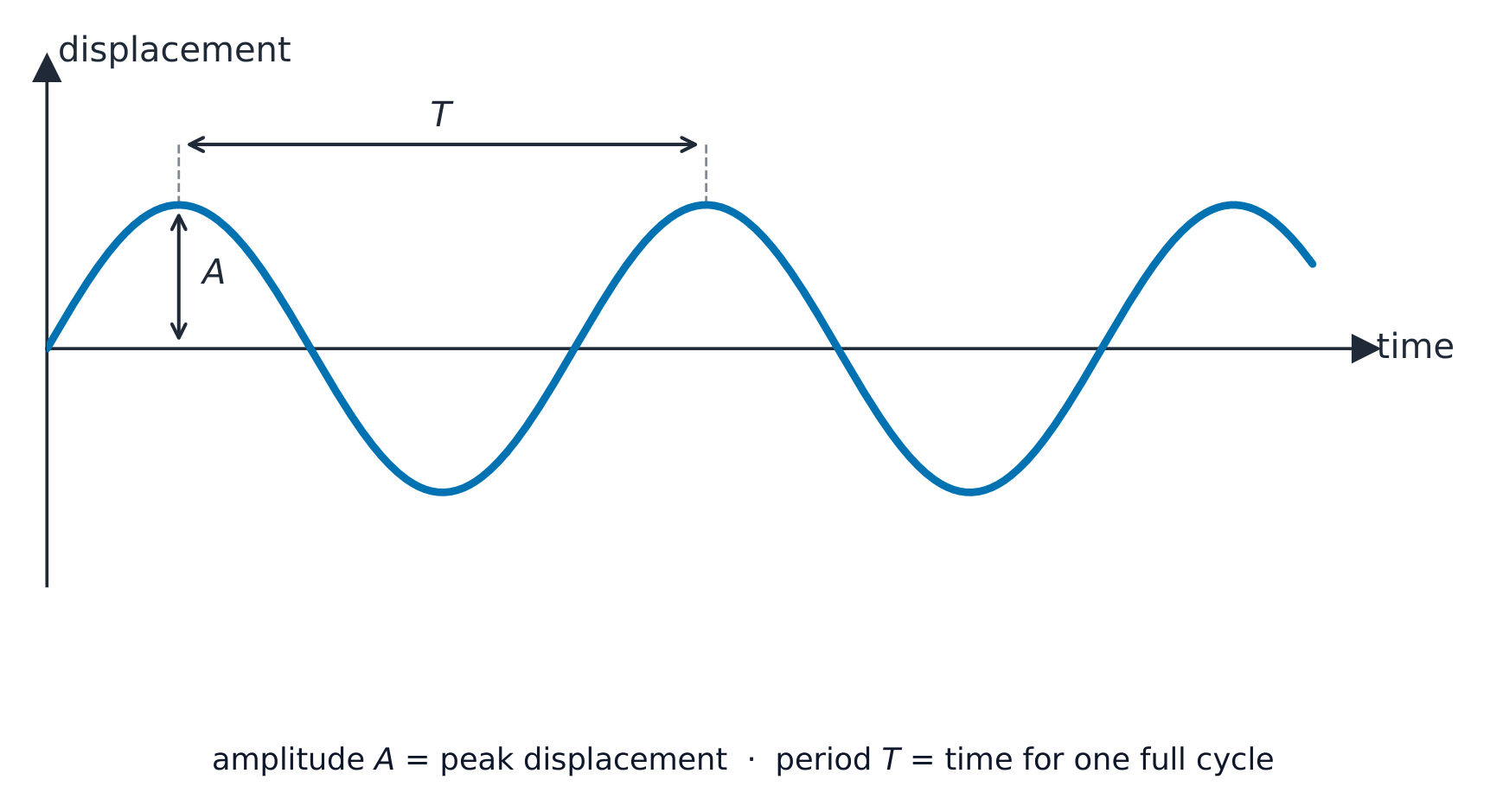
一张位移-时间图显示波的振幅和周期
Match each graph to what you read off it. · 把每种图与你从它读出的量配对。
A snapshot against distance shows the wavelength; one point watched over time shows the period. · 对距离的一张快照显示波长;一个点随时间观察显示周期。
Which can be read from a displacement-distance graph? Select all · 所有 that apply. · 从位移-距离图上能读出哪些?选出所有适用的。
The period comes from a displacement-TIME graph. Reading a wavelength off the time graph is one of the commonest errors in this topic. · 周期来自位移-时间图。从时间图上读波长是这个主题最常见的错误之一。
The amplitude of a wave is doubled. By what factor does its intensity increase? · 波的振幅加倍。它的强度增大为原来的几倍?
Intensity goes as amplitude squared, so doubling the amplitude quadruples it. Intensity is also power per unit area at right angles to the travel direction. · 强度按振幅的平方变化,所以振幅加倍强度变为四倍。强度还是垂直于传播方向的单位面积上的功率。
Worked example: a sound wave on a graph
A displacement–distance graph of a sound wave (travelling to the right) shows particles X and Y $1.5$ wavelengths apart, separated by $0.24\ \text{m}$. The frequency is $2.0\ \text{kHz}$. Particle Z sits at zero displacement on a part of the graph that falls from left to right.
- Wavelength: $1.5\lambda = 0.24$, so $\lambda = 0.16\ \text{m}$.
- Speed: $v = f\lambda = 2000 \times 0.16 = 320\ \dfrac{\text{m}}{\text{s}}$.
- Z now: just behind Z (to its left) the displacement is positive, so Z is moving forward, in the direction of travel.
- Z a quarter of a period later: the whole pattern has moved on by $\dfrac{\lambda}{4}$, so Z takes the displacement that was $\dfrac{\lambda}{4}$ behind it — a crest, $+A$. Sketch the new graph as the old one shifted right by $\dfrac{\lambda}{4}$.
- Check: a particle at zero displacement is passing through its rest position, which is where it moves fastest — so it makes sense that it reaches maximum displacement a quarter period later.
例题:图上的一列声波
一列向右传播的声波的位移–距离图上,粒子 X 和 Y 相距 $1.5$ 个波长,间距 $0.24\ \text{m}$。频率为 $2.0\ \text{kHz}$。粒子 Z 位于位移为零、图线从左到右下降的一段上。
- 波长: $1.5\lambda = 0.24$,所以 $\lambda = 0.16\ \text{m}$。
- 速率: $v = f\lambda = 2000 \times 0.16 = 320\ \dfrac{\text{m}}{\text{s}}$。
- Z 此刻: Z 的后方(左侧)一点点位移为正,所以 Z 正在向 前 运动,即沿传播方向。
- 四分之一周期后的 Z: 整个图形向前移动了 $\dfrac{\lambda}{4}$,所以 Z 取到原来在它后方 $\dfrac{\lambda}{4}$ 处的位移——一个 波峰,$+A$。把新图画成旧图向右平移 $\dfrac{\lambda}{4}$。
- 检查: 位移为零的粒子正经过它的平衡位置,那里速度最大——所以它在四分之一周期后到达最大位移是合理的。
On a displacement–distance graph, two particles that are exactly two wavelengths apart are separated by $0.68\ \text{m}$. The wave has frequency $1.0\ \text{kHz}$. What is its speed, in m/s? · 在位移–距离图上,恰好相距两个波长的两个粒子间距为 $0.68\ \text{m}$。波的频率为 $1.0\ \text{kHz}$。它的速率是多少(单位 m/s)?
$2\lambda = 0.68$, so $\lambda = 0.34\ \text{m}$ and $v = f\lambda = 1000 \times 0.34 = 340\ \dfrac{\text{m}}{\text{s}}$ — the speed of sound in air. · $2\lambda = 0.68$,所以 $\lambda = 0.34\ \text{m}$,$v = f\lambda = 1000 \times 0.34 = 340\ \dfrac{\text{m}}{\text{s}}$——空气中的声速。
The displacement graph of a longitudinal wave looks exactly like a transverse wave, but the particles are not moving up and down. The vertical axis is displacement along the line of travel. Say "forward and back", and remember that the wave travels while the particles only oscillate about fixed positions.
纵波 的位移图看起来和横波一模一样,但粒子 并不是 在上下运动。纵轴是 沿 传播方向的位移。要说"向前和向后",并记住传播的是 波,粒子只是绕固定位置振动。
You've got it
- transverse: vibration perpendicular to the energy transfer (rope, light, ripples)
- longitudinal: vibration parallel to the energy transfer — compressions & rarefactions (sound)
- on a longitudinal wave's graph, positive = forward; look just behind a particle to see where it is going
- displacement–distance shows $\lambda$; displacement–time shows $T$
你掌握了
- 横波:振动垂直于能量传递方向(绳子、光、涟漪)
- 纵波:振动平行于能量传递方向——压缩与稀疏(声音)
- 在纵波的图上,正 = 向前;看粒子后方一点点,就知道它要去哪里
- 位移–距离显示 $\lambda$;位移–时间显示 $T$