| English | 释义 | 拼音 |
|---|---|---|
| work done/wɜːk dʌn/ | 功 | gōng |
| displacement/dɪˈspleɪsmənt/ | 位移 | wèiyí |
| conservation of energy/ˌkɒnsəˈveɪʃn ɒv ˈenədʒi/ | 能量守恒 | néng liàng shǒu héng |
| efficiency/ɪˈfɪʃənsi/ | 效率 | xiào lǜ |
| thermal energy/ˈθɜːml ˈenədʒi/ | 热能 | rè néng |
| power/ˈpaʊə/ | 功率 | gōnglǜ |
Holding a bag does no work
- Hold a heavy bag still and your arm aches — but in physics you do zero work.
- Work needs the force to move something along its own direction.
- No movement (or a sideways force) means no work done 功.
Work done by a force
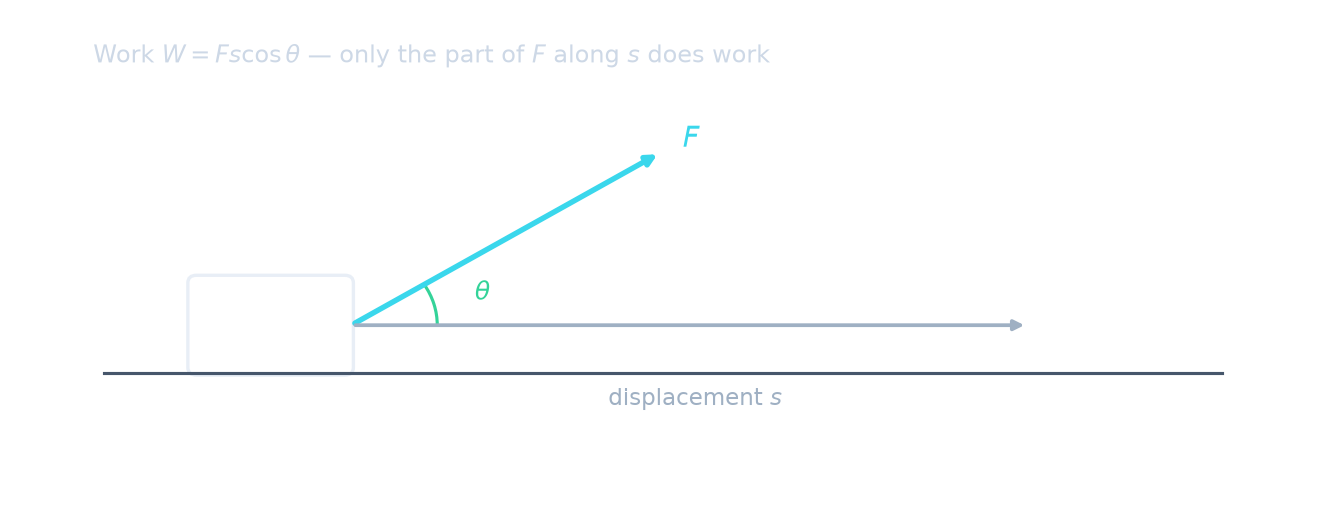
- $W = F s \cos\theta$, where $\theta$ is the angle between force and displacement 位移.
- Only the part of the force along the motion does work. Unit: $\text{J} = \text{N}\cdot\text{m}$.
功、能量与功率
PE + KE = constant
做功转移 能量;下落时势能变成动能,总量不变。
一个 $10\ \text{N}$ 的力沿力的方向把箱子推动 $3.0\ \text{m}$。做了多少功?
难度 2/5 · 今日首次完成可获 140 金币及少量额外奖励
力沿运动方向($\theta = 0$),所以 $W = Fs = 10 \times 3.0 = 30\ \text{J}$。
Positive, negative, zero
- Force along the motion → positive work (energy given to the object).
- Force opposite the motion → negative work (e.g. friction takes energy away).
- Force at right angles → zero work.
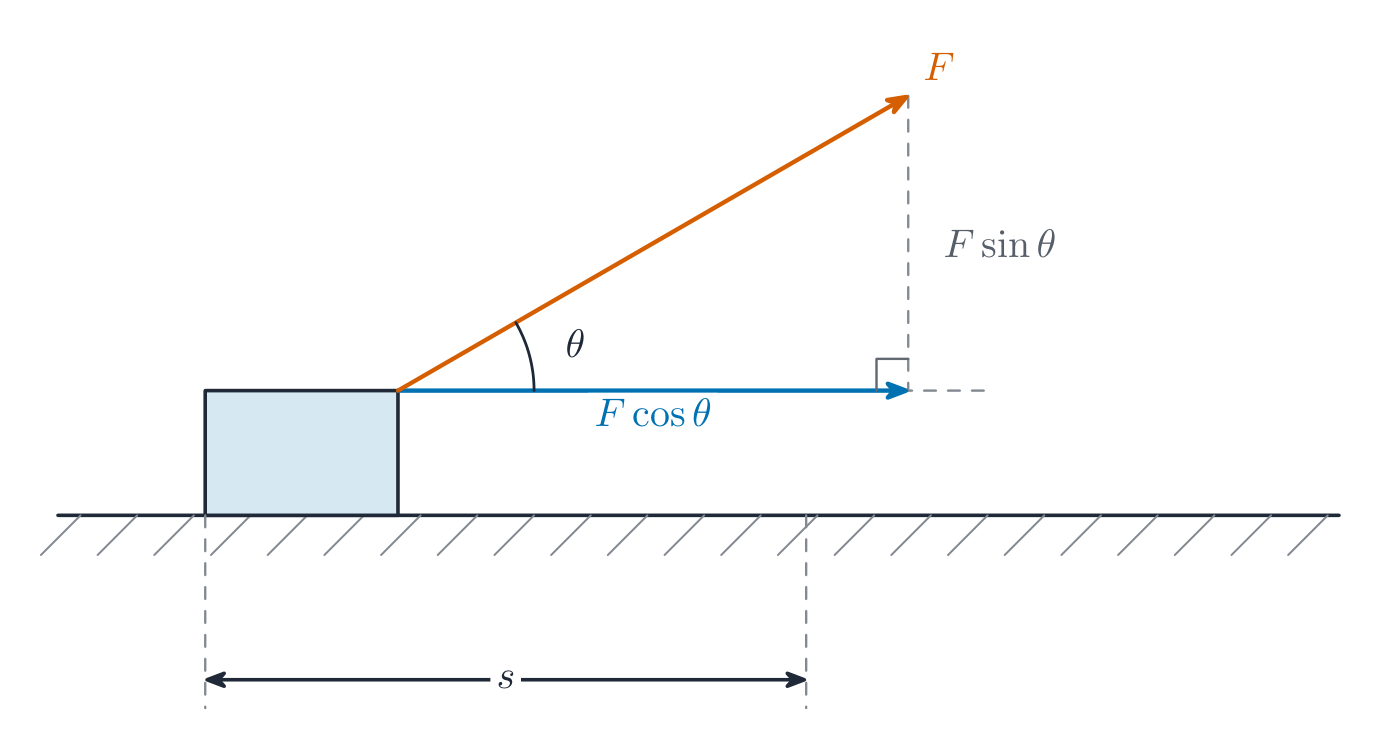
Only the component F cos(theta) along the displacement does work
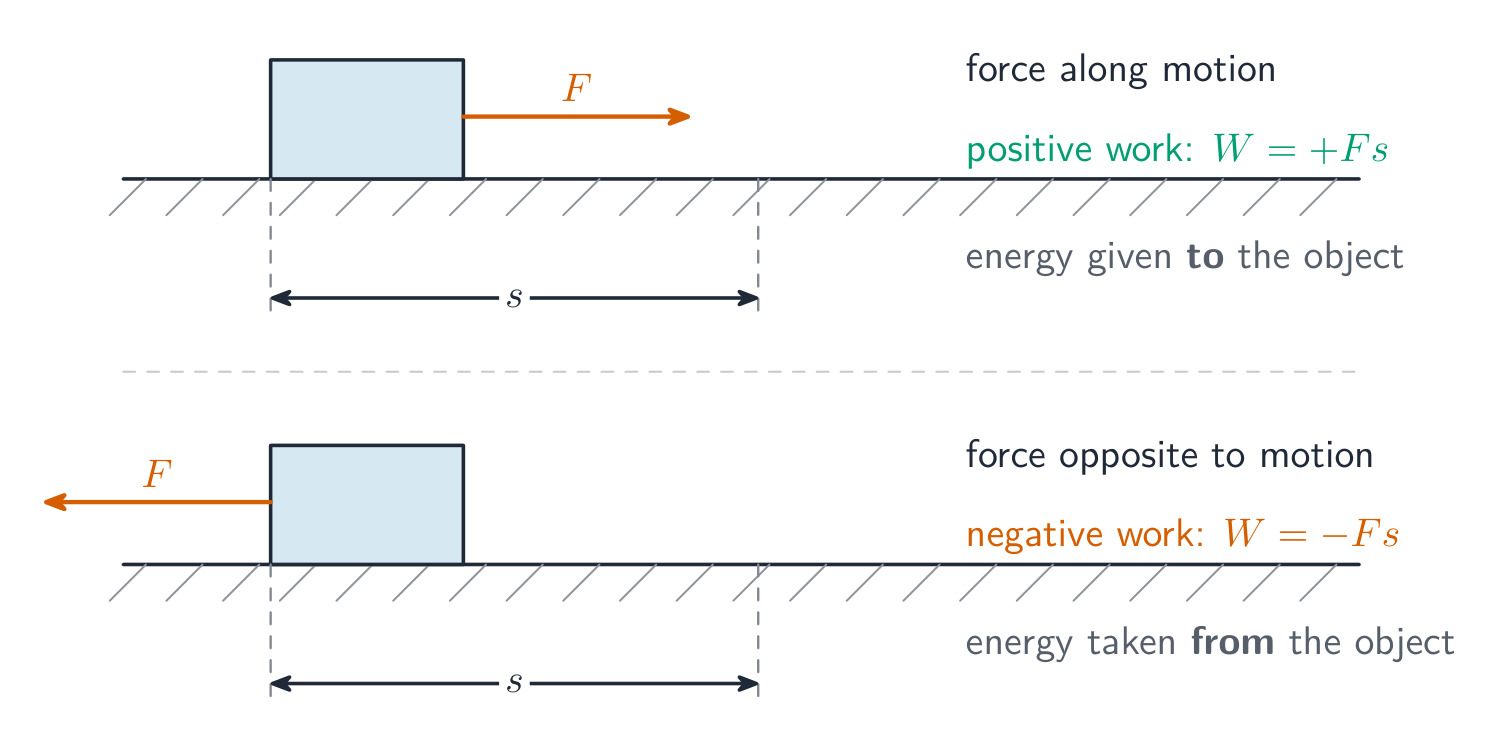
Positive work (force along motion) and negative work (force opposite motion)
与运动方向成直角的力做多少功?
难度 1/5 · 今日首次完成可获 100 金币及少量额外奖励
$W = Fs\cos 90^{\circ} = 0$。平路上汽车所受的法向接触力不做功。
作用在滑动物体上的摩擦力做负功。
难度 1/5 · 今日首次完成可获 100 金币及少量额外奖励
摩擦力方向与运动相反($\theta = 180^{\circ}$),所以 $W = -Fs$——它带走能量。
Conservation of energy 能量守恒
- Energy is never made or destroyed — it only changes form or moves between objects.
- In a closed system the total energy stays constant.
能量不能被创造或消灭,只能从一种形式 ____ 到另一种形式。
难度 1/5 · 今日首次完成可获 100 金币及少量额外奖励
这就是能量守恒——封闭系统中的总量保持不变。
将每个术语与考官标记的定义匹配。
难度 2/5 · 今日首次完成可获 140 金币及少量额外奖励
功的定义里最后那半句,正是使垂直于运动方向的力完全不做功的原因。
Efficiency 效率
- $\text{efficiency} = \dfrac{\text{useful output}}{\text{total input}} \times 100\%$.
- It is always below $100\%$ — some energy ends up as "useless" thermal energy 热能.
能量流动与效率
输入能量分成有用功和浪费的能量;效率 = 有用 ÷ 输入,而有用 + 浪费始终等于输入。
一台机器输入 $200\ \text{J}$,输出 $60\ \text{J}$ 的有用能量。它的效率是多少(用 %)?
难度 2/5 · 今日首次完成可获 140 金币及少量额外奖励
$\dfrac{60}{200} \times 100\% = 30\%$。另外的 $140\ \text{J}$ 被浪费,主要变成热。
Power 功率
- Power is the rate of doing work: $P = \dfrac{W}{t} = \dfrac{\Delta E}{\Delta t}$.
- Unit: $\text{W} = \dfrac{\text{J}}{\text{s}}$.
Power, force and velocity
- For a force $F$ along the motion at speed $v$: $P = Fv$.
- A car at steady speed needs $P = F_{\text{resist}} \times v$; lifting a weight at speed $v$ needs $P = mgv$.
一个力 $F$ 作用在以速率 $v$ 沿力的方向运动的物体上。输出的功率是:
难度 1/5 · 今日首次完成可获 100 金币及少量额外奖励
在时间 $\Delta t$ 内位移是 $v\Delta t$,做的功是 $Fv\Delta t$;除以 $\Delta t$ 得到 $P = Fv$。
Worked example: a car at steady speed
- A car travels at a steady $25\ \text{m/s}$ against a total resistive force of $600\ \text{N}$. Find the useful output power of its engine.
- At steady speed the resultant force is zero, so the driving force equals the resistive force: $F = 600\ \text{N}$.
- $P = Fv = 600 \times 25 = 1.5\times10^{4}\ \text{W} = 15\ \text{kW}$.
- The step that carries the mark is stating why the driving force equals $600\ \text{N}$: constant velocity means zero resultant force.
- If the car were accelerating, the driving force would be larger than $600\ \text{N}$ and you could not use the resistive force in $P = Fv$ at all.
Marks that slip away
- Efficiency is useful output divided by total input. The input is always the larger number, so an answer above $100\%$ means the two were swapped.
- In $P = Fv$, $F$ is the driving force. It equals the resistive force only at constant speed.
- Use the vertical height in $mg\Delta h$, never the distance along a slope.
- Work done by a force is the force times the distance moved in the direction of the force. A force at right angles to the motion does no work.
- On a force-extension graph the area is the energy stored. The gradient is the stiffness, and reading one for the other is a whole question lost.
一辆汽车以恒定$25\ \dfrac{\text{m}}{\text{s}}$行驶,所受总阻力为$600\ \text{N}$。其有用输出功率是多少(kW)?
难度 2/5 · 今日首次完成可获 140 金币及少量额外奖励
匀速运动意味着合力为零,因此驱动力等于$600\ \text{N}$,且功率为$P = Fv = 15\ \text{kW}$。解释驱动力为何等于阻力才是得分关键。
哪些情形下力不做功?选出所有适用的。
难度 2/5 · 今日首次完成可获 140 金币及少量额外奖励
刹车做了很多功,只不过是负功。轨道那一条最漂亮:引力始终垂直于运动方向,所以卫星的速率从不改变。
把效率的计算按顺序排列。
难度 3/5 · 今日首次完成可获 200 金币及少量额外奖励
输入总是较大的那个数。效率超过 100% 说明两者弄反了,而除以浪费掉的能量是另一条常见的错路。
You've got it
- work $W = Fs\cos\theta$ — only the part of $F$ along the motion counts
- energy is conserved; efficiency = useful ÷ total (always < 100%)
- power $P = \dfrac{W}{t} = Fv$