Kinetic and potential energy · 动能与势能
| English | 中文 | Pinyin · 拼音 |
|---|---|---|
| kinetic energy/kɪˈnetɪk ˈenədʒi/ | 动能 | dòng néng |
| gravitational potential energy/ˌɡrævɪˈteɪʃənl pəˈtenʃl ˈenədʒi/ | 重力势能 | zhòng lì shì néng |
| thermal energy/ˈθɜːml ˈenədʒi/ | 热能 | rè néng |
| momentum/məʊˈmentəm/ | 动量 | dòngliàng |
| elastic potential energy/ɪˈlæstɪk pəˈtenʃl ˈenədʒi/ | 弹性势能 | tán xìng shì néng |
| compression/kəmˈpreʃn/ | 压缩 | yā suō |
The roller-coaster swap
- At the top of a drop a coaster crawls; at the bottom it races.
- Height has turned into speed — potential energy into kinetic energy 动能.
- Energy is just moving between two stores.
过山车的能量互换
- 在下落的顶端,过山车爬得很慢;到了底部,它飞驰而下。
- 高度变成了速度——势能 变成了 动能。
- 能量只是在两个储存之间移动。
Gravitational potential energy 重力势能
- Lifting a mass $m$ through a height $\Delta h$ stores $\Delta E_{\text{P}} = mg\Delta h$.
- It comes from the work done against gravity: $W = mg \times \Delta h$.
Gravitational PE depends only on the change in height Δh, not on the path taken
Wind turbines transfer the kinetic energy of the wind into electrical energy
引力势能
- 把质量 $m$ 提升高度 $\Delta h$,储存 $\Delta E_{\text{P}} = mg\Delta h$。
- 它来自克服重力所做的功:$W = mg \times \Delta h$。

引力势能只取决于高度的变化 Δh,与所走的路径无关

风力涡轮机把风的动能转化为电能
Kinetic & potential energy · 动能与势能
PE + KE = constant
Potential energy turns into kinetic energy — the total never changes. · 势能 变成 动能——总量永不改变。
A $2.0\ \text{kg}$ book is lifted $5.0\ \text{m}$. How much gravitational PE does it gain? (Use $g = 9.81\ \dfrac{\text{m}}{\text{s}^2}$.) · 一本 $2.0\ \text{kg}$ 的书被提升 $5.0\ \text{m}$。它获得多少引力势能?(取 $g = 9.81\ \dfrac{\text{m}}{\text{s}^2}$。)
$\Delta E_{\text{P}} = mg\Delta h = 2.0 \times 9.81 \times 5.0 \approx 98\ \text{J}$. · $\Delta E_{\text{P}} = mg\Delta h = 2.0 \times 9.81 \times 5.0 \approx 98\ \text{J}$。
Kinetic energy
- A mass $m$ moving at speed $v$ has $E_{\text{K}} = \tfrac{1}{2}mv^{2}$.
- It comes from the work done to speed it up: $W = Fs = \tfrac{1}{2}mv^{2}$.
动能
- 以速率 $v$ 运动的质量 $m$ 具有 $E_{\text{K}} = \tfrac{1}{2}mv^{2}$。
- 它来自使它加速所做的功:$W = Fs = \tfrac{1}{2}mv^{2}$。
A $4.0\ \text{kg}$ trolley moves at $3.0\ \dfrac{\text{m}}{\text{s}}$. What is its kinetic energy? · 一辆 $4.0\ \text{kg}$ 的小车以 $3.0\ \dfrac{\text{m}}{\text{s}}$ 运动。它的动能是多少?
$E_{\text{K}} = \tfrac{1}{2}mv^{2} = \tfrac{1}{2} \times 4.0 \times 3.0^{2} = 18\ \text{J}$. · $E_{\text{K}} = \tfrac{1}{2}mv^{2} = \tfrac{1}{2} \times 4.0 \times 3.0^{2} = 18\ \text{J}$。
Match each energy store to what it depends on. · 把每种能量与它取决于什么配对。
Two of the three go as a square, which is why doubling a speed or an extension quadruples the energy while doubling a height only doubles it. · 三者中有两个按平方变化,这就是速率或伸长量加倍会使能量变为四倍、而高度加倍只使它加倍的原因。
Two traps. Squaring: doubling the speed gives four times the kinetic energy, not two. Height: $\Delta h$ is the vertical change in height, never the distance along a slope — a ramp of length $3\ \text{m}$ that drops $1.5\ \text{m}$ uses $1.5\ \text{m}$.
两个陷阱。平方: 速率加倍,动能变成 四 倍,而不是两倍。高度: $\Delta h$ 是 竖直 高度的变化,绝不是沿斜面的距离——一条长 $3\ \text{m}$、下降 $1.5\ \text{m}$ 的斜面,用的是 $1.5\ \text{m}$。
The energy swap
- On a frictionless ramp, GPE becomes KE: $mgh = \tfrac{1}{2}mv^{2}$, so $v = \sqrt{2gh}$.
- The mass cancels — every object reaches the same speed from the same height.
- With friction, some of it becomes thermal energy 热能 instead.
能量互换
- 在无摩擦斜面上,引力势能变成动能:$mgh = \tfrac{1}{2}mv^{2}$,所以 $v = \sqrt{2gh}$。
- 质量被消去了——从同一高度出发,每个物体到达的速率都相同。
- 有摩擦时,其中一部分变成 热能。
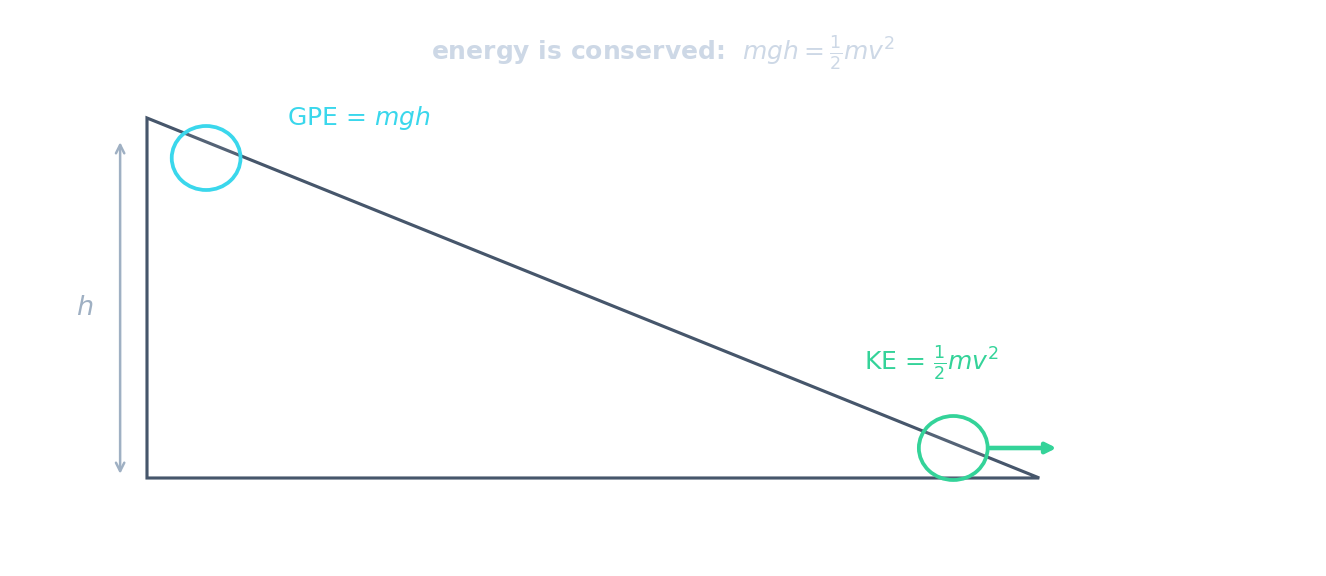
As a ball rolls down a frictionless ramp, its gravitational PE turns mainly into: · 当一个球滚下无摩擦斜面时,它的引力势能主要变成:
With no friction, all the lost GPE becomes kinetic energy: $mgh = \tfrac{1}{2}mv^{2}$. · 没有摩擦时,损失的全部引力势能都变成动能:$mgh = \tfrac{1}{2}mv^{2}$。
A 2.0 kg block slides from rest down a smooth ramp, dropping 1.5 m in height. What is its speed at the bottom, in m/s? (g = 9.81 m/s^2) · 一个 2.0 kg 的物块从静止沿光滑斜面下滑,下降 1.5 m 高。它到底端时的速率是多少 m/s?(g = 9.81 m/s^2)
mgh = mv^2/2, and the mass cancels: v = sqrt(2 x 9.81 x 1.5) = 5.4 m/s. Use the VERTICAL drop, never the distance along the ramp. · mgh = mv^2/2,质量约掉:v = sqrt(2 x 9.81 x 1.5) = 5.4 m/s。用竖直下降高度,绝不用沿斜面的距离。
In $mg\Delta h$ the height is the distance travelled along the slope. · 在 $mg\Delta h$ 中,高度是沿斜面走过的距离。
It is the VERTICAL height gained or lost. Using the slope distance always overestimates the energy change, by a factor of 1/sin(theta). · 是升高或降低的竖直高度。用斜面距离总会高估能量变化,倍数是 1/sin(theta)。
Worked example: a ramp with friction
A $2.0\ \text{kg}$ trolley is released from rest at the top of a ramp $3.0\ \text{m}$ long that drops $1.5\ \text{m}$. It reaches the bottom at $4.0\ \dfrac{\text{m}}{\text{s}}$. Find the work done against friction and the average friction force.
- GPE lost: $mg\Delta h = 2.0 \times 9.81 \times 1.5 = 29\ \text{J}$.
- KE gained: $\tfrac{1}{2}mv^{2} = \tfrac{1}{2} \times 2.0 \times 4.0^{2} = 16\ \text{J}$.
- The difference is the work done against friction: $29 - 16 = 13\ \text{J}$.
- Friction force: work = force × distance along the ramp, so $F = \dfrac{13}{3.0} = 4.5\ \text{N}$.
- Check: without friction the speed would have been $\sqrt{2 \times 9.81 \times 1.5} = 5.4\ \dfrac{\text{m}}{\text{s}}$ — larger than $4.0$, as it must be.
例题:有摩擦的斜面
一辆 $2.0\ \text{kg}$ 的小车从一条长 $3.0\ \text{m}$、下降 $1.5\ \text{m}$ 的斜面顶端由静止释放。它到达底部时速率为 $4.0\ \dfrac{\text{m}}{\text{s}}$。求克服摩擦所做的功和平均摩擦力。
- 损失的引力势能: $mg\Delta h = 2.0 \times 9.81 \times 1.5 = 29\ \text{J}$。
- 获得的动能: $\tfrac{1}{2}mv^{2} = \tfrac{1}{2} \times 2.0 \times 4.0^{2} = 16\ \text{J}$。
- 差值就是克服摩擦所做的功: $29 - 16 = 13\ \text{J}$。
- 摩擦力: 功 = 力 × 沿斜面的 距离,所以 $F = \dfrac{13}{3.0} = 4.5\ \text{N}$。
- 检查: 没有摩擦时速率会是 $\sqrt{2 \times 9.81 \times 1.5} = 5.4\ \dfrac{\text{m}}{\text{s}}$——比 $4.0$ 大,理应如此。
A trolley rolls down a rough ramp. Compared with a frictionless ramp, which statements are true? Select all that apply. · 一辆小车沿粗糙斜面滑下。与无摩擦斜面相比,下列哪些说法正确?选出所有正确的。
The GPE lost is fixed by the height drop and is the same on both ramps. Friction takes some of it as thermal energy, so the KE at the bottom is smaller by exactly the work done against friction. · 损失的引力势能由下降高度决定,两条斜面相同。摩擦把其中一部分变成热能,所以底部的动能恰好少了克服摩擦所做的功。
Energy and momentum 动量
- Combining $p = mv$ with $E_{\text{K}} = \tfrac{1}{2}mv^{2}$ gives $E_{\text{K}} = \dfrac{p^{2}}{2m}$.
- Handy when you know the momentum but not the speed.
能量与动量
- 把 $p = mv$ 和 $E_{\text{K}} = \tfrac{1}{2}mv^{2}$ 结合,得到 $E_{\text{K}} = \dfrac{p^{2}}{2m}$。
- 当你知道动量但不知道速率时很有用。
Kinetic energy written in terms of momentum $p$ is: · 用动量 $p$ 表示的动能是:
From $p = mv$ and $E_{\text{K}} = \tfrac{1}{2}mv^{2}$, substituting $v = p/m$ gives $E_{\text{K}} = \dfrac{p^{2}}{2m}$. · 由 $p = mv$ 和 $E_{\text{K}} = \tfrac{1}{2}mv^{2}$,代入 $v = p/m$ 得到 $E_{\text{K}} = \dfrac{p^{2}}{2m}$。
Energy methods
- Write the energy at the start and end, then balance the books.
- Spring: a block's KE becomes elastic potential energy 弹性势能 $\tfrac{1}{2}kx^{2}$ at greatest compression 压缩.
- Bounce: the height ratio $\dfrac{h_2}{h_1}$ is the fraction of energy kept.
A stretched or compressed spring stores elastic PE ½kx², ready to become kinetic energy
能量方法
- 写出 开始 和 结束 时的能量,然后把账目配平。
- 弹簧:一个方块的动能在最大压缩时变成 弹性势能(elastic potential energy) $\tfrac{1}{2}kx^{2}$。
- 反弹:高度比 $\dfrac{h_2}{h_1}$ 是保留下来的能量比例。

一根被拉伸或压缩的弹簧储存弹性势能 ½kx²,准备变成动能
A block slides into a spring on a frictionless surface. At greatest compression its kinetic energy has all become ____ potential energy. · 一个方块在无摩擦表面上滑入弹簧。在最大压缩时,它的动能全部变成了 ____ 势能。
KE → elastic PE $= \tfrac{1}{2}kx^{2}$ at the point of greatest compression, then back to KE as the spring pushes it off. · 在最大压缩点,动能 → 弹性势能 $= \tfrac{1}{2}kx^{2}$,然后弹簧把它推开,又变回动能。
When friction acts, some mechanical energy becomes thermal energy. · 当摩擦作用时,一部分机械能变成热能。
Yes — that "lost" energy is not destroyed; it heats the surfaces and surroundings. · 是的——那部分“损失”的能量并没有被消灭;它把表面和周围加热了。
Worked example: a block meets a spring
A block slides down a slope and hits a spring with $60\ \text{J}$ of kinetic energy. While the spring compresses to its maximum, the block's gravitational PE falls by a further $10\ \text{J}$. All the energy the block loses becomes elastic PE in the spring, whose constant is $k = 3500\ \dfrac{\text{N}}{\text{m}}$. Find the maximum compression and the force on the block there.
- Energy into the spring: $60 + 10 = 70\ \text{J}$ (the block loses both its KE and some GPE).
- Compression: $\tfrac{1}{2}kx^{2} = 70$, so $x^{2} = \dfrac{140}{3500} = 0.040$ and $x = 0.20\ \text{m}$.
- Force at maximum compression: $F = kx = 3500 \times 0.20 = 700\ \text{N}$.
- Check: on a force–compression graph the area under the line to $x = 0.20\ \text{m}$ is $\tfrac{1}{2} \times 700 \times 0.20 = 70\ \text{J}$ — the same energy, found the other way.
例题:方块撞上弹簧
一个方块沿斜面滑下,以 $60\ \text{J}$ 的动能撞上一根弹簧。在弹簧压缩到最大的过程中,方块的引力势能又减少了 $10\ \text{J}$。方块损失的全部能量都变成弹簧的弹性势能,弹簧常数 $k = 3500\ \dfrac{\text{N}}{\text{m}}$。求最大压缩量和此时方块受到的力。
- 进入弹簧的能量: $60 + 10 = 70\ \text{J}$(方块 既 损失动能,也 损失一部分引力势能)。
- 压缩量: $\tfrac{1}{2}kx^{2} = 70$,所以 $x^{2} = \dfrac{140}{3500} = 0.040$,$x = 0.20\ \text{m}$。
- 最大压缩时的力: $F = kx = 3500 \times 0.20 = 700\ \text{N}$。
- 检查: 在力–压缩量图上,到 $x = 0.20\ \text{m}$ 为止线下的面积是 $\tfrac{1}{2} \times 700 \times 0.20 = 70\ \text{J}$——同样的能量,用另一种方法得到。
A block with $40\ \text{J}$ of kinetic energy hits a spring of constant $k = 2000\ \dfrac{\text{N}}{\text{m}}$ on a level surface. All its KE becomes elastic PE. What is the maximum compression, in m? · 一个动能为 $40\ \text{J}$ 的方块在水平面上撞上一根常数 $k = 2000\ \dfrac{\text{N}}{\text{m}}$ 的弹簧。它的全部动能变成弹性势能。最大压缩量是多少(单位 m)?
$\tfrac{1}{2}kx^{2} = 40$, so $x^{2} = \dfrac{80}{2000} = 0.040$ and $x = 0.20\ \text{m}$. · $\tfrac{1}{2}kx^{2} = 40$,所以 $x^{2} = \dfrac{80}{2000} = 0.040$,$x = 0.20\ \text{m}$。
You've got it
- gravitational PE $\Delta E_{\text{P}} = mg\Delta h$ (vertical height!); kinetic energy $E_{\text{K}} = \tfrac{1}{2}mv^{2}$
- on a frictionless ramp $mgh = \tfrac{1}{2}mv^{2}$, so $v = \sqrt{2gh}$; with friction the missing energy is the work done against it
- in momentum terms, $E_{\text{K}} = \dfrac{p^{2}}{2m}$; a spring stores $\tfrac{1}{2}kx^{2}$
你掌握了
- 引力势能 $\Delta E_{\text{P}} = mg\Delta h$(竖直高度!);动能 $E_{\text{K}} = \tfrac{1}{2}mv^{2}$
- 在无摩擦斜面上 $mgh = \tfrac{1}{2}mv^{2}$,所以 $v = \sqrt{2gh}$;有摩擦时,少掉的能量就是克服摩擦所做的功
- 用动量表示,$E_{\text{K}} = \dfrac{p^{2}}{2m}$;弹簧储存 $\tfrac{1}{2}kx^{2}$