| English | 释义 | 拼音 |
|---|---|---|
| power/ˈpaʊə/ | 功率 | gōng lǜ |
| potential energy/pəˈtenʃl ˈenədʒi/ | 势能 | shì néng |
| kinetic energy/kɪˈnetɪk ˈenədʒi/ | 动能 | dòng néng |
| conservation of energy/ˌkɒnsəˈveɪʃn ɒv ˈenədʒi/ | 能量守恒 | néng liàng shǒu héng |
| work done/wɜːk dʌn/ | 功 | gōng |
| joule/dʒuːl/ | 焦耳 | jiāo ěr |
| gravitational potential energy/ˌɡrævɪˈteɪʃənl pəˈtenʃl ˈenədʒi/ | 重力势能 | zhòng lì shì néng |
| watt/wɒt/ | 瓦特 | wǎ tè |
The energy that powers 功率 everything
- A roller coaster at the top of its first hill has maximum potential energy 势能. As it plunges down, that energy converts to kinetic energy 动能 — speed.
- Conservation of energy 能量守恒 lets you predict the speed at any point without knowing the path in between.
Work done 功
- Work done by a constant force: $W = Fd\cos\theta$ (measured in joules 焦耳).
- Work is the energy transferred by a force acting through a distance.
Worked example. A 50 N force pulls a box 4 m along the floor at $30^{\circ}$ to the horizontal. $W = 50 \times 4 \times \cos 30^{\circ} = 200 \times 0.866 = 173.2\text{ J}$.
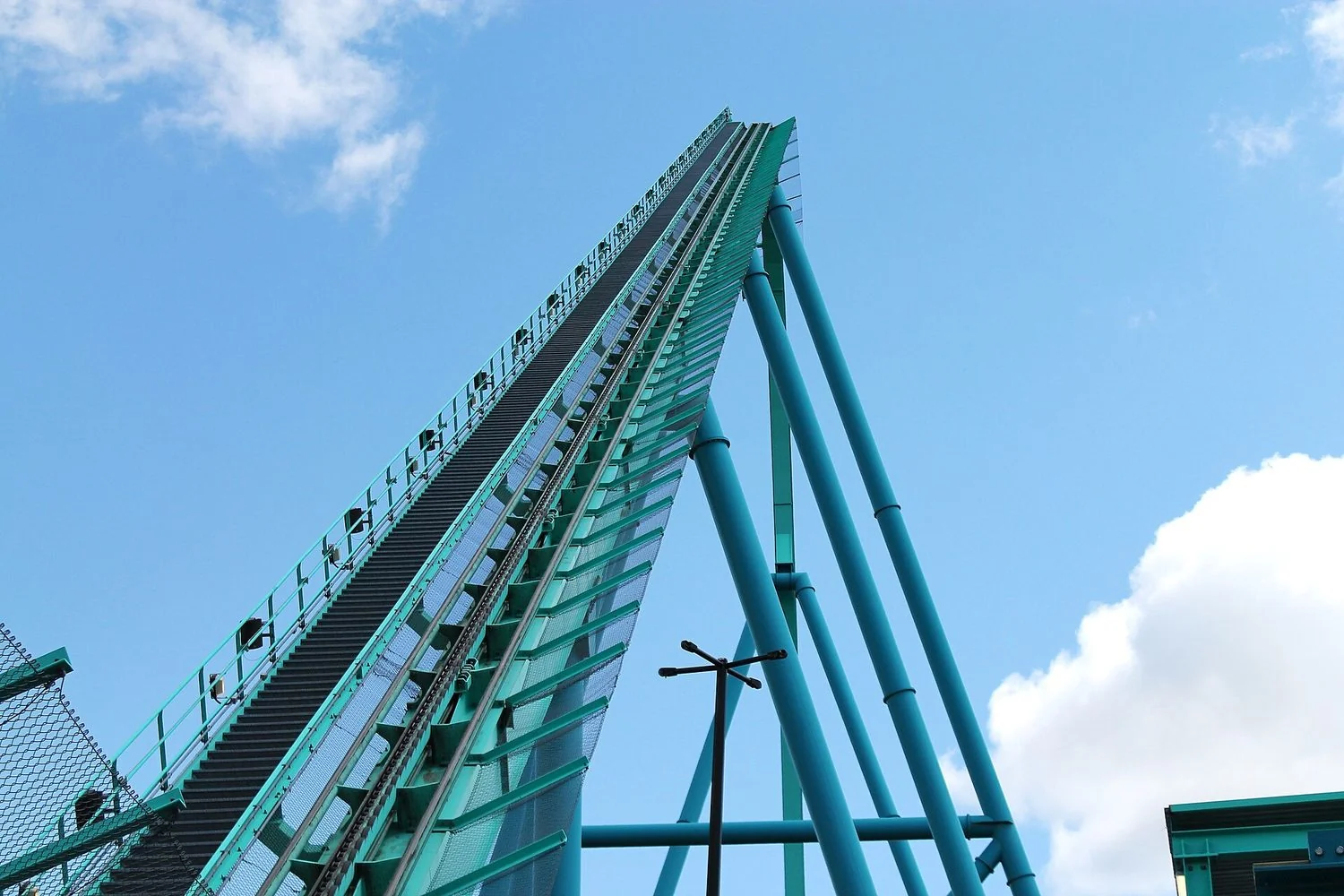
A roller coaster trades potential energy for kinetic energy
一个 50 N 的力沿地板拉一个箱子 4 m(θ = 0°)。做的功 = Fd cos θ。求它(J)。
难度 2/5 · 今日首次完成可获 140 金币及少量额外奖励
W = 50 × 4 × cos 0° = 50 × 4 × 1 = 200 J。
把每个量与它的公式或含义配对。
难度 2/5 · 今日首次完成可获 140 金币及少量额外奖励
能量守恒:动能和势能互换,而功率是做功的速率。
Kinetic and potential energy
- Kinetic energy (movement): $\text{KE} = \tfrac12 mv^2$.
- Gravitational potential energy 重力势能 (height): $\text{PE} = mgh$.
KE depends on $v^2$, not $v$. Doubling the speed quadruples the kinetic energy. A car at 60 mph has four times the KE of one at 30 mph — and needs four times the braking distance.
能量守恒
PE + KE = constant
当球下落时,势能变成动能——但总量从不改变。
一个质量为2 kg、以3 m/s运动的物体的动能是多少(KE = ½mv²),单位为焦耳(J)?
难度 2/5 · 今日首次完成可获 140 金币及少量额外奖励
KE = ½ × 2 × 3² = ½ × 2 × 9 = 9 J。
取 g = 10,一个质量为 2 kg 的物体被提升 5 m,其重力势能(PE = mgh)为多少焦耳?
难度 2/5 · 今日首次完成可获 140 金币及少量额外奖励
PE = mgh = 2 × 10 × 5 = 100 J。
把一个物体的速度翻倍使它的动能翻倍。
难度 1/5 · 今日首次完成可获 100 金币及少量额外奖励
KE = ½mv²,所以 v 翻倍使 KE 变成四倍(2² = 4 倍)。
Conservation of energy
- With no friction, total energy is conserved (conservation of energy).
- Loss in PE = gain in KE (for a falling object): $mgh = \tfrac{1}{2}mv^2$.
一个 1 kg 的球从 5 m 落下(g = 10)。用 mgh = ½mv²,求底部的速度(m/s)。
难度 2/5 · 今日首次完成可获 140 金币及少量额外奖励
mgh = ½mv² → v² = 2gh = 2(10)(5) = 100 → v = 10 m/s。
Power
- Power is the rate of doing work (in watts 瓦特): $P = \dfrac{W}{t}$.
- For a force pulling along the motion: $P = Fv$.
- Work is the scalar product of force and displacement; differentiating velocity gives the instantaneous acceleration.
一辆汽车以12 kW的功率在20 m/s的速度下行驶。利用P = Fv,其驱动力是多少,单位为牛顿(N)?
难度 2/5 · 今日首次完成可获 140 金币及少量额外奖励
F = P/v = 12000/20 = 600 N.
You've got it
- work $W = Fd\cos\theta$; KE $= \tfrac12 mv^2$; PE $= mgh$
- with no friction, total energy is conserved
- power = rate of work; $P = Fv$
Write from the data: find the kinetic energy
- A 2 kg body moves at 4 metres per second. A 3 kg body is raised 4 m with g = 10.
- Find the kinetic energy and the gain in potential energy.
求一个质量为2 kg、速度为4 米每秒的物体的动能,以及一个质量为3 kg的物体升高4 m后的势能增量。取g = 10。
32的一半是16。3乘以40等于120。
动能是多少?
难度 1/5 · 今日首次完成可获 100 金币及少量额外奖励
二分之一乘以2乘以16等于16焦耳。